Well, this has nothing to do with Sgt.Pepper.
This is about going to the South Pole and what followed.
But it was twenty years ago today, so it seemed like a good starting line.
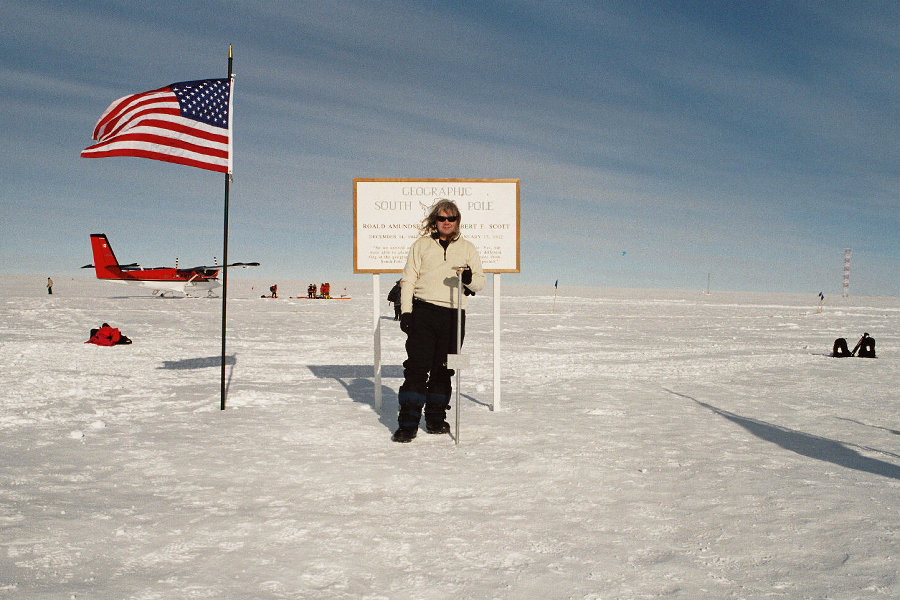
On January, 2nd 2006, I stood at the South Pole.
The actual trip, it was an easy one.
It was a fly-in. I flew to Antarctica (to a base near a place called Patriot Hills). Stayed there a couple of days. And another plane took me to the South Pole, where I spent a couple of hours.
And that was it.
No exhausting activity, no hardships to endure. Fly to the pole, take some pictures and fly home again.
But still...
It was (kind of) the journey of a lifetime.
And over the years I kept wondering whether that made any difference. Whether it was some sort of life-changing event. Or nothing more than a cool and expensive trip.
Ultimately, it probably changed something.
And this text is partly an indication.
I haven't written a text a decade after going to Greenland for the first time. Or my first trip to the USA. Or Svalbard.
But that's the third time I feel like writing about the South Pole trip (I wrote about it after one year and after a decade), which seems to indicate that it means more to me than other journeys.
There are some obvious things, but they're probably the wrong reasons.
Of course, the South Pole is a definite place. Good for checkmarking. Either you've been there or you haven't.
For other places it's fuzzier. When have you been to Brazil? Does stepping out of the plane in Sao Paulo count? Do you need to drive at least a thousand miles? Be out in the countryside? Swim at the beach? Drink a caipirinha that's not made with lime? Learn samba? See the carnival in Rio?
There's a wide range of experiences that Brazil has to offer. And "I've visited Brazil" includes a lot of places.
"I stood at the South Pole" is well defined.
(Of course, this is mostly nonsense. There are a lot of different South Pole experiences, and skiing there from the coast or wintering at the station is surely a different thing than stepping out of a plane for a photo opportunity. And you can always be more specific about places in Brazil as well. "I've been in the opera house in Manaus." or "I stood at the Equator in Macapá" are well defined as well.)
Though this presumably has nothing to do with any specific trip. It's likely to be more about my grouchiness about a book I got.
It's one of those books that were trendy for a while, about some (usually large) number of places to see or things to do before you die or reach a certain age or settle down (or whatever).
I didn't so much dislike the presumptuousness of it, telling me what I must do. (That wasn't until a John Finnemore sketch years later.)
It was the vagueness of it.
Because the first thing to do, if you see such a list, is to check how many of these things you've already done.
And, like so many of these books, the 'to do' activities were (with minor rewrites) taken from tourist brochures.
Now, if it's something like "Easter Island" or "Machu Picchu", that a sufficient clear "yes" or "no" choice.
It might be tricky in some special cases. I have seen the Balmoral Hotel in Edinburgh from the outside. Does that count as "places I've seen" or do I have to have been inside? And if so, is strolling through the lobby enough? Does going to the restaurant count? Or do you need to spend the night in one of the rooms?
It's a bit like "Have I visited Paraguay?"
I have been on a tour of the Itaipu hydroelectric dam, which is right on the border of Paraguay and Brazil.
Formally, the border is in the middle of the dam and I crossed it and walked to the other side.
Technically, I was on Paraguay grounds.
But I was in a tour group and I couldn't have left the dam on the Paraguay side.
I presume, that formally I didn't enter Paraguay.
Probably it's similar with international transit lounges on airports.
I once switched planes in Montevideo, so I was on Uruguayan soil. But I wouldn't claim that I visited Uruguay, as I didn't go through passport control and thus didn't really enter the country.
But that's a matter of personal choice.
If there's a "Things to see: Stonehenge" or "Things to see: Cunard's QE2", you can make up your own rules what's required to have "achieved" it (including fractional numbers).
But the book has also many things that are too vague to checkmark. And too specific to be covered by some made-up personal guidelines. For example, "The Nashville music scene". When have you seen that?
Going through Nashville and seeing a guitar shop? Seeing a street musician? Visit the hall of fame? Attending a concert? Anywhere? Or in the Gran Ole Opry? Or is it sufficient to hear some country music at home?
It's a travel advertisement "Come and see the Nashville music scene! It's Music City USA!" turned into a "thing to see" (actually, a "place to see", which makes even less sense for "the music scene") without even a moment of rational thought. (And that was before such books were written by an AI.)
Or the "Cruise at the Chilean coast". Which is also hardly a "thing to see", but more something to do. But even if you allow for that - what 'counts' as having done that? I've been to Magdalena Island, which is a small island full of Magellanic Penguins, close to Punta Arenas in Chile, per boat twice. Is that a 'cruise' or does that need to be one of the multi-day tours? If they had written "Go around Cape Horn in a ship", that still wouldn't be a "place to see", but at least it would be clear whether someone had done that.
But for a book where the main attraction lies in "how many of these have I done/seen", it's annoyingly bad. Even if you don't have any more ambition than repackaging travel advertisements, do it properly and put in a specific achievement! You can still copy in all the tourist stuff as 'background information' and 'other things nearby'. But at least provide a checklist, so people can checkmark what they have 'achieved'. Even if the things are overly specific. "Have Afternoon Tea at the Balmoral" will annoy people who have actually stayed at the hotel, but found the idea of having Afternoon Tea there silly. But at least it's something you've either done or haven't. And if you ar not sure about it, then you should have an interesting story to tell.
But putting in "The best restaurants in Guadeloupe" is insolence. Beside the fact that you rarely go to restaurants to 'see them', it neither specifies what are the best restaurants, nor how many you need to visit in order to have done that and can move on.
So, I'm a bit touchy about the whole concept of having visited a specific place.
Even though, with the South Pole, that was precisely the reason for the trip.
But I don't think that this is the reason why I still wonder about the South Pole trip.
I've been to other unusual places and I didn't feel the urge to write about them years later.
I guess the thing that made it 'life changing' was that I realized that I could do unusual stuff.
Before that, my vacations were, well, things out of a vacation brochure. It, kind of, still is, but it's a different kind of brochure now.
There were things that I, the generic office worker that didn't do any sports, could do on vacation. And then there were the other kinds of trips that were only for adventurers. You needed to live your life outdoors, preferably as a kayak tour guide in the summer and a skiing instructor in the winter. Spending your spare time running marathons and climbing mountains. And jumping down from the mountains in a flight suit. And that's about the basics before you even start going on adventure trips.
Still true - for the high-profile, high-risk adventure activities.
But that's gradual.
And the main lesson from the South Pole was that there isn't a sharp line between "normal tourist" and "professional adventurer" travel.
I don't think that I would have ever considered spending two weeks riding on a dog sled with an Inuit hunter, going about his business. As I did the year after going to the South Pole. That's what well trained professionals who make documentaries about extreme lives do.
Or, a year later, skiing to the North Pole on, literally, thin ice.
Or, the following year, going on a dog sledding tour on the Beaufort Sea, starting from an Arctic Island. With no dog sledding experience at all.
All things that aren't as hard as they look.
Yes, they require a bit of endurance.
But that's about all it requires.
There's no need to be super-fit, athletic and skilled.
It wouldn't hurt, but it's not mandatory.
What is (mainly) needed is wanting to do it. And getting a good guide.
In that respect, the South Pole trip made a big difference in attitude towards travelling.
That's where it opened up opportunities for trips I hadn't even considered before.
And two more things:
I don't like sleeping in tents at -20°C. And losing 10 kg to be allowed to stand on the wing of a biplane isn't fun either. Or simple stuff, like getting up early in the morning.
But I find that I don't mind. It's not like I am grumpy all the time and then only enjoy to good bits. Essentially, I tend do the things that need to be done. And don't dwell on them.
Which is something I hadn't been aware of before the South Pole trip.
The South Pole trip was expensive, even at that time. (The cost has tripled in the 20 years since.)
And I had been concerned whether it made sense to spend (almost) all my money on a vacation.
It might have been better used to buy a mid-range car or consider buying an apartment and having the first 10% down payment in cash. Or do ten nice seaside vacations instead. Or five cruises in the Pacific.
Or some of the other nice things that money can buy.
In short - would I hate myself later for wasting all the money for, ultimately, being at the South Pole for two or three hours and taking a few pictures.
It turned out - I didn't.
And that was also true for all the other, slightly less, but still quite, expensive trips.
I'm not sure whether they were always the best use of the money. But there hasn't been a single vacation where I thought later: I should have used that money to buy a new TV (or whatever) instead.
Which is good to know. And now I worry a lot less about the cost of vacations. They still need to be affordable (meaning that I need to have the money available - I'm not going into debt to go travelling). But if that's the case, I book the vacation without giving much thought about what else I could have spent the money on and whether that would have made me happier.
So, yeah. Twenty years later, having been to the South Pole didn't change my life. Much.
I am not wiser, more in tune with the Earth, working harder on improving myself, living a better life or having found my calling.
All the standard things that apparently are mandatory now for adventure travel failed to happen.
I looked at a web article that told the story of someone who undertook "a self-motivated challenge to climb Kilimanjaro". then underwent a "transformation that he never could have expected" and is now "an ultra-runner and high altitude mountaineering".
Nope. Didn't happen for me. Still a slob.
Then again, I don't go on lecture tours to "inspire change" or "empower humanity".
I was also a bit surprised that the article claimed to "smashing stereotypes", and will this would "bury everything you think you know about the stereotypical adventurer".
(Well, what it really said was that it would "...burry everything...", which probably says more about the stereotypical blogger than the stereotypical adventurer. But I digress...)
The statement was unexpected, as this is pretty much exactly the expected stereotypical "Transformation Arc" of "The Hero's Journey". Or, as summarized by the Google AI: 'a common narrative structure where a protagonist goes from their "ordinary world" into "new and uncharted territories" on a quest, faces trials, and ultimately returns home "transformed, equipped to heal their ordinary world'.
So the story hardly smashes any stereotypes. It's pretty much the most clichéd storyline there is.
But what I did get after the South Pole experience were more interesting vacations than I had ever assumed I would go on.
And while twenty years ago today, Sgt.Pepper hasn't taught the band to play, standing on the South Pole twenty years ago today, taught me about the possibilities of adventure travel for couch potatoes.
And that made a big change. Not a life change. But changing vacations ever since.
Worth it.