One constant thing about dogsledding: plans change.
But that's not necessarily a bad thing.
I'm in it for the dogsledding, so if that happens and is enjoyable, even if not as planned, it will be a good trip.
And there was some great dogsledding in fine weather on solid trails and beautiful nice surroundings.
Not where I thought it would be, though.
For a number of reasons, I wanted this year's tour to be a deluxe trip.
The only client on the tour was me.
This wasn't cheap (which is why I don't do it all the time), but it had some perks. The main one was that I had eight dogs in my team.
(The other relevant one was that we would, given the choice, rather stay in a cabin than in a tent. I don't really mind staying in a tent and will do so if needed. But I don't see any special appeal in doing so. For the second part of the trail we were prepared to spend time in a tent, but due to changed plans we didn't.)
The initial plan was to start in Ivalo (in Finland) and dogsled back to the kennel in Langfjordbotn (in Norway).
The tour would be with the same company I went with the previous year, with Ben (the owner) usually sledding ahead and Nina (the dog handler) following me.
The first change of plan was unexpected.
Of course, in a way, all plan changes are unexpected; otherwise they would have been part of the plan. But this one wasn't due to weather (which is usually the main factor for changing plans).
Usually, all of Lapland, whether it is located in Norway, Sweden or Finland, tends to be seen as one region. While they belong to politically quite different countries, with Finland being an EU member, using the Euro as currency, Sweden an EU member, but with its own currency, and Norway not in the European Union, all are part of the Schengen Area. Travel between the countries is unrestricted and often not even noticeable.
On last year's trip, we probably went from Norway to Finland and back again a dozen times, as the borderline between both countries was in the middle of a river we were sledding on.
But with the beginning of the year some rules had changed. It was no longer easy to bring two dozen dogs to Finland to go sledding towards Norway.
I don't know what the specific reason was. Whether it had something to do with a Norwegian business operating in Finland and not having required permits. Or whether it was tax reasons. Or whether it had something to do with bringing the dogs in.
There might have been some way to do it, but it would definitely have involved all kinds of negotiations, administration, forms and permits.
The revised plan was that Ben would call a friend in Finland (most dog-mushing companies know each other). We would drive with the friend's (Finnish) dogs from Ivalo to the border. And then we would cross the border on foot and drive on with Ben's (Norwegian) dogs on the other side.
In my mind, it seemed like something from a Cold War movie spy exchange, with two groups of dog sled teams driving (preferably on a foggy morning) from both sides to the middle of a frozen river. And then someone stepping off one sled, slowly crossing the border, and stepping onto another sled. And then, silently (as if the meeting between two large groups of dogs would ever be silent) both groups of sled teams would go back the way they came.
In real life, it wouldn't be as cinematic, of course.
We would probably arrive near some cabin in the evening. A van with a dog trailer would be waiting. The dogs already at a stake-out line outside.
We would unhitch the dogs, put them in the trailer, and someone would drive them back to Ivalo (or wherever they came from).
And next morning, we would attach the new dogs to the sleds and drive on.
A week before the trip, Ben called.
Weather in Finland had been good in February and the first half of March, but it had been really warm (and also a bit rainy, it seems) in the weeks since then.
And the trails in Finland were...not good.
Technically, we could still start from Ivalo. But it wouldn't be a nice tour.
The ice on the rivers (where we would do most of our travel) was still thick enough. But there wasn't enough snow on top of it. We would be mostly sledding on melted and refrozen snow. Which the dogs could do (because they will run on almost anything), but it would be nasty for their paws. And the sled wouldn't glide smoothly either.
Given that starting in Finland was complicated anyway, and the trip would not be that enjoyable on these trails, there was an obvious solution: Don't go to Finland.
That made sense, but had one problem: It was already a week before the trip. And I had booked flights to, and accommodation in, Ivalo a long time ago. Changing that on short notice was tricky.
As a result, the next change of plan was that Nina would drive the about 450 kilometers from Langfjordbotn to Ivalo by car, pick me up and we would drive back to Langfjordbotn.
The trail conditions there were still good. And it wouldn't involve the complicated issue of bringing dogs across the border or switching dog teams in mid-journey.
When I arrived in Ivalo, conditions were as expected.
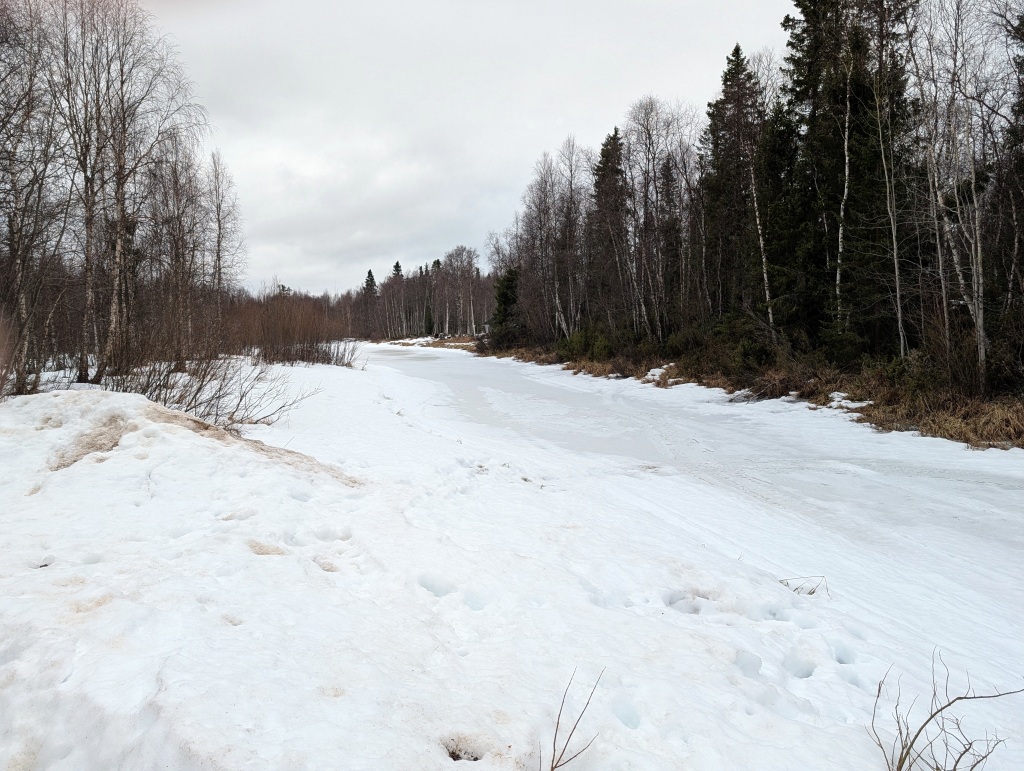
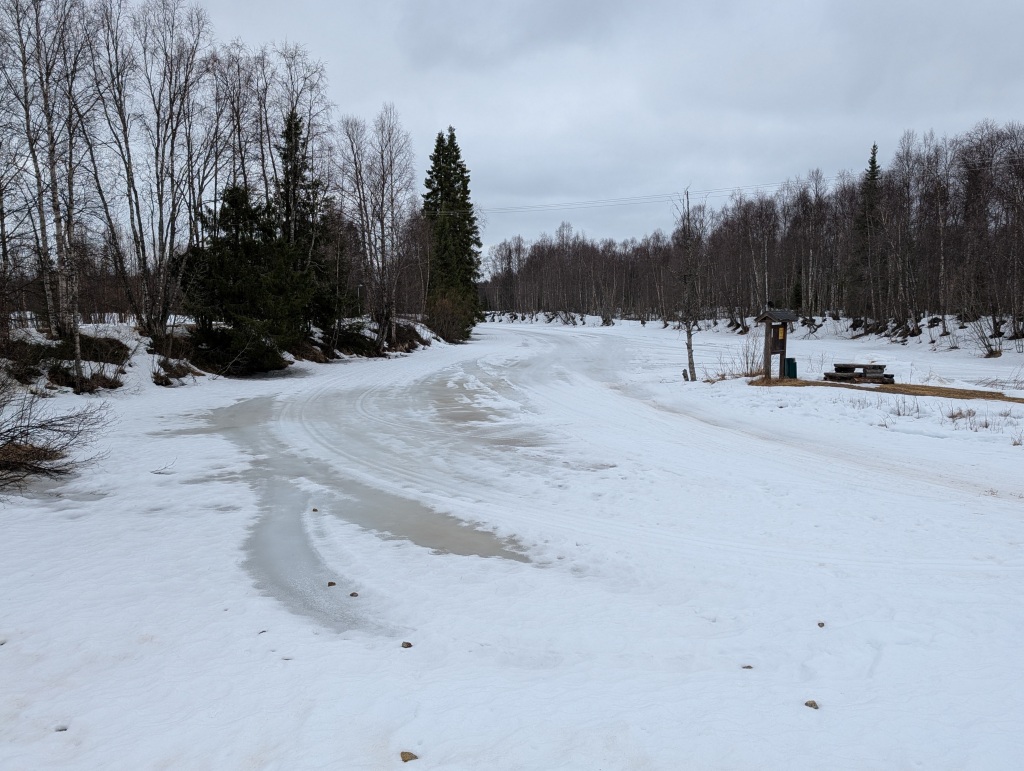
There was still ice on the local brooks (and the main river, the Ivalojoki); the surface was icy, hard and uneven. It was clearly the right call not to start here.
To be on the safe side, in case a flight was cancelled or my luggage got lost, I got to Ivalo a day early. So I had time to look around.
I had never been to Ivalo before, but I had been to Saariselkä and Kakslauttanen, which are the next places, about 25 km and 35 km down the road about a decade earlier.
Ivalo felt different. Especially at this time of year.
While Saariselkä and Kakslauttanen are big tourist places, Ivalo doesn't seem to have many tourist attractions.
It feels a bit like a 'support place' for the tourist resorts. A town where the people who work in the tourist industry actually live. It has supermarkets, hotels and restaurants, but most of it seems to consist of residential areas.
And those seemed mostly empty.
I don't have any real data on this (and people might have simply been away at work during the day), but I had the impression that the winter season was pretty much over and most of the people working in the tourist industry had closed shop for the season and went somewhere south for a vacation.
I didn't have much of a plan on what to do in Ivalo, so I mostly walked around a bit.
(Not quite accurate, though. I did have a plan on what to do in Ivalo that had nothing to do with the dogsledding plan. Not far from Ivalo, on the other side of the river, there's a place called "Aurora Village". And while I didn't want to go there for Aurora watching, which I could have done, if there had been any, from other places as well, they do have an Ice Karting track, which was something I wanted to try. But when I got to Ivalo, they had already closed the track for the season.)
As a town, Ivalo seems to be doing well.
I walked along one of the main streets to a residential area and then found that they had an extremely well maintained walking trail through the woods, back to the city center.
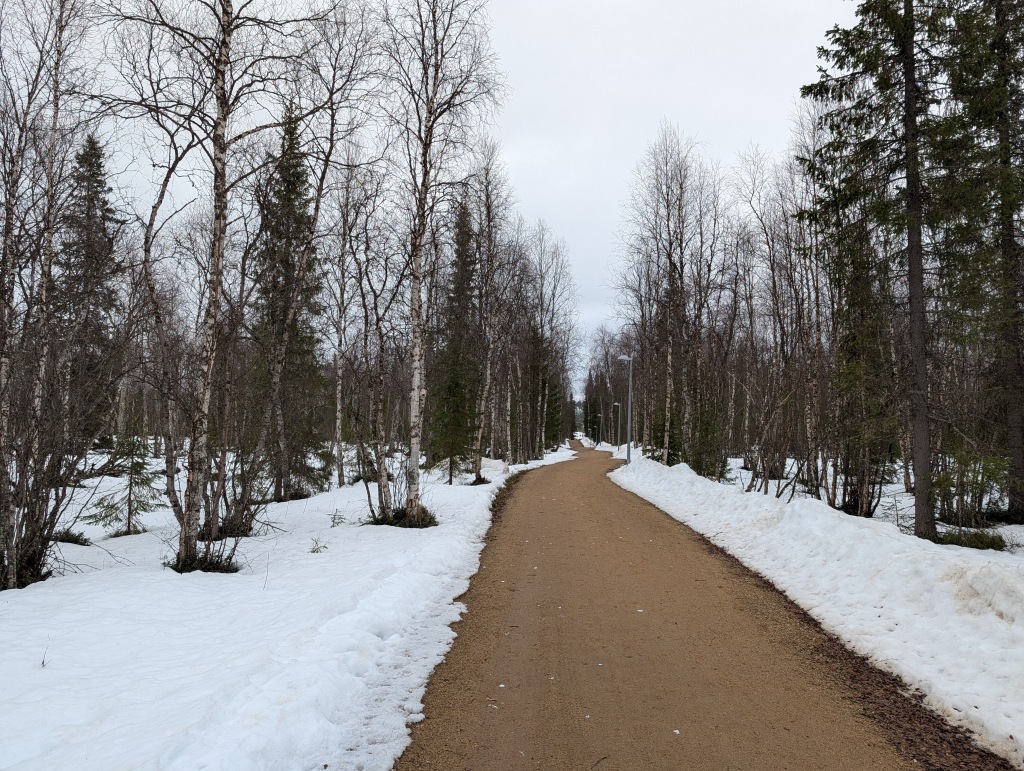
It isn't a trail that's essential for anything (you can get to the end of the trail faster if you stick to the main roads). It's there for jogging and because they like the outdoor life in Finland.
And the trail was in an amazingly good condition. The surface was even and cleared of snow and debris. There were lights all along the way. And a toilet building at the end of it.
For a trail that's a kind of luxury to have, a lot of effort seems to go in making it a nice one. I liked that a lot.
Another thing that I liked in Ivalo (and doesn't fit anywhere else in this trip report) was a shopping bag.
I did some shopping in Ivalo (mostly sweets to munch while dogsledding) and I bought a shopping bag from the supermarket.
It was a kind of silver-grey and didn't seem to have much of a shop logo on it (there were logos printed on the carrying handle and a small one on one of the sides, but they were unobtrusive). I only noticed when I had the bag out at night that it was made from reflective material.
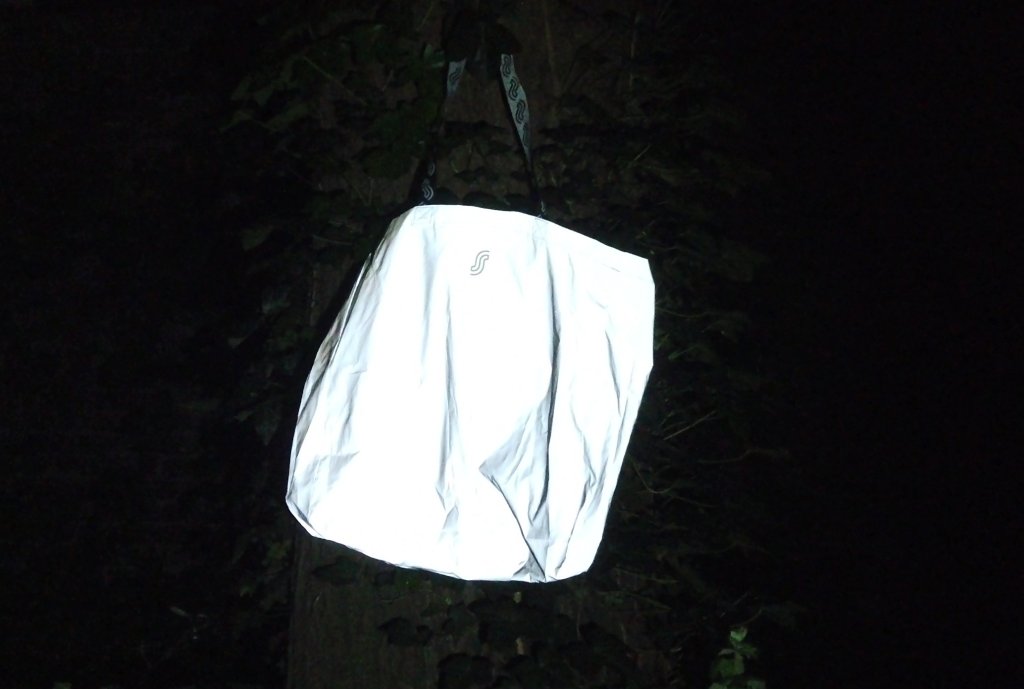
Which seems immensely sensible and practical. And I have never seen that anywhere else.
Northern Finland has long nights during the winter. And wearing something bright and reflective (instead of, let's say, a black leather jacket) is the smart thing to do. Having shopping bags that help to make the person carrying it visible is a good idea. And they went for it, didn't make a big thing out of it (as far as I can tell, there were no big banners saying "Safety bags. Because we care for you.") And they didn't undermine the idea by putting advertisements on the bag. (I would almost be willing to bet that, if they did it at home, there would be a tagline in big print right across the bag. Probably negating most of the effect the reflective surface has. But here, the marketing department had been sufficiently restrained to make it a reflective shopping bag. And nothing more.) It's hard to convey how impressed I was by the bag and the fact that it exists as a regular shopping bag. (In order to clarify: It wasn't free. Like for all shopping bags nowadays, you pay for it. But it wasn't presented as anything special. It was simply the shopping bag that was available at the checkout lane.)
In any case, I met up with Nina the next morning and we drove back to Langfjordbotn.
The drive was uneventful. Which kind of shows how often I've been in the Lapland area by now.
At some point, we had to stop for a moment, as some reindeer were crossing the road.
About ten minutes later, it occurred to me that I hadn’t even reached for my camera.
When I was north of the Arctic Circle for the first time (almost 30 years ago, back in 1997), we stopped the car to take pictures, because there was a single reindeer beside the side of the road.
And there were a few reindeer pictures in the years since.
By now, however, it's mostly "Another reindeer on the road. Good that we saw that in time."
So, yes, an uneventful drive.
When we arrived in Langfjordbotn, it was time for another change of plans.
There's a neat mountain plateau close to Langfjordbotn. At that point the plan was that we'd go up there for a couple of days, doing some dogsledding in the mountains. Maybe camp somewhere.
There is one hut on the fjord side of the mountains. The hut belongs to the Red Cross, but can be rented.
I'm not entirely sure how this works. Whether the hut houses Red Cross personnel during the season and is then rented out during times where it's not staffed. Or whether it's more like the remote STF mountain huts in Sweden, which are intended mostly as shelters but can be partly rented as well. Or whether these are simply huts that are owned by the Red Cross, but are only available for rental.
But, in any case, the hut is at a great location with a fantastic view of the fjord. It was available. And it wasn't far.
(The last part wasn't that important as far as the dogsledding itself was concerned. If at all, it was a negative factor. On a direct line, it's only about 3 km from the kennel. As a matter of fact, you can easily see the kennel from the hut. And while the hut is about 400 meters above the kennel, which is a bit of a climb for the dogs, going there directly would probably take less than an hour. It would be a short dogsledding day. But then again, we wouldn't need to go to the hut directly, but could, as we then did, go the long way round and end up at the hut after a much longer drive. The advantage of the hut being so close was that it was quick to reach by snowmobile. Instead of having the dogs carry all the food and equipment up the mountain, Ben put all of that on a snowmobile trailer and got it driven up to the hut in the morning before we even started getting our sleds ready.)
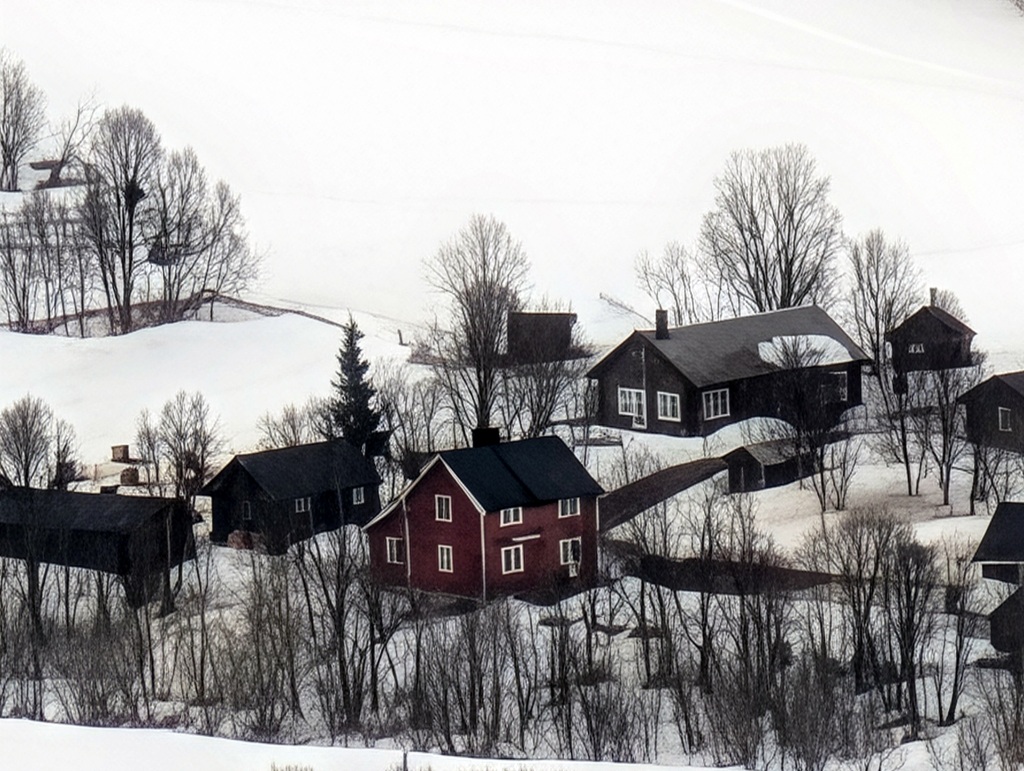
So far, so good. Everything according to plan.
But strong winds were predicted for the next night. And the area next to the hut offers no shelter from the wind. While we would be fine and comfortable within the cabin, the dogs would have an unpleasant night. (As usual with sled dogs, they would have been ok. And if we had been caught by bad weather in the mountains, it wouldn't have been much of an issue with the dogs out in strong wind. But as we knew it would be coming, it didn't seem sensible to expose the dogs to it without any real need.)
So: Change of plan.
Instead of heading up into the mountains with full teams, Nina and I would do a day tour in the lower areas around Langfjordbotn and return to the kennel. Then the dogs could have a comfortable night in their dog houses.
As this was the first day and I haven't been out with a 'proper' team (which, for me, still means eight dogs) for four years now, for the day tour, I got a smaller team to get accustomed to driving a dog sled again.
My team that day consisted of Lima, Chaser, Zoe, Burrito, Pie and Dash.
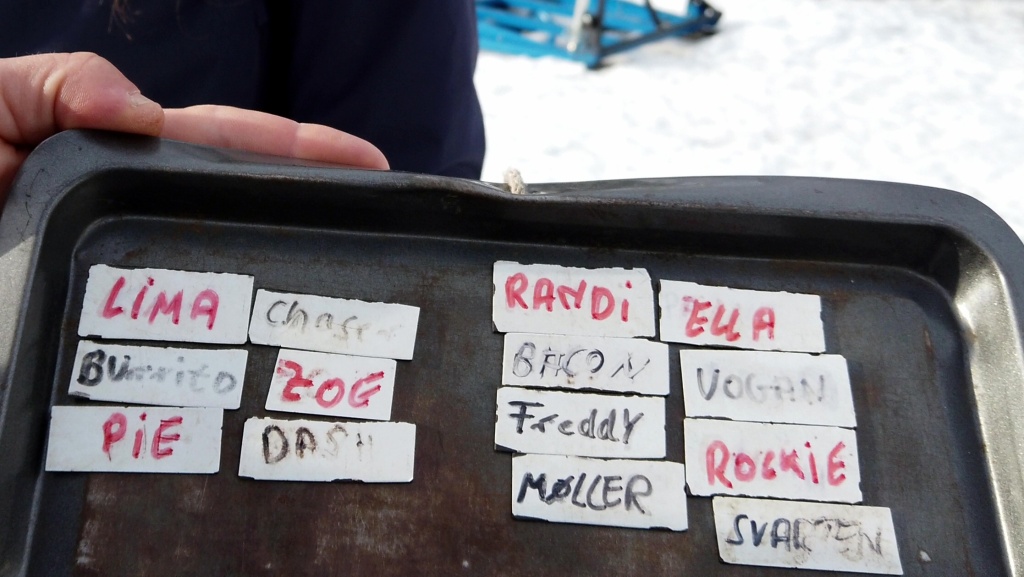
I'll go into more detail about the dogs later. From the six dogs I was driving on the first day, five remained in my team for most of the rest of the trip. Only Lima was 'sorted out' after that first day (and, as far as I can tell, remained at the kennel for the rest of the time and didn't participate in the rest of the trip at all). Lima was then later replaced by the three "Simpson characters": Homer, Bart and Milhouse.
I didn't know any of the dogs I had on that first day, as there was no overlap between those six dogs and the dogs I had the year before. (That changed later, as Bart and Milhouse had been on my team the previous year.)
The weather was mostly overcast, but I was dogsledding again, so I was happy.
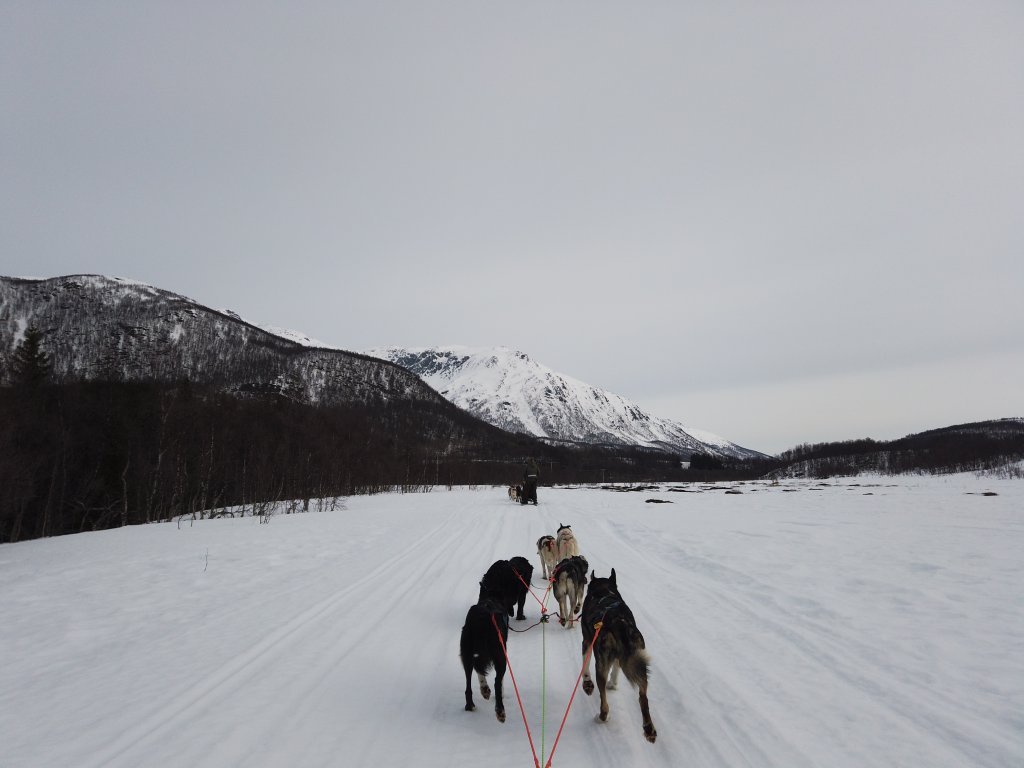
While I had only six dogs, it was easy going. Partly because we stayed mostly on the 'flat bits' and didn't go up any mountains (that would be the next day), but mostly because the sled was essentially empty.
Not really empty, as that makes the sled bounce and difficult to control. I had some ballast in my sled (I think it was a big log or some dog food) to give it some weight.
There isn't that much space that is 'flat' between the mountains on both sides (after all, that's pretty much the definition of a fjord that it has steep mountains on both sides), so our trail on the first day was going a bit back and forth, heading along one side of the road, then turning around, driving back, then going across and down the other side of the road and back.
It didn't matter. I was dogsledding. We were doing a decent run. Conditions were good. And while scenery isn't that important for dogsledding anyhow, I would have a lot of that on the following days.
Next morning it was time to do some more serious dogsledding.
This is probably a good time to introduce the dog team.
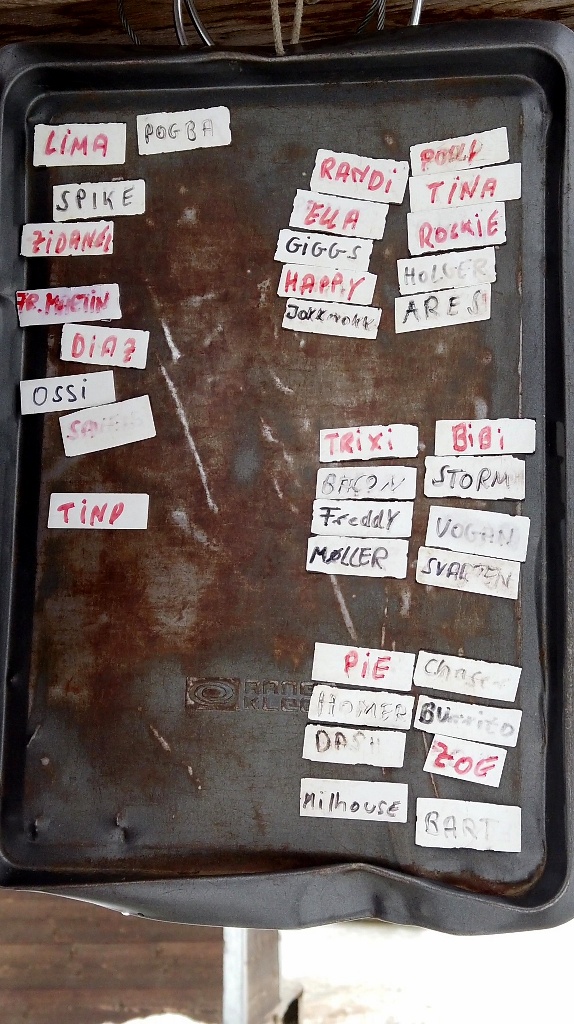
I'm aware that the following part anthropomorphises the dogs a lot.
And that dogs don't "work like that". At all.
However, forming a mental image of the 'personality' of a dog, even if not that accurate, makes it easier to remember and identify it.
Bart, most likely, is not disapproving of his surroundings. But it's easier to remember him as "the grumpy one". And I'm fairly sure that Zoe doesn't consider herself the "unlikely one" at all.
So let's just say that, if we imagine casting for a movie with these dogs, these were the roles I would give them.
This year, I had three "Simpsons" in my team, i.e. dogs named after characters from "The Simpsons".
I had three "Simpsons" in my team last year as well. But then I had Maggie as one of them, who has found another home in the meantime. Now I had Homer instead of Maggie.
Homer is essentially a hooligan. (Again, that's me "casting" dogs in roles. Not what the dog really is.)
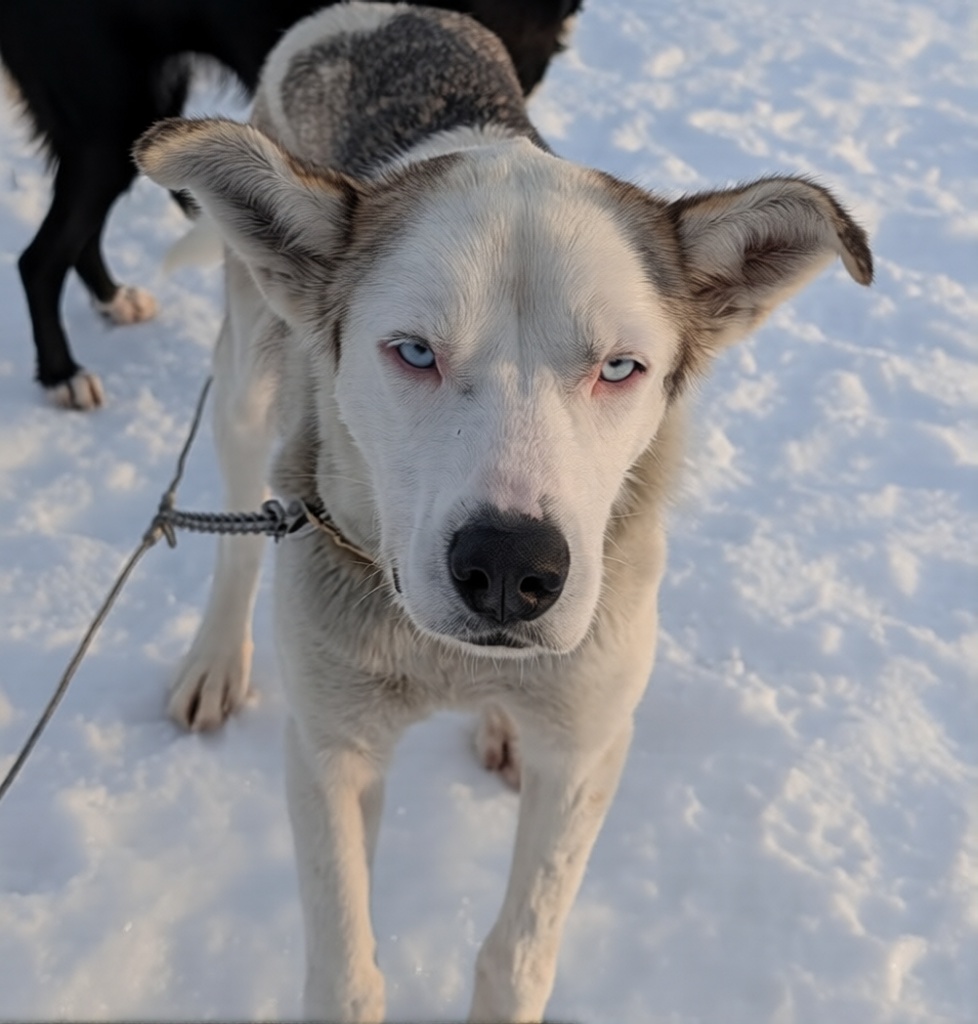
A bit like someone coming down the street, acting tough and shouting "I'll smash your head in" (or something like "You waste of space! Keep lookin' at me like that and I'll take your 'ead clean off!"). Essentially working on the assumption that aggression is the best defense, in a "I'll rip you apart before you can do anything unpleasant to me" manner.
When the dogs were at the stake-out line outside one of the cabins we went to, someone went straight towards Homer and tried to pet him. And Homer went directly for his hand. Nothing happened (the visitor was pulling back quickly enough and I'm not sure how much of Homer's activity was warning and how much was an attempt to bite the hand). Homer is not a happy, playful people-pleaser kind of dog.
Oddly (or maybe not - basically it's the way an anxious and fearful dog acts), once Homer gets to know you, he’s a sweet dog: all wagging tail, cuddles, and a love of belly scratches.
A bit like a hooligan who headbutts everyone he meets out on the streets and doesn't like the look of. And after a couple of pints in a pub decides to take a liking to you and suddenly you're 'bestest friends' for life.
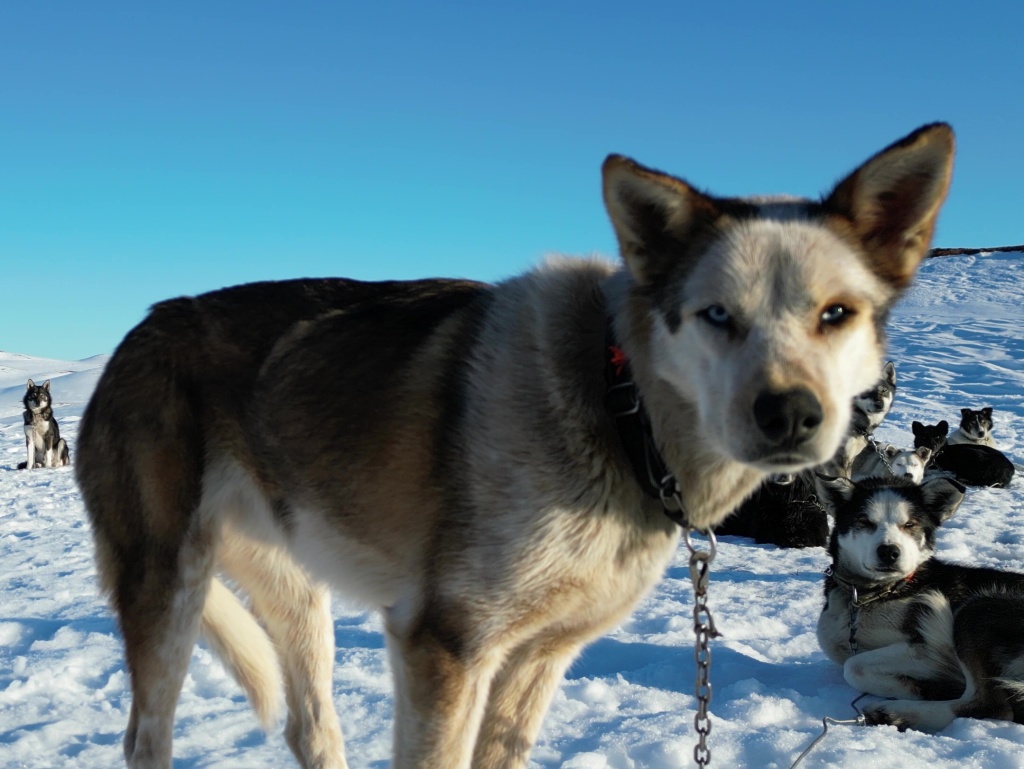
In contrast, Bart doesn't mind people. Although he disapproves of them. And pretty much everything else.
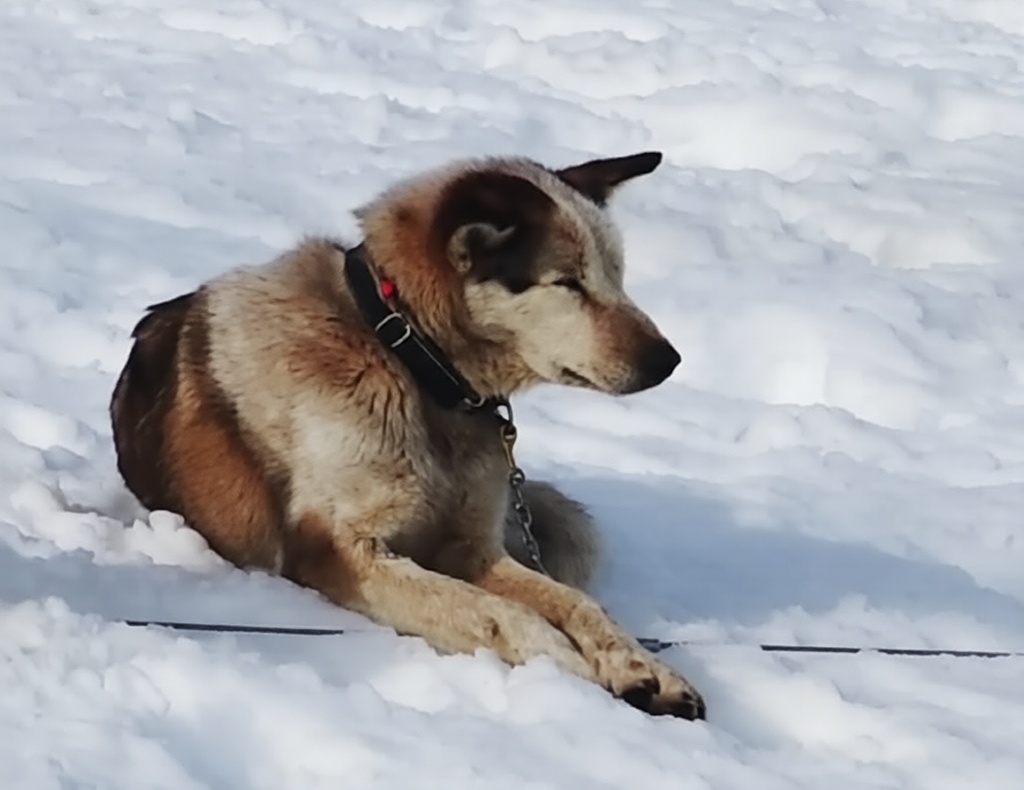
In the picture, Bart is lying down. Most of the time, when other dogs were already getting a bit of sleep, Bart tended to be sitting on the snow and looking at the surroundings with a disapproving look.
Sometimes you have people who seemingly don't have anything better to do, who stand outside their houses, look at everything and dislike it. Usually they are reasonably polite, say "Hello" and "Good Morning" to passers-by, but they always give the impression that they are only there to find something to complain about. And, ideally, write a strongly worded letter to the local newspaper afterwards.
That pretty much fits Bart. Polite and doesn't make any trouble, but does not give the impression of being a happy dog. Ever.
Once again - this is the impression the dogs give, not how they are. While Bart gives the impression that he likes to complain about everything (too warm, too cold, snow too soft, too icy, the wrong colour...), like all sled dogs, he doesn't. Which can be a problem. I did screw up big time on the tour and put his harness on the wrong way. Which caused massive chafing on one of his legs. And I didn't notice that for about 20km. And even then, it wasn't me who noticed it, but Ben, who was seeing the dog from the front and noticed the front leg moving oddly.
But it's not like Bart did give any indication that anything was wrong. Like giving a yelp. Or stopping. He continued pulling properly (Bart was in wheel position) all the time. Sled dogs in general are tough and don't complain. (As Nina mentioned later, someone told her a quote about sled dogs (Siberian Huskies in particular): "When a sled dog lets you know something is wrong, it's time to dig its grave.") So, the idea that Bart is a complainer is obviously wrong. He still acts that way.
The third of the "Simpsons", Milhouse is mostly not a problem.
But potentially a big one.
On the first couple of days, in the mountains, Milhouse was great.
Good pulling, no trouble at all.
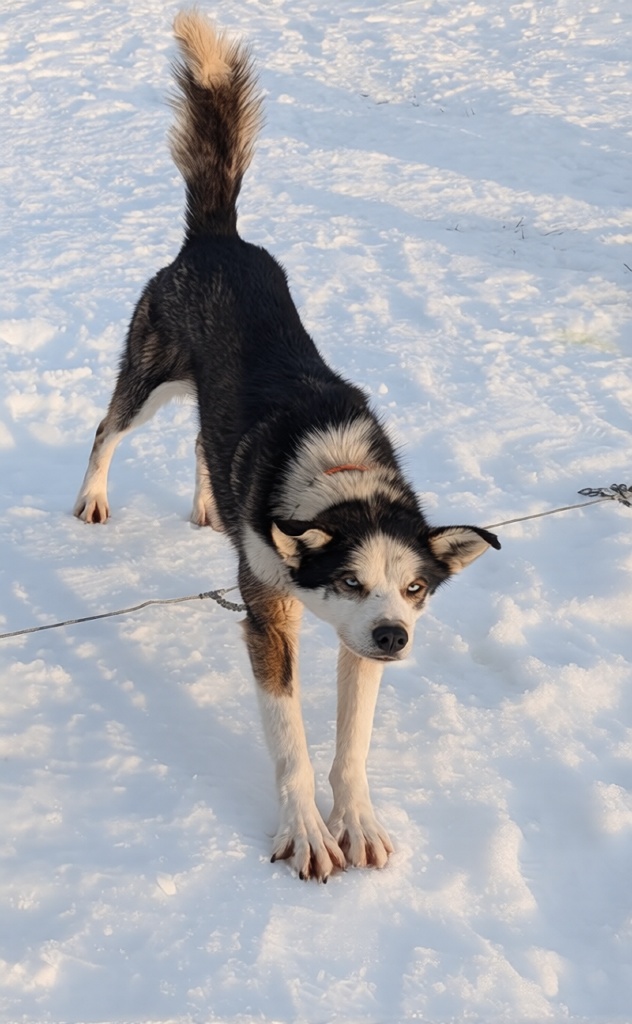
When we had a rest day at the kennel, I looked up what I had written about him the previous year and was surprised that I had him down as trouble. He had been barking aggressively at other dogs when we encountered another team on the trail and I wrote that "...every time we encountered another sled, I was going "...on by, on by, on by, MILHOUSE NO!, on by...".
The first days, there wasn't any of that. We had passed another dog team on a rather narrow trail and there was no reaction from Milhouse at all. When I re-read last year's trip description, I was surprised. I mentioned that to Ben and Nina and even asked them whether they had trained Milhouse or whether he'd simply grown more mature since last year.
And it seemed like the latter had been the case.
Until the next-to-last day of the tour, when Milhouse was in lead. And some skiers with their family dog were waiting at the side of the trail to let us pass. And instead of passing, Milhouse went right towards the small dog. Nothing bad happened (we had enough impulse with the other dogs and the sled to pass by), but it was a tense moment.
After that, on the last day, Milhouse kept going for any other team that came our way. (Though that wasn't a problem then anymore. He wasn't in lead, but in wheel again (where his options of changing the direction were limited) and on the right side (as other teams usually passed on the left, so there was always another dog between him and the that team). And a lot of me yelling "NO, MILHOUSE NO!" again.)
Before that looks like the "Simpsons" are a bunch of dangerous psychopaths: They aren't.
And all of them are strong pullers. It's great to have any of them on the team. Even better all three of them. But you have to adjust for their personalities.
The rest of them are a lot easier to deal with.
If Bart, Milhouse and Homer are the 'bad boys', then Dash is the comic relief.
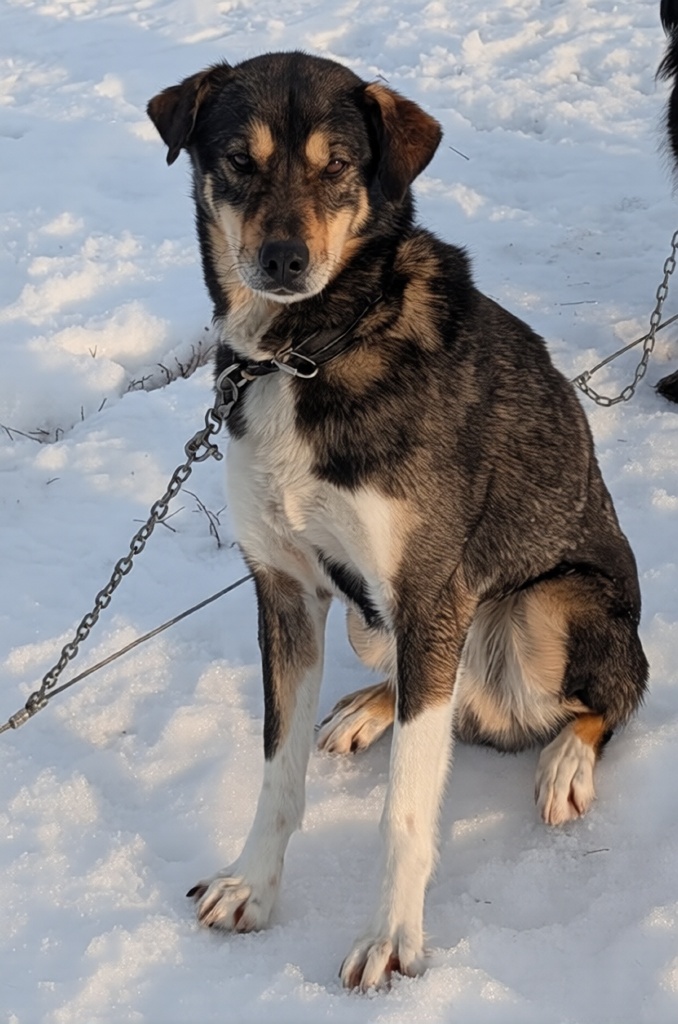
As far as behaviour goes, Dash is unremarkable. Quiet, reliable, good eater, good puller. The dog in the team you tend to ignore. A bit like a machine part that never troubles you. People think about their car tires or engine, but not about the door hinges. Or, to fit with the dog's name, nobody worries about their dashboard breaking down.
Dash would be wholly unremarkable if there weren't the ears.
Most sled dogs have stiff, pointy ears. But Dash has floppy, rounded ears.
They flap while he is running.
Mostly they flap randomly. But sometimes they flap in sync. And then it looks (from my position standing on the dog sled) like someone tied a little bat on the head of one of the sled dogs. And it looks a tad silly. (It's not like the dog cares. But in a buddy story of sled dogs, Dash would be cast as the somewhat goofy one.)
If Dash is the comic relief, then Zoe is the plucky "little engine that could". Against all odds.
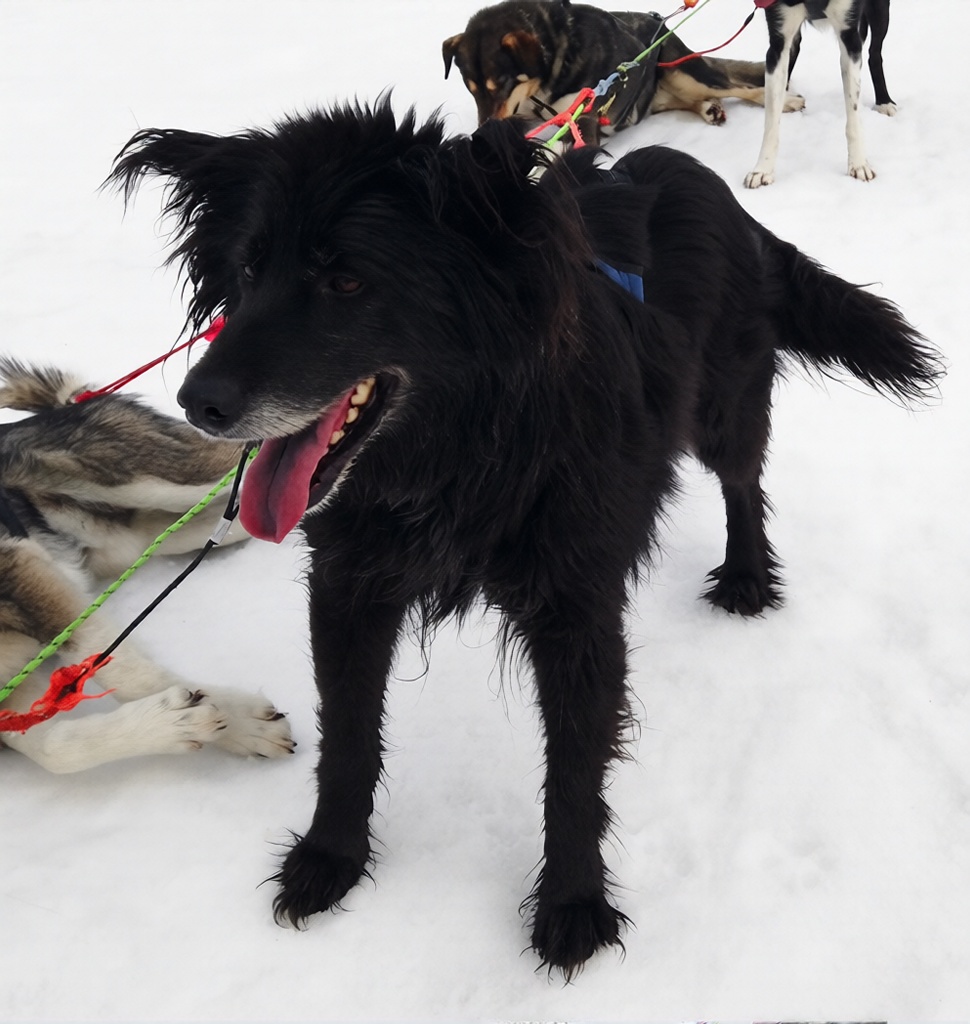
Though not that little, Zoe is the dog that looks least like a sled dog.
More like a fluffy family dog that got bored with the routine and confinement of indoor life and ran away to join the circus. Or, at least, live an active outdoor life.
In a story, Zoe would be the dog who always knew that she was destined to be a sled dog. And depending on story needs, either everyone would tell her that this would never happen, because she was the wrong kind of dog for it. And she would make it anyway, due to sheer perseverance. Basically the character that defines the term "dogged determination".
Or it would be the dog that nobody ever had the heart to tell her that she can't be a sled dog. And she became a sled dog because she never became aware that it wasn't an option.
In any case, Zoe is a great sled dog and, together with Dash, the reliable core of the team.
Of course, in real life terms, that's probably all nonsense. Besides the fact that dogs don't think about career plans, Zoe also isn't an unlikely sled dog.
She comes from a competitive racing kennel, so she has been bred for dogsledding and isn't some random addition to the Ben's kennel. She only looks fluffier than most of the other sled dogs.
Talking of fluffy-looking...
The "loveable sidekick" of the group would be Burrito.
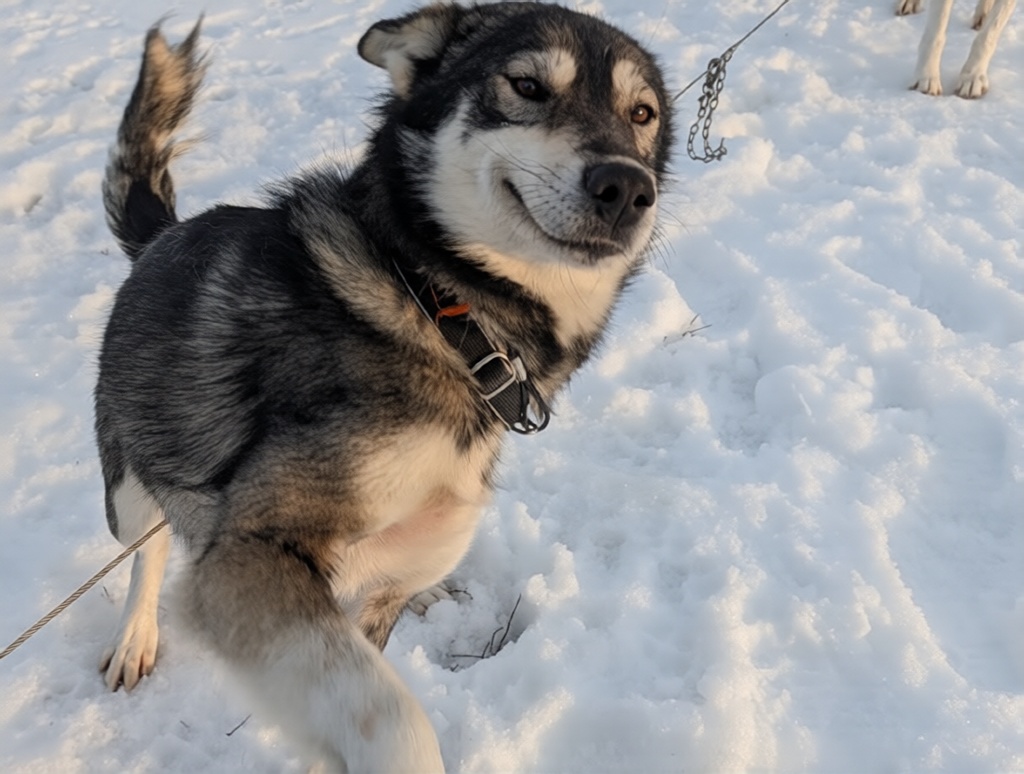
Always cute, always happy, always the one with the wagging tail and ready to be cuddled. And a bit silly as well.
That leaves the two leads. (In the sense of being the lead dogs, not necessarily the lead characters in a story.)
Pie is the professional.
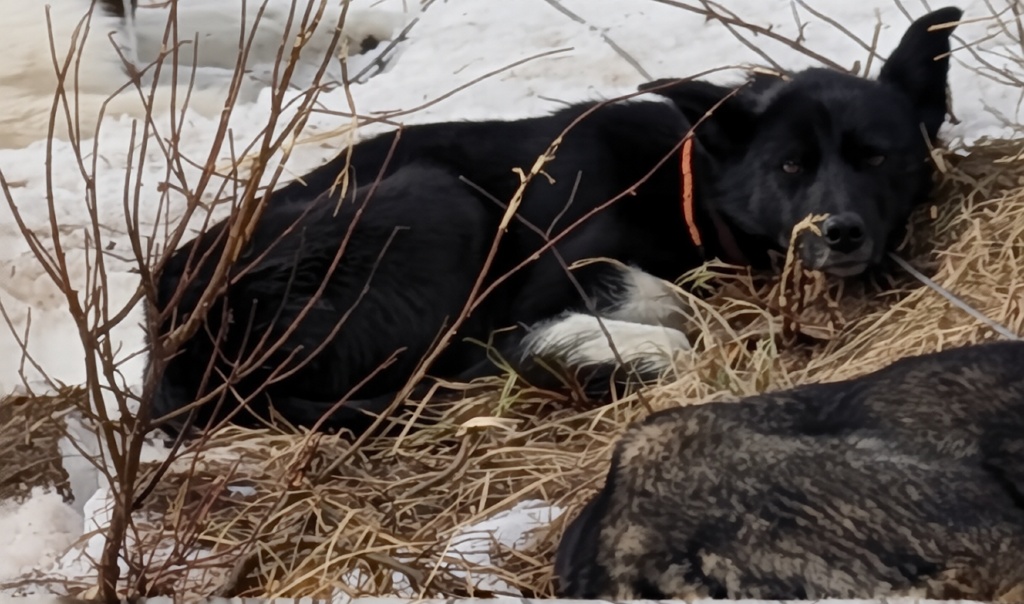
Even though she is relaxing in the picture, once she's on the trail she's good at remaining alert, paying attention to the sled in front and finding a good path when she isn't following directly.
Which is a two-edged sword.
In theory, any lead dog of a team that's not on the first sled should follow the trail the first sled took. And not select their own path. But dogs are, in general, direct about things and don't understand detours. We had some situations when we stopped and Ben had to point his team in a specific direction, as we were switching from a path that we were on to another path at an acute angle.
If this is done while moving, the dogs will (more or less) directly follow the team ahead. Sometimes cutting the corner a bit, which can cause problems if there's soft snow or a tree. But mostly they follow the same path.
If there is a stop, however, and the lead team turns onto another path ahead, the dogs will rarely walk ahead, run to the point where the other trail departs and then follow that path.
They will try to go to where the team in front currently is located. And if the way to them is off the trail, then the dogs will go 'cross country'.
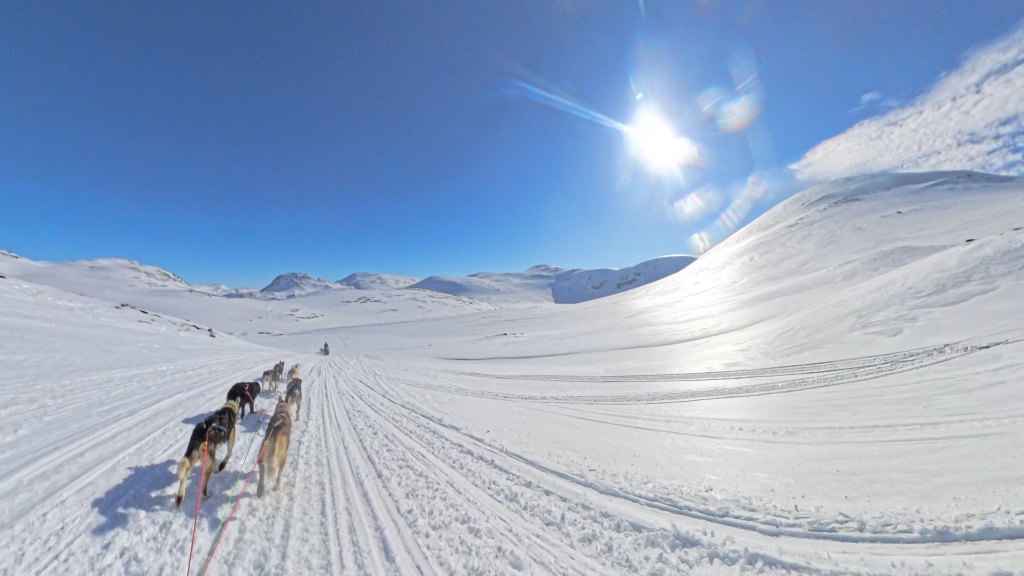
In the scene below (a couple of days later when we were no longer in the mountains), Ben had stopped and taken a tight right turn about twenty meters ahead.
So, of course, my team didn't bother to go those 20 meters, but stepped sideways off the trail and made their way directly to the other trail. (Sorry about the image being tilted, but I had the camera strapped to my hand and needed to focus more on keeping the sled controlled than on pointing the camera properly.)
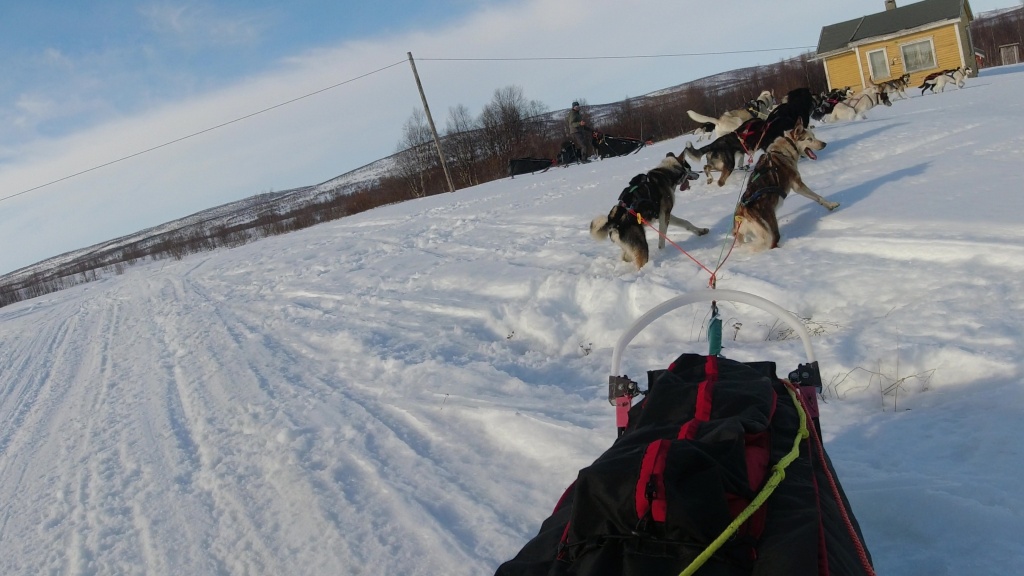
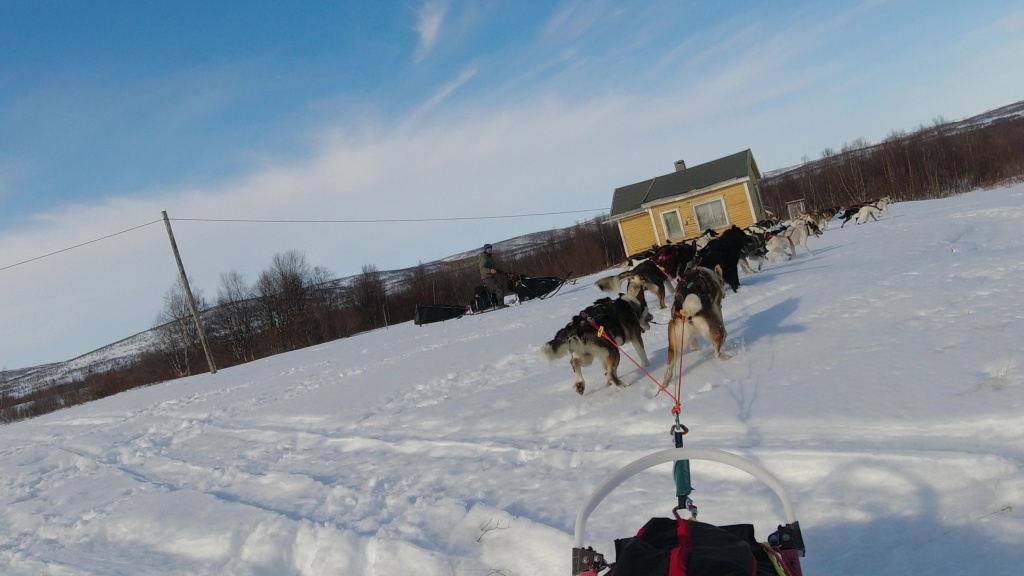
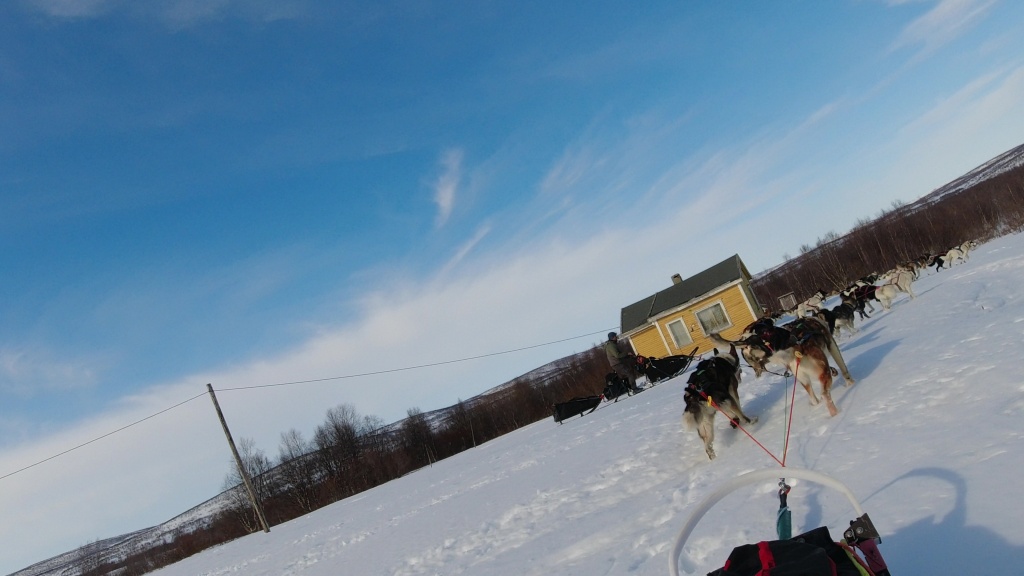
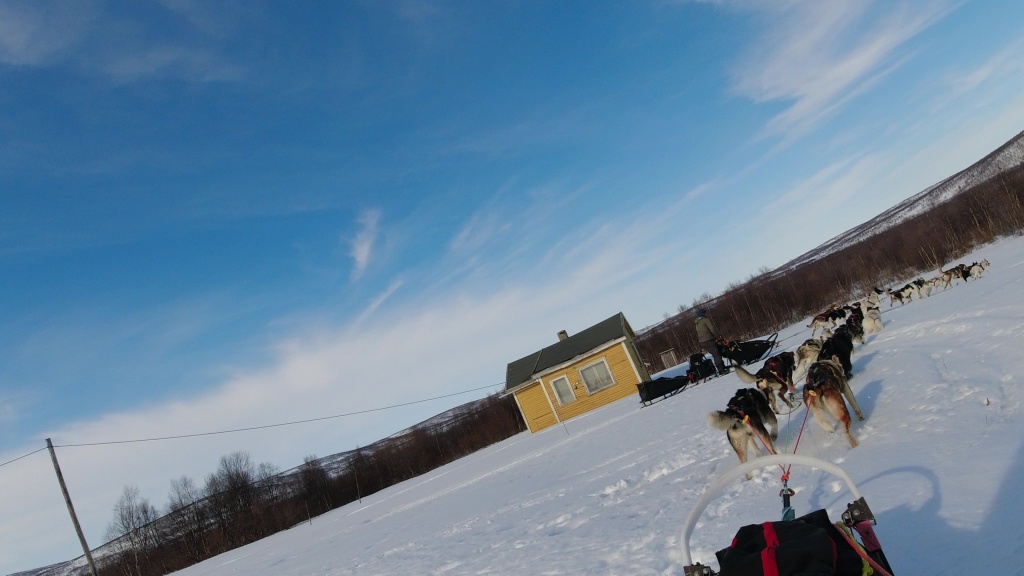
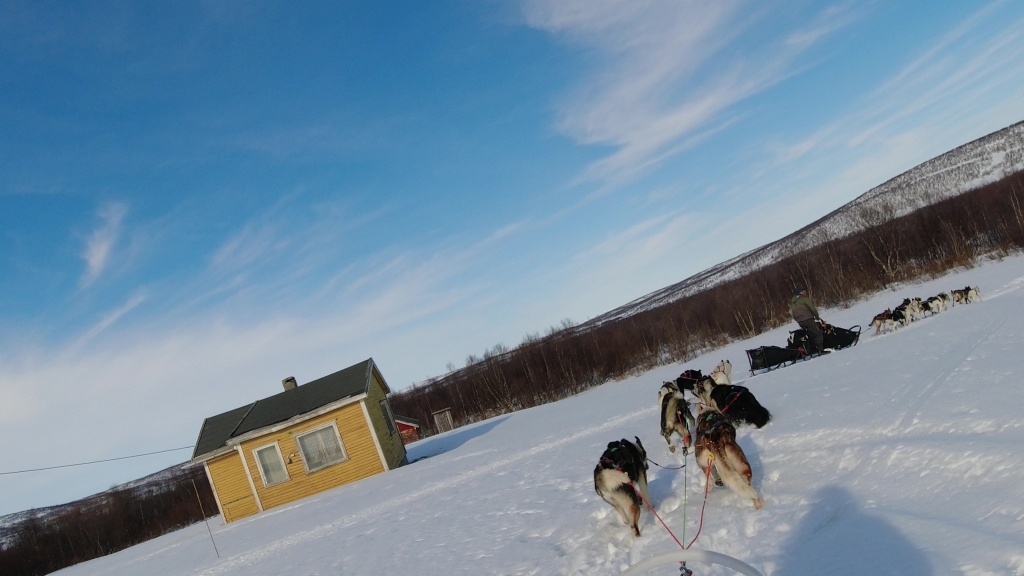
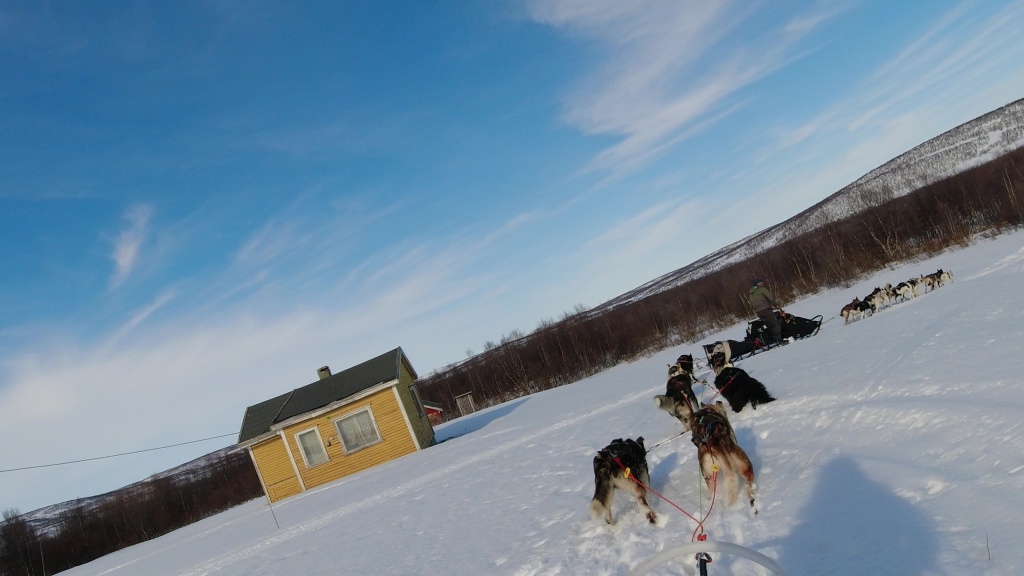
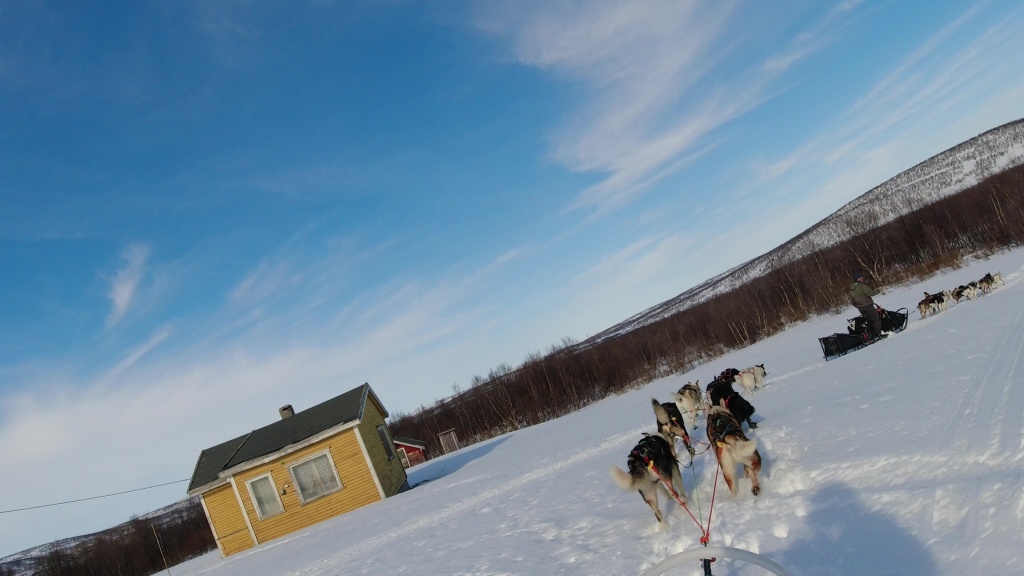
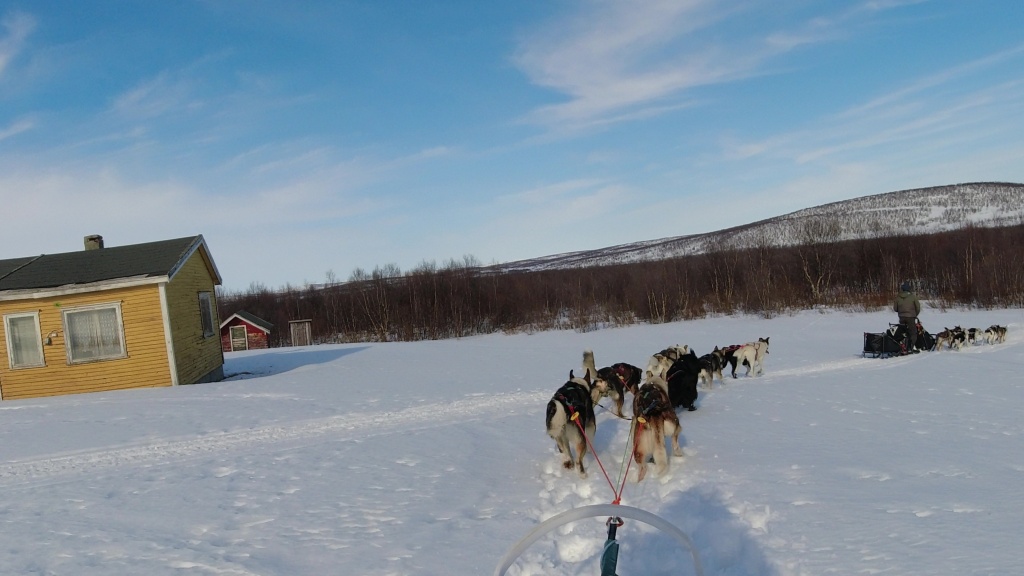
In the end, it all went very smoothly. And we came out nicely behind Ben's sled, without teams running into each other or any other issues.
While it is one of the situations where you would prefer your own lead dogs to follow the trail the lead sled took, instead of aiming for the sled directly, that's how it works.
And that's where you are happy about having a lead dog like Pie. Who, when she makes her own decision and chooses her own way, at least does that smartly.
Which, unfortunately, doesn't bring us neatly to the last dog of the team.
Chaser can do things smartly and is a good lead dog when not distracted.
Chaser gets distracted a lot, though.
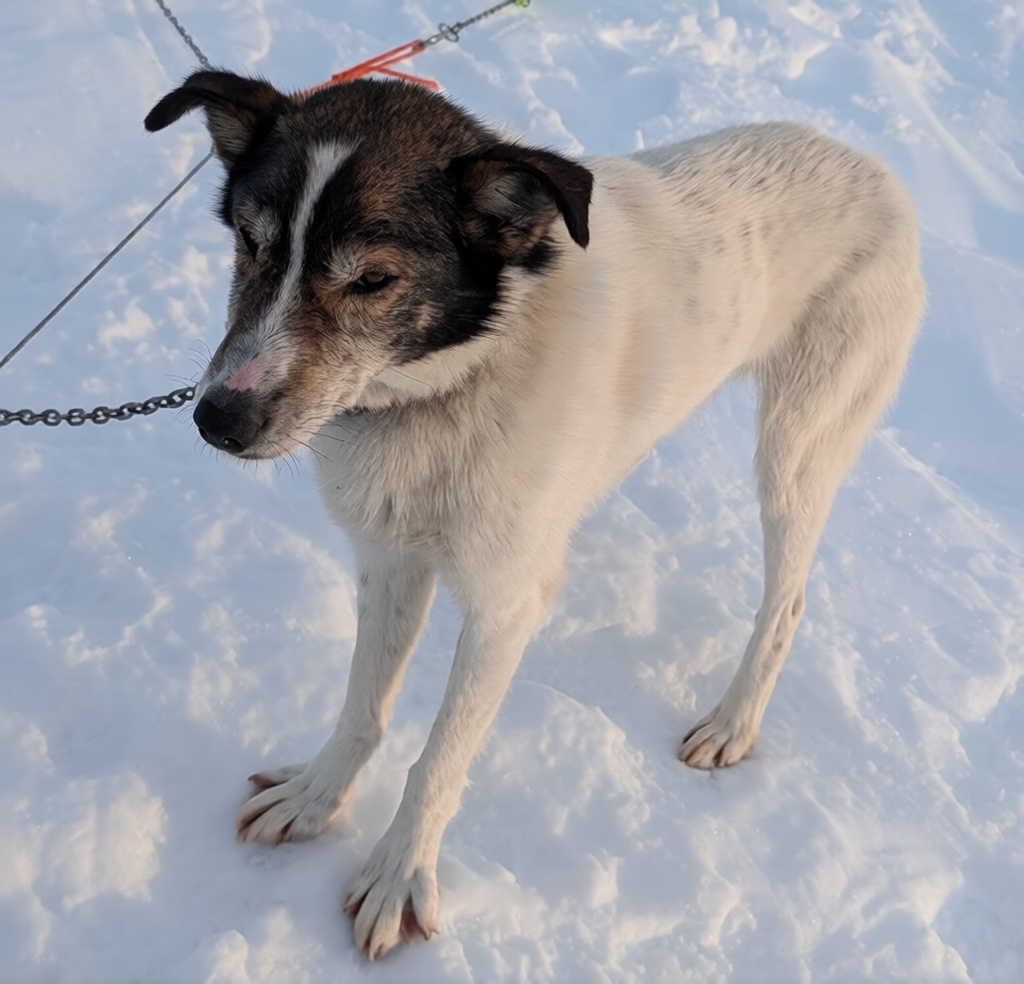
Chaser is a great lead dog on a big white plain. When the only thing that is there is white and made from snow and ice.
Everything else needs to be marked.
So if there's an exposed patch of dirt on the side of the track, Chaser will detour to pee on it. If there's a stone peeking out of the snow, Chaser will lift a leg. A trail marker? A tree? Another quick step to the side for a quick marking.
Not much of an issue for any dog that is not a lead dog. But as a lead dog (especially as the dogs are usually not run with a neckline between the leads), Chaser has a bit more freedom to detour.
It's also noticeable during stops on the way. While Pie tries to stand straight ahead and keep the main line straight and tight, Chaser will amble to the side of the trail to pee on something.
Mostly that can be ignored (it's a dog quirk that doesn't affect the sledding), but it can be annoying when the trail goes uphill, the sled is going slowly and you're working in the back to keep the sled going (as a moving sled has less resistance and is easier to pull (and push) than a stopped one that needs to get moving again) - and then your lead dog decides that the slow pace means that it's time to have a break by some bushes at the side of the trail and bring the whole team to a stop. Not really a problem. But annoying.
Having introduced the team, back to dogsledding.
The first part was the hardest one of the whole tour - good to get the difficult stuff out of the way early.
From the kennel up to the hut were about 400 meters altitude difference on about 5 km of trail. (The actual distance from the foot of the mountain to the hut is about 1.5 km, but the trail goes in serpentines.)
It's no extreme climb by any means, but going up 400 meters in half an hour (which includes Chaser-induced stops) was the hardest effort during this trip.
And it was less exhausting than I had feared.
Of course, it did help that there were eight dogs to pull me and the sled up, that they had rest at their home kennel before we started (and not some night camp out on the snow) and that the sleds were light (as dog food had already been brought up to the hut and we weren't carrying tents or other camping gear).
But still. A couple of years ago, on another trip (to be fair: with a fully loaded sled including a week's supply of dog food and camping gear; and only six dogs), we went up 400 meters in about an hour (with an additional half hour break at halfway point) and I was completely exhausted at the end of it.
While this time, it needed a bit of effort. But that was about it.
Or maybe not. At least that is how I remembered it when I wrote the text for this page about a month after the trip. But I also keep a notebook during trips to write things down while they are still fresh in memory. And when I looked it up, I found: "Lots of uphill - eight dogs turned out not to help much - not as impressive as they were last year. Lots of pushing with a near empty sled." It seems it wasn't as easy as I remember it now. Though it wasn't as bad as it looks in that note. The GPS trail clearly shows that we got up there without long stops along the way. And much faster than on a similar trail a couple of years ago. And even though that wasn't all the uphill driving we did that day, my legs didn't hurt when we reached the hut. The dogs might not have pulled as effortlessly as I had expected. But all in all, there wasn't anything to complain about.
Ultimately a good thing, as we didn't stop at the hut, but went on along some mountain tracks and looped back, adding another 300 meters of altitude on the way (although on less steeper slopes). And was I still doing fine at the end. Good dogs! (Whatever can be said about their quirks and personalities - they are really good at their main job: pulling sleds.)
I won't include many pictures from that day of dogsledding. The weather was fine and good for dogsledding, but it was mostly overcast with some blue patches here and there.
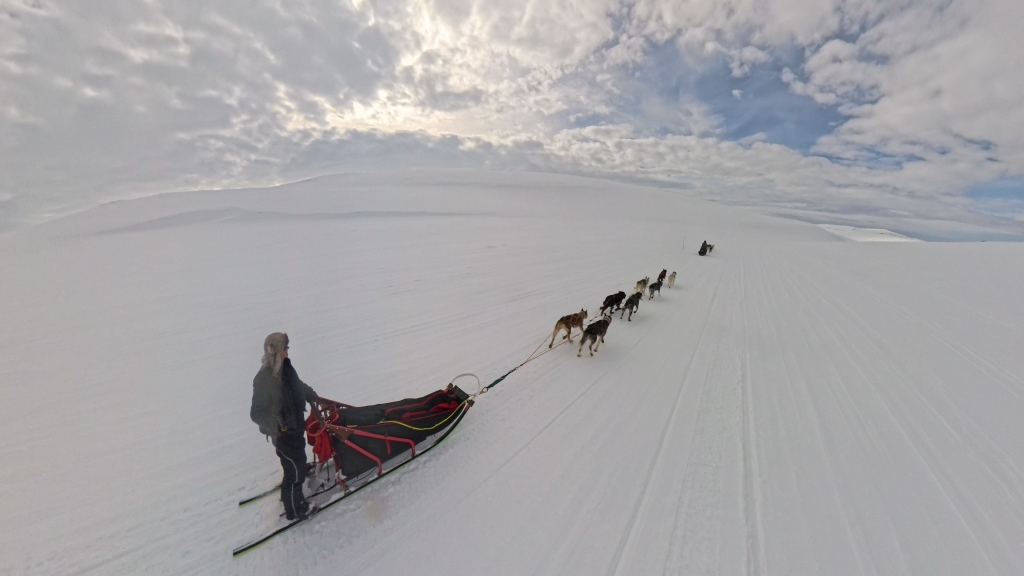
As we covered most of the same trail again on the next day (and partly on the one following that as well) and we had 'postcard weather' on those days, I'll use pictures from those days instead.
All in all, it was a solid run of almost 50 km before we got back to the hut, put the dogs on the stake-out lines and went into the hut.
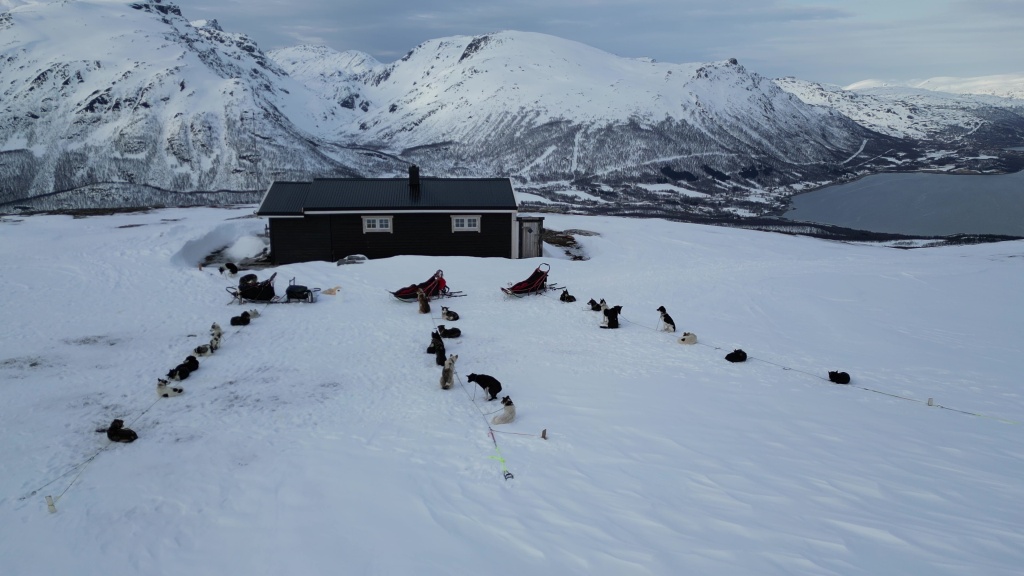
Slightly unusually, we stayed awake for a couple of hours after dinner and played some card and dice games.
Usually, everyone is tired after a long day of dogsledding. And the next day is going to be long and exhausting as well. So you go to sleep early, mostly right after dinner.
But even though we had covered a decent distance with some non-trivial uphill running, it had been an easy day. Light sleds, with everything (including water) already at the hut, made it easy going. It also didn't take long to get the dogs fed in the evening. And the hut had a lot of space and was comfortable.
And we would have an easy start the next morning, with no need to pack the sleds (as we would be returning to the hut, we could leave everything there). Feed the dogs. Make breakfast for ourselves. Harness the dogs. Ready to go.
So we had longer evenings in the hut than usually.
Not in any extreme way (we didn't stay up until 2 am or anything like that). In most cases, however, you have dinner around 8 pm, are finished around 9 pm and then you hit your sleeping bag. (Even more so when you are out camping, as sitting in the tent, even if there's a fire going, is more uncomfortable than the sleeping bag. So, you don't sit around when you're done with dinner.) Here we were staying up until maybe 11 pm. Actually, not that late, but it was unusual to have anything resembling a social activity after dinner. (As chaotic as it was. An issue was that the rules for the card game didn't make much sense. Following the rules made it the most boring game ever. We tried to 'improve' gameplay with additional house rules, which doubtlessly made the game more lively. But not better. And introduced even more badly defined edge cases. As a games night, it was a bit of a disaster, but as a social gathering, it worked.)
Next day the weather was perfect. Bright sunshine all day!
Of course, Bart still looked grumpy.
We went for fairly long run in the mountains. At almost 60 km - our second longest day on the whole trip.
The start was slightly chaotic (dogs not going the way they were supposed to go), but after that, all went smoothly.
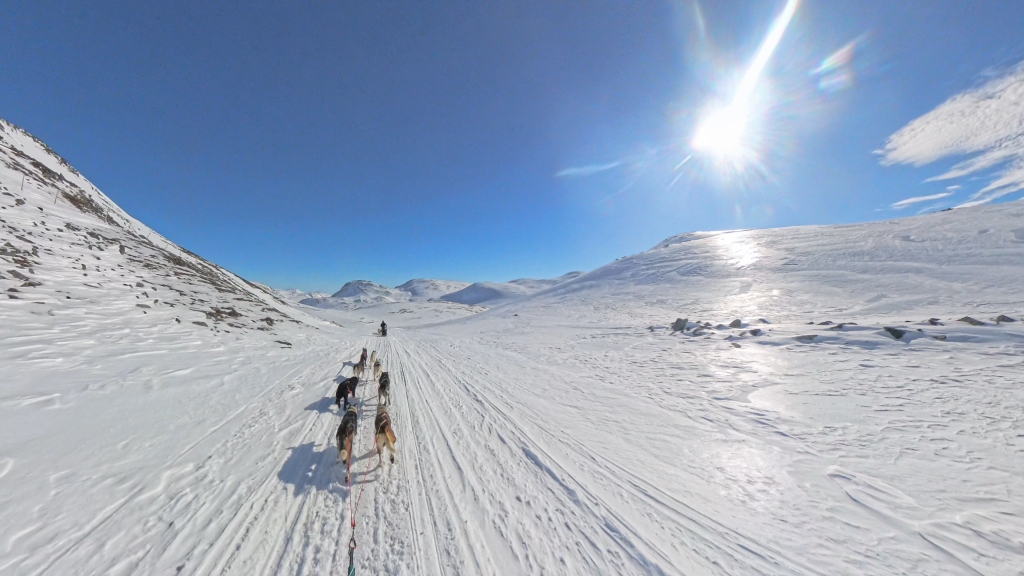
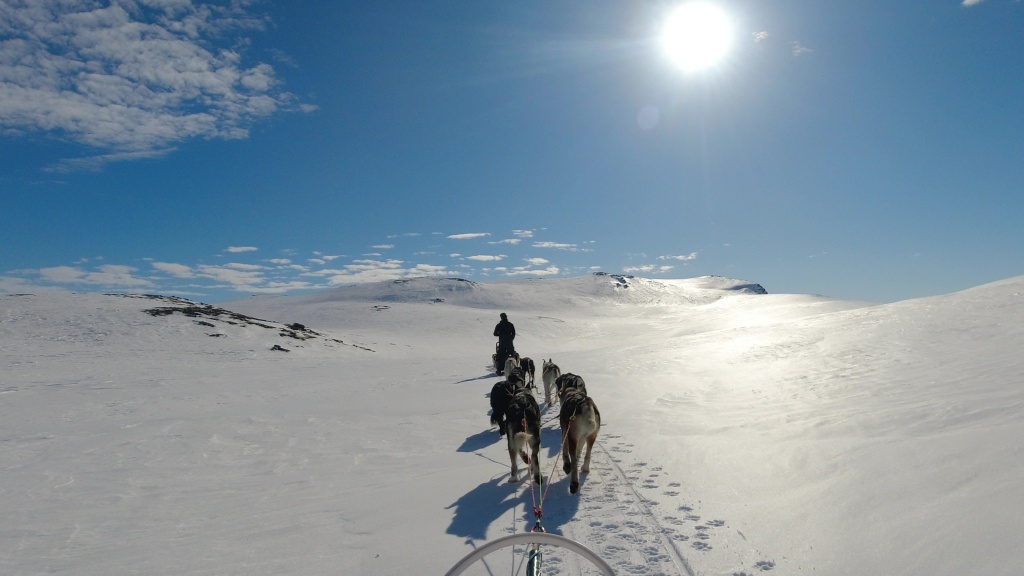
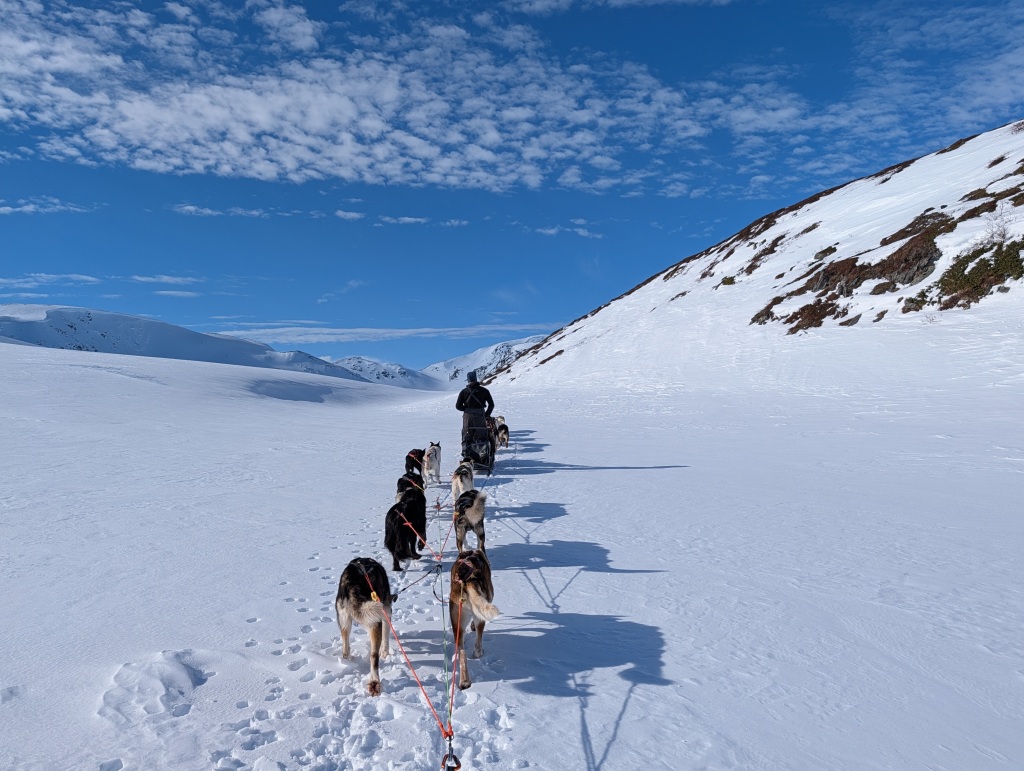
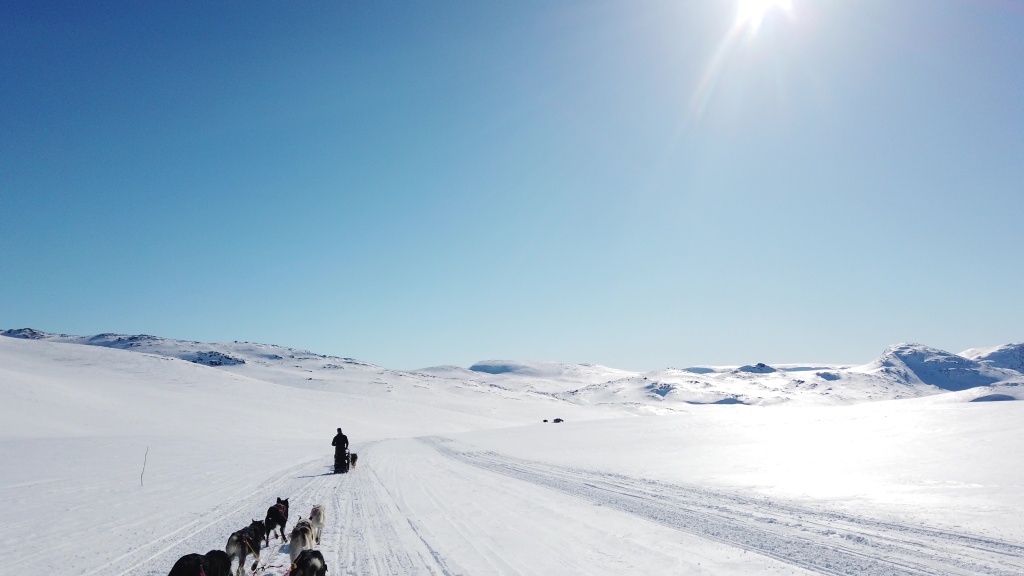
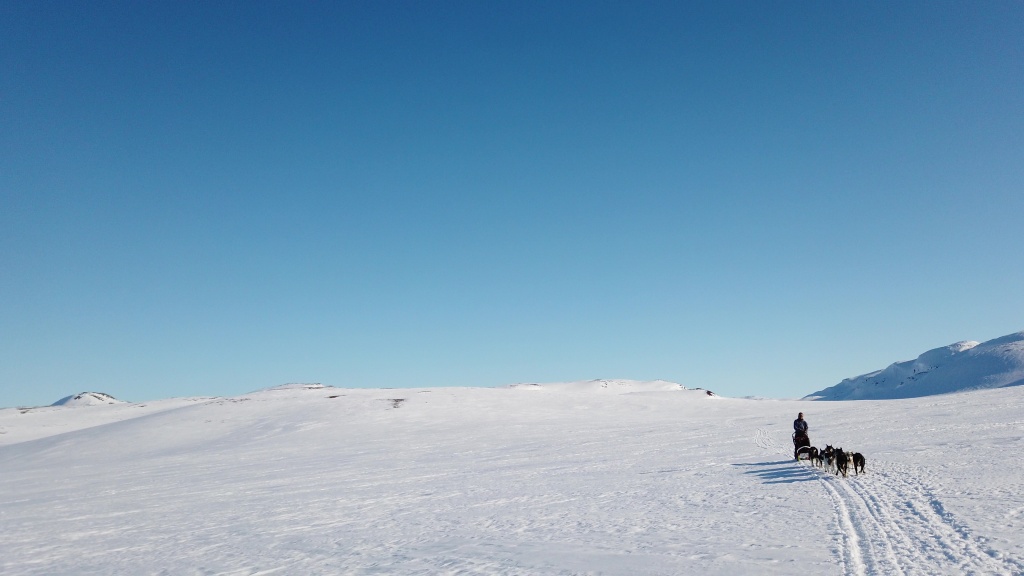
Around noon, it was warm enough to wear a T-shirt again while dogsledding.
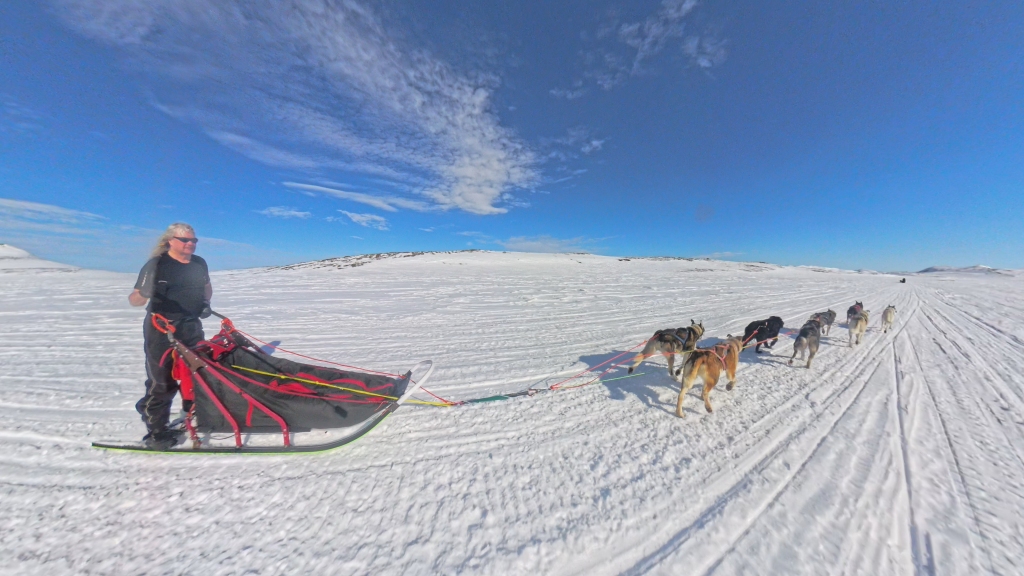
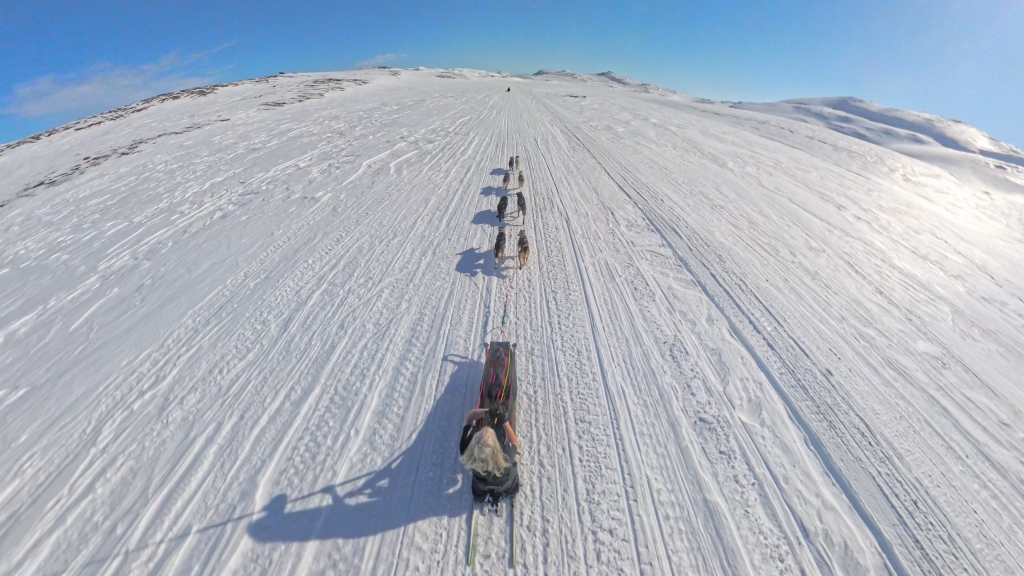
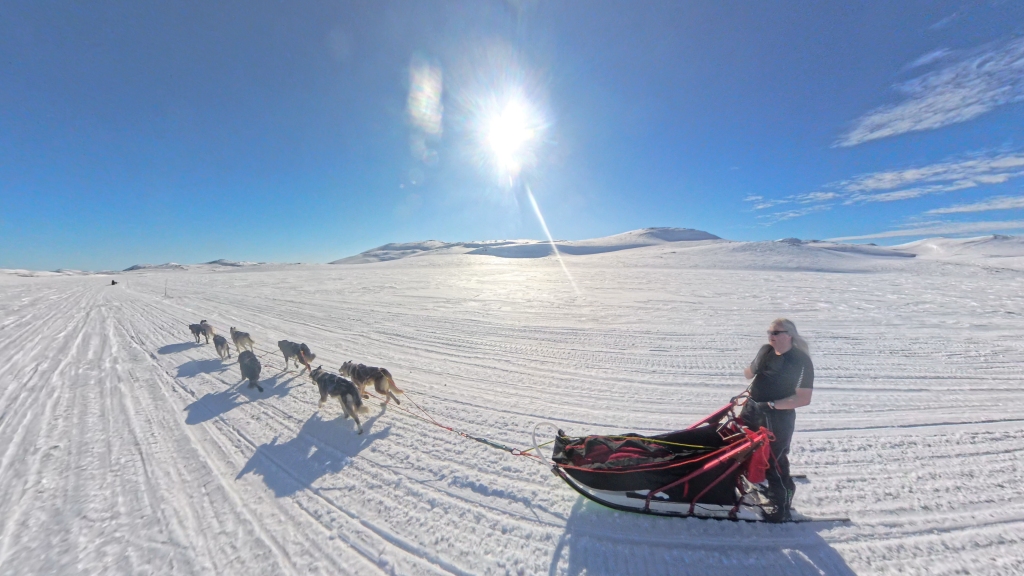
We nearly went halfway to Alta, before turning around and heading back to the hut.
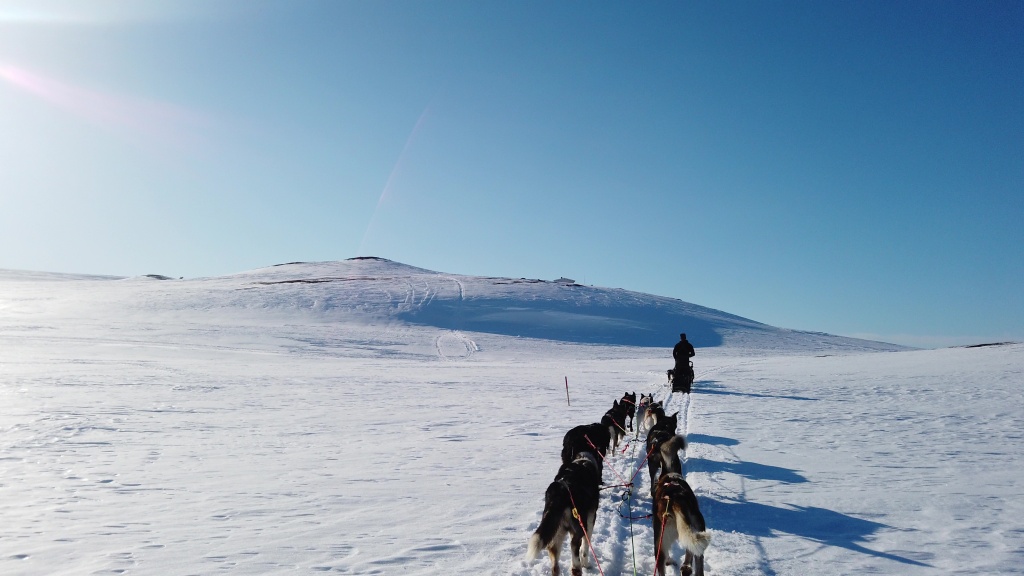
In bright sunshine, the location of the hut and the view from it was even more impressive.
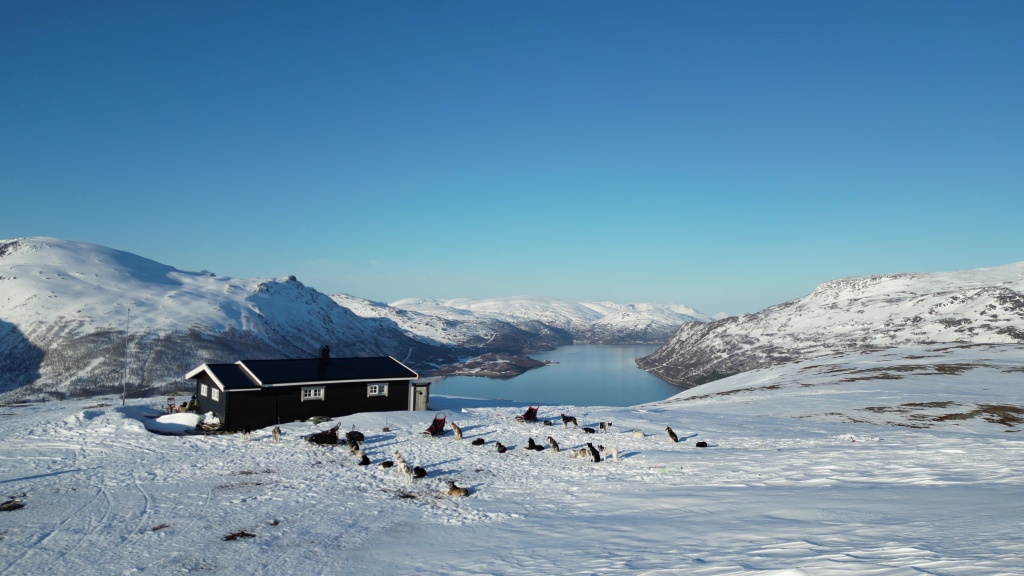
Although the picture makes it look a bit like it is located right at the shore of the fjord. In reality, the fjord is about 400 meters below and even the near side is 2 km away. It's a great location anyway.
Next day had more of the same, but in a smaller "group". (If two people already make up a group. But we also had 16 dogs with us, so maybe that counts.)
Ben had to stay at the hut to return it properly. He probably also wanted to be back home early. So only Nina and I went along some mountain trails with our sleds. And Ben sorted out things at the hut and then went with his team directly down the mountain and to the kennel. Which probably took him 20 minutes.
We took a longer route. Still the shortest trip of the tour (even shorter than the 'warm-up' tour on the first day), but again on a fantastic day.
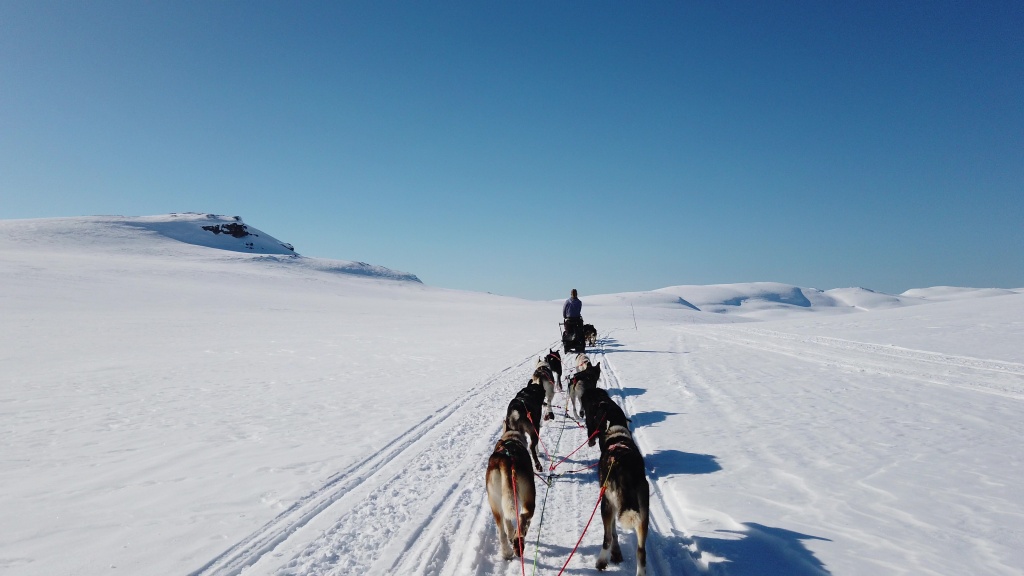
Partly we went 'cross country', but mostly we followed the established trails.
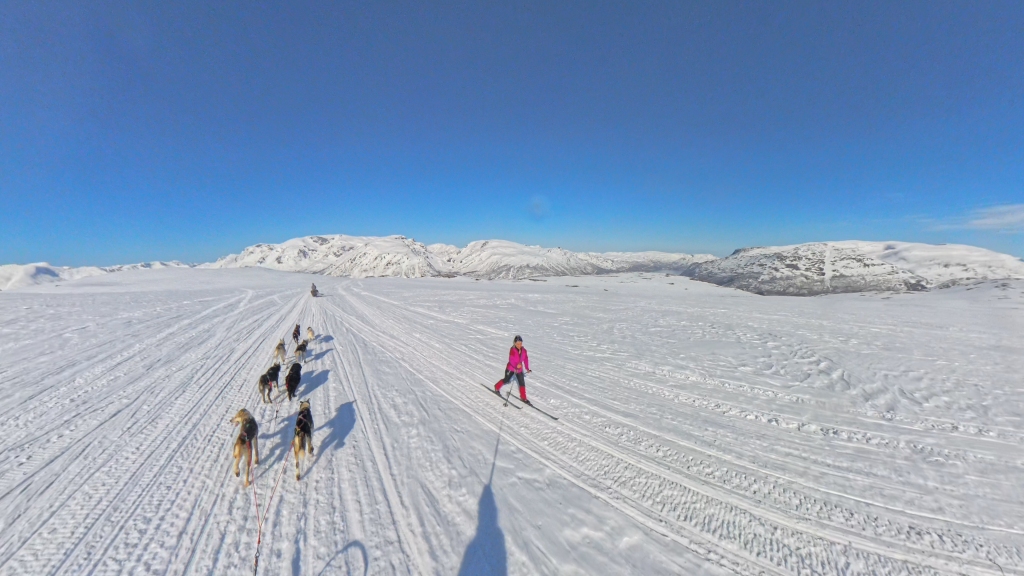
Which were getting busy.
As can be seen from the number of tracks, there's a fair amount of traffic on the main trails.
Especially as it was now a Saturday, so many locals were taking their skis, snowmobiles or dog sleds to enjoy the weekend in the mountains, going skiing or fishing. There's attitude to life called "Friluftsliv" in Norway (essentially it's the idea to "go and play outside", regardless of age).
So while the mountains weren't exactly crowded (Langfjordbotn isn't exactly a tourist destination, so it's mostly locals up there; and the nearby mountain area is roughly 20km x 30km, which means that even if the whole population is up there, it's still mostly empty space), there was more traffic along the main track and more groups gathered around fishing holes than on the previous days.
Then it was time for the unusual part of the sled tour and something I hadn't done before - the descent.
Of course, I have been dogsledding downhill before (otherwise I would still be on some mountain plateau somewhere) and this one wasn't that steep. But it was a long way. And if anything had gone wrong, there's a lot of things that can get worse while the dogs sprint down the mountain with an uncontrolled sled pursuing them.
So we played it safe. Not only did we unhook the backlines of the dogs (well, obviously except for the lead dogs), so that they were only connected to the tugline with their collars, which reduced their pulling power.
We also put chains around the runners of the sleds in order to increase friction. (These were massive chains. In fact, they were snow chains made for trucks.)
With all that preparation, the downhill drive itself was unspectacular.
I felt in control of it and everything went smoothly. (Although, most of it due to the fact that we had prepared the sled.)
I was still surprised how much pulling power the dogs had, even though they were only attached with necklines. Even with the chains, we were going with some decent speed, even after the path had gone level and the chains were still attached.
We stopped the sleds, packed the chains away, hooked up the dogs and drove back to the kennel.
The next day was a rest day.
A proper one for everyone, including the dogs, as we were at the kennel. (Having a day off somewhere out on the trail is presumably not quite as restful for the dogs as spending the night in their own dog houses.)
I decided to do some minor sightseeing.
There's a church about four kilometers away.
I didn't really want to visit the church, but it seemed like a good destination as any. And 'walk to Langfjord Church and back again' sounded like more of a plan than 'walk four kilometers, turn around and walk back'.
Not really expecting to be allowed to (but sometimes it doesn't hurt to ask), I asked whether I could take a dog with me to go 'walkies'.
Turned out that, with some precautions, I could.
I wore a skijoring harness and the dog was attached to that. The worry was that the dog might suddenly get excited about something, start running, taking me by surprise and pulling the leash out of my hands (and I had direct knowledge how strongly a sled dog can pull with the neckline). There wasn't any worry that the dog might get lost, but it wouldn't care about anything I would be yelling at it and head back to the kennel, running along the street and possibly getting hit by a car.
So, we went out firmly attached to each other.
I had expected to spend most of the walk trying not to be pulled over by the dog (which went by the unlikely name of "Frau Martin", but I don't know the story behind that). I had been walking shorter distances with active sled dogs in the past and that usually took some effort to stay in control.
But this dog walked with me as if it was doing a job interview.
Walking right by my side (though it took a few hundred meters until we established that I would be on the side of the road were the cars were passing by and the dog on the other side), looking up every few steps to ensure that everything was fine, touching my hand with its nose from time to time.
Basically, a dog stating "Look, I'm the perfect dog for you, always on your side, always paying attention.".
And no pulling on the leash at all.
A dog that really would like to get a job as someone's house dog.
And though dogs don't think like that, it's probably a good attitude to have. Because the 'not pulling' is also something the dog does when in front of a sled. Which is not the sign of a good sled dog.
It's a bit like an inverse of Zoe. While Zoe doesn't look like a sled dog, she's good at it and gives the impression that being a sled dog is what she wants to be. While "Frau Martin" looks like the stereotypical sled dog, but gives the impression that being a sled dog is not at all what she wants to be.
So Ben is looking for someone to give her a good home.
That's not going to be me. But whoever it is will be happy with the dog.
Without any pulling or other problems we reached the church.
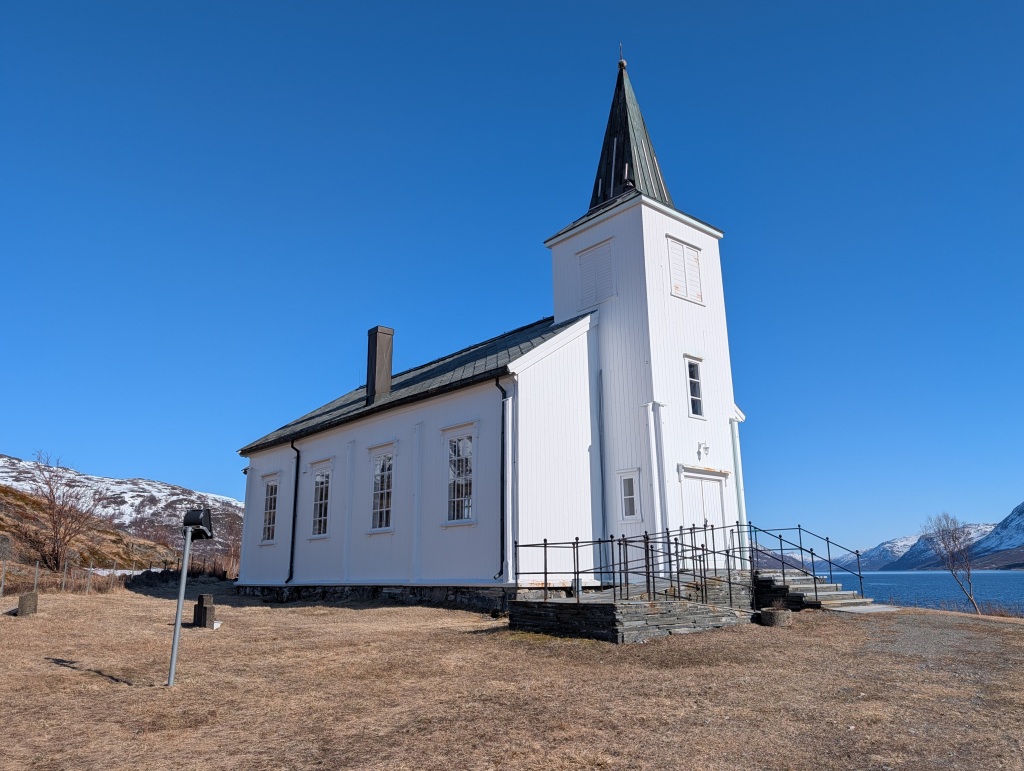
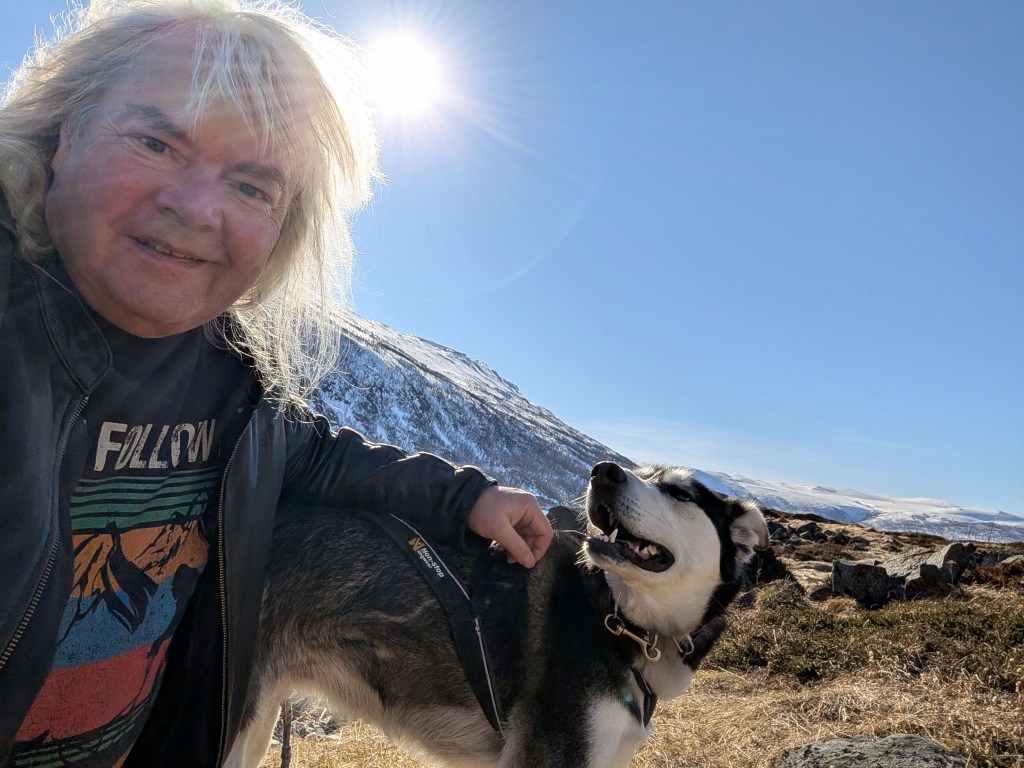
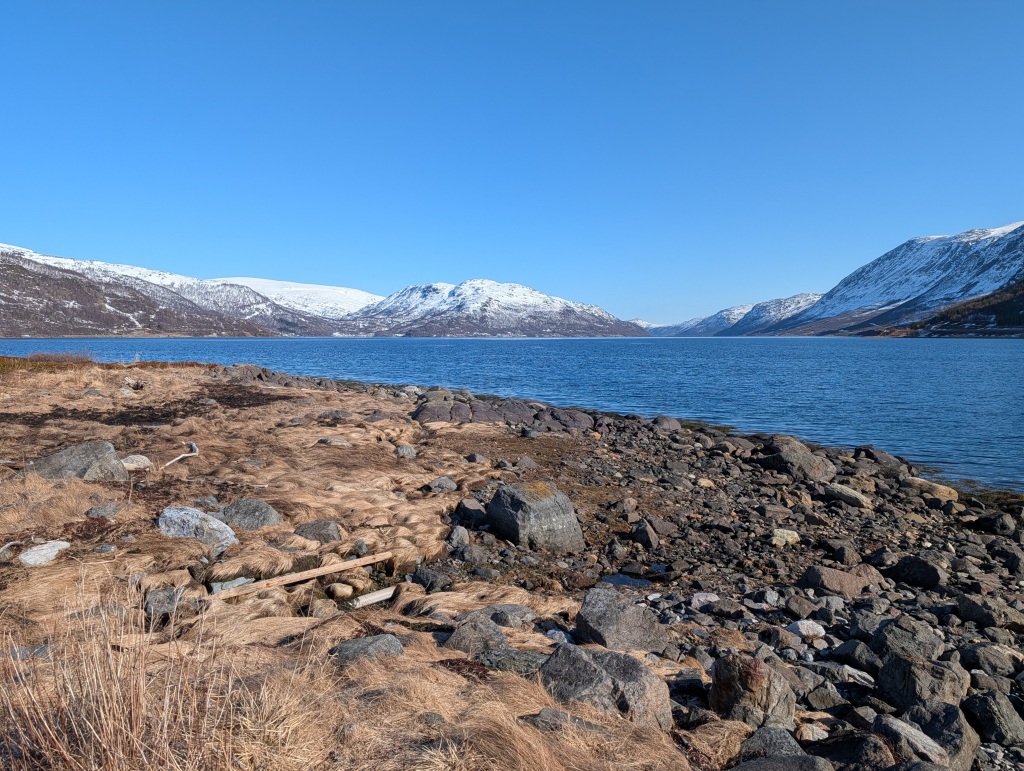
A short rest by the side of the fjord, enjoying the view and the sunshine, and we walked back again.
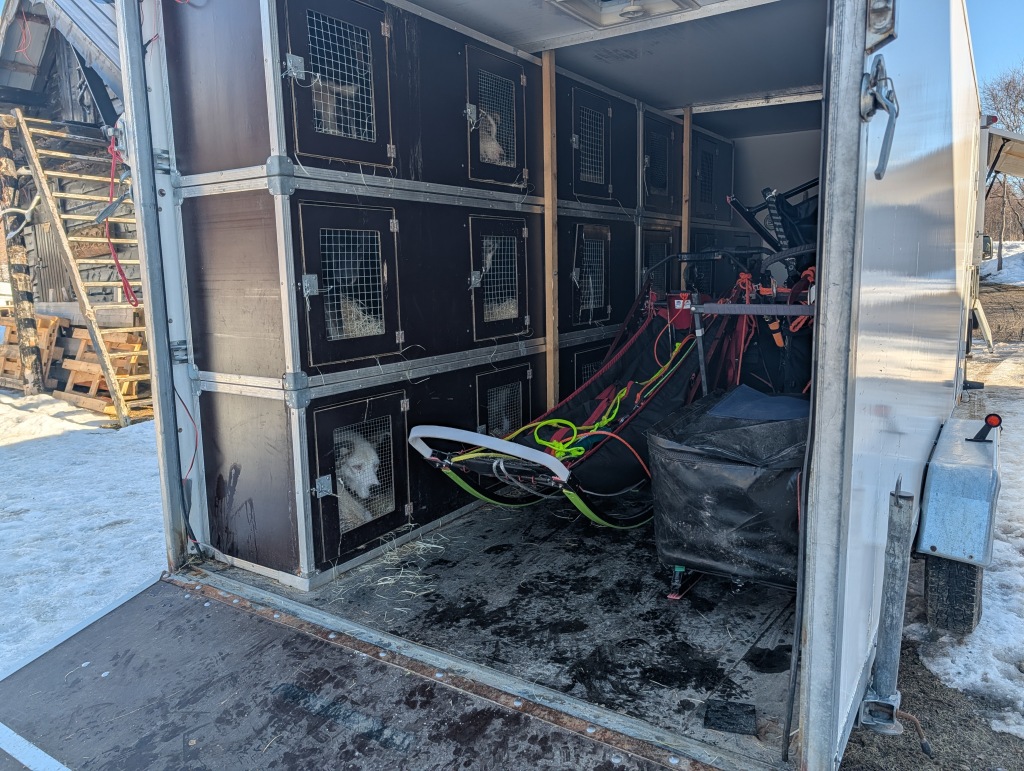
Next day we loaded the dogs and sleds into the van and the trailer. We drove for about 90 minutes to a parking spot on the other side of Alta, near a lake called Stuorajávri.
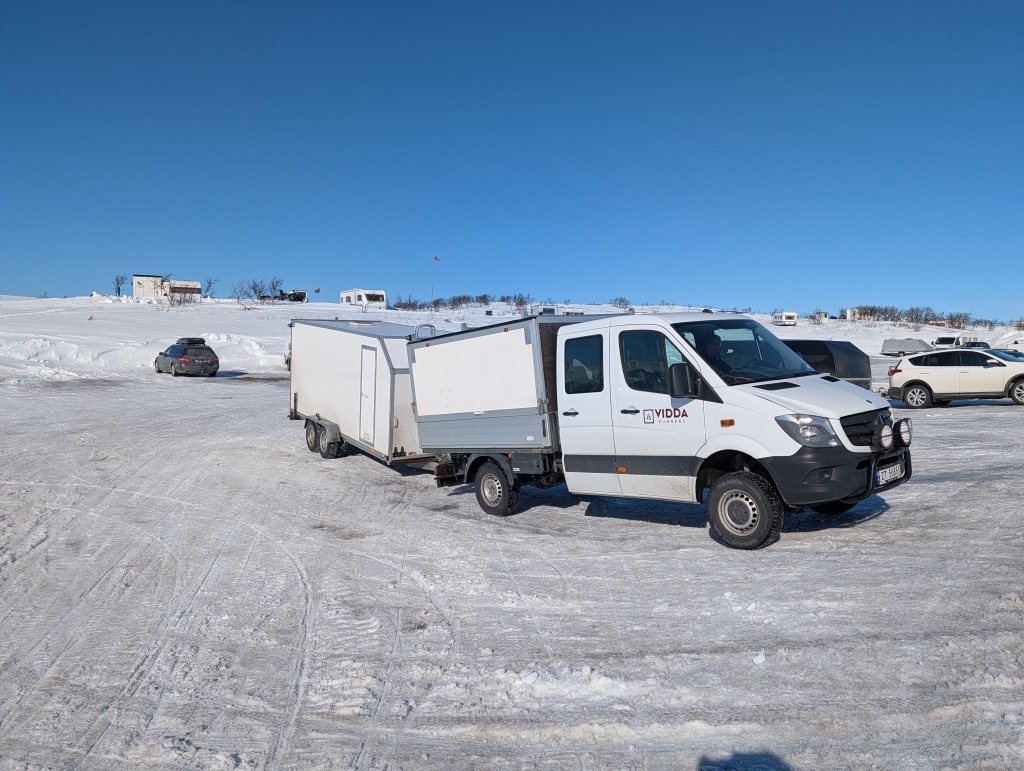
From there, we had planned to go to a cabin called Mollisjok Lodge, where we had stayed the previous year, and then head on to Beaivvašgieddi. We tried to go to the place last year, but changed plans due to weather conditions.
Beaivvašgieddi is a long way from anywhere (and that's in an area where almost everything is a long way from anywhere else) and the location of a church building. It was built more than a hundred years ago with the specific goal of not being close to anything. The idea was to have a church for reindeer herders at a location that wouldn't favour anyone, so nobody could complain too much about having a harder time to get to church than anyone else.
Today the church is rarely used (it seems like it there's a church service once per year at Eastern, but otherwise it's empty).
As we didn't manage to get there last year (and it's a good destination as any), it felt a bit like "unfinished business". And the weather forecast looked fine this time, so why not go there?
It's also about a day's sledding from Mollisjok Lodge, so the timing worked out nicely.
We had five days available, and it was one day to Mollisjok Lodge, one day to Beaivvašgieddi church. Another two days back. Which would give us one extra day to either do a daytrip from one of those places (leaving the gear behind and running with light sleds, as we would be back in the evening). Or do a detour on the way back. (There's a place called Jergul Astu about 30-50 km (depending on the trail taken) that we could go to and then head to Mollisjok Lodge from there the next day.)
The start from the parking lot at Jotka North was more interesting than we had expected it to be, but went well.
As the dogs were well rested, we didn't fully trust the snow anchors, so we attached the sleds to something else as well.
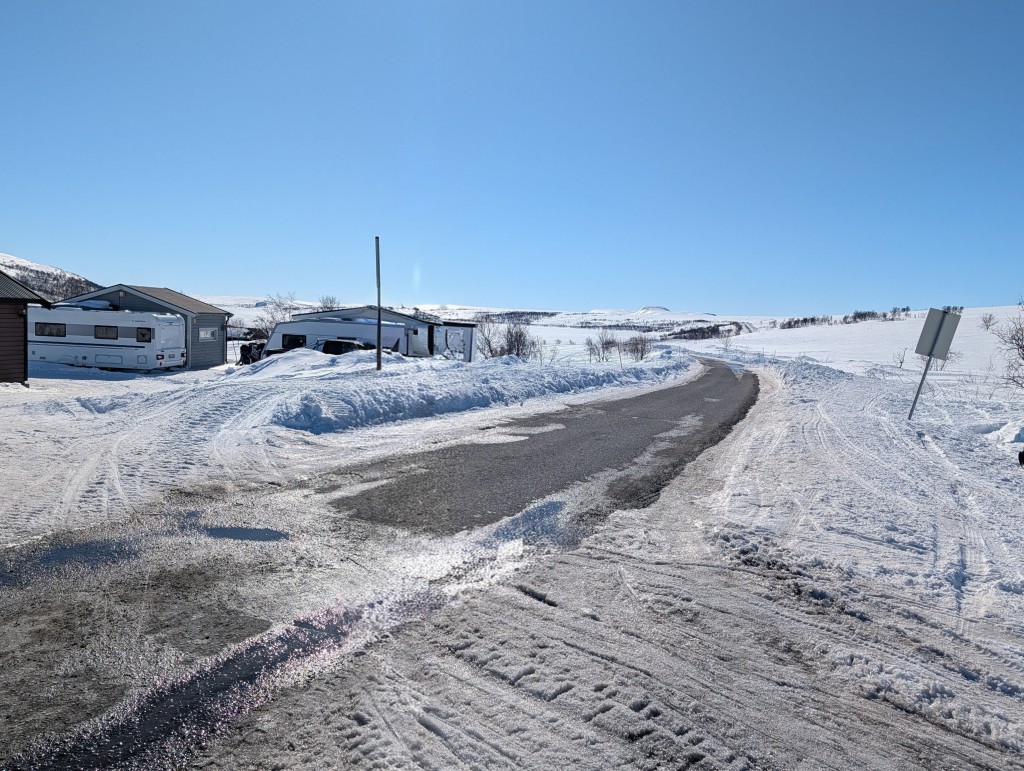
We needed to go along the trail on the left side of the road, which, behind the houses and trailers, went down to the lake.
To decrease potential problems, my team started on the left side of the road. Already standing on the proper trail, so I wouldn't need to cross the road. My sled was attached to the pole visible near the center of the image.
Ben would start on the right side of the road, his sled attached to the sign visible there. There was a second 'snowmobile crossing' about 30 meters ahead (slightly visible by the snow 'smeared' on the road near the corner.
And Nina's sled was attached to the van in the parking lot, her lead dogs standing roughly where the picture was taken.
The plan was that Ben would start, follow the road (ideally on the snowy bit on the right side as long as possible) and them turn onto the proper track at the snowmobile crossing ahead. Then I would unhook my sled and follow straight ahead. And Nina would cross the road right here and then follow my team.
Which probably would have worked.
But there was a car coming down the road from behind us. And, instead of passing by, stopped right next to us.
I assume that they had seen Ben's and my team and didn't want to interfere with our start (or maybe they just wanted to watch those proceedings).
The effect, however, was that Ben started and got on the trail where he had planned to.
And there now was a car between me and Nina. I tried to wave at them to indicate that they should move, but they didn't react. And Ben shouted at me that I should go. So I got going with my team (also as planned).
But Nina couldn't follow me directly, as the car was in the way.
A moment later the car started to move. But instead of crossing the street, her teams decided to follow the car.
Instead of on the trail, Nina was now dogsledding down the road.
At some point she managed to get her dogs to turn left and off the road and onto the trail. But that wasn't at any of the places where the snow had been flattened, but right across the snow heaps on the side of the road.
Ultimately no problems and we ended up on the proper trail in the right order. But also, not exactly the smooth start that we had planned.
From there on, for the rest of the day, it was easy driving.
We followed the lake for about eight kilometers, followed by some mostly flat terrain and then entered the largest lake of the Finnmark, the Iešjávri, then continued mostly on other lakes and rivers after that.
As there was a lot of space available on the lake and the trails were wide, we also enjoyed some more relaxed driving, with us changing positions a couple of times (Nina heading to the front and Ben falling behind to the back and vice versa), allowing for some overtaking along the trail, which is always interesting.
For a while, we three even drove side by side. Which is unusual. But fun. And looks and feels great.
So, all in all, an easy day of relaxing dogsledding in fine weather over mostly flat ground.
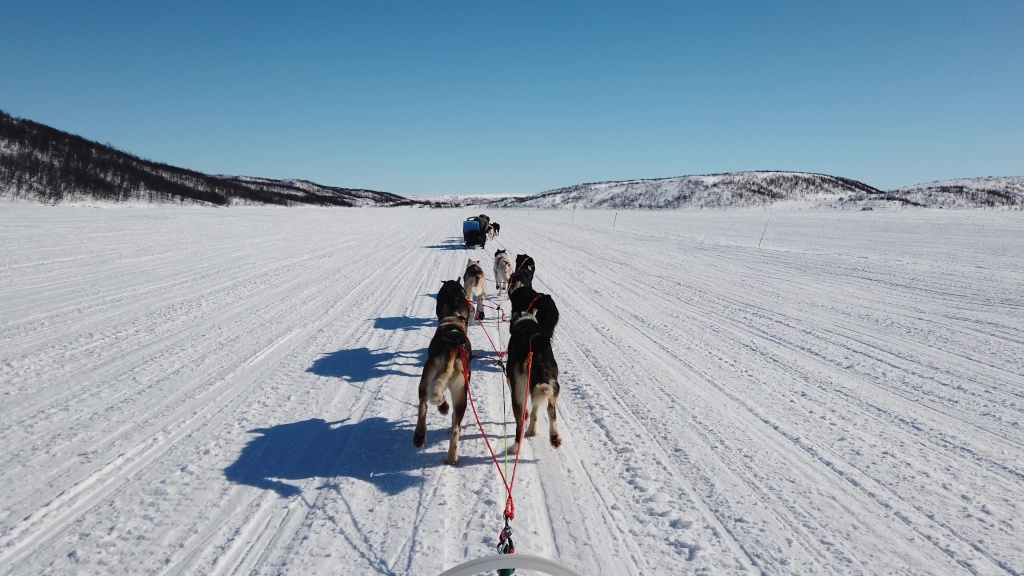
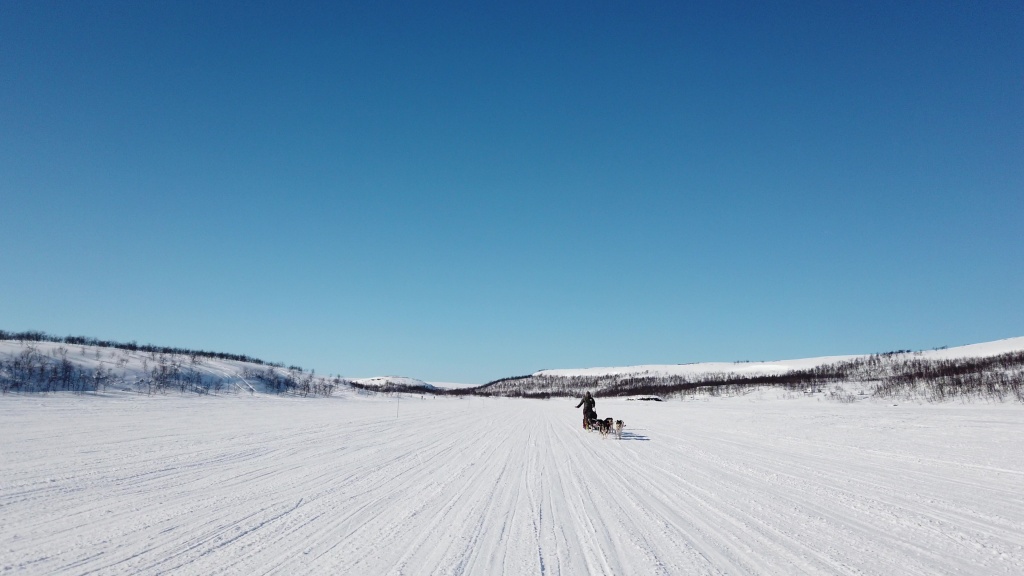
We 'only' went for a comparatively short run of about 40 km. That's 'short' in relation to the terrain. We had shorter tours up and down the mountains, but that was, well, up and down the mountains. On the plains, we could have continued a long time. But we had started out sledding about an hour later than usual (due to packing the van and driving the dogs to the starting point). And Mollisjok was the best place to stop, as there isn't anything else around. (Since Mollisjok is the most remote cabin in Norway - farther away from the next road than any other place.)
Mollisjok is a popular stop along the trail. Especially for long distance skiers. It's roughly 35 km from the catered cabin at Jotka. And then it's about 25-35 km to cabins at Šuoššjávri, Ravnastua or Jergul Astu.
On skis, that means you can start out near Alta and go to Jotka in a day (or drive to the parking place we have been using), and from there have a long day skiing (on mostly flat ground) to Mollisjok and continue to one of the other cabins on the next day. As skipping Mollisjok would make it a very long day for skiers (although I'm sure that there are cross-country skiers in Norway that consider a 70 km trip an easy run), almost all skiers spend the night there. Sometimes there are snowmobilers as well, but for them it seems to be mainly a lunch stop.
After some nice dinner and restful sleep, we headed out towards the church at Beaivvašgieddi the next morning.
The first 20 km or so were uneventful and mainly along lakes and rivers.
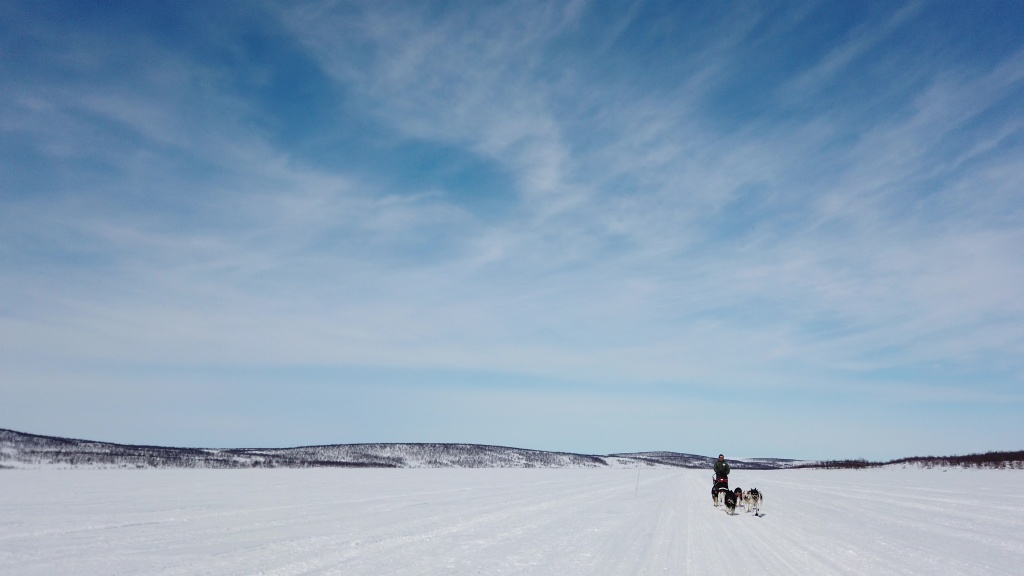
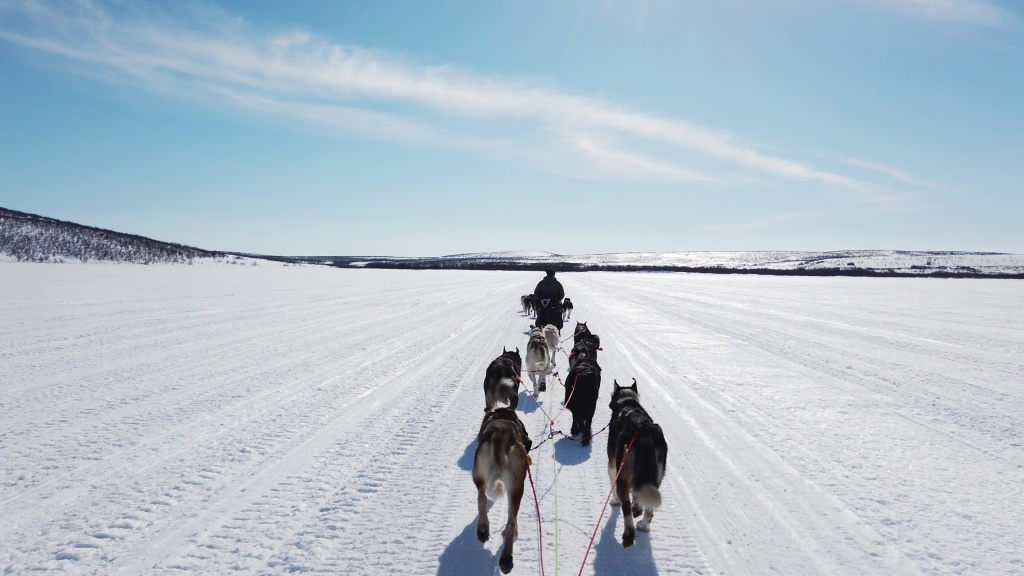
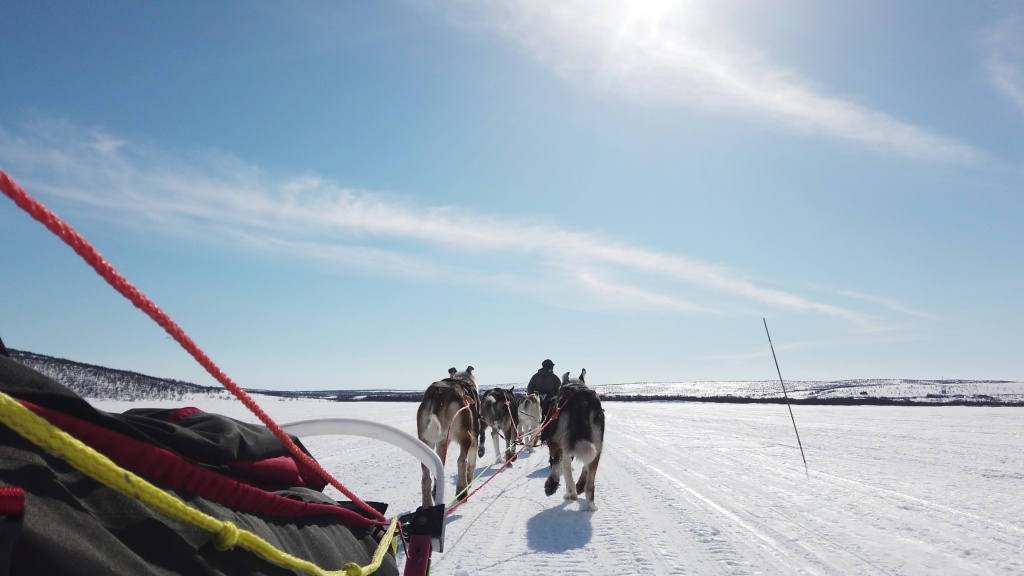
There was a road crossing at Šuoššjávri. The road can be busy, as it's the main east-west connection in the area (the next east-west roads are about 100 km to the north and 150 km to the south). For example, it was the road we had taken when we drove from Ivalo to Langfjordbotn less than a week earlier. But as it mostly connects sparsely populated areas on both sides, 'busy' mostly means a car every couple of minutes.
And the snowmobile crossing (which we used for crossing with the dog sleds) is at a good location with unobstructed views to both sides. So crossing the road turned out to be easier than expected.
While not going so much along rivers and lakes, the trail south of the road was still mostly flat, so we made good progress for the next 15 km and were less than an hour's drive from Beaivvašgieddi church.
At that point we reached the foot of a small hill, upon which something like a camper trailer stood, only on skis instead of wheels and pulled by a snowmobile instead of a car.
It belonged to a reindeer herder, who informed us that a herd of reindeer was right on the other side of the hill.
As it is not a good idea to try to go with more than two dozen dogs through a herd of reindeer, we were asked not to continue. They drove for us a nice turning loop with the snowmobile, so that the dogs had something to follow and didn't need to make the trails themselves. And we went back to from where we came. (As there wasn't an easy alternative route around the reindeer herd.)
So, for the second year in a row, we didn't get to see Beaivvašgieddi church.
Now Ben presented two options.
By the time we would be back at the road, we would have covered a distance of about 50 km, which would be a good daily distance. We could go on for a few more kilometers and then find a good camping spot and spend the night there in a tent.
Or we could make it a long day trip and turn right after crossing the road and head to Jergul Astu, another 25 km away. Where we could stay in a cabin.
I couldn't see any fault with the second plan, so it was an easy choice to make.
I like dogsledding a lot (there's a reason why this was the 18th consecutive year where my primary vacation was a dogsledding trip) and any option that includes "two more hours of dogsledding" is a winner by default. And while I don't dislike staying in tents, being given the choice of staying in a tent or in a cabin, is an easy choice as well. (Especially combined with an indoor toilet and a warm shower...)
If the choice had been to stay at the cabin at Šuoššjávri or go another two hours and then camp, I might have had to think a few seconds longer (but I assume the 'more time dogsledding' option would have still won).
The section from the road crossing to Jergul Astu turned out trickier than I had suspected.
Everything went (surprisingly) well, but I struggled more on that section than anywhere else on the tour (excluding two or three messy starts).
The snowmobile track follows a river named Karasjohka.
We did go along the same stretch of river the previous year (although in the opposite direction).
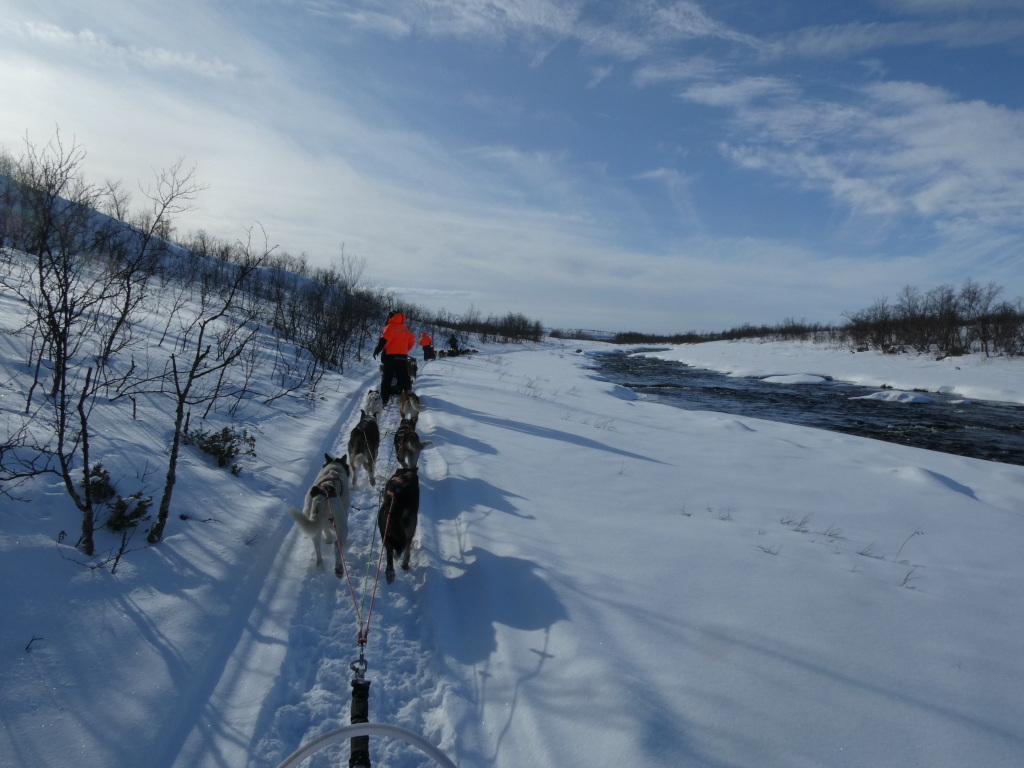
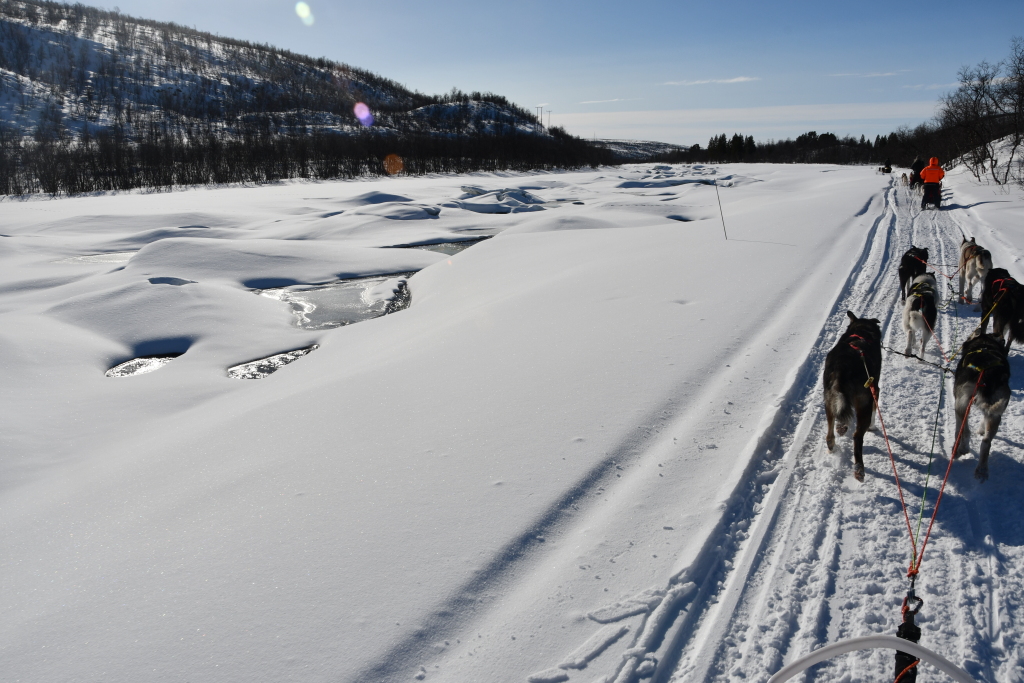
Karasjohka River in 2025:
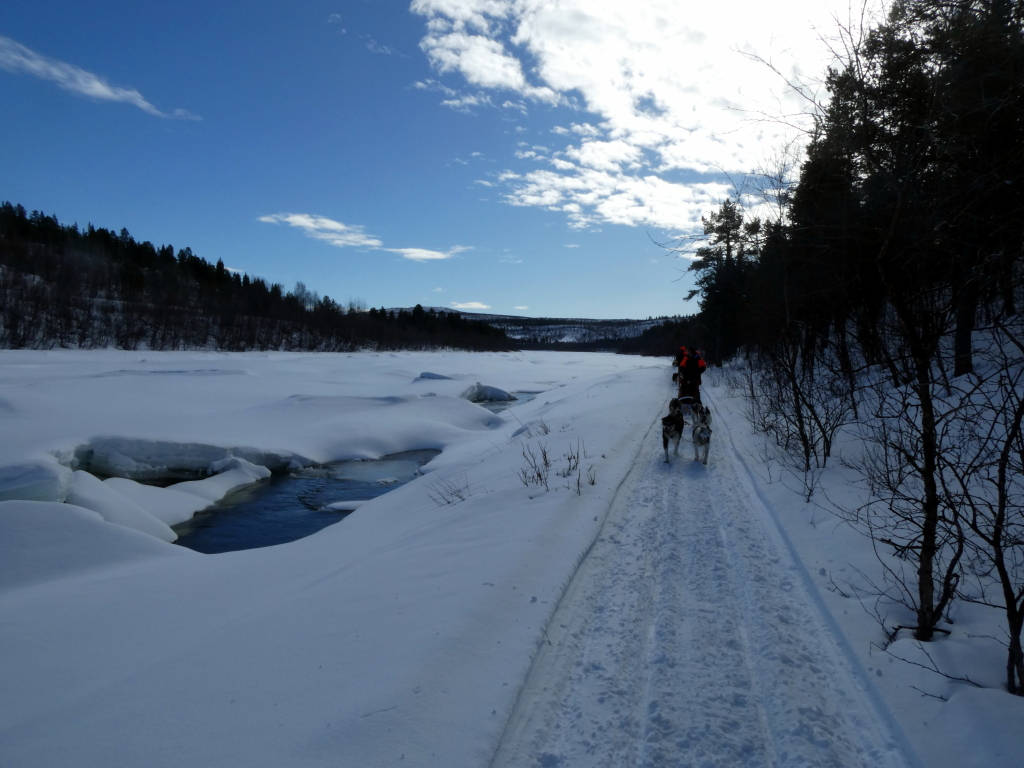
Karasjohka River in 2026:
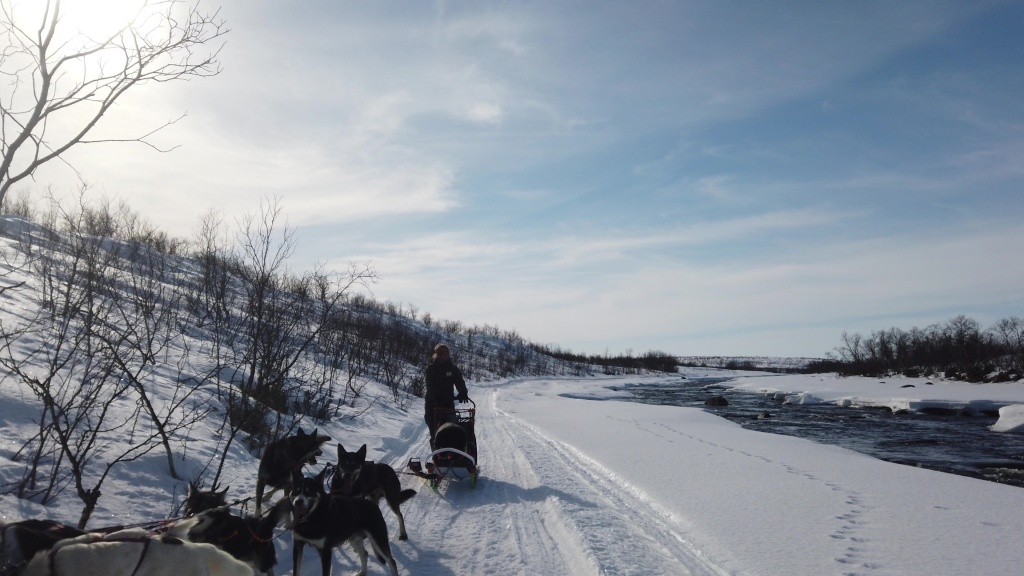
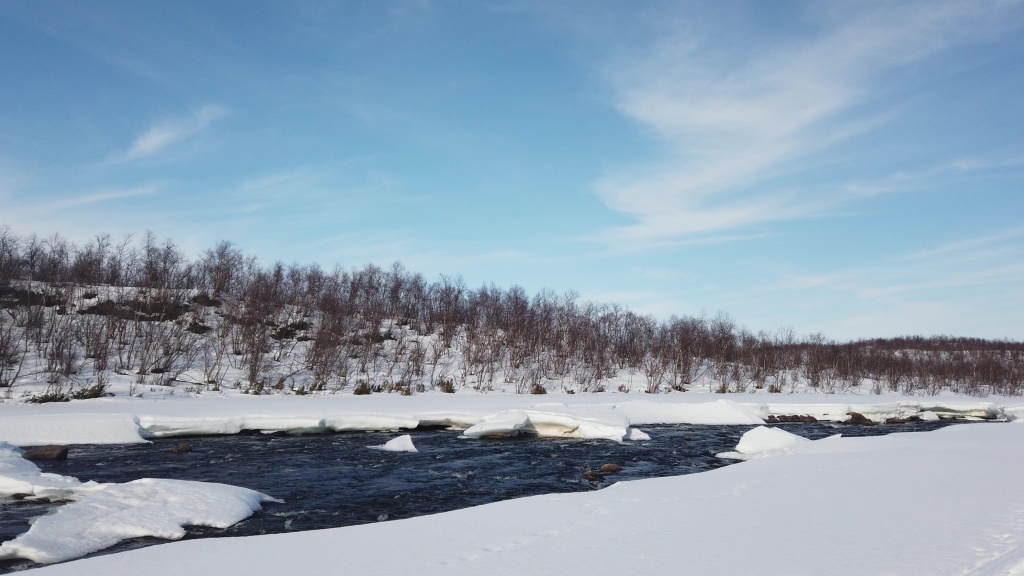
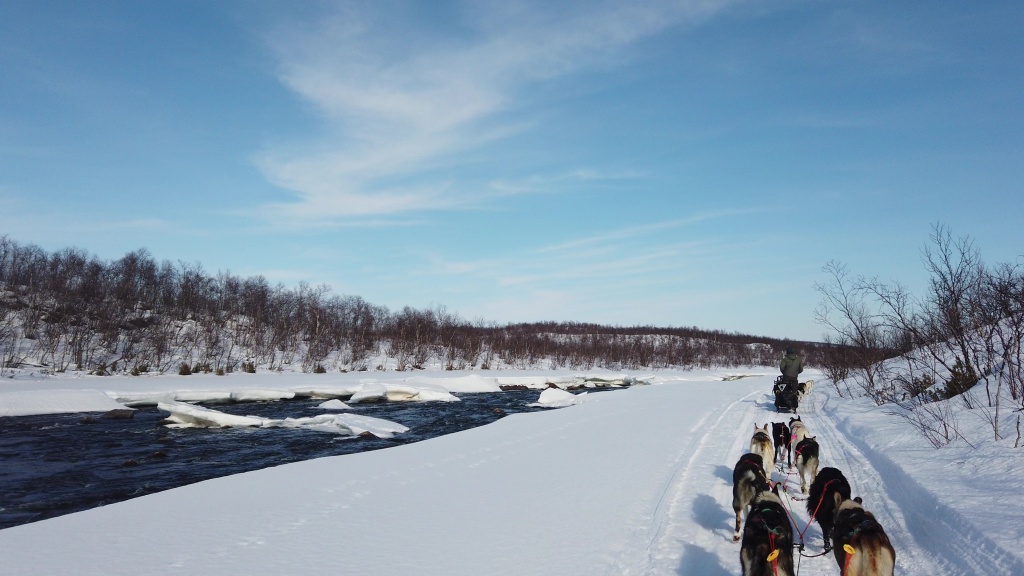
Conditions were essentially identical. Sunny day, parts of the river already open and the trail partly running along the river banks.
At some point we needed to get a bit higher up the river bank while the trail curved to the left. And while the dogs followed the trail, the sled was slightly to the left of it and started to slide to the side and down the slope.
Which is a situation I encountered once before, way back in 2016.
Back then, the sled skid down the bank until it was almost at a right angle to the dog team. And while the dog team stopped at that point, I fell from the sled, down the bank and into the open water below.
Nothing bad happened. Below was only a pond with some open water. No raging river or a deep fjord. I rolled out of the pond, ran up to my sled and we got it back on the track and secured.
But I was soaking wet. I got into a dry sweatshirt, but didn't bother with changing trousers, shoes or jacket (I didn't have any other suitable shoes with me anyway) and drove the rest of the day in somewhat damp gear. It wasn't as bad as it sounds. It was reasonably warm (above freezing) and the outer layers were still isolating, so I was spending the rest of the day in lukewarm water. Not as good as being dry, but no risk of hypothermia either.
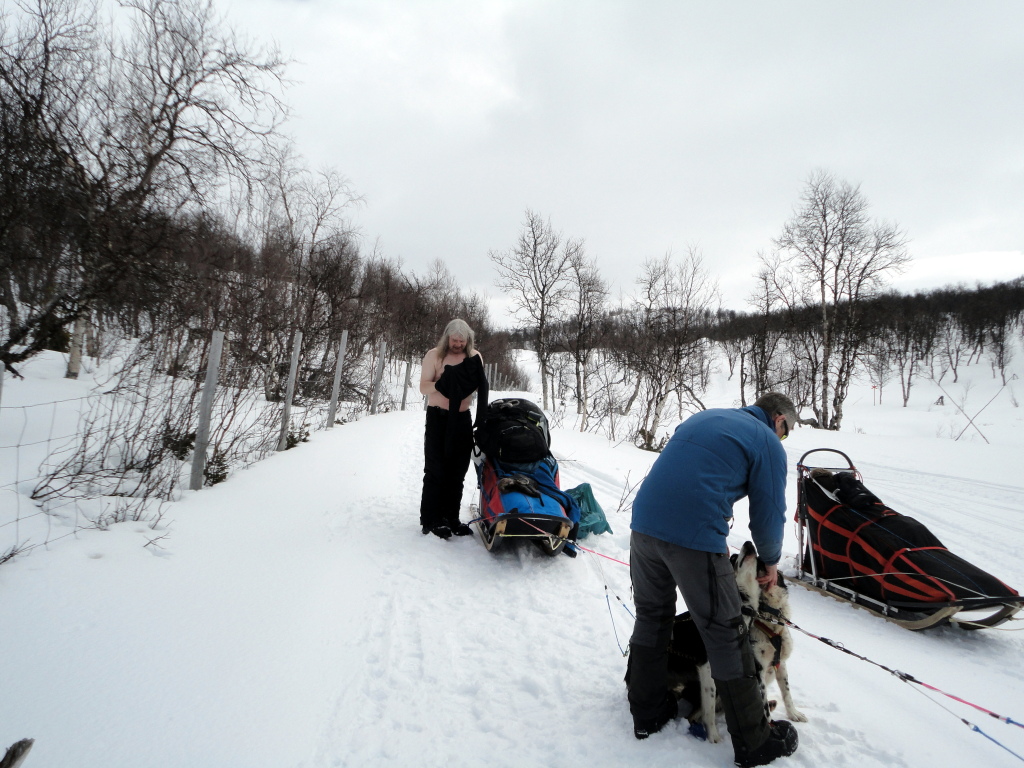
While that ended up as little more than a somewhat embarrassing story from a decade ago, I knew the situation and didn't want to do it again.
Luckily, it seems like I have learned at least something in the last ten years and managed to get the sled back on track this time. (Not sure how - most of it was more reacting than thinking. But it worked.)
Another tricky bit was about a kilometer further on.
It made clear that the trails are not designed with dogsledding in mind, but are made primarily for snowmobiles.
The situation was (partly) the opposite of the one before.
We were on a section where the trail was a bit higher, on the top of the river bank, and going down to the side of the river itself.
But instead of going down onto a straight bit of trail, there was a huge pile of snow the trail curved around at the bottom. (Presumably not only snow, but a rock or pile of rubble covered in snow).
And on the river side of the bank, next to the trail were the remains of some cut off shrubbery.
Easy to do with a snow mobile, as you got direct control over speed and steering.
Nasty on a dog sled, as the dogs will run down the river bank, but you can't let your sled follow normally, because it would get stuck in the shrubbery. You need a bit of excess speed to get past that bit. Then you hit the brakes slightly, so the towline tightens up again, the sled swivels and you follow your dogs down to the river. You can't keep the line tight too long, because then you would not make the corner at the bottom, but the dogs would pull you over the pile of snow, which would cause the sled to tilt sideways or even topple over. Hence you let the sled slide without braking towards the river and only hit the brakes again once you're past the pile of snow, so the sled turns around and follows the dogs once it has passed the pile of snow and is running on the trail again.
Obviously, all of this is possible and can be done by any competent dog sledder (and obviously neither Ben nor Nina considered it any sort of obstacle), and even I managed to do it (though more by luck than by skill). But as far as difficulties go, this was the second hardest piece of driving I did this year (the hardest one was on the next day, at the same point, going the opposite direction).
I don't want to over-dramatize the situation (and everything went without any problems), but as most of the rest of the trip was easy going over wider, flat trails (mostly in bright sunshine, warm weather and great trail conditions), it is difficult to write much more about that than "we had another nice day of dogsledding". So, anything that's different from that warrants a more detailed description. If only in order to write something.
Jergul Astu is a comparatively large site as it is close to the main road, so it's used as a starting point by many snowmobilers.
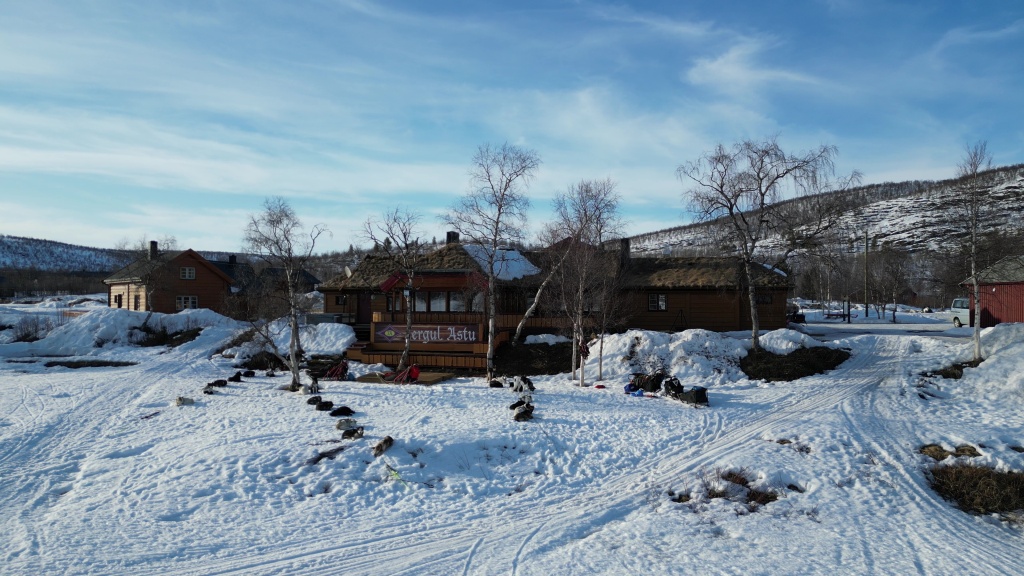
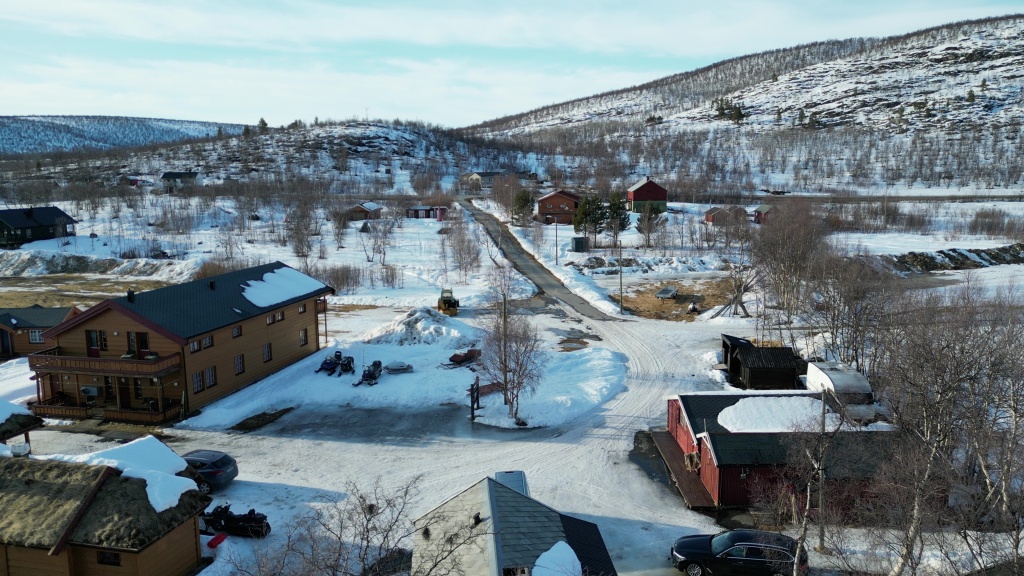
It is also one of the checkpoints (and possible resting place) for the Finnmarksløpet dog sledding race, which had happened about a week or two earlier. The places where the dog teams had been resting were still visible on the river.
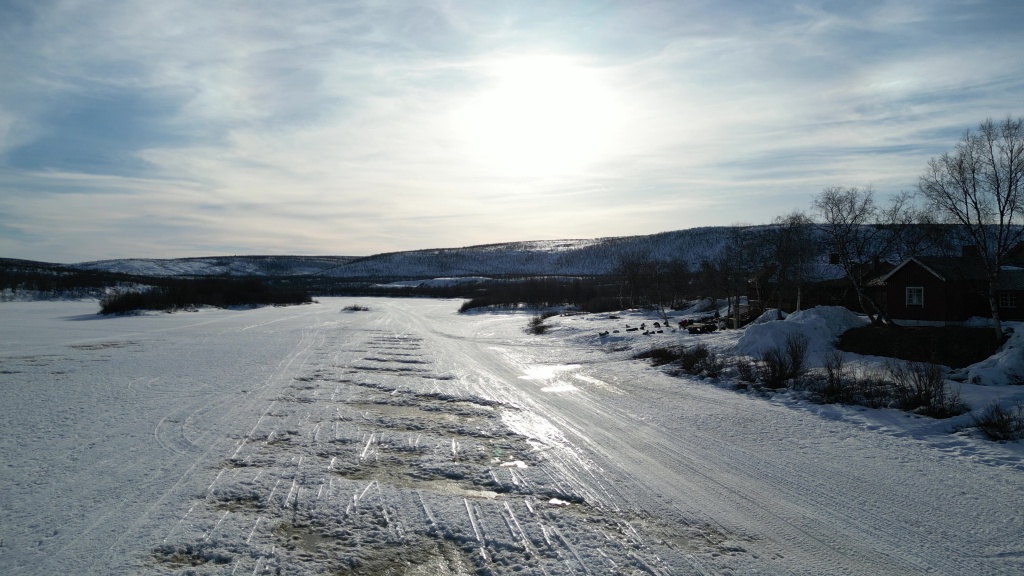
We (and presumably the dogs) had a relaxed night there, after the longest day of dogsledding during this trip at more than 70 km.
Next morning, we turned around and headed back to Mollisjok. Jergul Astu isn't that a good starting point for a day trip and returning in the evening. So we went to Mollisjok to do a round trip from there on the following day, before returning to van, trailer and parking lot on the day after that.
The start was slightly chaotic.
As we had arrived in the order Ben, I and Nina, the dogs were 'parked' in that order.
Since we wanted to go back the way we came, it seemed sensible to reverse the running order and let Nina go first.
Which made sense to us, but not necessarily to the dogs.
When Nina got her team ready to go, the dogs tried to go, instead of down to the trail, in the directions of Ben's dogs. (Obviously assuming that those would continue further along the trail and they were supposed to follow.)
Which made their lead dogs (and tugline) move into my team.
So Nina had to keep her sled secured, go down to her lead dogs, untangle the mess, point her dogs towards the right direction of the trail and then run back to her sled and get it going before her dogs turned around again. (While the dogs on my and Ben's teams got noisy and excited, as they were keen to get running again.)
It all worked out well in the end, with Nina in lead, me in the middle and Ben following.
But as there were a few people staying at Jergul Astu, we had a bit of an audience on that start. And it seems like they had a good laugh about the 'incompetent dog sledding people' that morning (and, so rumour has it, put a video of it on social media).
The rest of the day went well.
I was a bit nervous when we got to the bit of the trail where we had to go from the river up the bank after going around the snow pile on the side. And it was as tense as I had feared, as the dogs did take a bit of a shortcut and didn't run around the pile, but partly over it, so my sled went up the bank already tilted to the side. Which increased the chance that I would either fall off or slide with the sled to the side and get caught in the shrubbery bits on the side of the trail.
But, again, luck was on my side and I managed to keep the sled upright and onto the trail before it reached the shrubbery. All in all, no issues. Although I assume for the next five minutes I was running mostly on adrenaline.
The rest of the day was easy, though.
Eight dogs in front of the sled, good scenery, good weather, good snow conditions, good trails. (It is getting repetitive when everything goes well...)
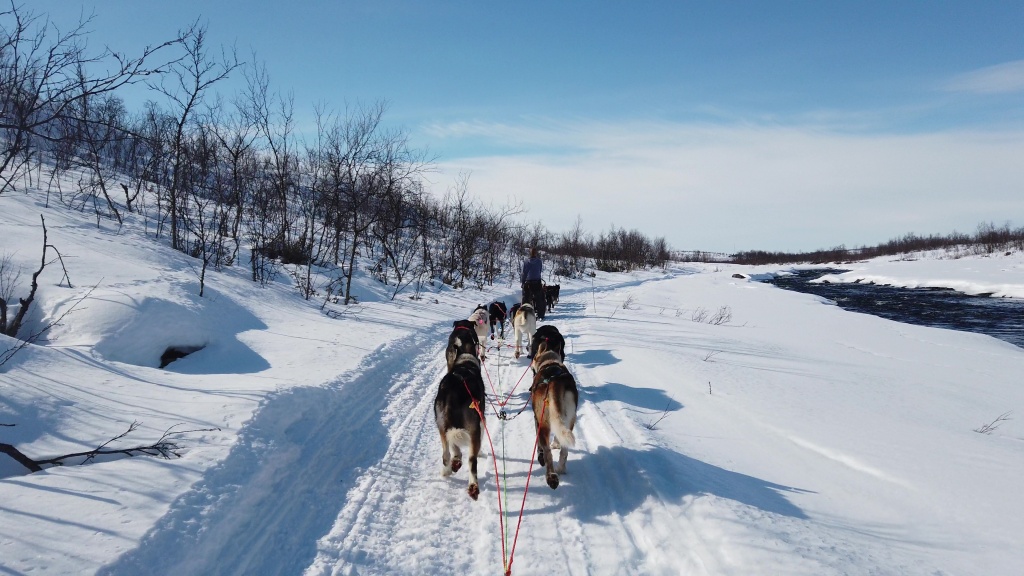
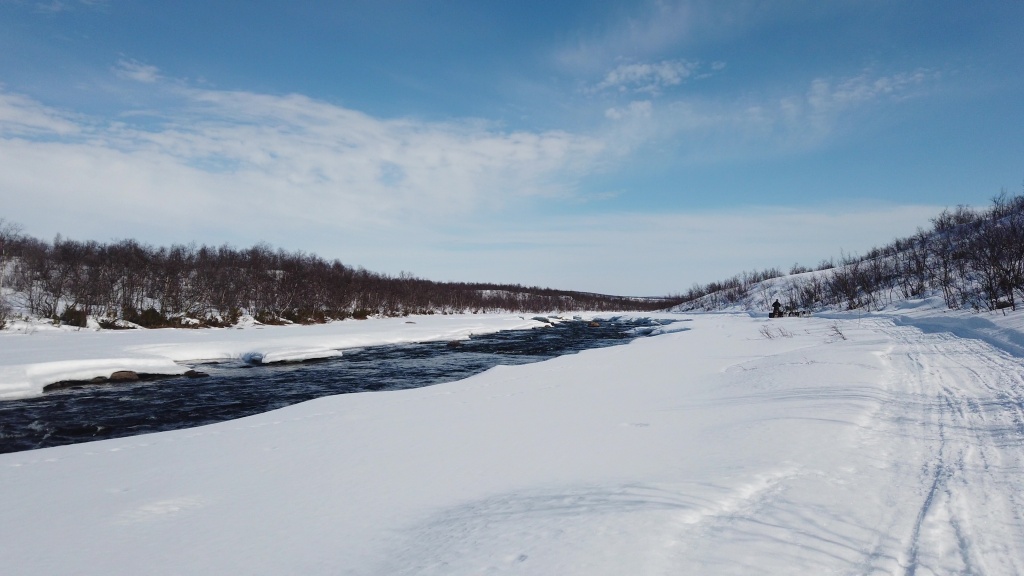
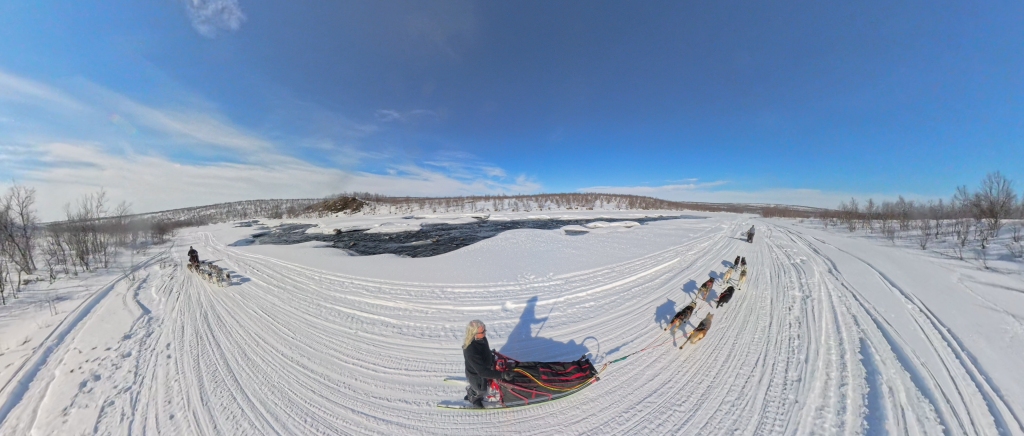
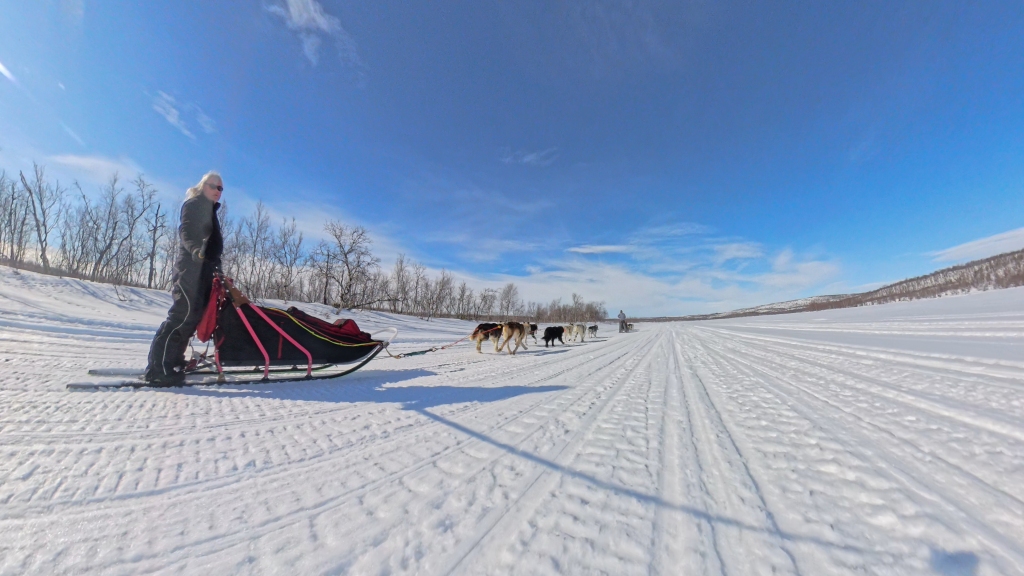
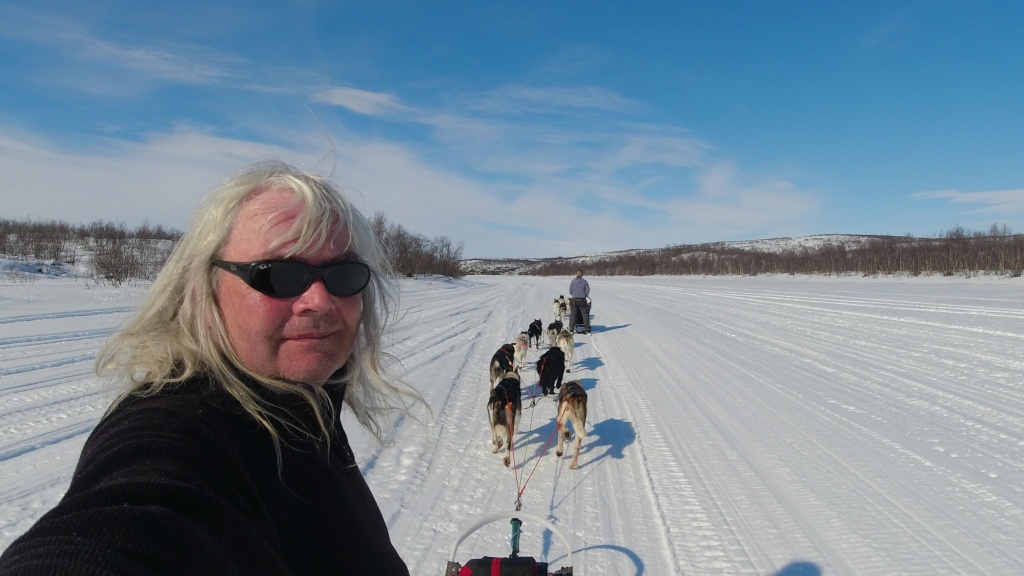
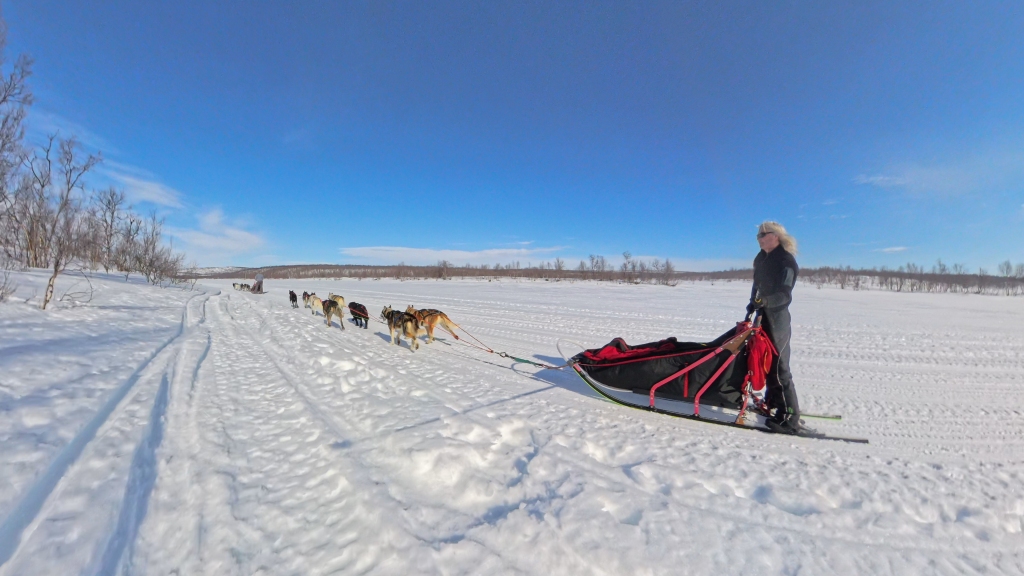
As it isn't that far from Jergul Astu to Mollisjok Lodge (we had covered the same trail the previous day, but had gone the additional 30 km towards Beaivvašgieddi Church and back), we arrived at Mollisjok in the early afternoon and sat down at an outside table for a coffee break.
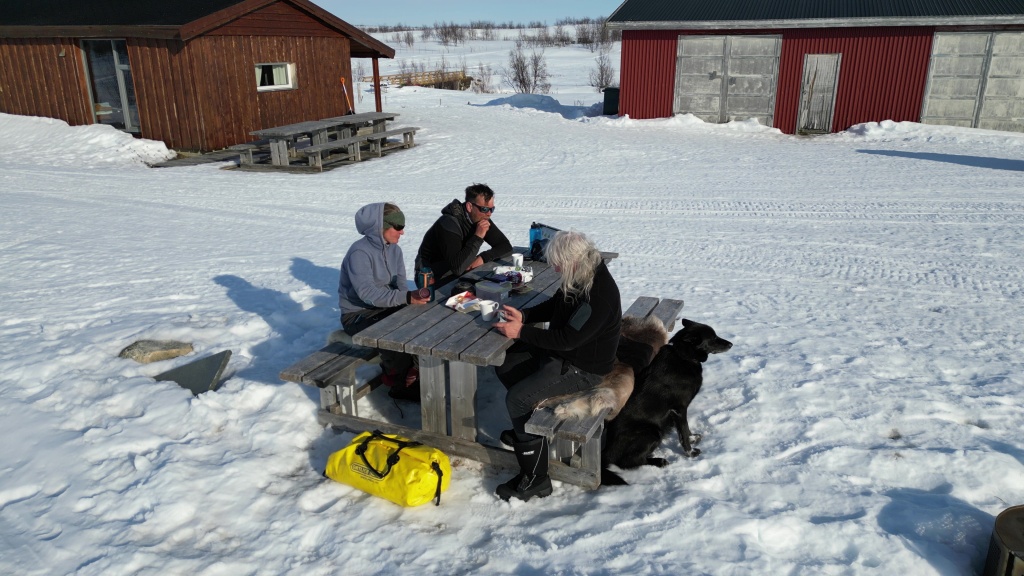
The dog that is sitting with us isn't one of Ben's dogs.
It's the dog that lives at Mollisjok lodge.
And makes sure that everyone is aware of that the fact that he belongs there and can do what he pleases.
If someone sits outside, he joins in as if he has every right to do so (which, presumably, he actually has, so it's alright).
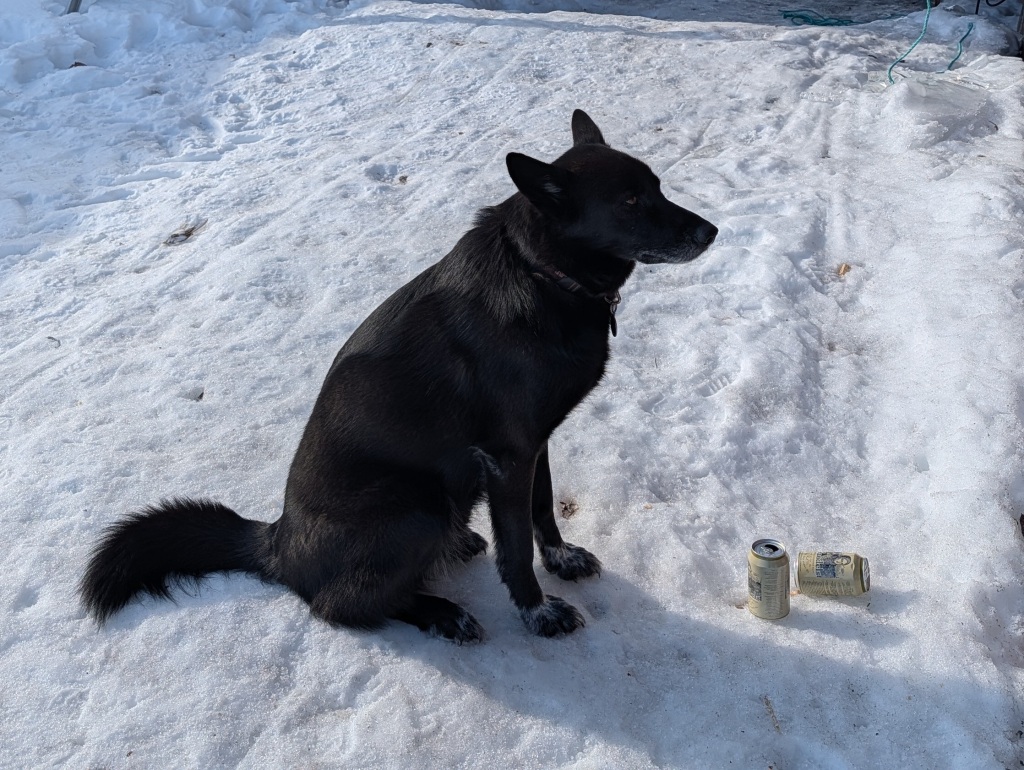
But after he has a couple of beers too many, he tends to go down to the sled dogs parked opposite of the lodge on the other side of the river and shows them what he thinks of them.
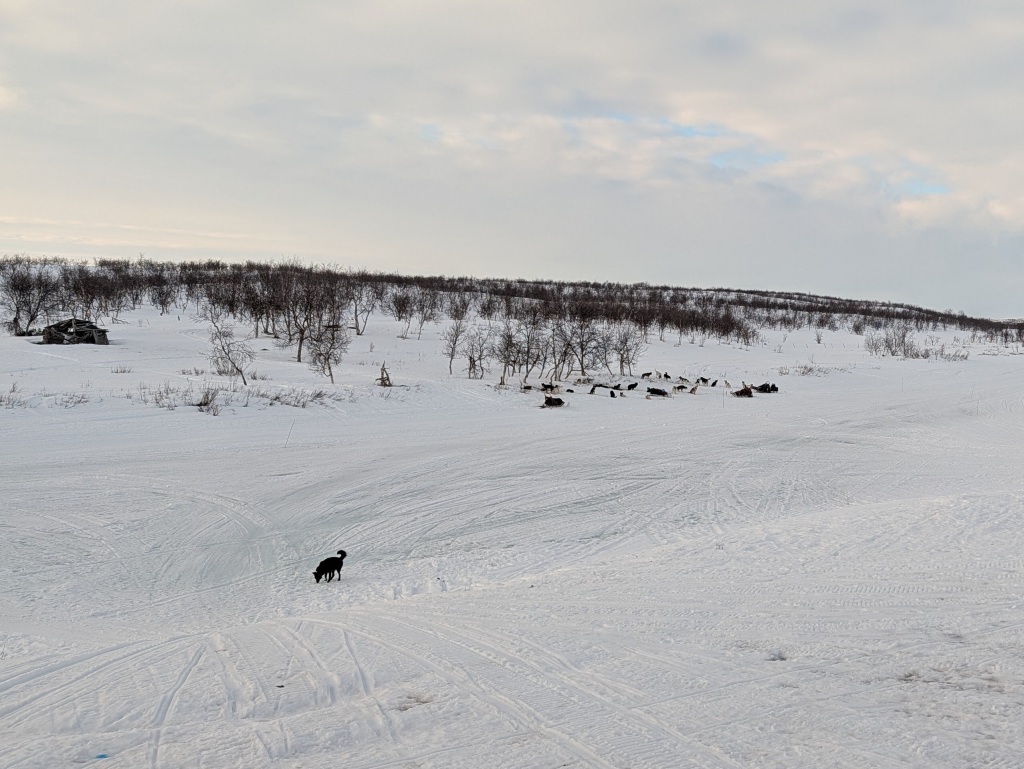
Which isn't particularly nice. Especially not walking over to them, keeping out of reach of the leashed dogs and dropping a pile right in front of them.
As far as dogs go, it's normal behaviour. He is the local dog, he can roam freely, it's his territory. So it's natural to mark it and ensure that the other dogs are well aware who's the top dog around here.
After another restful night (this time Ben and Nina were in one of the rooms in the main cabin as well, while they had stayed in a separate cabin two nights earlier), Ben and I went on a daytrip towards Ravnastua.
The teams were a bit mixed-up this time, as Nina stayed at the lodge. One of her dogs had gotten hurt on the previous day. It wasn't clear where or when (the assumption was that it was either at the start or that nasty bit of shrubbery next to the path around the snow pile and up the river bank, but it was impossible to say in retrospect).
Nothing critical, but the dog could do with a day of rest. The same applied to Bart, due to the chafing on his leg.
With two dogs that would do well with a day off, Ben and Nina decided on six other dogs that would benefit most from a day of rest.
As a result, Ben's and my team were reshuffled. I now had Svarten and Møller as my wheel dogs and also Storm as part of the team, with Chaser and Bart staying behind and Burrito running on Ben's team.
I alreadt knew Møller, as he had been one of my wheel dogs the previous year, but Storm and Svarten were new to me. (Storm had been on Ben's team that year, Svarten on Nina's.)
As Svarten and Møller were in wheel, Homer and Milhouse got the lead position in my team.
There was some more shifting of dogs during that day.
At some point Pie seemed to run a bit oddly and I wasn't sure whether she was limping, so Ben switched her for Bacon (who looks like his brother Burrito - at first, I had thought Ben had put Burrito back in my team) in order to be able to keep an eye on her. Fortunately, I had been overly cautious and everything was all right with Pie.
That was also the day when Milhouse turned nasty in lead and tried to lunge at someone's family dog standing beside the trail (nothing happened, but the situation shouldn't have happened in the first place), so Ben put Milhouse in his team for the rest of the day and Pie back into mine.
So it was a lot switching dogs back and forth on that day. Slightly unusual as we had essentially run the same teams in the same formation for almost all the rest of the trip.
Again, besides that, there's little to say about the day.
The weather wasn't as good as on the days before.
Mostly overcast and at some point a bit of sleet coming down.
Nothing extreme, but not the 'postcard scenery' we had on the rest of the trip.
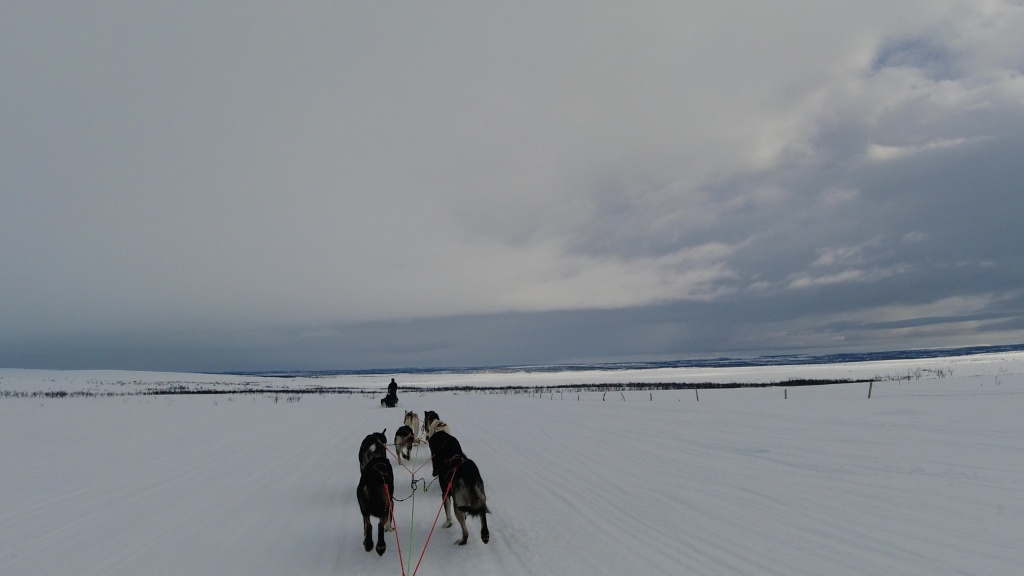
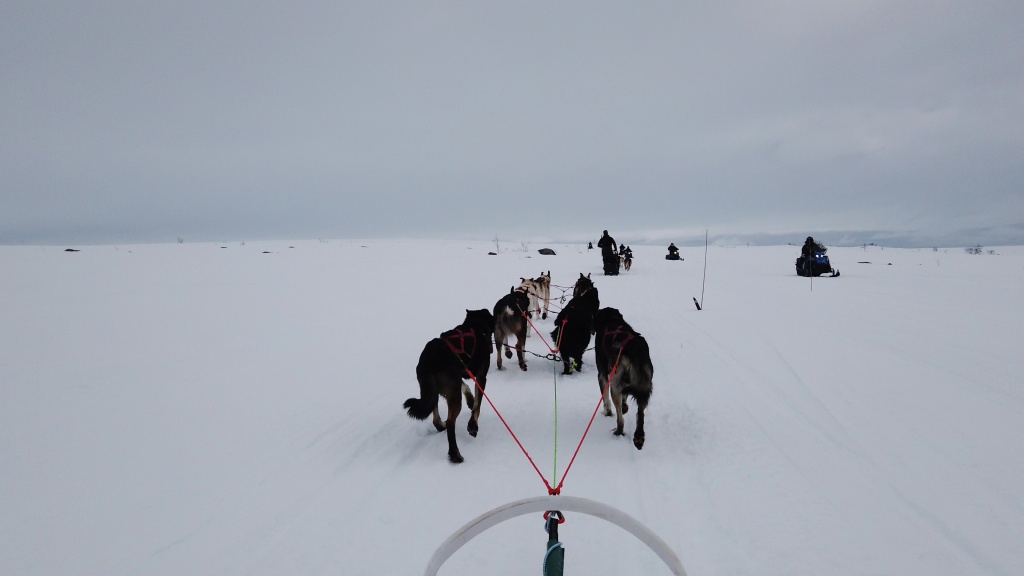
The scenery was also somewhat different.
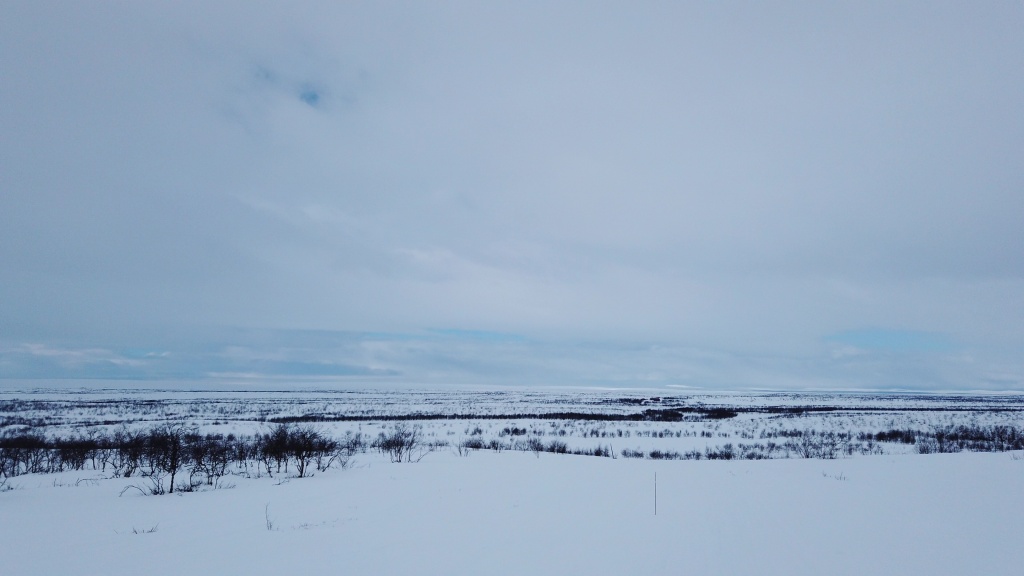
So far, we either had been up in the mountains or down on rivers and lakes.
Here we were, once we had turned off the river onto the trail to Ravnastua, on an elevated plain.
Still with a bit of vegetation around, but mostly sparse and empty.
We drove the roughly 27 km to Ravnastua, which is a comfortable daily distance for skiers starting out of Mollisjok and a comfortable half daily distance for dogsledding, turned around and back to Mollisjok.
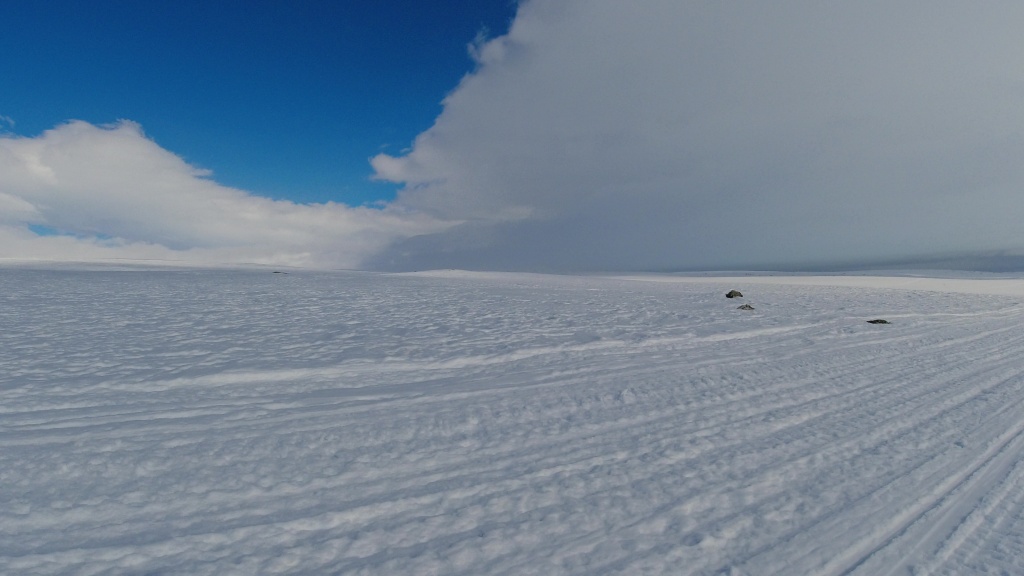
On the way we managed to leave the overcast skies behind for a bit and got to drive in the sunshine for half an hour. By the time we arrived in Mollisjok, the cloud layer had caught up with us.
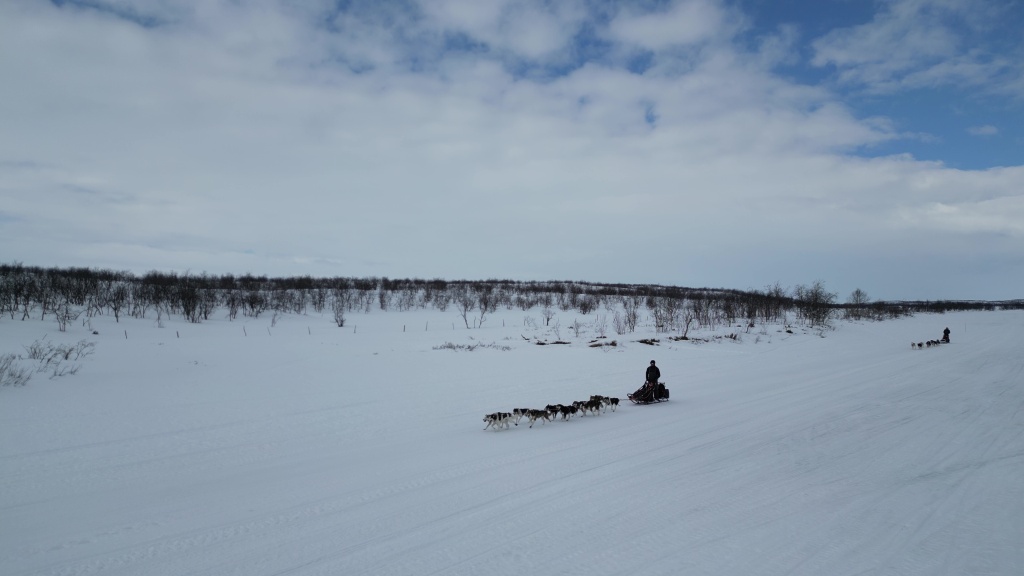
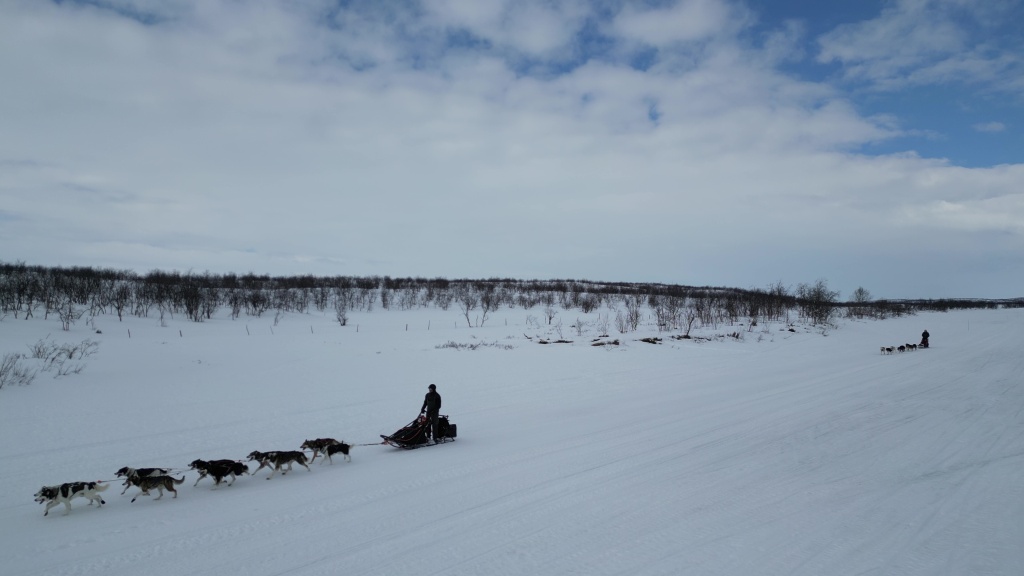
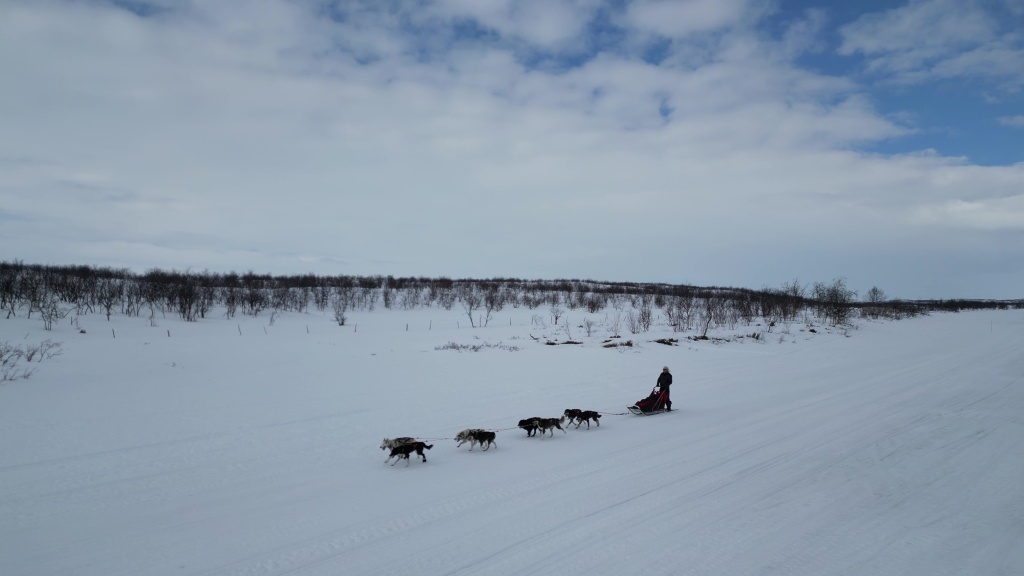
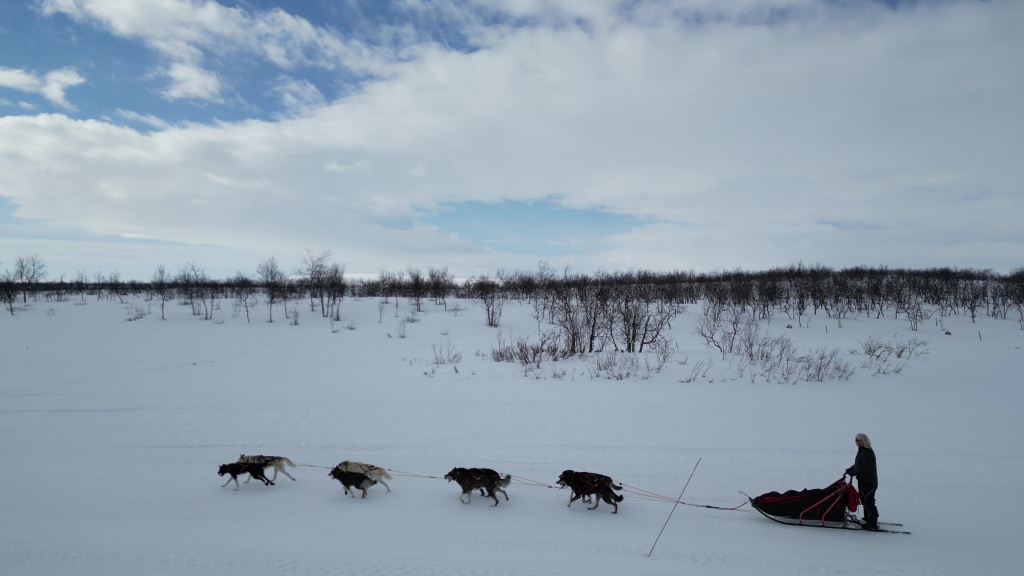
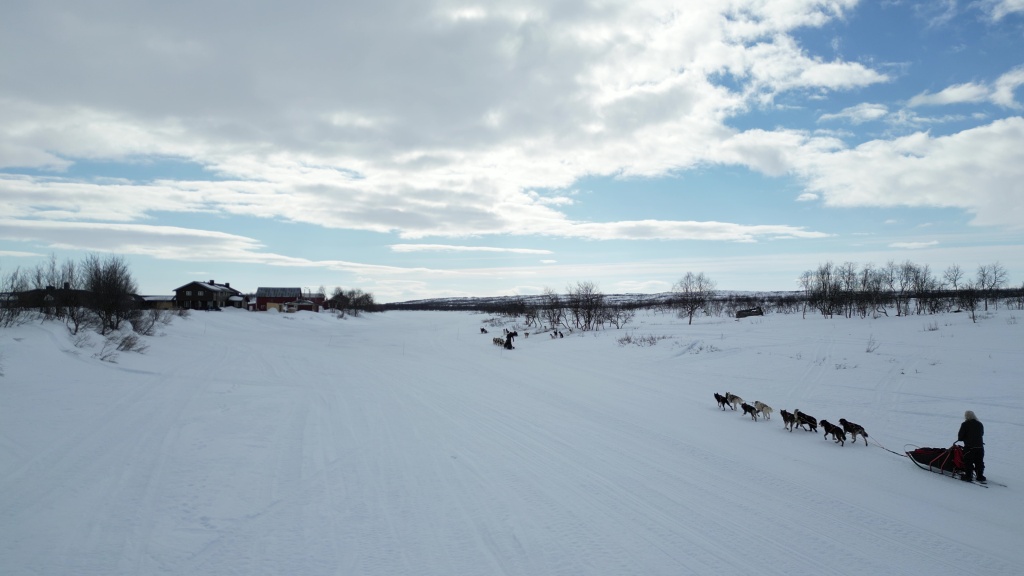
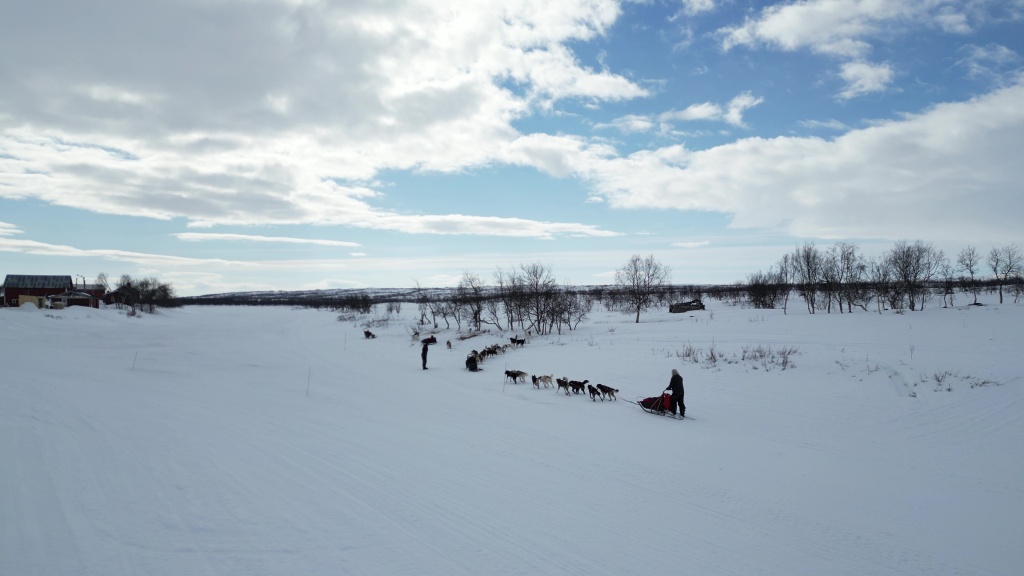
Next day was already the last day of the trip.
Fortunately, it was a great day to end on.
The clouds were (almost) gone again, the trails were still good and we had some decent amount of sledding on (mostly) lakes and rivers with light sleds ahead of us.
It didn't keep Homer or Bart from looking a bit grumpy, though.
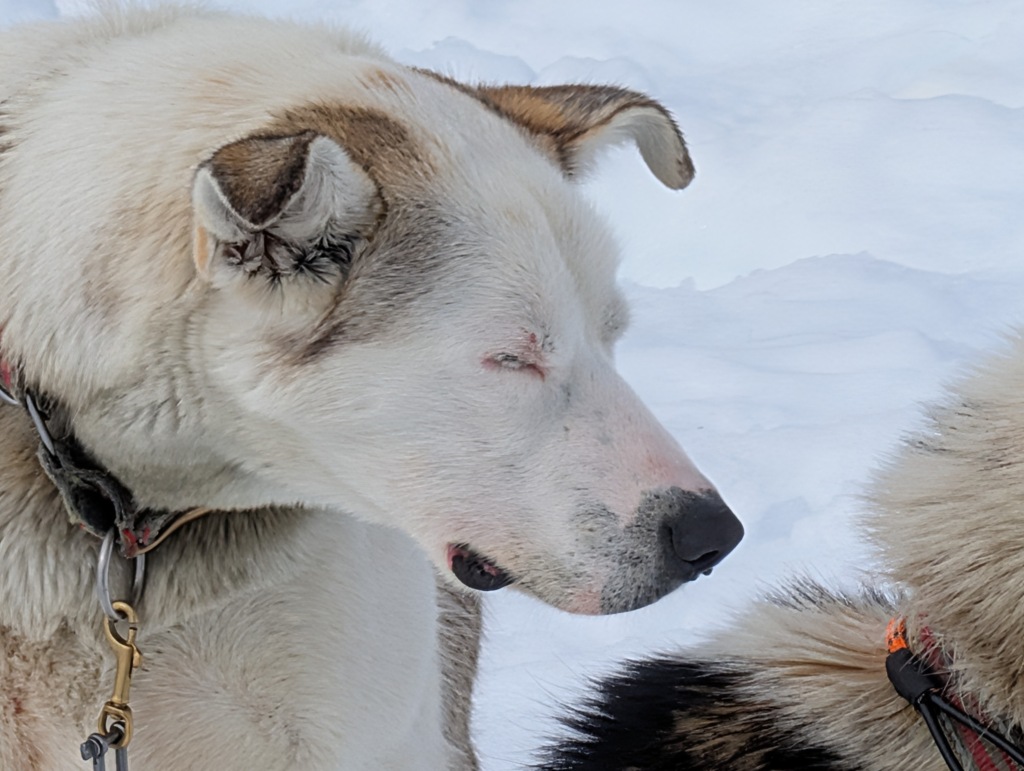
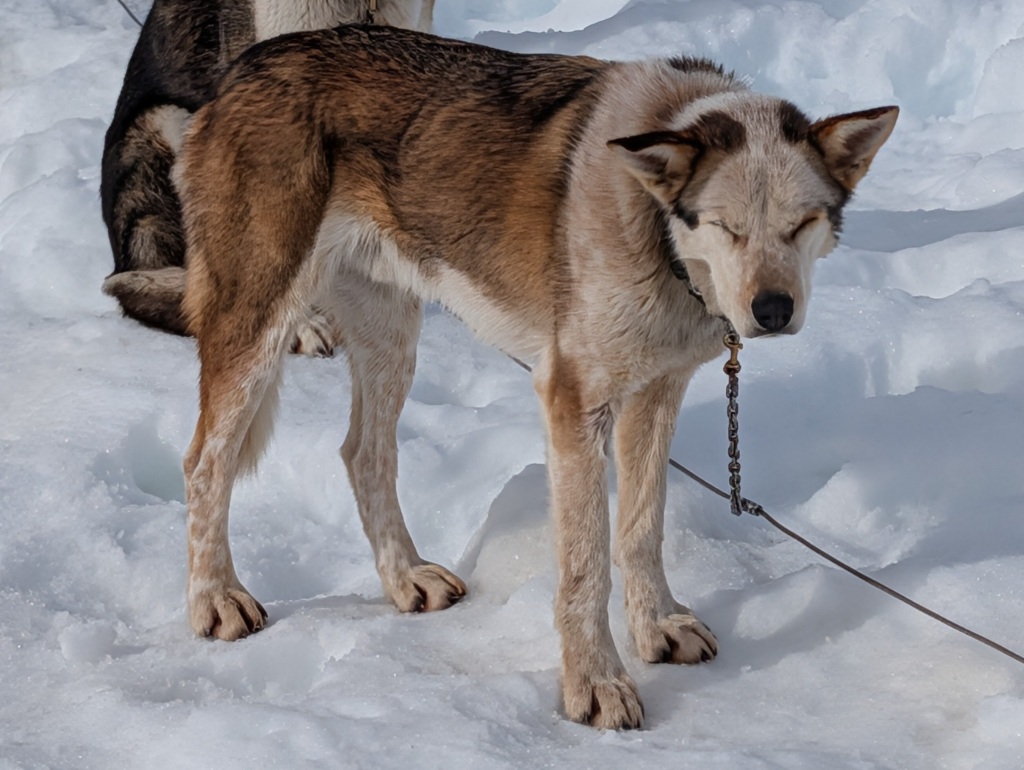
But the dogs were also fine again, so we drove our sleds with the 'original teams' and all dogs pulling the sleds and none riding in it.
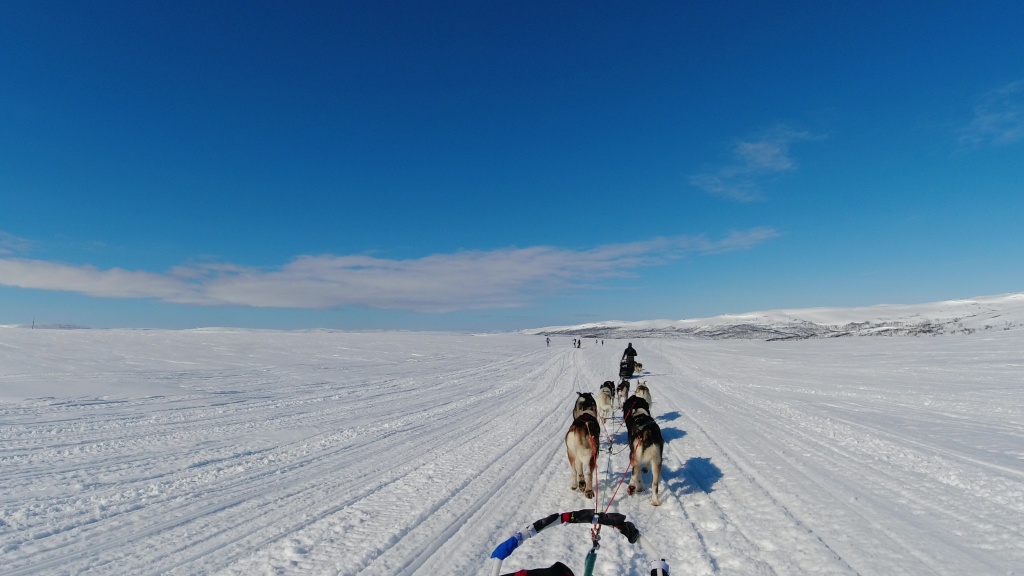
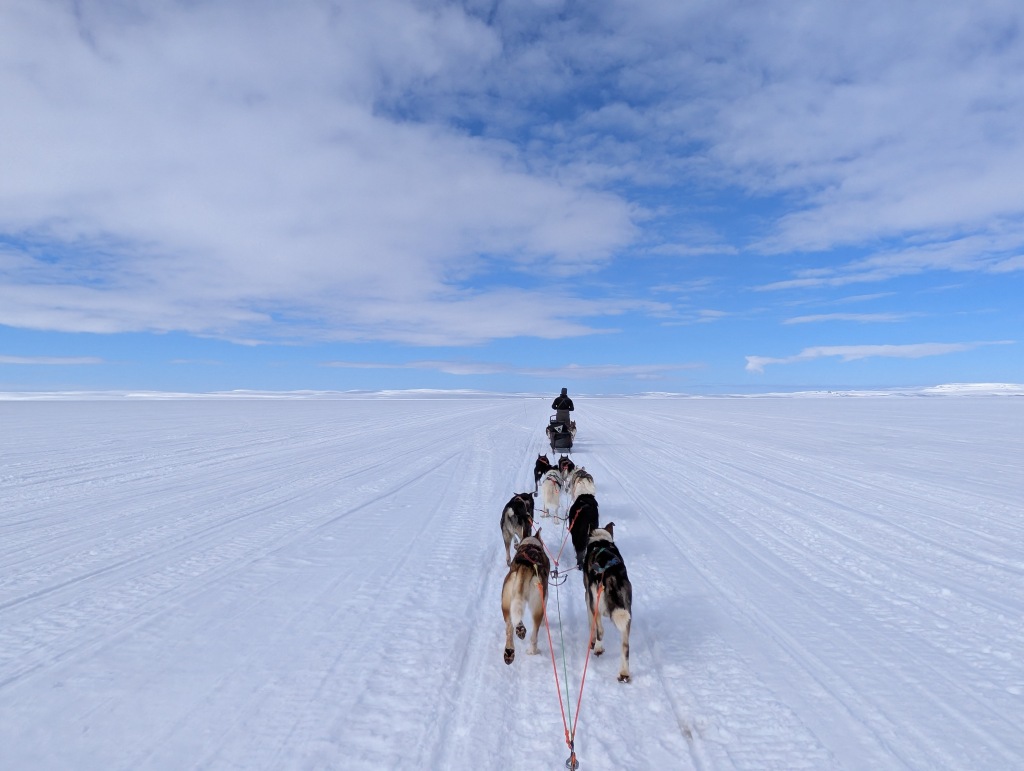
I didn't take as many pictures that day as I had done on the rest of the trip, as I wanted to enjoy the dogsledding on the last day of the trip and not distract myself from it.
But I did take snapshots of the Jotka cabins when we passed by.
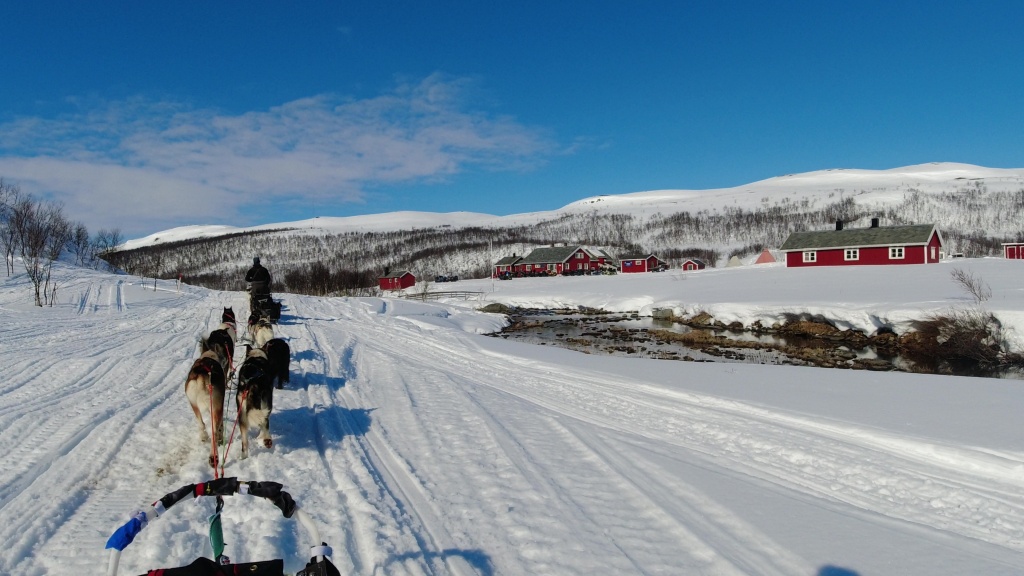
It will be Nina's next place of employment. After working as dog handler for Ben a couple of years, she will be working at Jotka Fjellstue next winter.
But for now, we were only passing by.
One last dogsledding picture from this year, with a rocky hill at the side of the trail.
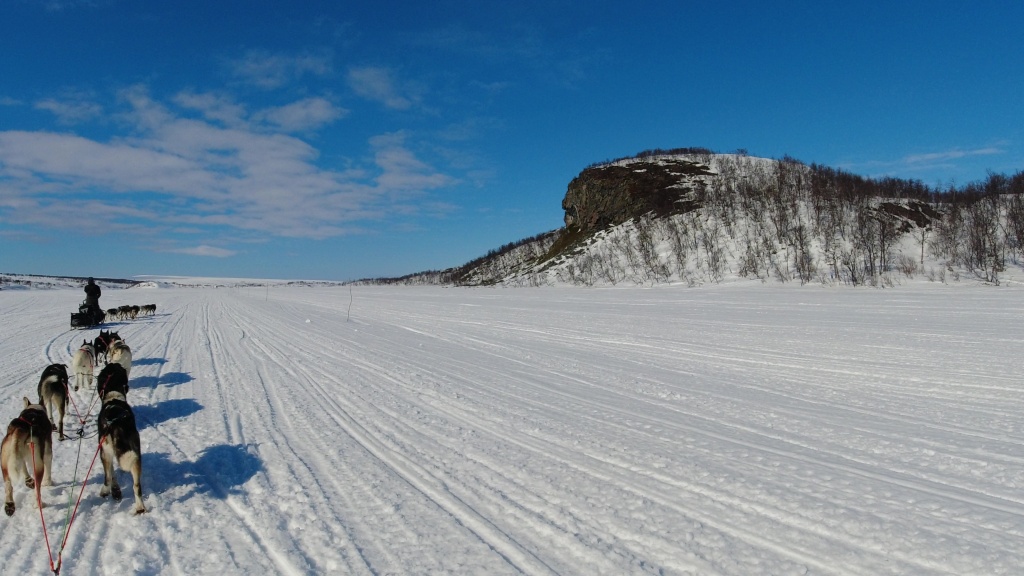
I'm not sure where it was - at that point I intentionally didn't look at my GPS anymore.
I knew there were only five kilometers or less to go, but I didn't want a 'countdown' of the remaining distance and concentrate on the dogsledding instead.
Soon, too soon, we were back at the parking lot.
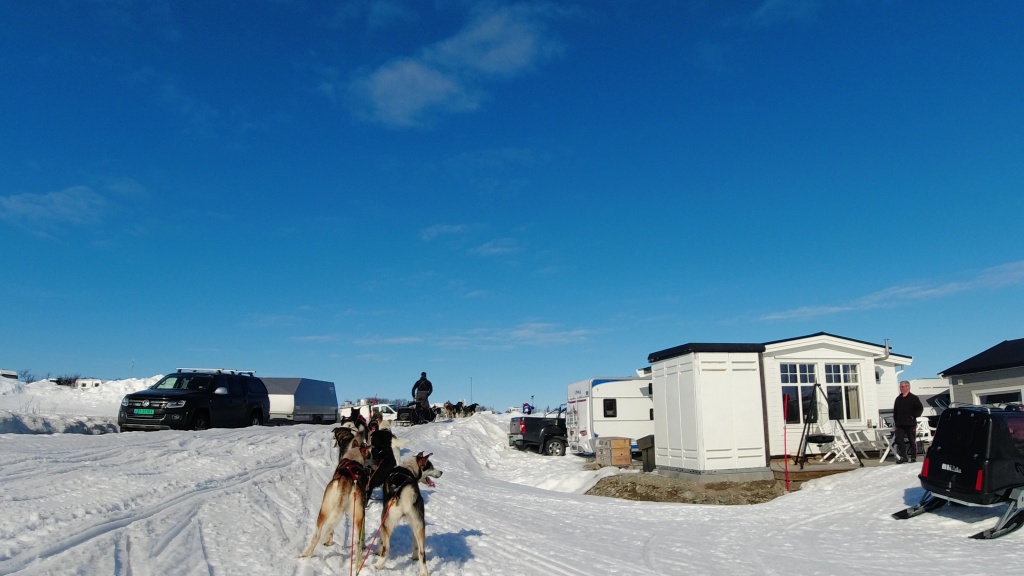
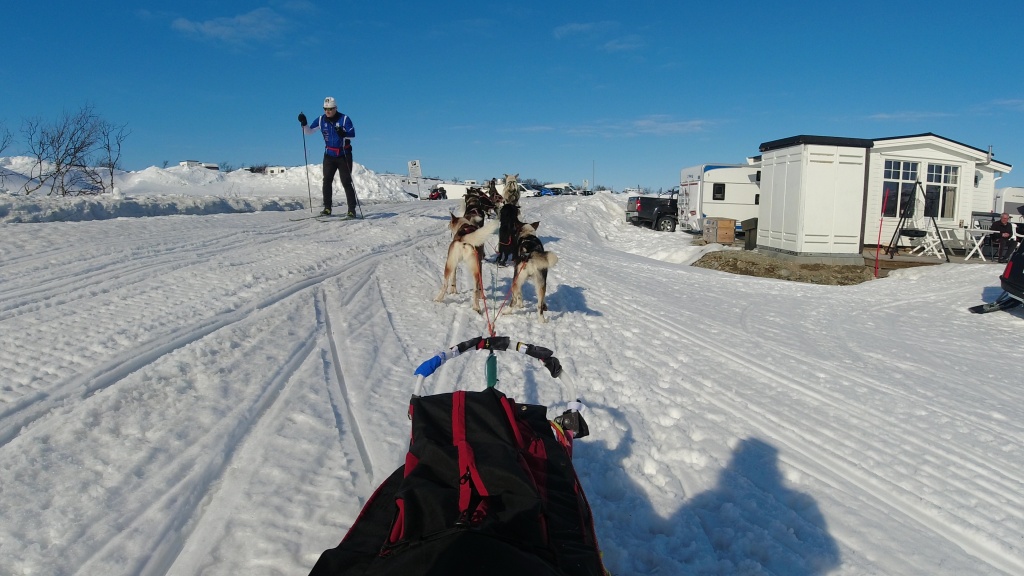
Which was busy. It was a Friday, so people were heading towards spending the weekend in the outdoors.
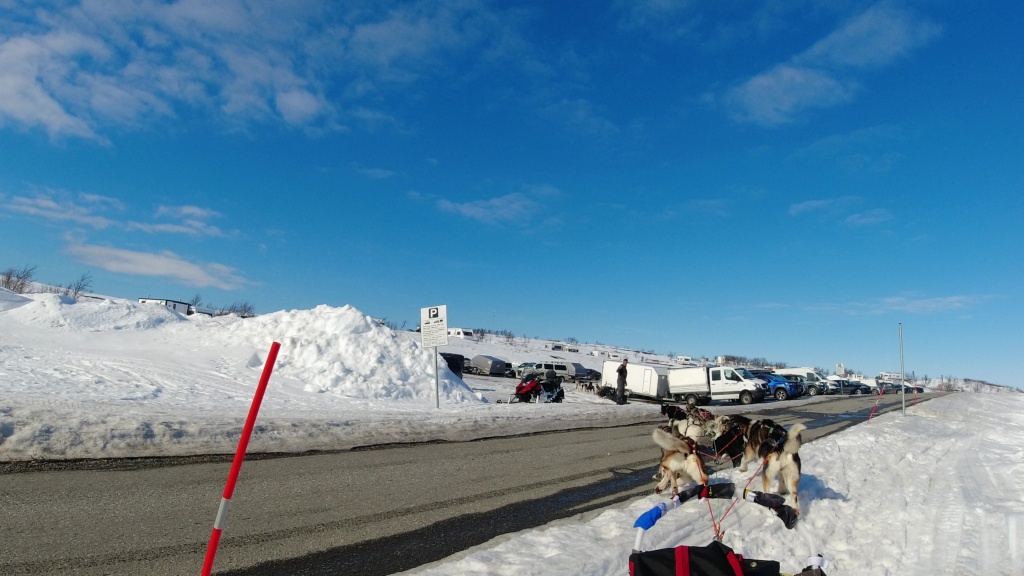
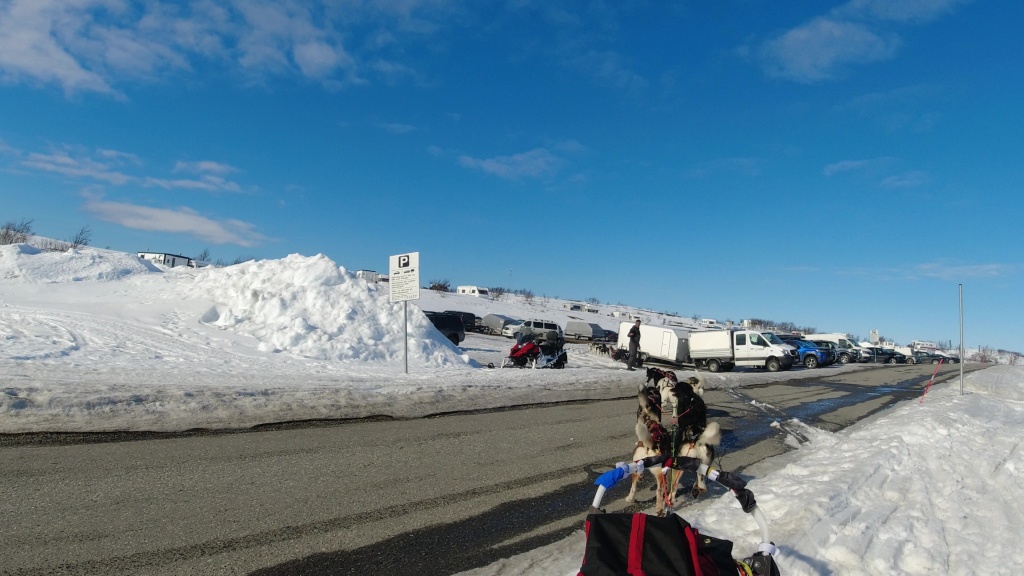
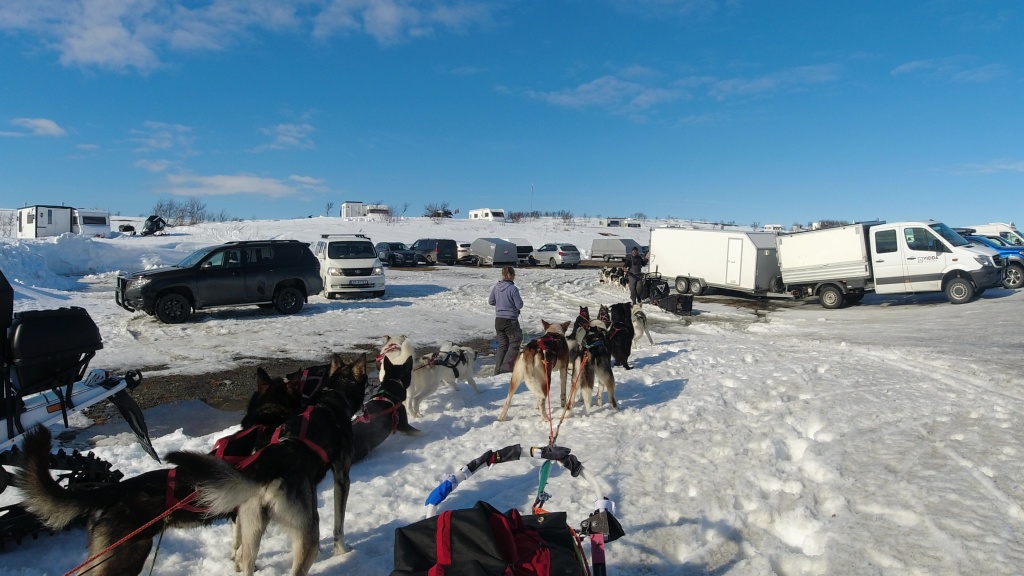
Everything went well, including the final street crossing towards the parking lot. (It would have been a bit embarrassing to drive hundreds of kilometers without issues on a dog sled, only for something go wrong and lose the sled on the last ten meters.)
Arriving at the parking lot also showed how lucky we had been with the weather and the trails.
It had been sunny and warm for the last couple of days, but the trails had still been in good condition.
Here at the parking spot however, probably due to cars driving through and the ground below being dark and getting warmer in the sunlight than on the lakes, the ground was covered ankle-deep in water and slush.
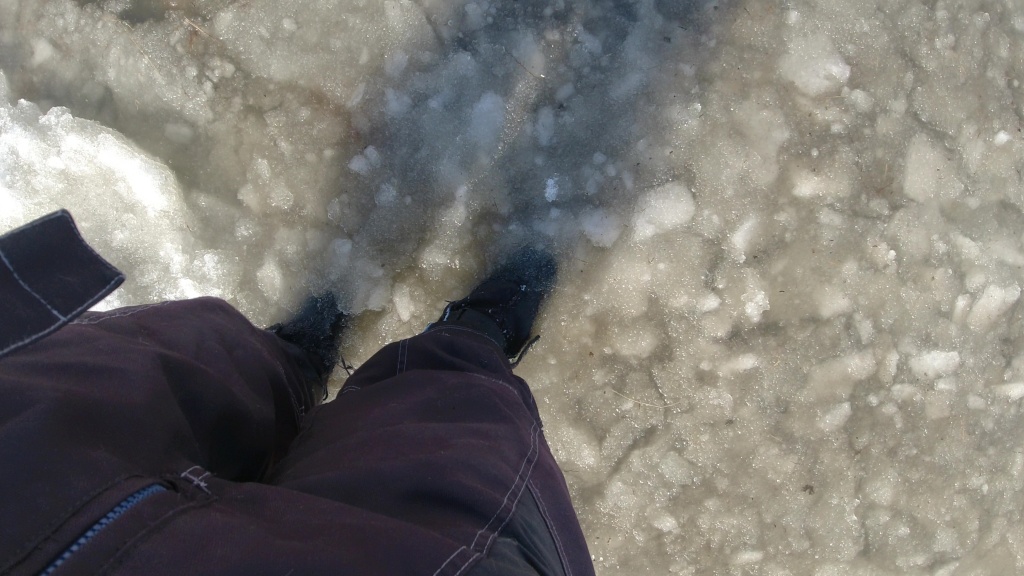
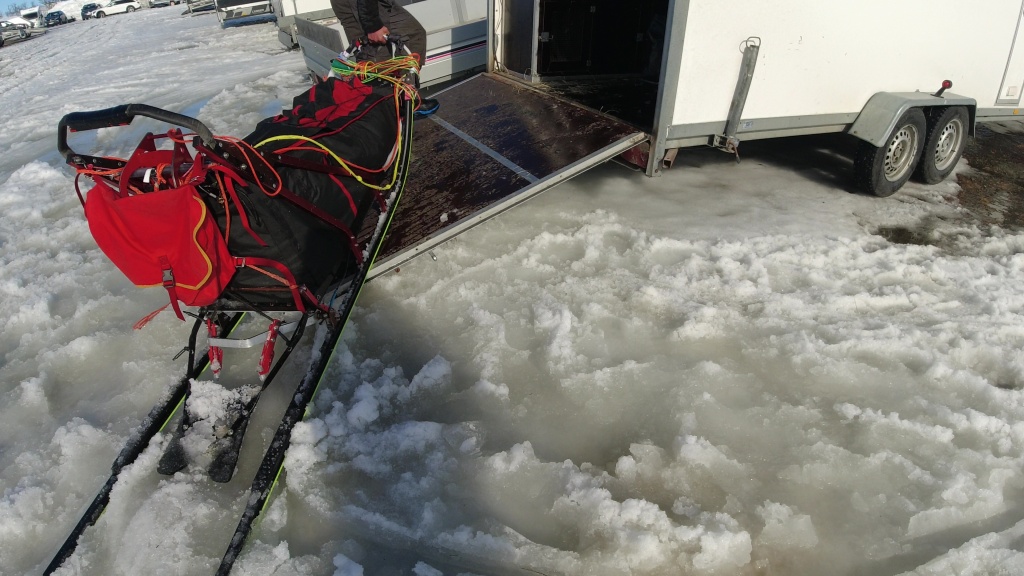
For us it meant little more than that the sleds got a bit wet when we loaded them into the van.
But a few more days of warm weather (or even warmer days) could easily have meant that the surface of the lakes had looked like this.
And while it would technically not have been an issue (the dogs will run through slush if they have to), it's no fun to do so.
So, we were reminded again how lucky we had been with the weather.
(Fortunately, there was a short cold spell predicted for the next couple of days, so it was likely that the people who were heading outside for the weekend would not be caught on melting trails. But I left the next day, so I don't know what the weather turned out to be.)
In any case, we loaded dogs, sleds and ourselves into the van and headed back to Langfjordbotn.
While loading the sleds I noticed that Nina had chosen an unusual method to dry out the booties we had been using during the trip.
In most cases, you daisy-chain them and hang them up inside the cabin to dry overnight.
But Nina had wrapped them around the bow of my sled, serving as some sort of decoration and getting them dried in the wind as well.
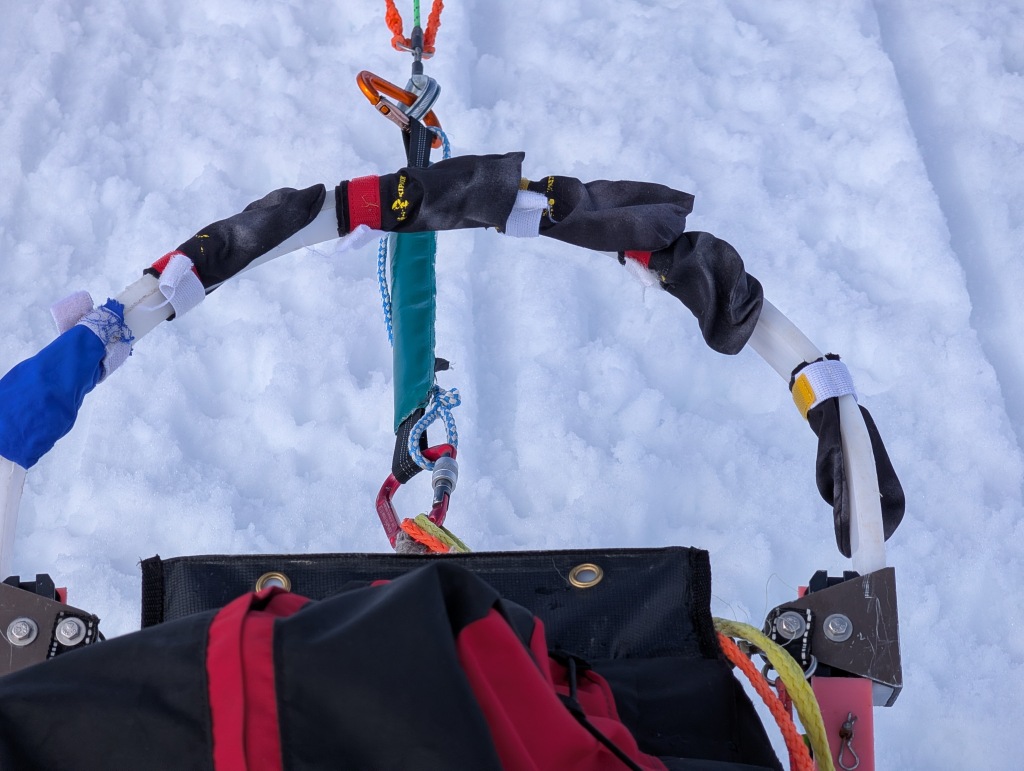
And that's it regarding the 2026 dogsledding tour.
All that was left to do was to get back to Langfjordbotn, get the dogs back to their dog houses, and get rid of the stubble on my face. (Not that much this time, as there was the rest day at the kennel in the middle of the trip, which had already given me the opportunity to shave.)
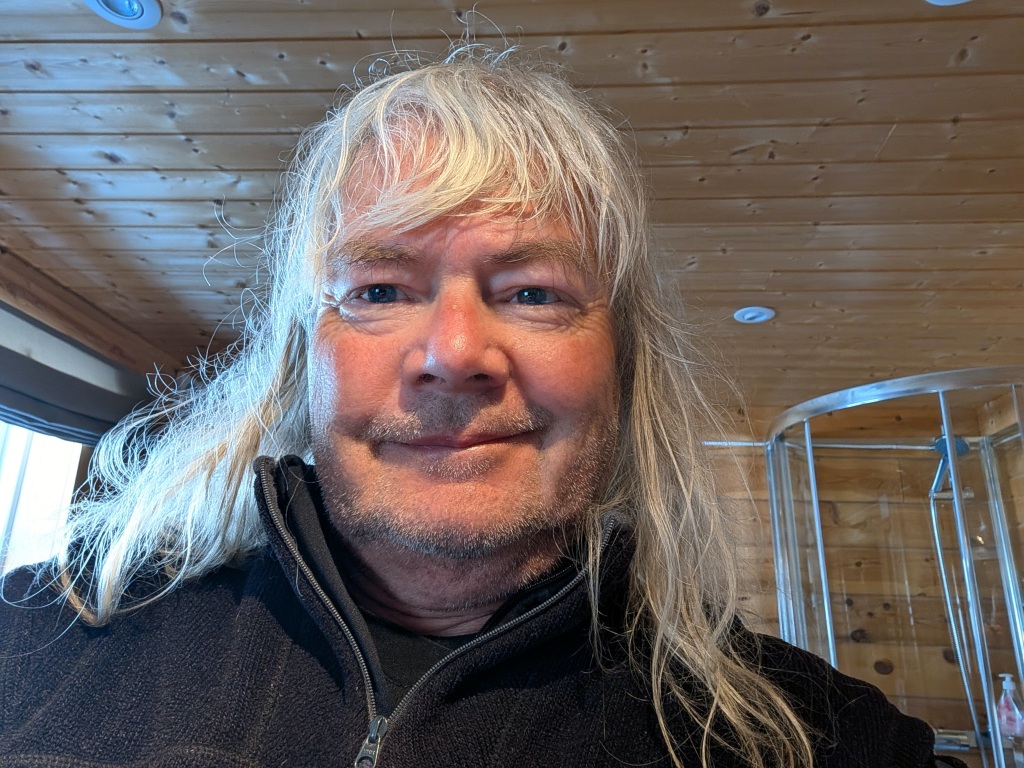
All in all a great trip (although, as usual, with little going according to plan).
What remains are the maps and the trip statistics.
Overall trip map:
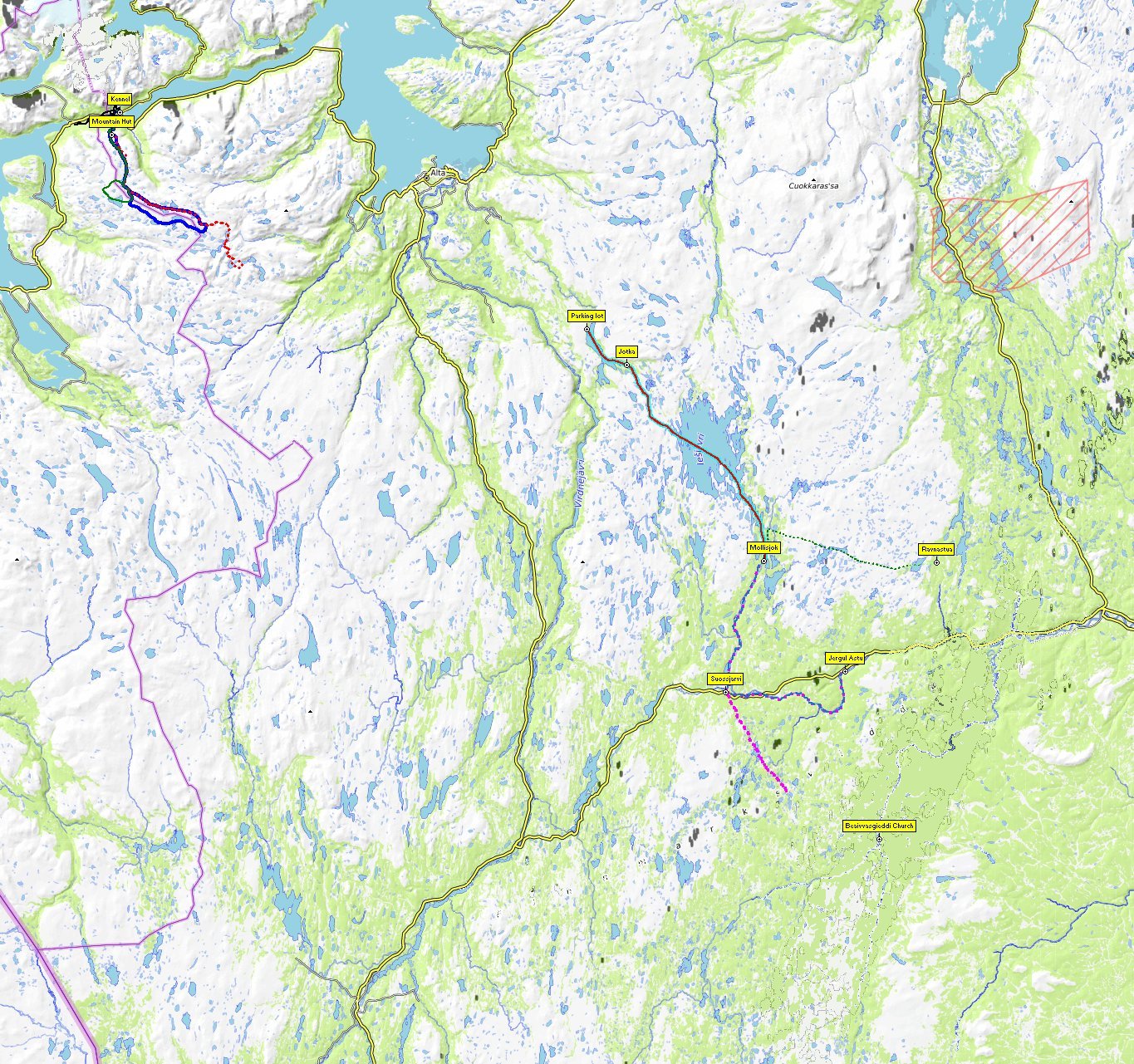
The two parts of the trip on separate maps:
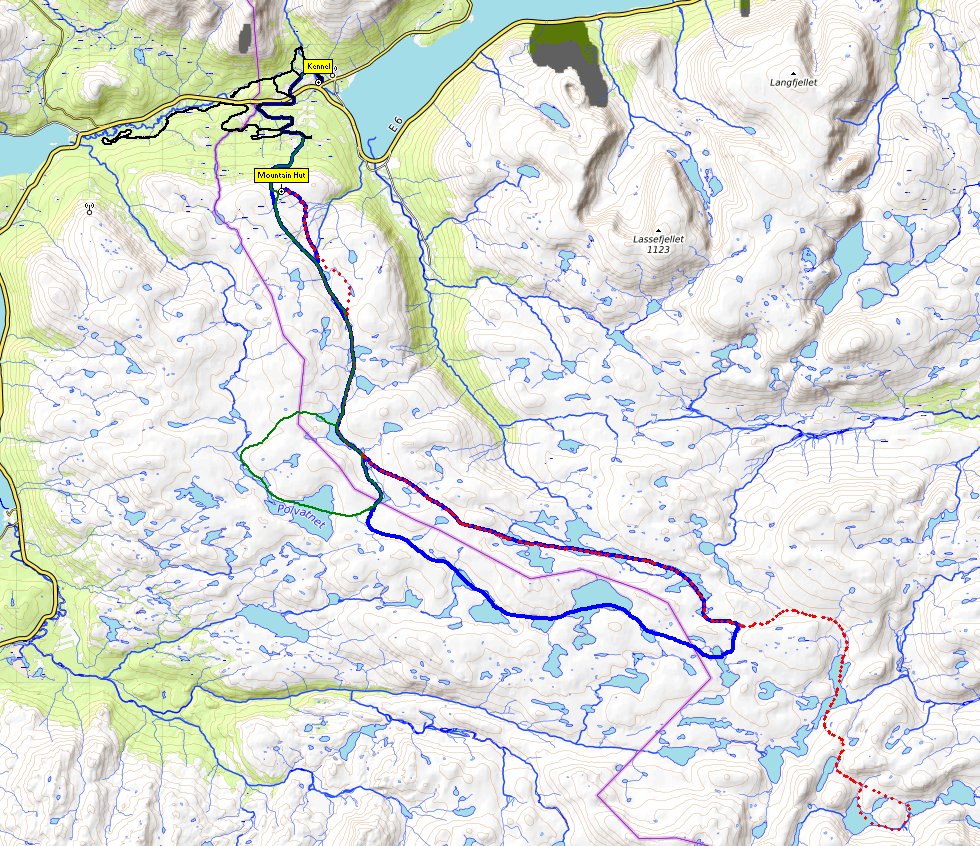 |
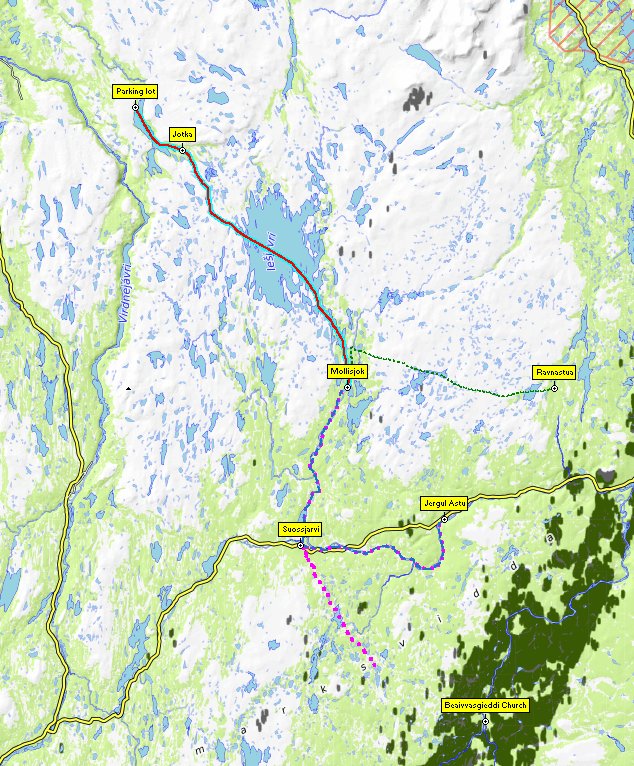 |
|
| First part | Second part |
| Date | From | To | Start | End | Total Time | Pause | Moving Time | Distance | Avg. | Mov. Avg. | Map Legend |
| 08.04.2026 | Alta Kennel | Alta Kennel | 10:15 | 12:37 | 02:22 | 00:02 | 02:20 | 33.5 | 14.14 | 14.34 | |
| 09.04.2026 | Alta Kennel | RC Hut | 10:20 | 15:03 | 04:43 | 00:23 | 04:20 | 48.5 | 10.28 | 11.19 | |
| 10.04.2026 | RC Hut | RC Hut | 11:10 | 16:14 | 05:04 | 00:26 | 04:38 | 59.4 | 11.73 | 12.83 | |
| 11.04.2026 | RC Hut | Alta Kennel | 11:37 | 14:18 | 02:41 | 00:13 | 02:28 | 32.8 | 12.22 | 13.29 | |
| 12.04.2026 | Rest Day | ||||||||||
| 13.04.2026 | Jotka Nord Parking | Mollisjok Lodge | 12:22 | 15:07 | 02:45 | 00:00 | 02:45 | 40.3 | 14.66 | 14.66 | |
| 14.04.2026 | Mollisjok Lodge | Jergul Astu | 11:35 | 16:40 | 05:05 | 00:11 | 04:54 | 73.9 | 14.53 | 15.08 | |
| 15.04.2026 | Jergul Astu | Mollisjok Lodge | 11:29 | 14:34 | 03:05 | 00:00 | 03:05 | 42.3 | 13.73 | 13.73 | |
| 16.04.2026 | Mollisjok Lodge | Mollisjok Lodge | 10:29 | 14:29 | 04:00 | 00:13 | 03:47 | 54.9 | 13.72 | 14.50 | |
| 17.04.2026 | Mollisjok Lodge | Jotka Nord Parking | 10:38 | 13:41 | 03:03 | 00:00 | 03:03 | 40.4 | 13.25 | 13.25 | |
| Total: | 32:48 | 01:28 | 31:20 | 426.0 | 12.99 | 13.60 | |||||
Here is also a zipped KML file (for viewing in Google Earth) of the trail we took: dogsledding2026.kmz.
And that covers the dogsledding part of the trip.
I didn't fly directly home after it. I spent a few days in Oslo on the way.
Oslo turned out to be less exciting than I had intended it to be.
Oslo is a nice enough city, but that's damning with faint praise.
Oslo is nice. But that about all it is.
And I wanted to do something a little more exciting.
Then it turned out that at Holmenkollen, the famous ski jump in the hills behind Oslo not only had a zipline, but also offered rappelling down from the jump tower.
That sounded like fun!
The zipline was right from the top of the jump tower and followed the ski jump.
With a bit of imagination, you could feel like you're about to go for a ski jump.
The flight path would obviously be different (as a ballistic curve, which a jumper follows, is different from a catenary curve, which a free hanging cable has). But to compensate for that, I would not crash into the ski landing area and break at least a dozen bones.
Much better.
And the abseil looked interesting as well. The part of the tower from which ski jumpers start is not directly supported by any pillars from the ground (the whole thing looks like a slash from the side, with the upper end hanging over the ground), so it would be a 57 meter abseil hanging freely in the air, without a wall directly in front of me.
Seemed like fun.
Unfortunately, outside of the main season, they only operate the abseil and the zipline at weekends.
Still. I was arriving in Oslo on a Saturday evening, so there was still the option of doing both on Sunday.
Turned out that this wasn't that easy.
While the zipline does operate on Saturdays and Sundays, out of season, they only do the abseil on Saturdays.
A couple of e-mails back and forth, it turned out that there was another option.
If there is a group booking, they are willing to do abseils on Sundays for groups.
And I could do a group booking for a 'group' of one person. (I had to pay extra for the group booking in addition to the abseil fee, but, given the general price level in Norway, that was surprisingly reasonable.)
I would need to be there before the official opening time for the abseil (and do the zipline during regular hours), but it seemed like it would all work out.
Some exciting stuff to do in Oslo.
Except, that on Saturday afternoon (I was just changing flights in Tromsø) I got the mail that it would be windy the next day, so all the activities (zipline and abseiling) were cancelled.
Sigh.
I visited the Holmenkollen ski jump on Sunday anyway.
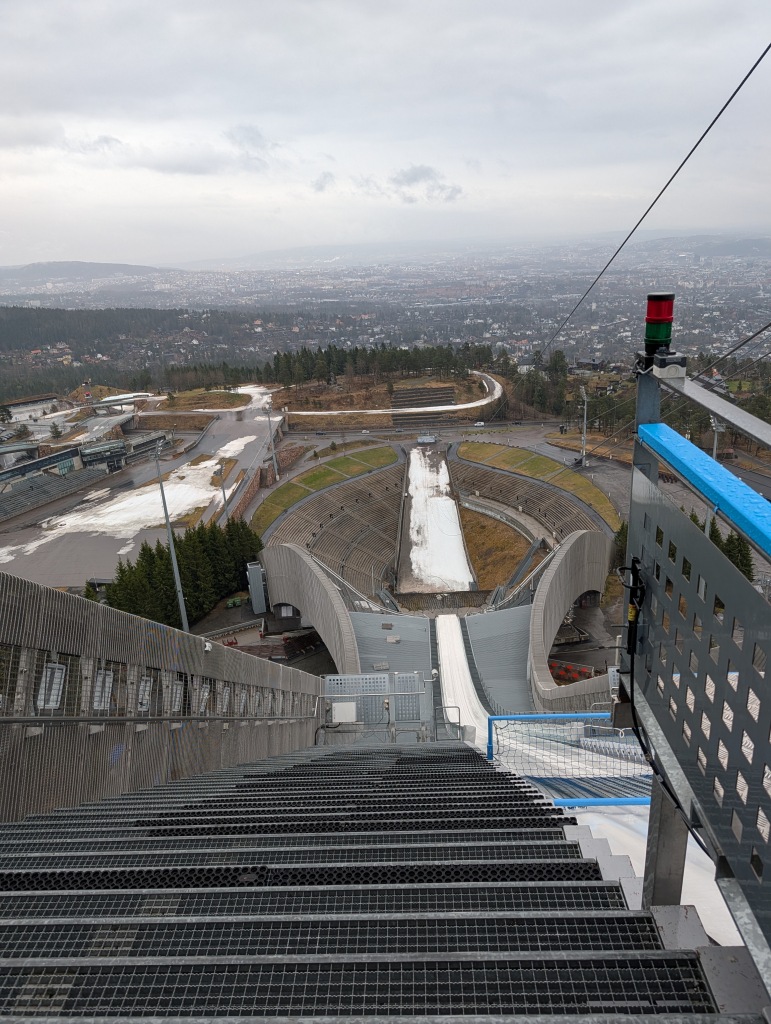
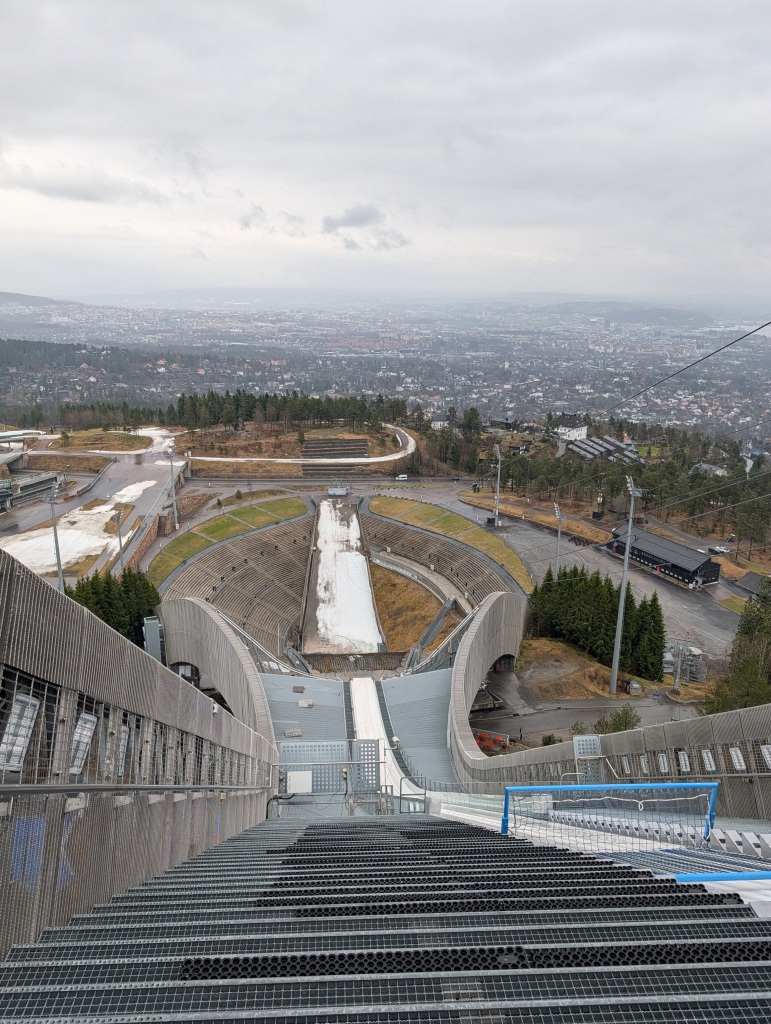
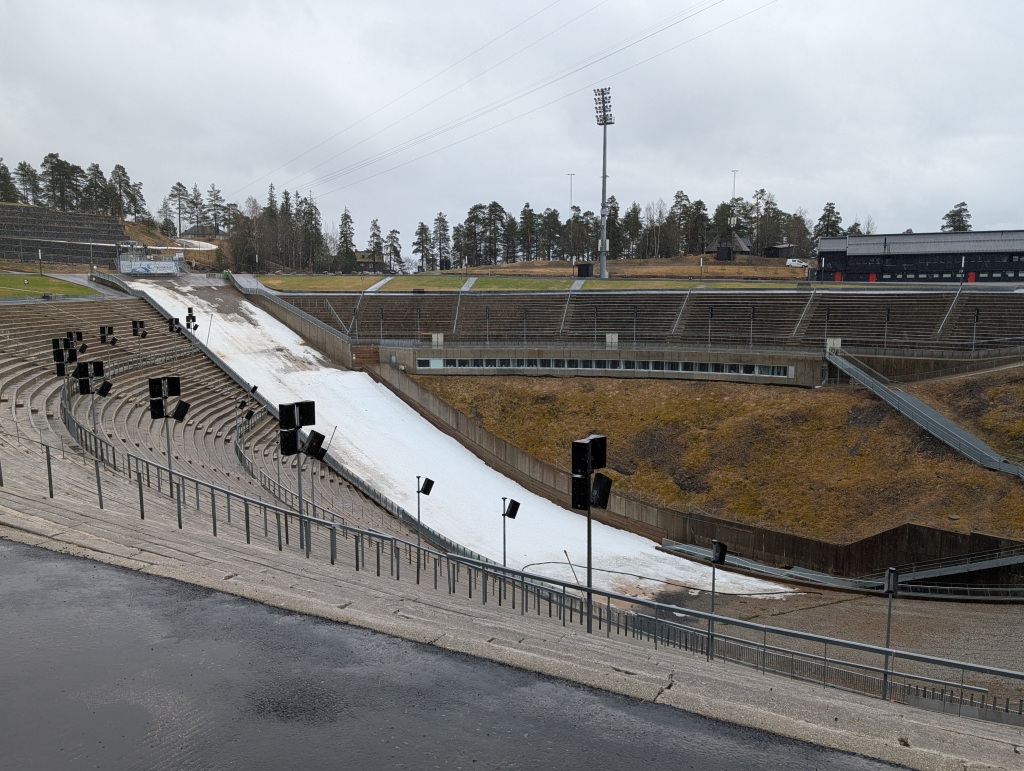
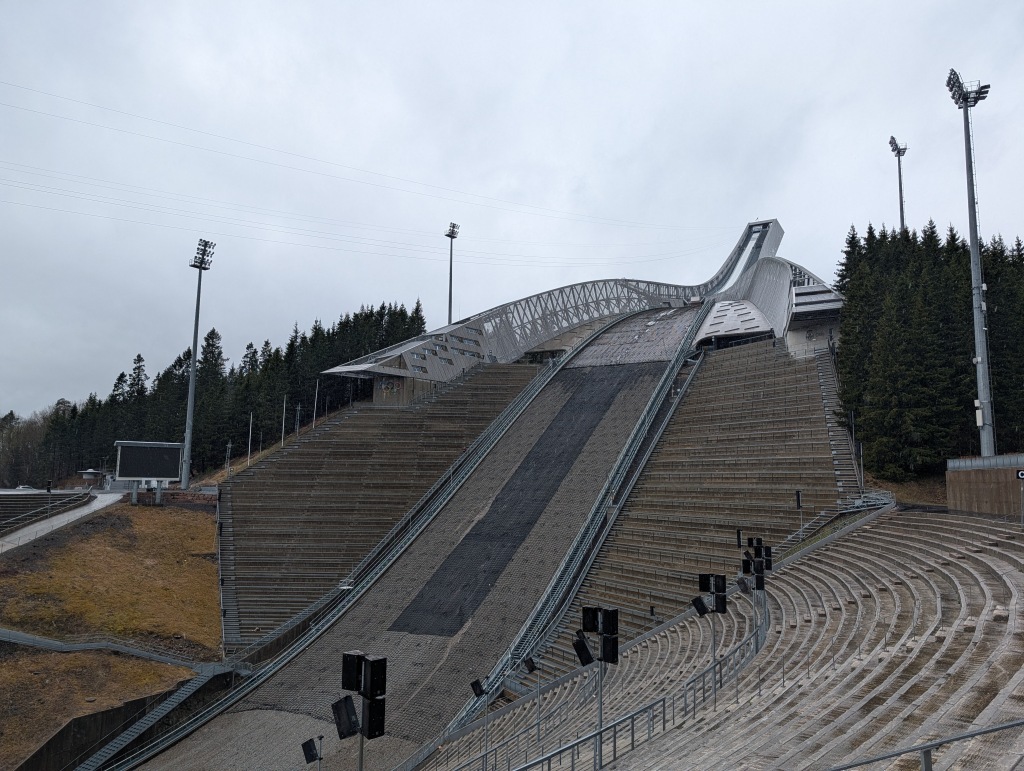
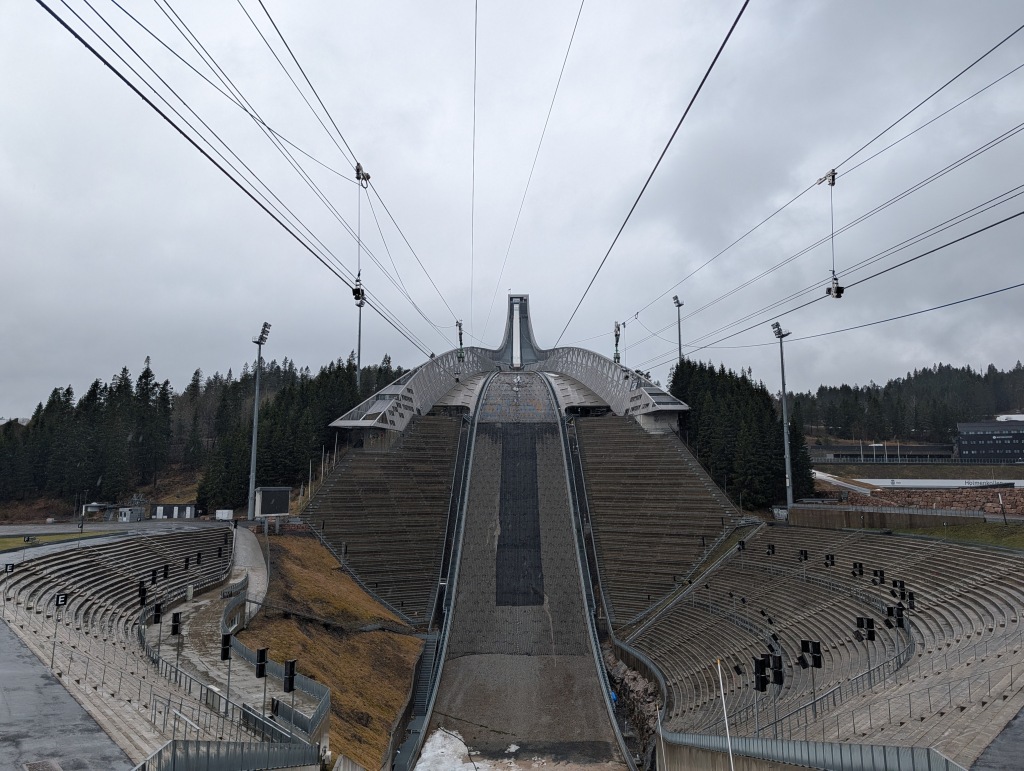
Partly because I hadn't really anything else planned and partly because I wanted to visit the ski museum.
Though not so much the part about skiing.
While it is (probably) nicely done, explaining the history of ski development and the different kinds of skis and why they were constructed that way. And also presenting skis used by various famous ski jumpers, I don't care much about skiing, so most of that was lost on me.
What I was interested in was a small presentation on Arctic and Antarctic travel, with a focus on the attempt of Nansen and Johansen to reach the North Pole.
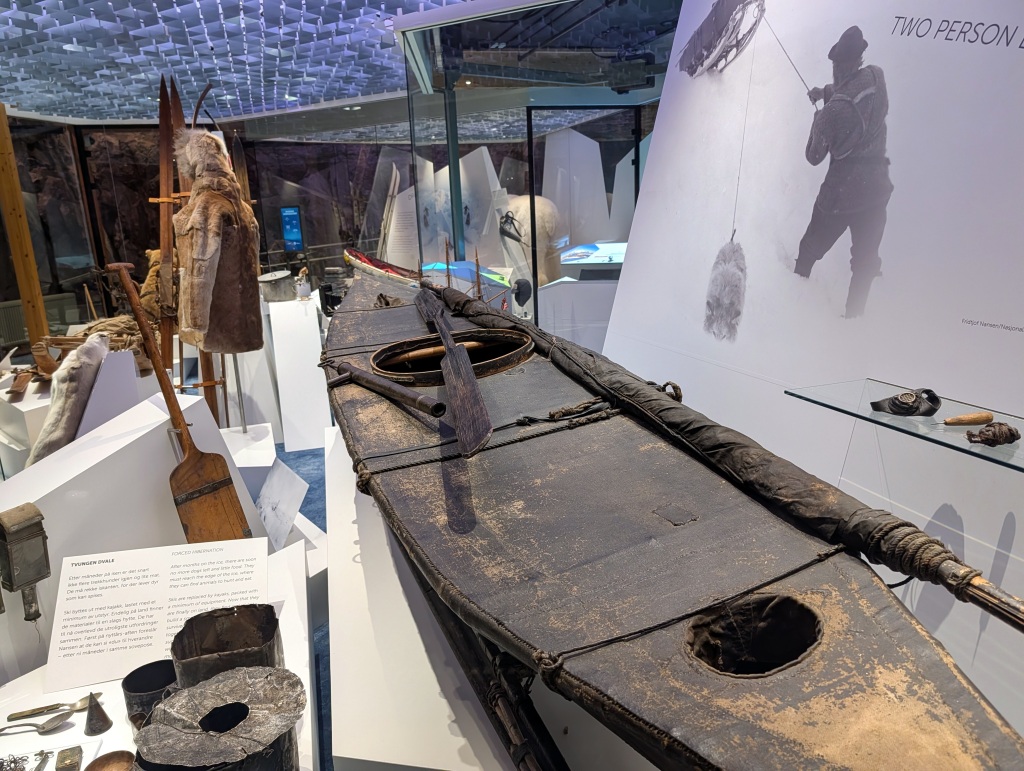
It also featured (for slightly odd reasons) a pair of skis that Scott had with him when he died in the Antarctic.
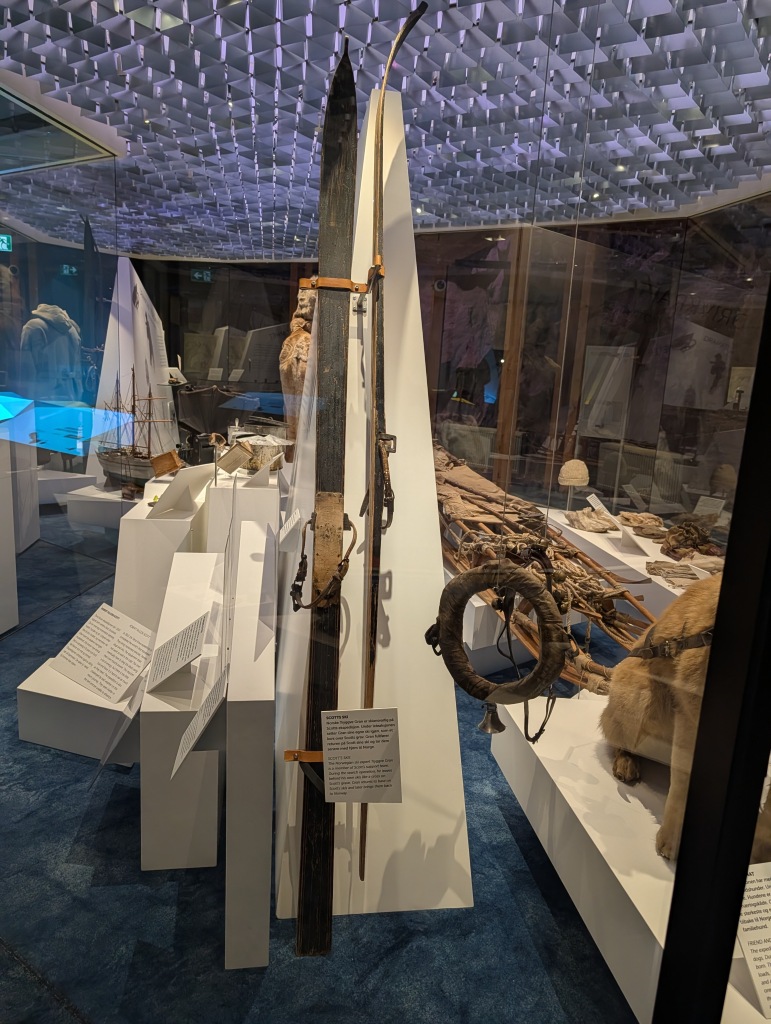
A Norwegian named Tryggve Gran had been part of the support team for Scott and was part of the group that found the corpses of Scott, Wilson and Bowers. For some reason, Tryggve decided to erect a cross on the spot, using his own skis. As he was now without skis, he took Scott's skis to travel back to the coast. And the skis ultimately ended up in the ski museum in Holmenkollen.
There's no real explanation why he didn't use Scott's skis to build the cross. And why he went home with dead man's skis. The whole story seems a bit odd.
Part of the ski museum was also a wind generator that could be set to various speeds to give an impression of the kind of wind a ski jumper faces on the inrun.
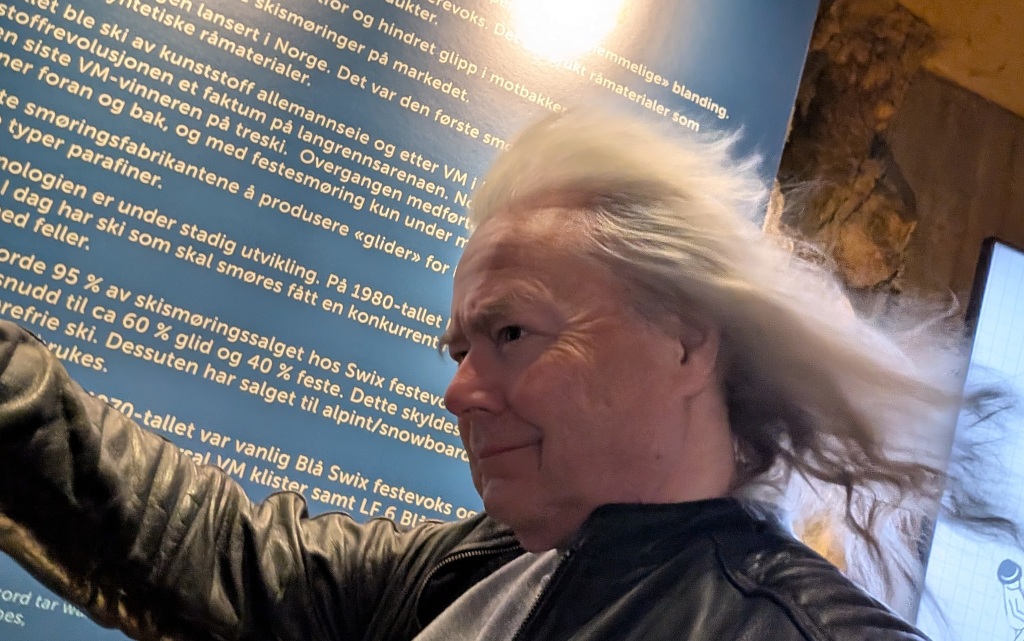
A bit later, I took the 'elevator' (moving diagonally, more like a cable car) to the top of the jump tower.
Where the wind was like this.
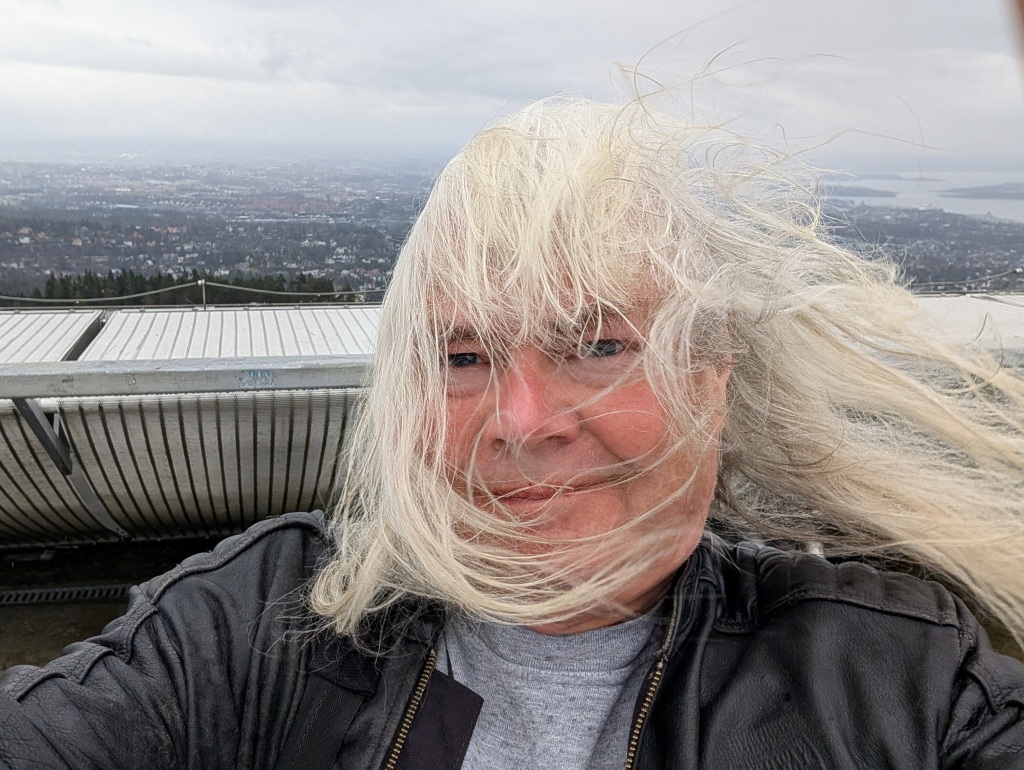
Yes, it was quite windy up there.
And, yes, it was understandable why they didn't do abseiling or ziplining that day.
Still a pity to have missed that.
According to tourist guides, there is a great view of the Oslo area from the jump tower. But, given the weather, it wasn't much of a view that day,
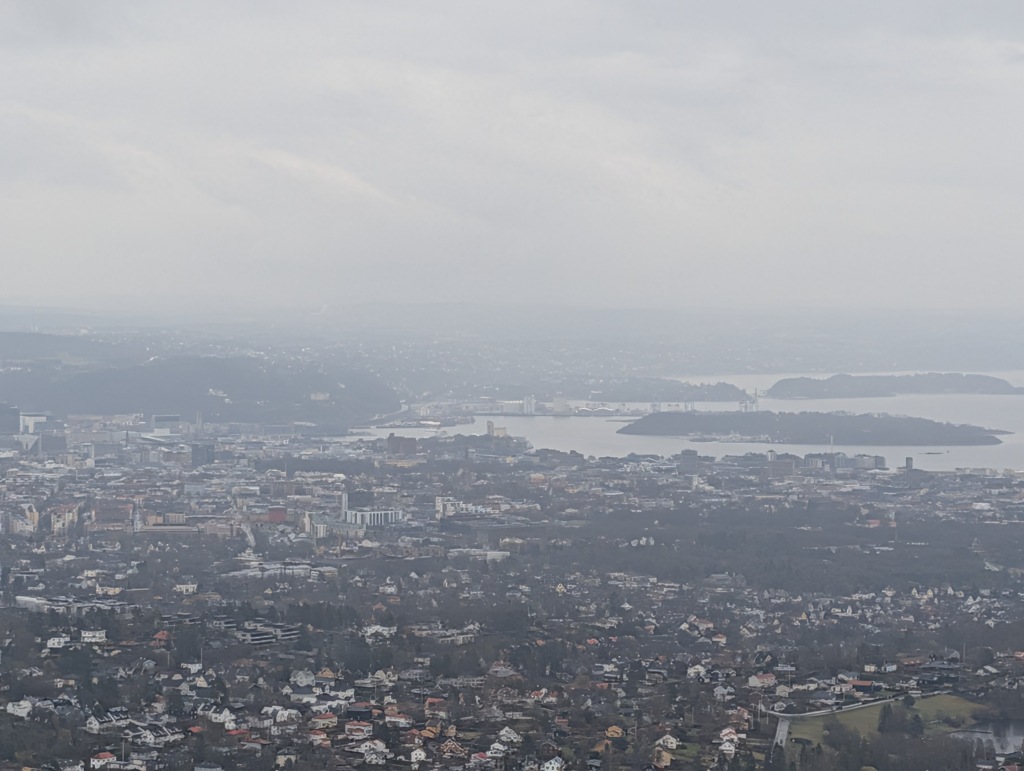
I walked around a bit in the spectator area at the lower end of the ski jump.
Taking the stairs felt a bit odd. As the steps were at an angle to the railing, it was difficult to walk down the steps, as you had to walk in a somewhat crablike fashion with partly sideways steps.
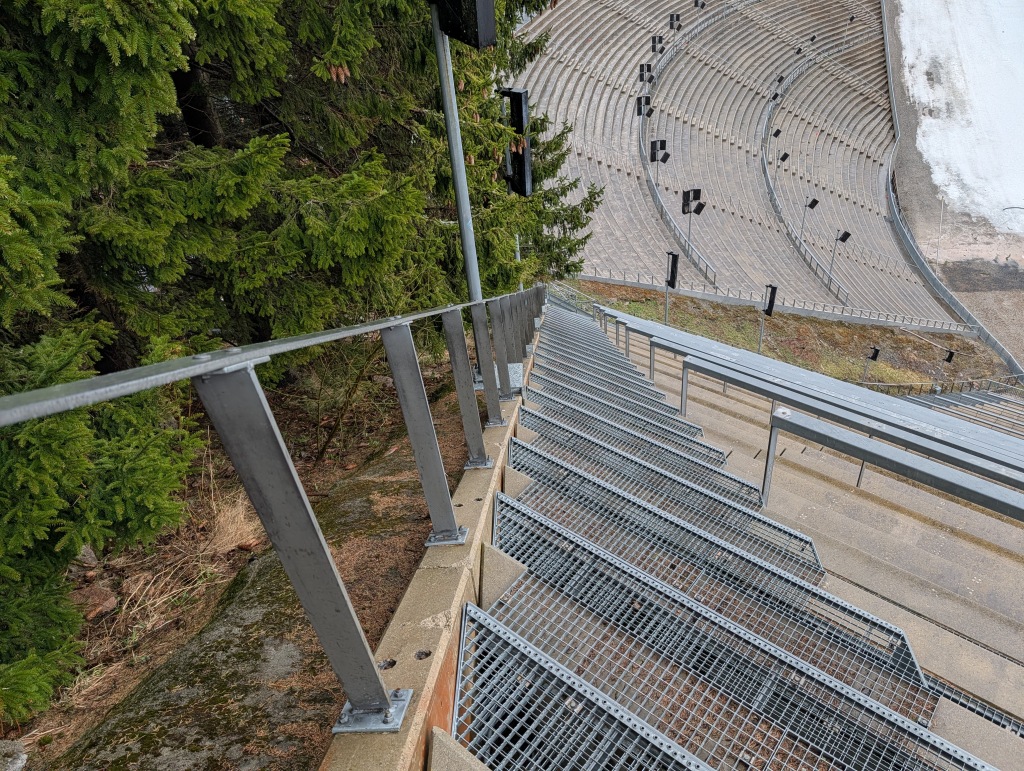
While I knew that there was this big ski jump at Holmenkollen, I hadn't been aware that it is part of a larger winter sports complex. Which includes cross-country skiing, as well as annual biathlon.
The biathlon shooting range is next to the ski jump. As there was nothing going on, I went and took a look.
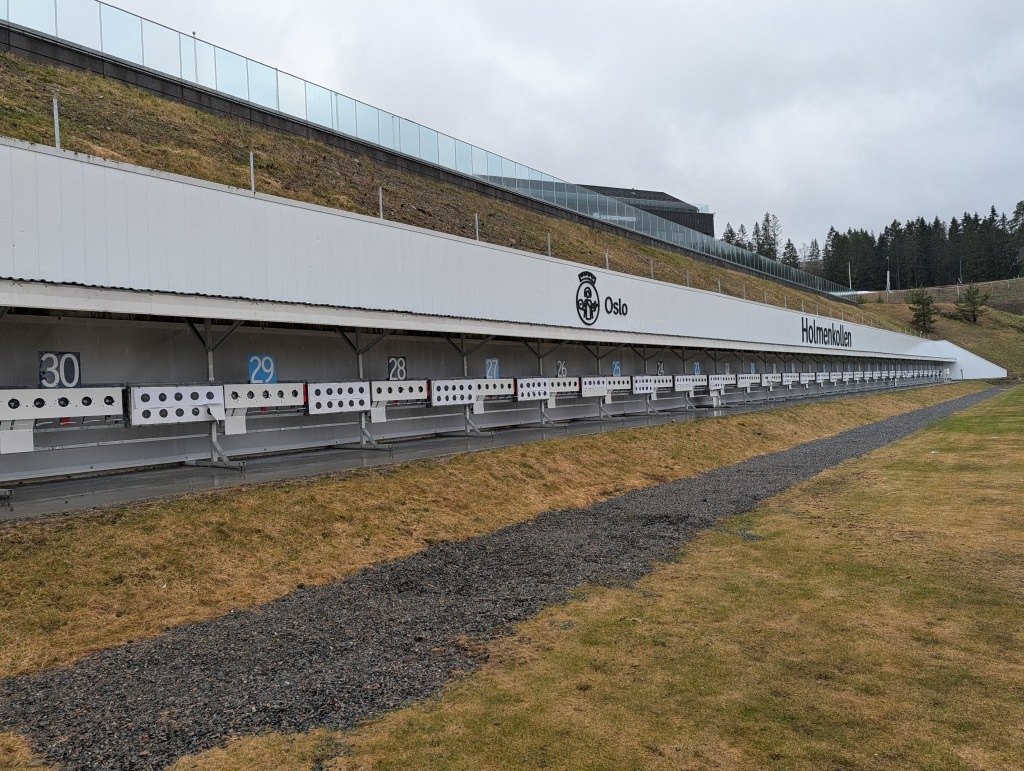
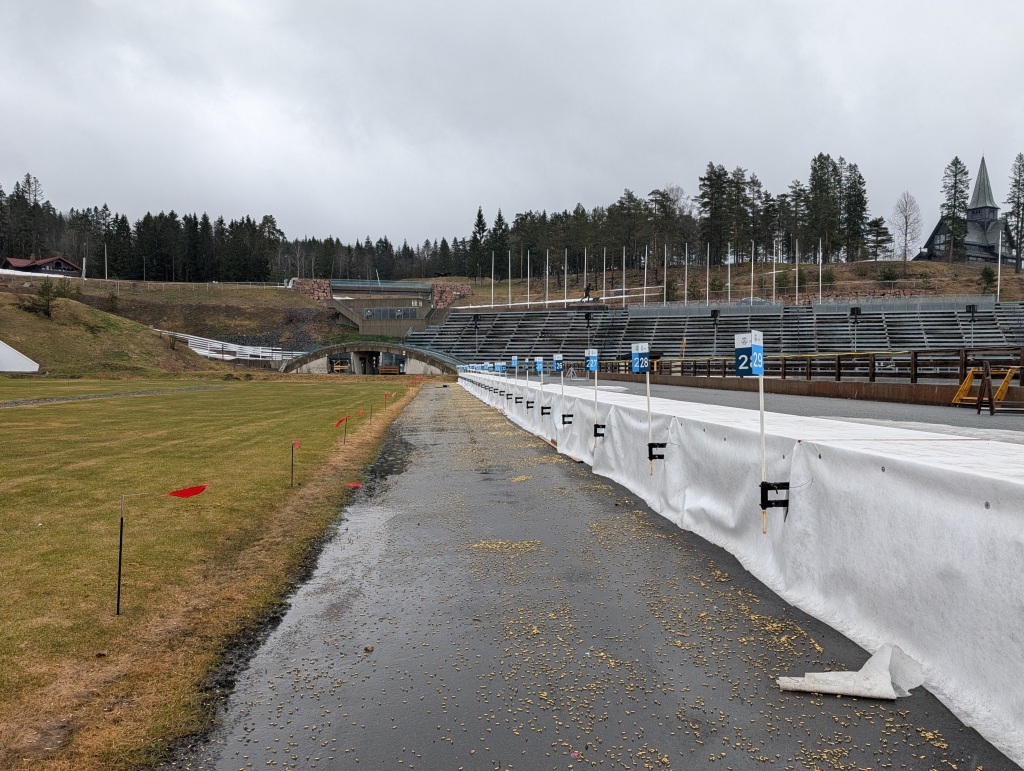
The mechanism is as simple as you'd suspect. A lever with a counterweight.
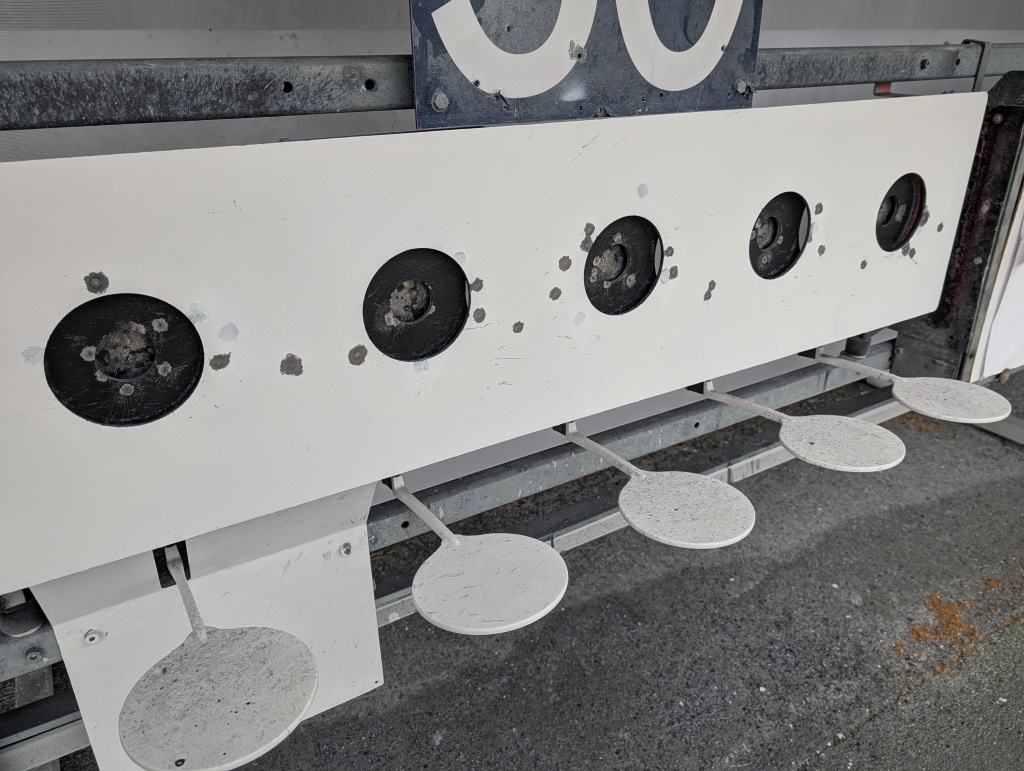
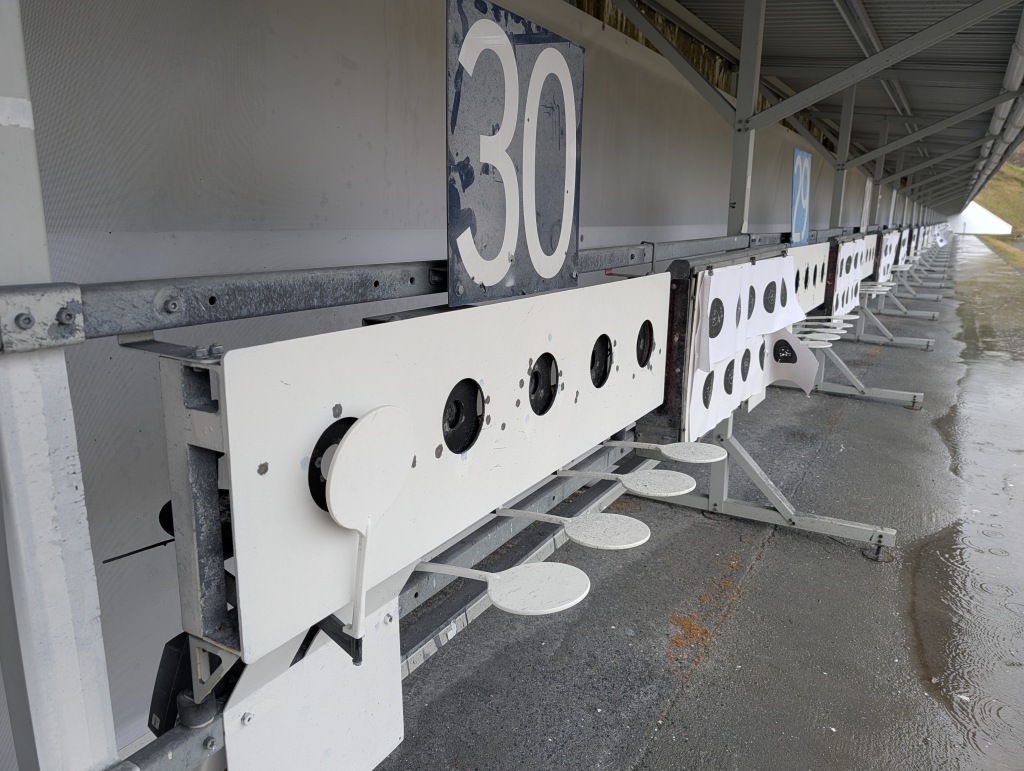
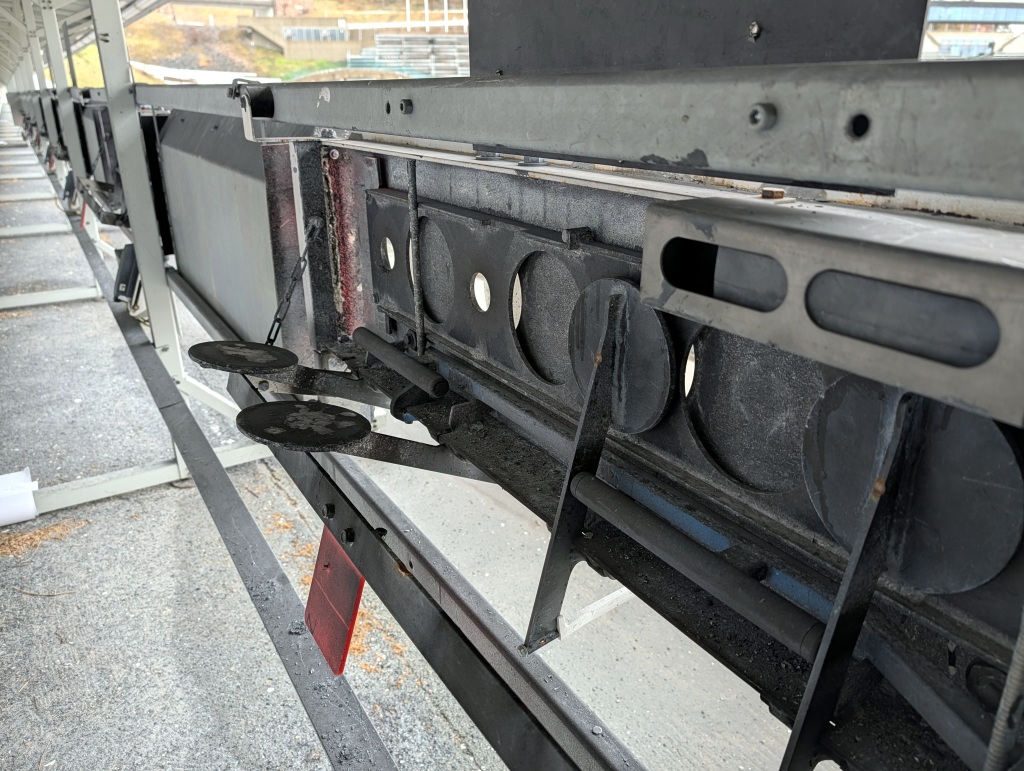
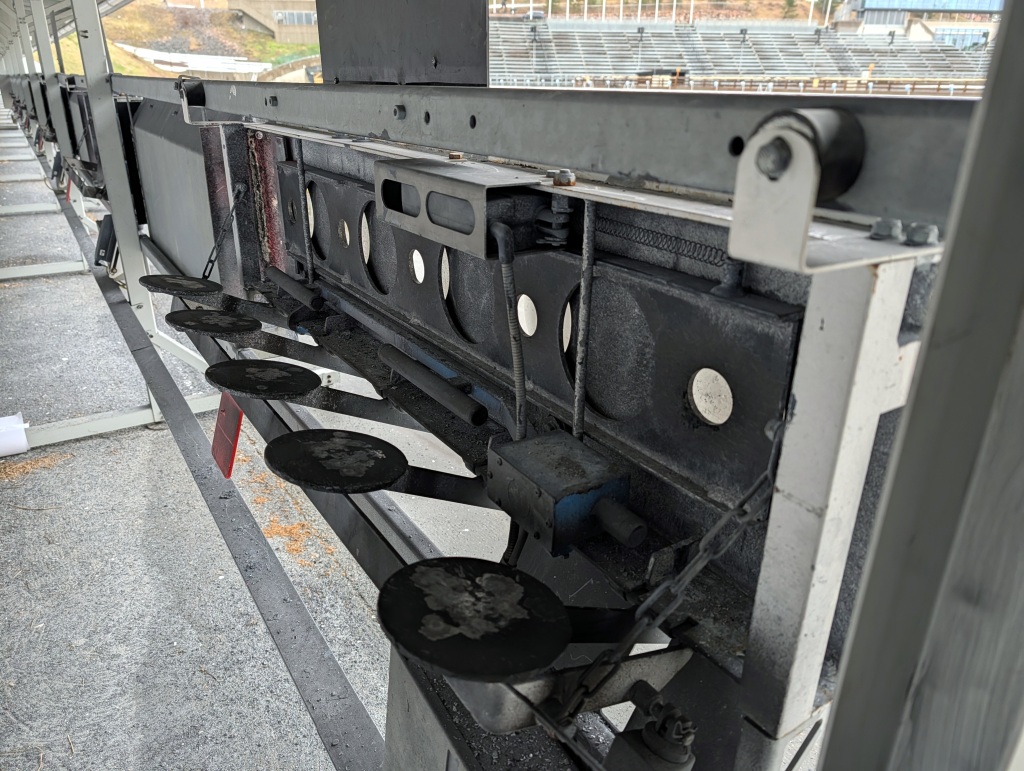
You hit the target (or the center of the target) with the bullet. The target gets pushed back, the lever construction 'topples over' and the white plate is raised, indicating a hit.
I had been wondering why (seen from the back), there are larger and smaller holes in the metal frame. Turns out that there are different target sizes used in biathlon, depending on whether the athlete is shooting lying or standing. And the whole back of the target is moved to the left or right accordingly.
I found it a bit surprising that the smaller hole (which is the one the target was set to when I was there) is created by covering the target plate with a black shape with a hole in it. That likely makes the real target hard to see. I have no idea why they didn't use some contrasting colour to paint it.
It also surprised me that the whole system was turned on. The place was deserted and I had been playing around with the target plates, trying to get a feel how much pressure was needed to tip them. (More than I thought, but a bullet presumably carries a fair amount of kinetic energy.) And suddenly some rods started to turn and reset the targets. Looks like the system is set up in a way that, after a target is hit, it will wait about 20 seconds before setting everything back to the initial state.
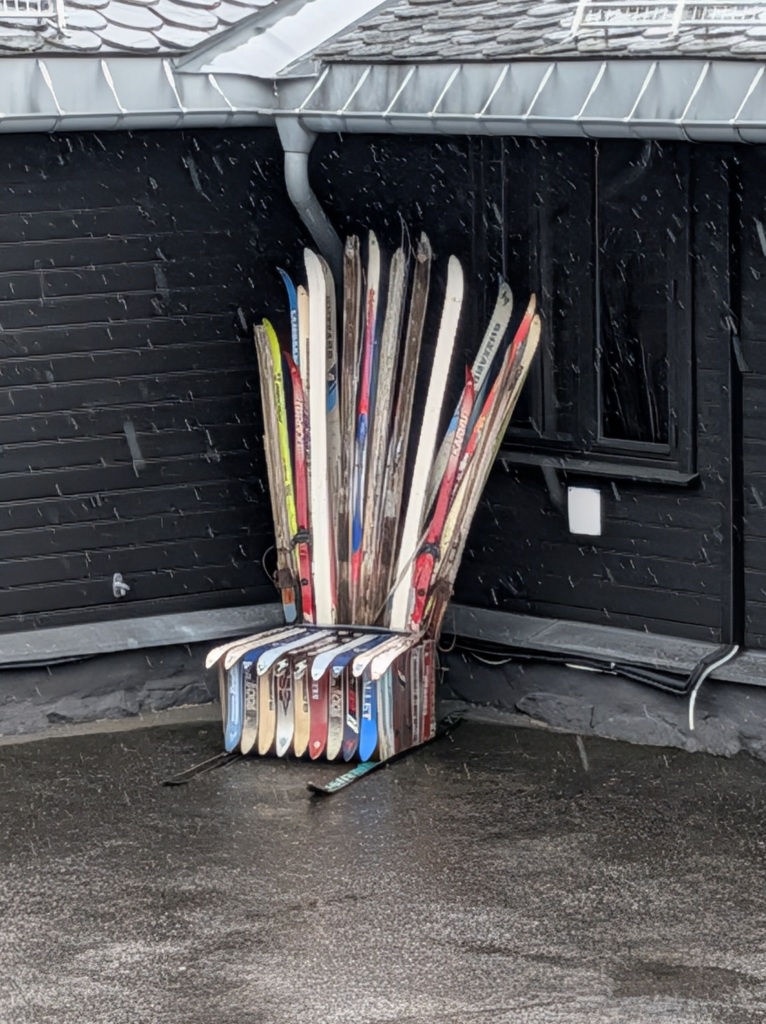
Not really related to any of that, but a restaurant nearby, next to the path to the train station, had a "Throne of Skis" on the outside.
Next stop was the Oslo Transport Museum.
Mostly because it was located on the same train line, it was still raining and entrance was included in the Oslo Pass.
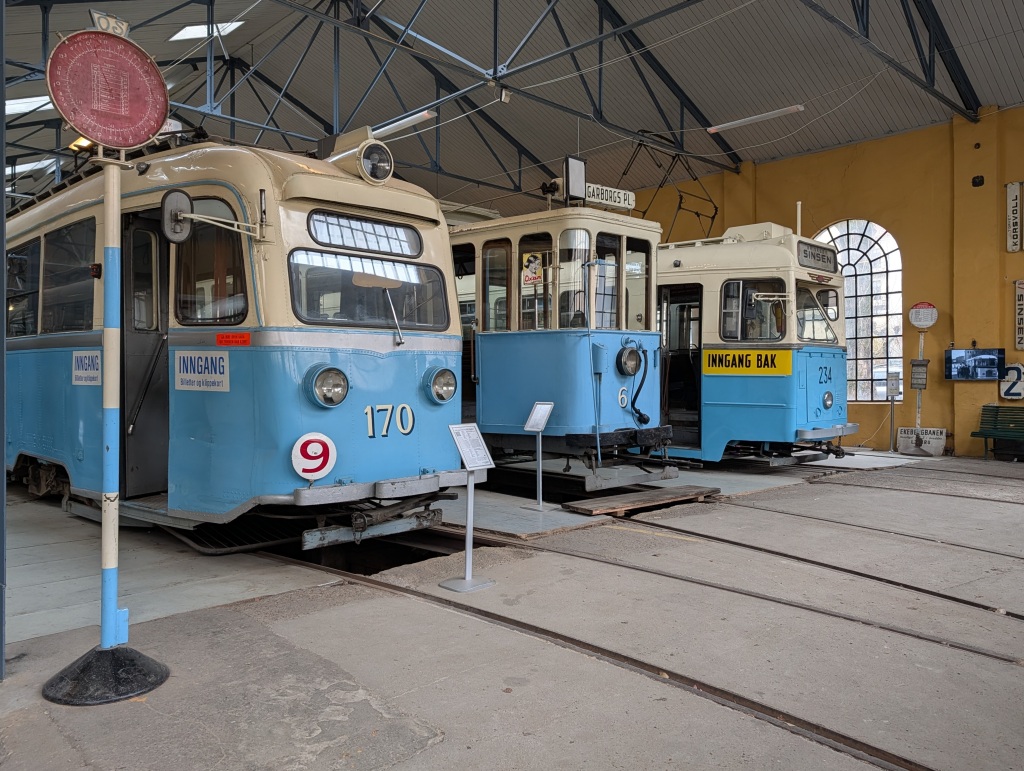
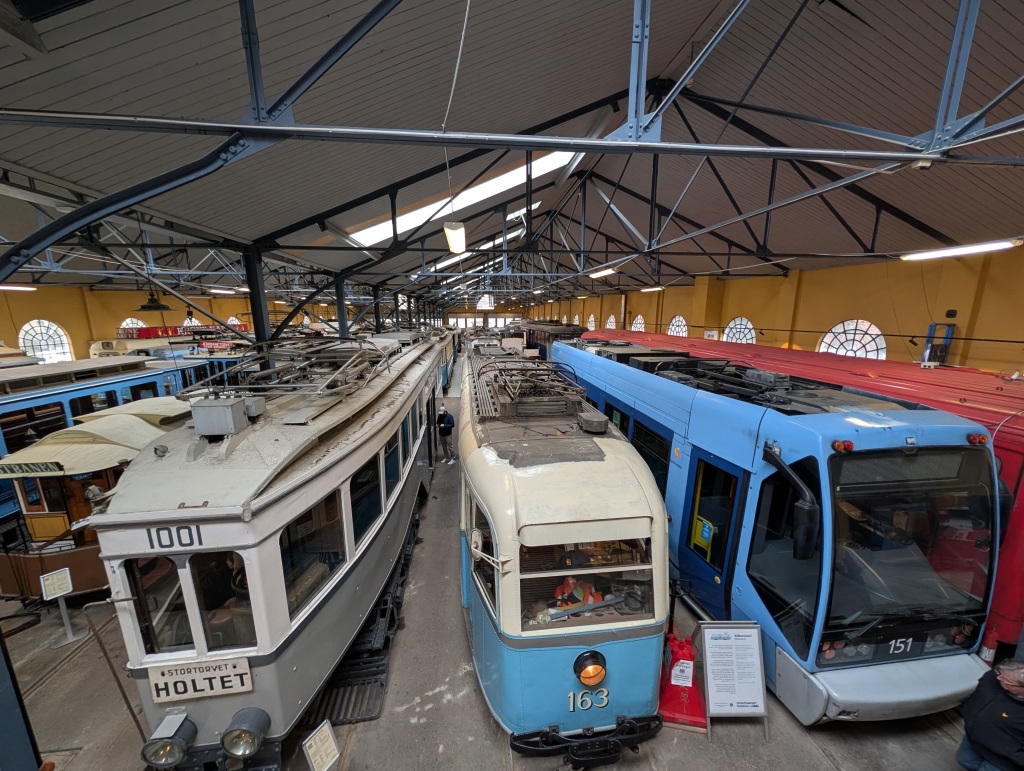
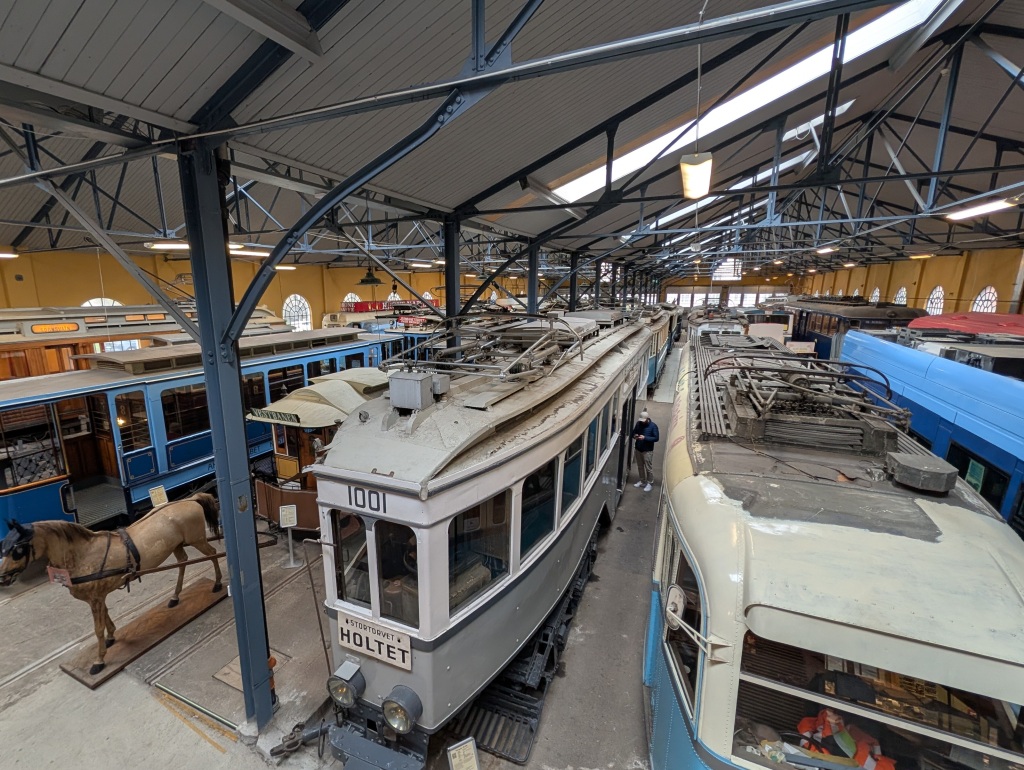
Not much to say about it. It's a museum with different trains and busses used in Oslo during the last century or so.
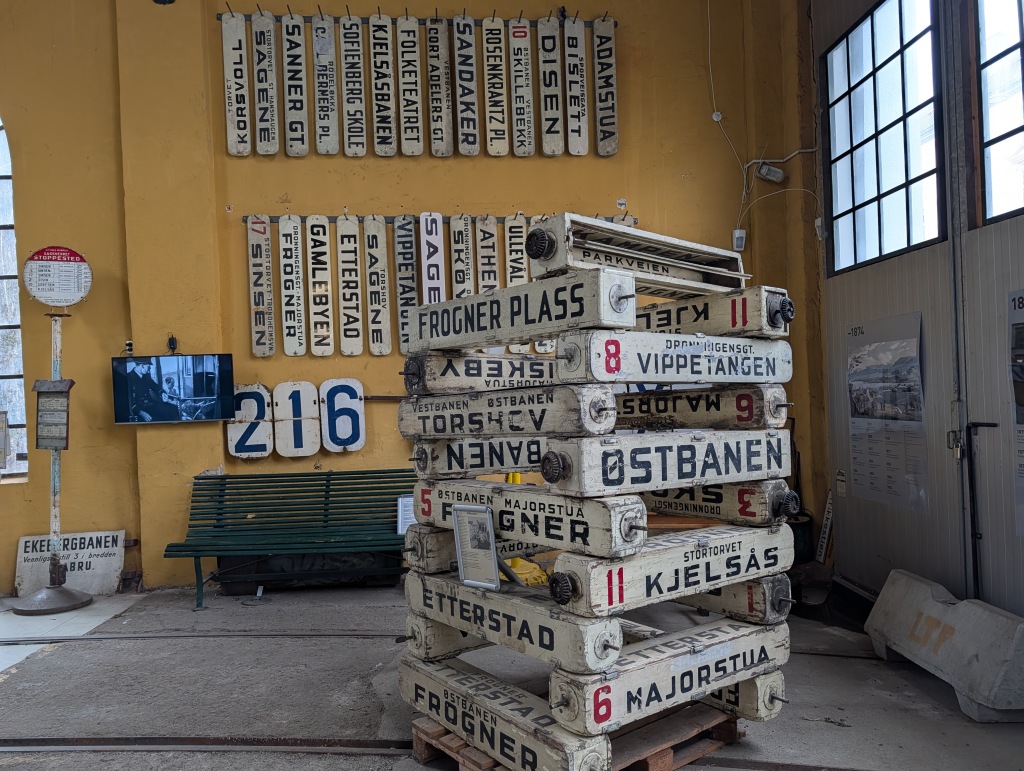
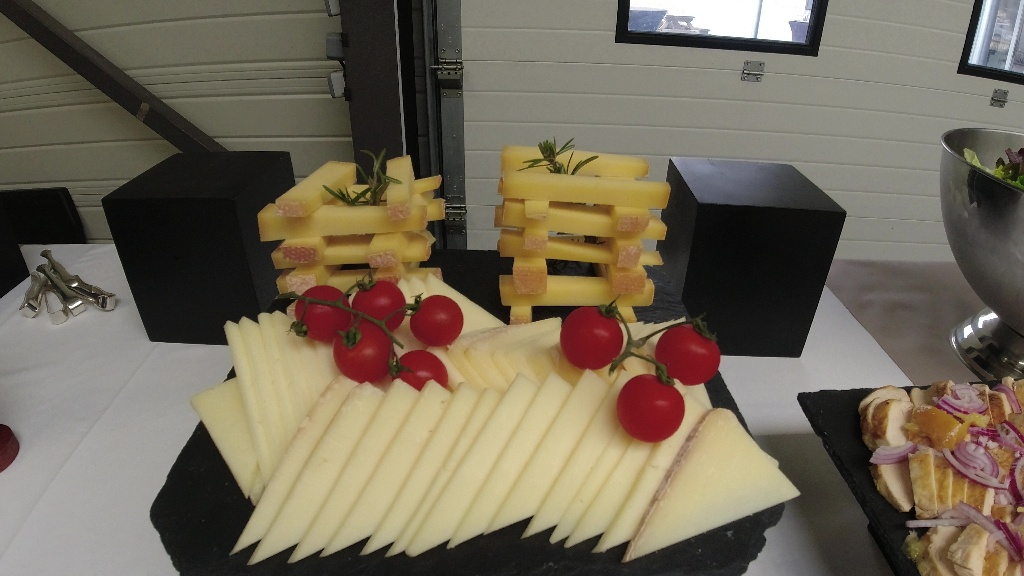
The pile of wooden blocks with station names was interesting, though. It looked a bit like the tower of cheese I had seen in Bordeaux two months earlier.
At first, I thought that these were simply some end-of-line buffers, with the name of the station painted on them.
Then I noticed that they had different texts on the four sides. And the cogwheel at one of the ends of each of them didn't make much sense for a railroad buffer either.
It turned out that these were indicators of where a tram or a train was heading.
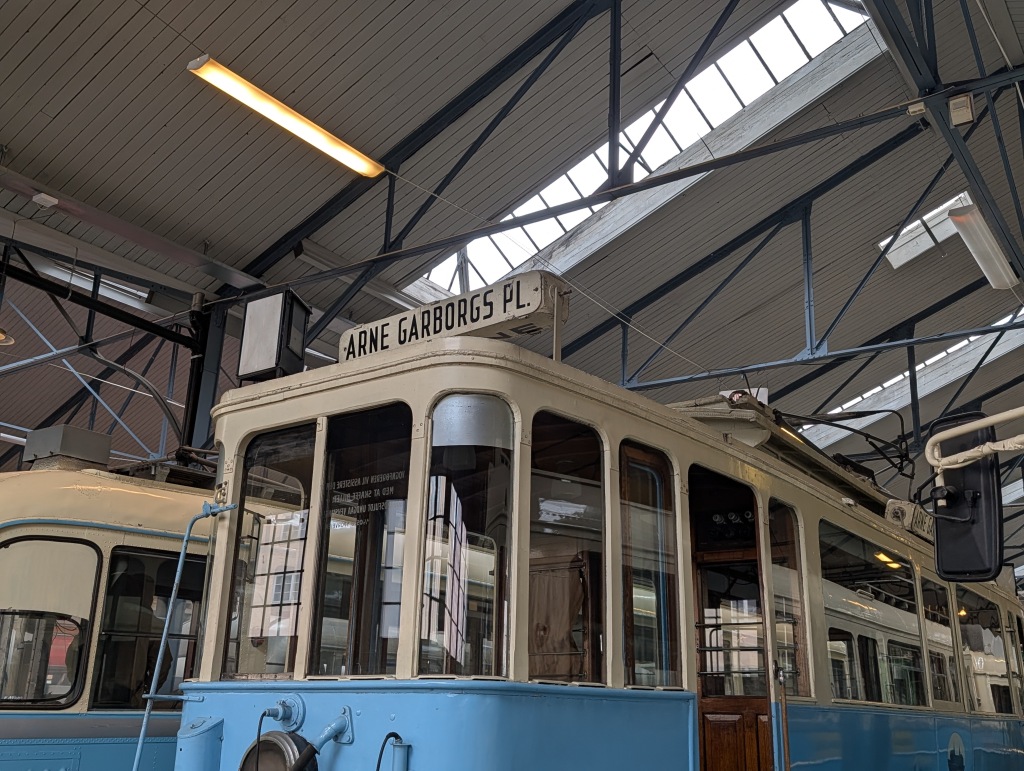
While other places used, in the era before digital displays, exchangeable destination plates (like on the wall behind the log pile) or some sort of scroll with place names, Oslo had rotating wood blocks on the top of trains. While not quite as cool as the revolving number plates on James Bond's Aston Martin, it is a neat idea.
Another thing that is probably unique to public transport in Scandinavia is that the trains to Holmenkollen used to have an outside ski rack.
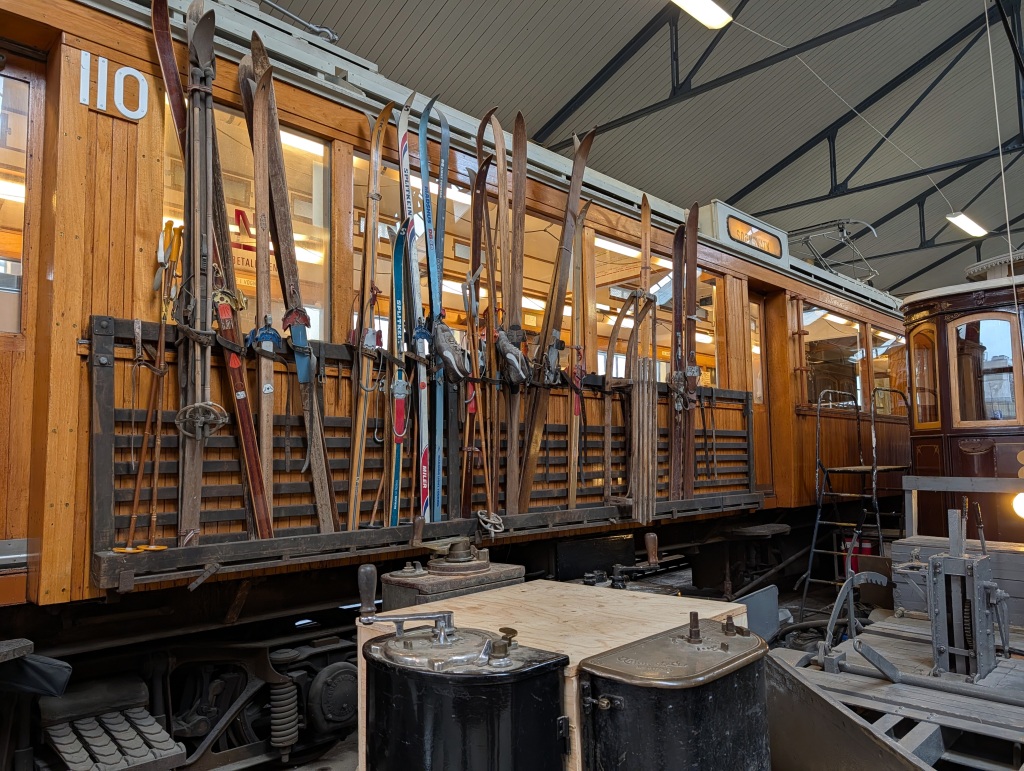
Next day the weather was fine again.
Sunny, warm, without a cloud in sight.
So I took the ferry to the Fram museum.
I would have taken the ferry anyway. While the Fram museum is on a peninsula and it would have been possible to walk there, it's a (roughly) ten-kilometer coastal path. Taking the ferry was faster and more convenient. But the good weather made it more enjoyable.
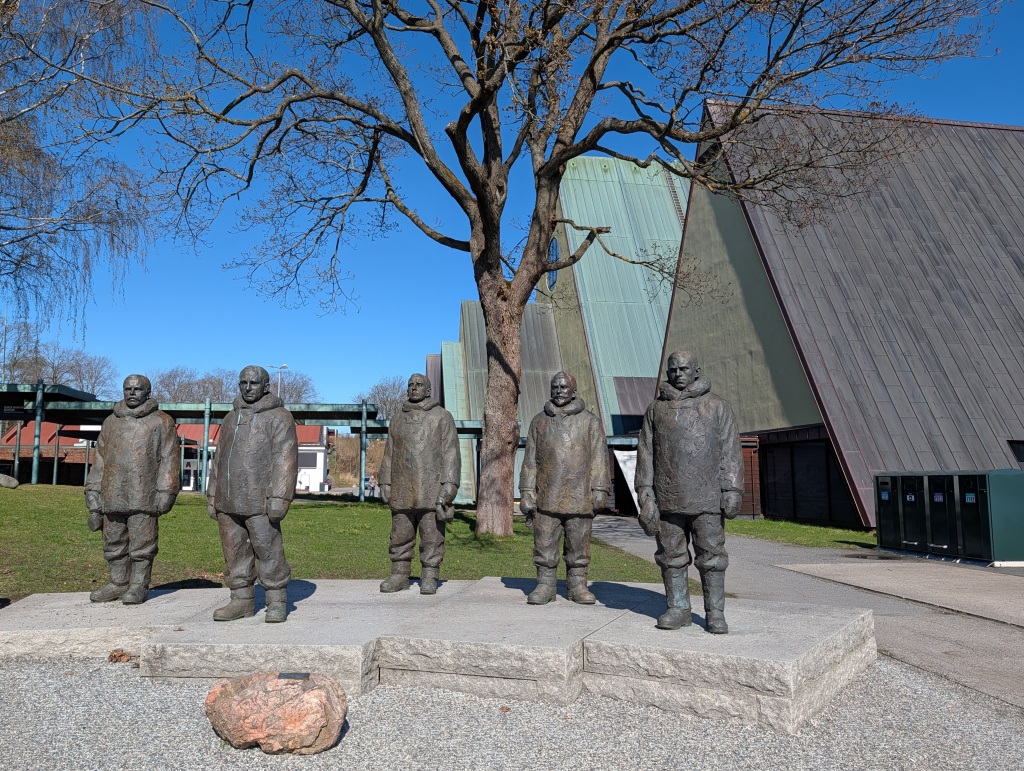
Outside of the museums are five statues representing the five people who used the Fram to get to Antarctica and continued from the coast to the South Pole, being the first to reach it: Roald Amundsen, Helmer Hanssen, Sverre Hassel, Oscar Wisting, Olav Bjaaland.
As the name of the museum implies, it is (mostly) dedicated to the Fram, which is the ship that was initially built for Fridtjof Nansen with the intention of drifting over the North Pole. And later was used by Amundsen for his journey to Antarctica.
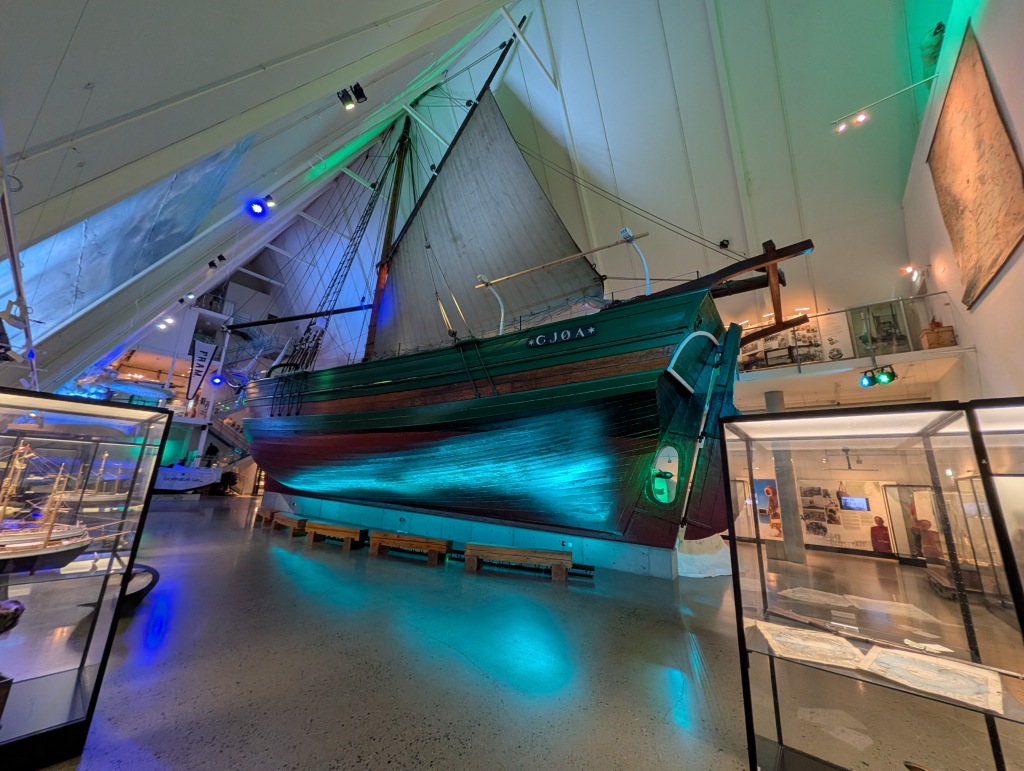
It's 'mostly' about the Fram, as there is also the Gjøa (the first ship that went through the Northwest Passage) on display.
The first thing that is noticeable about the Fram is that it's not an elegant ship.
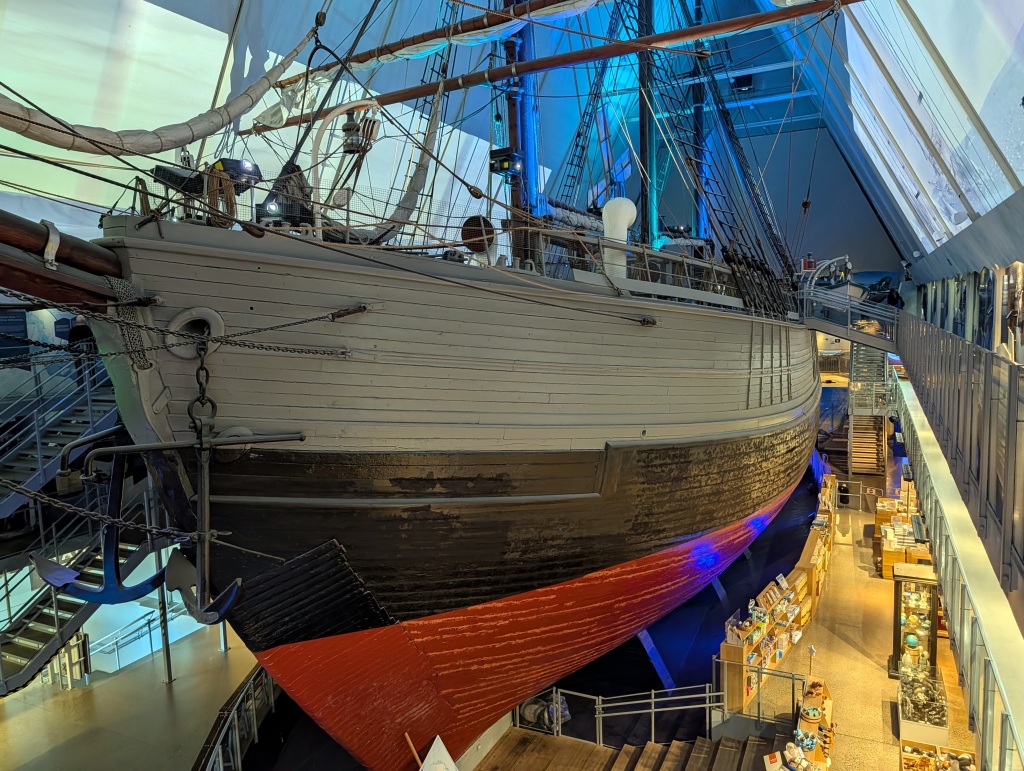
I'm no expert on ships, but even to me it seemed like the naval equivalent of a truck.
Utilitarian and built to maximize the available space. But not an ounce of style.
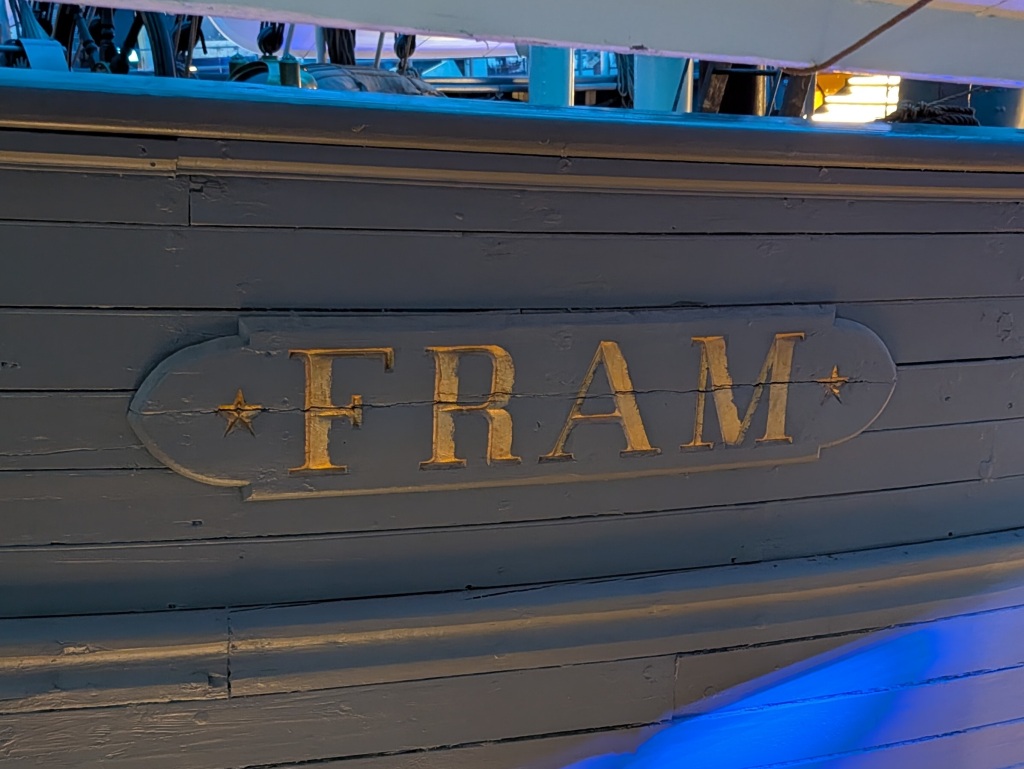
It doesn't even have its name written on its side (there's one at the stern, though). Possibly the idea was that, where the Fram was going to be travelling, there'd be nobody around to read its name.
Also, even to me, it didn't look like it would be stable in the water. From below, it looked more like a submarine - kind of rounded with neither a flat bottom, nor a protruding keel (except for a small one at the bow). It looked like it would roll a lot in open water. And indeed, as when I looked it up later, I found that "it rolled more than most ships in heavy seas".
But it was, obvious by the fact that it was sitting in a museum and not on an ocean floor somewhere, like the Erebus or the Endurance, very good at what it was designed to do - withstand the Arctic and Antarctic sea ice.
The inside looked utilitarian, but nice. A bit like a Scandinavian mountain cabin.
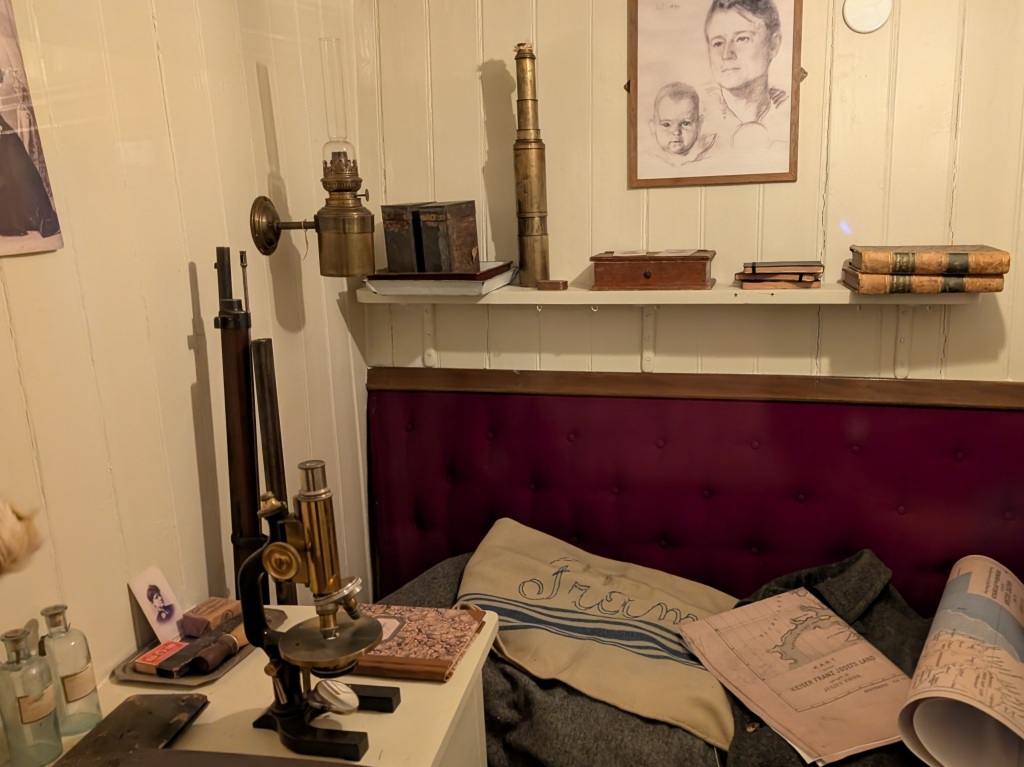
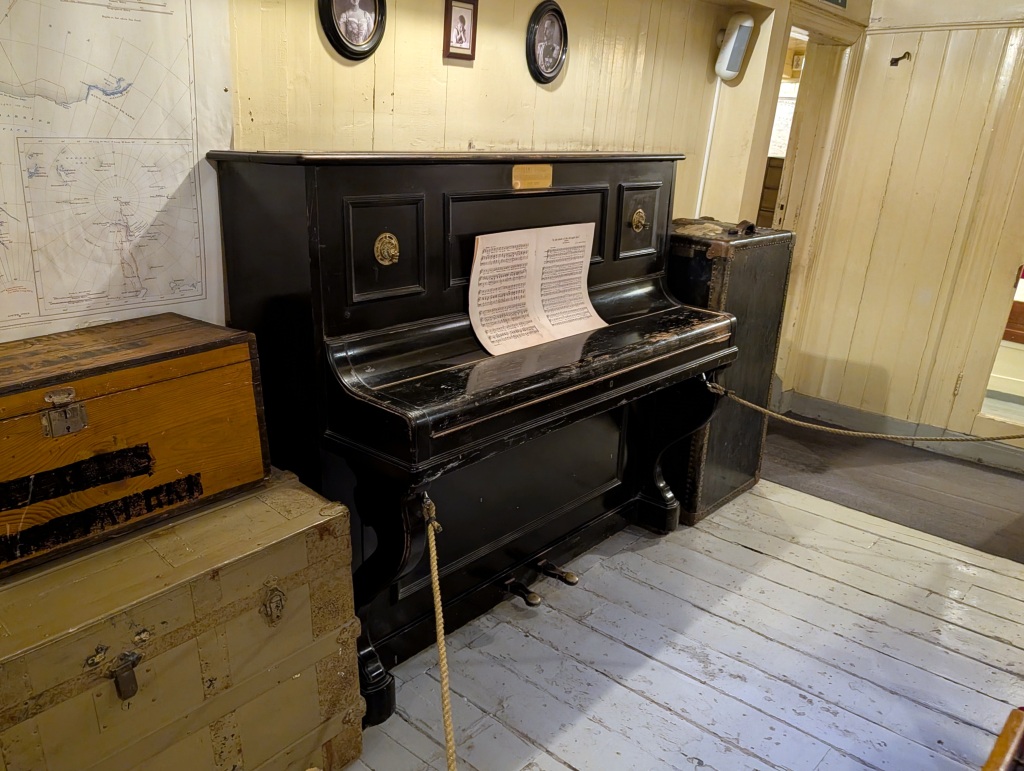
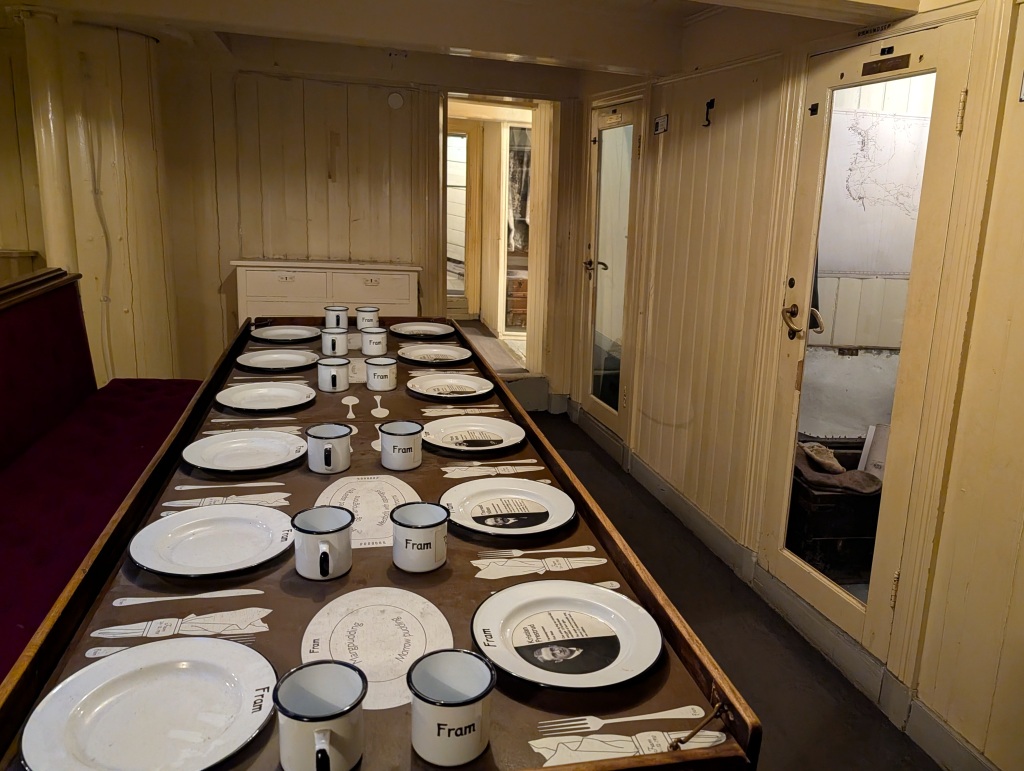
It's easy to imagine spending a couple of nights in there.
However, the ship was designed to carry twelve people and enough provisions and equipment to last for six years. And, presumably, it'll get somewhat dull after a year or two.
Also, the way it's currently presented, there's a lot of open space. When it was ready for an expedition though, every bit of space will have been tightly packed with things, so it will have felt a lot more cramped than it looks now.
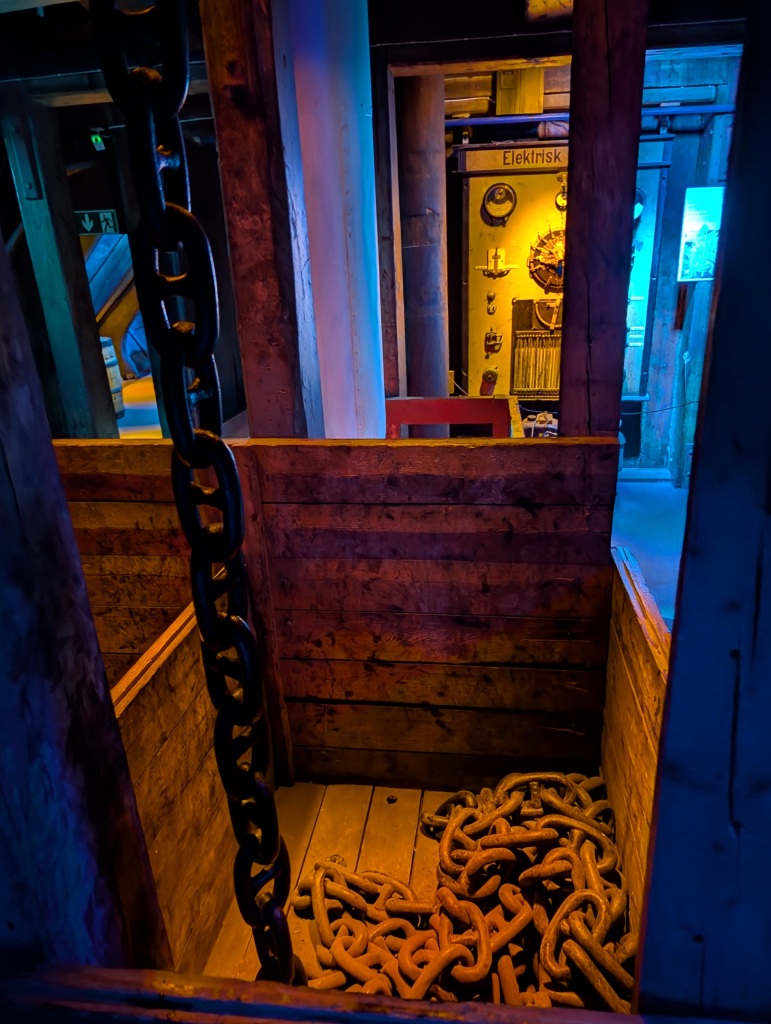
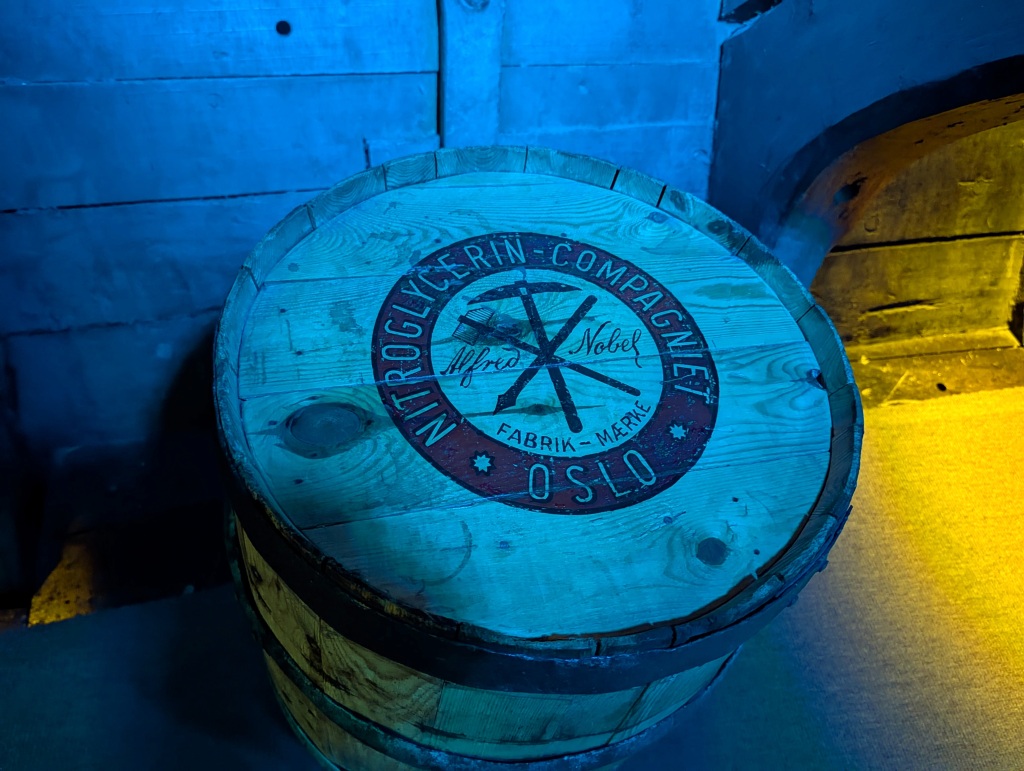
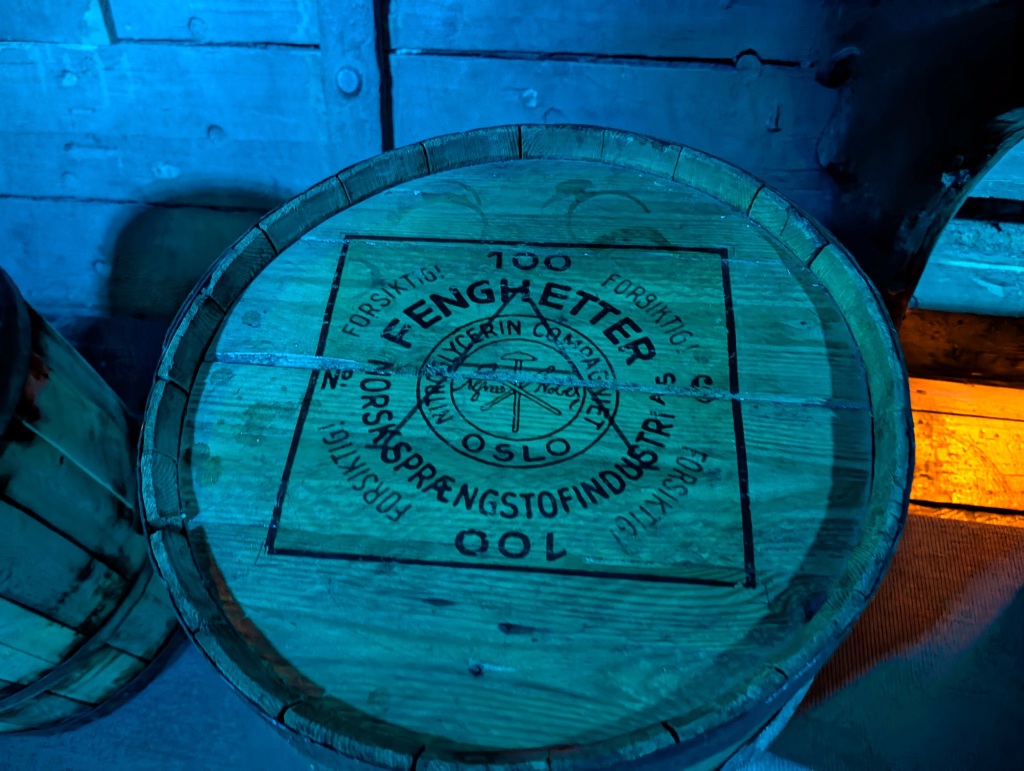
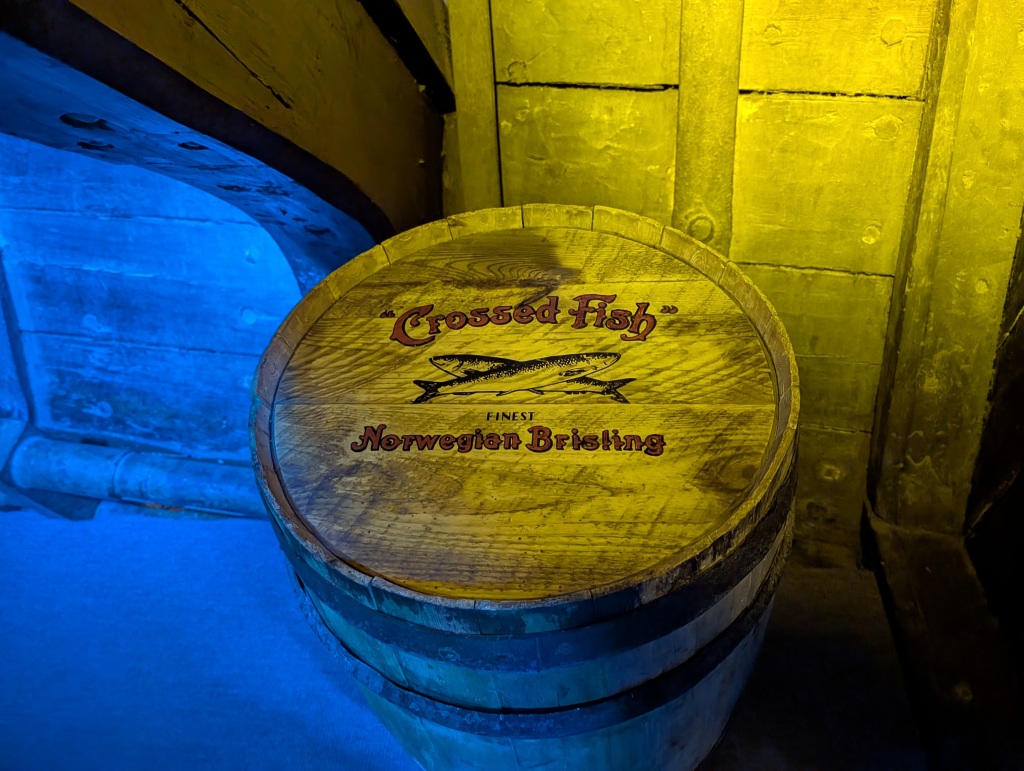
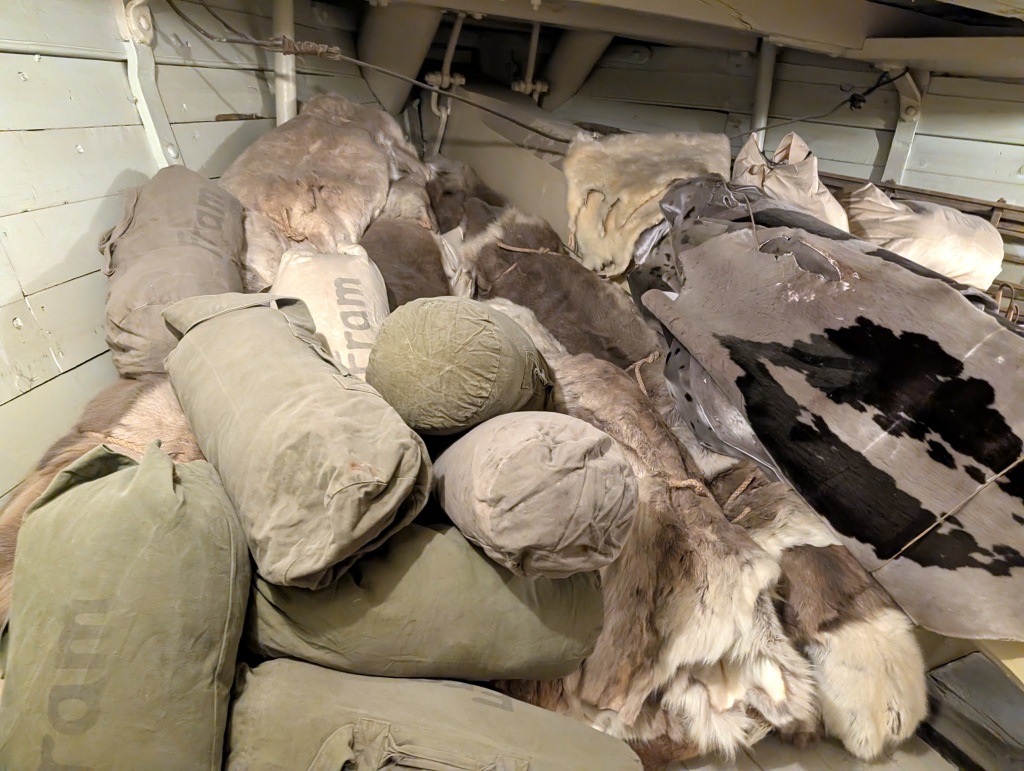
Still, the ship did its job and did it well.
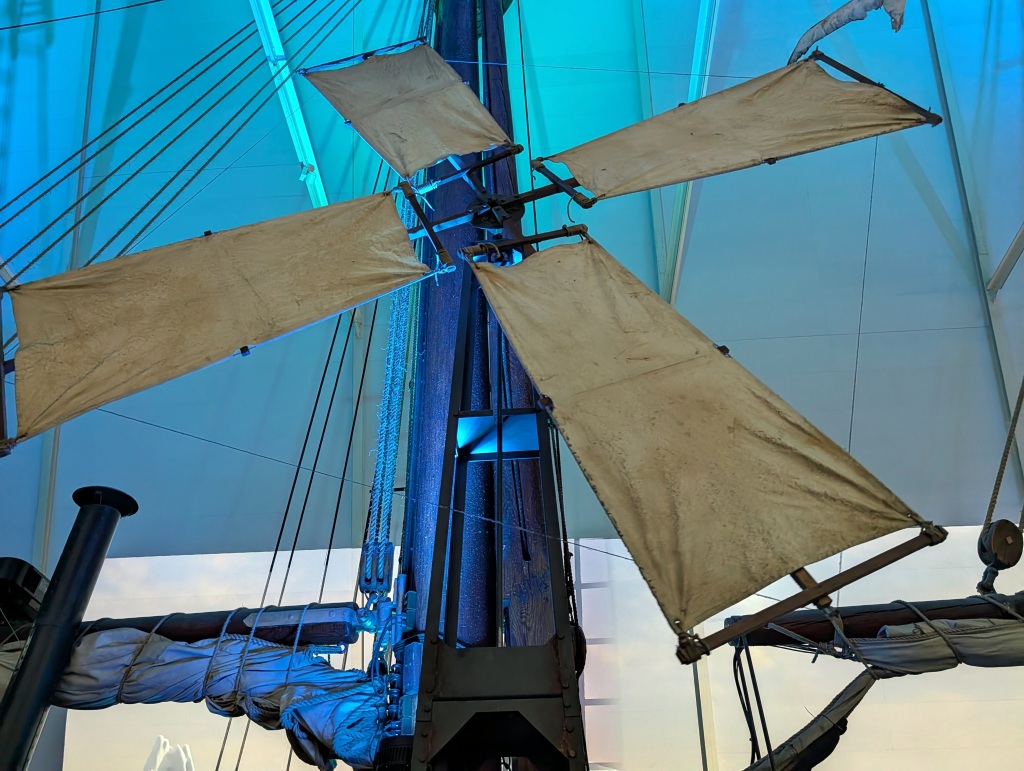
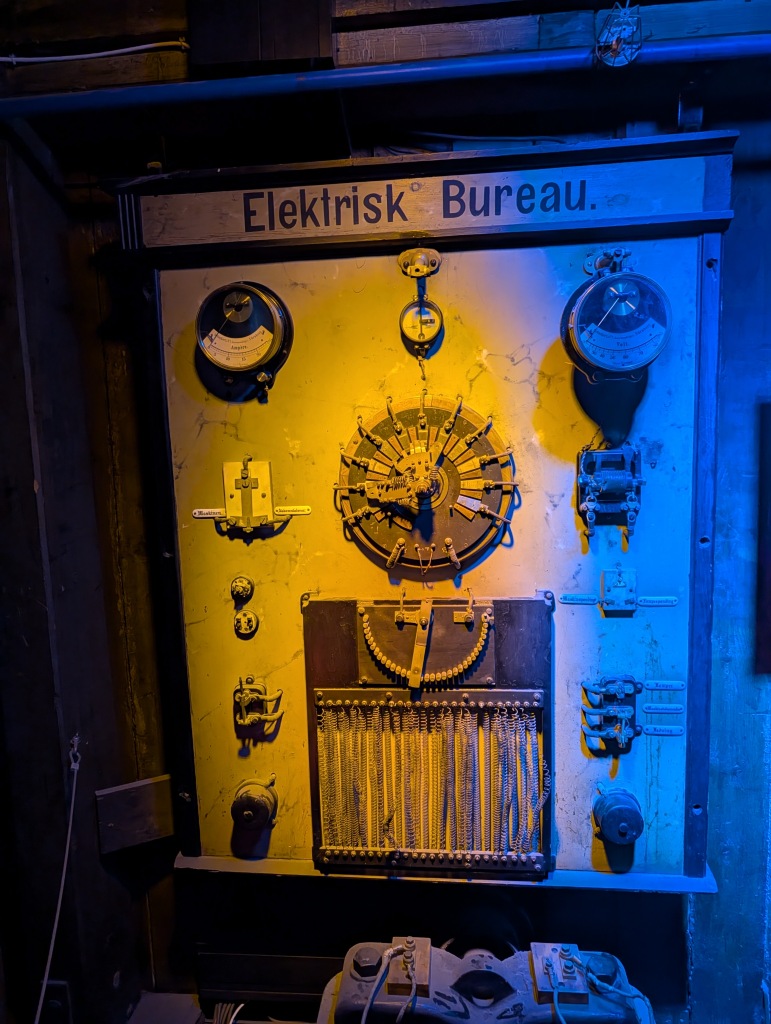
It was interesting to notice that there was a mid-sized windmill on deck with a generator attached to it, which provided electricity, allowing electric lights to be used below deck. (Note that the ship has no portholes at all, so it would have been pitch dark inside otherwise.)
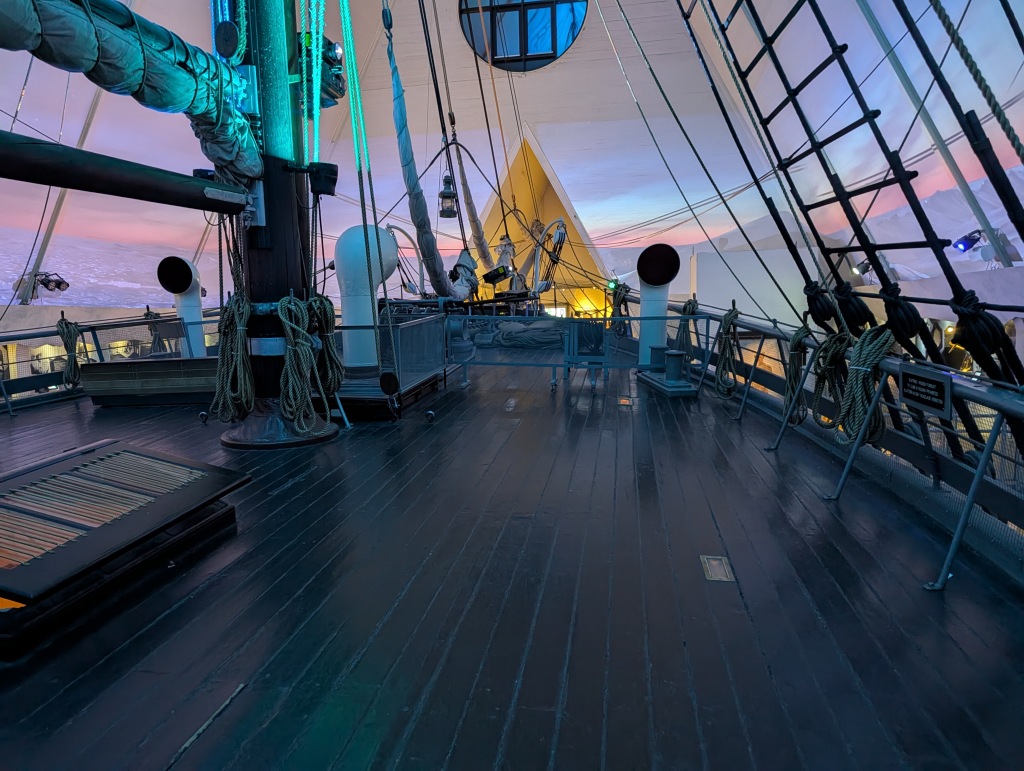
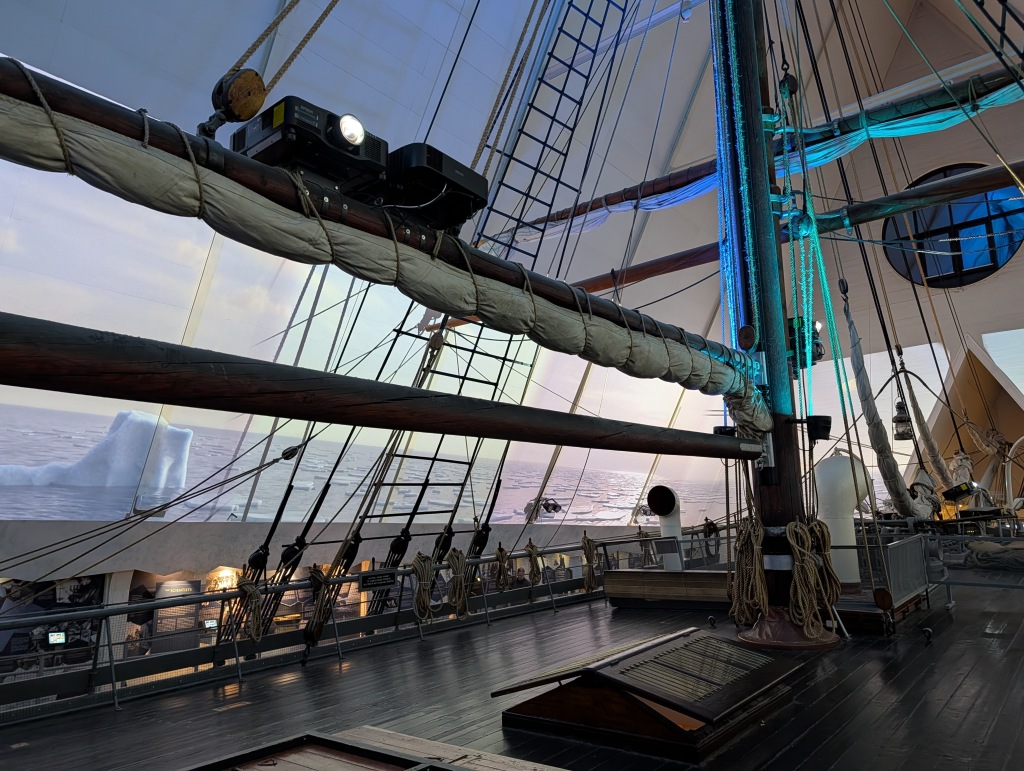
To provide some suitable ambience (and make the museum a bit more 'alive') the museum curators had installed video projectors in the rigging to project nautical environments (from calm sunsets to stormy seas) onto the slanted walls of the museum.
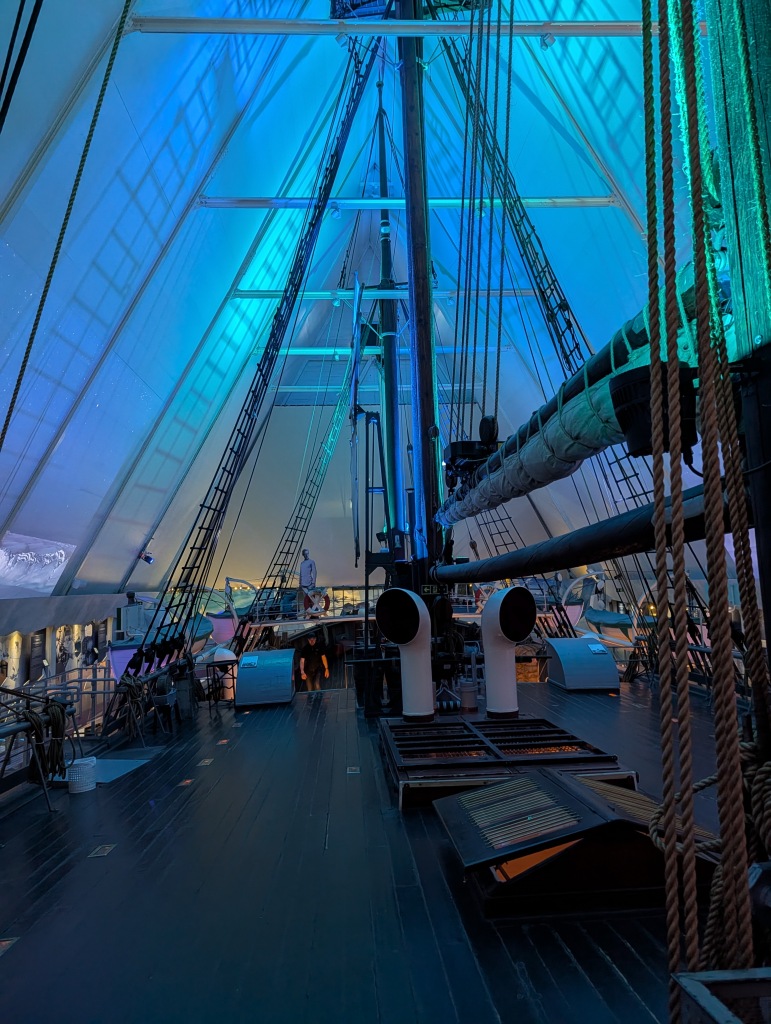
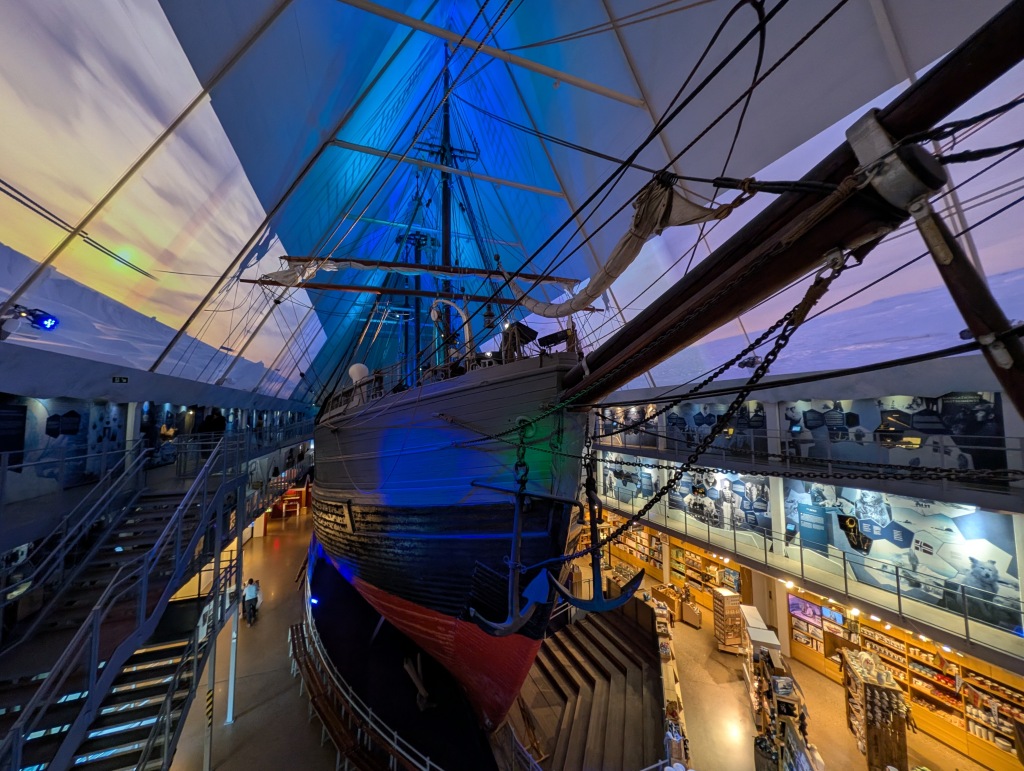
After visiting the Fram museum, I walked around on the peninsula for a bit, before catching the boat back to central Oslo.
At some point I had noticed a car for electric installations, which seemed to have some figure painted on its side, somewhat reminiscent of Wallace from "Wallace & Gromit: The Wrong Trousers".
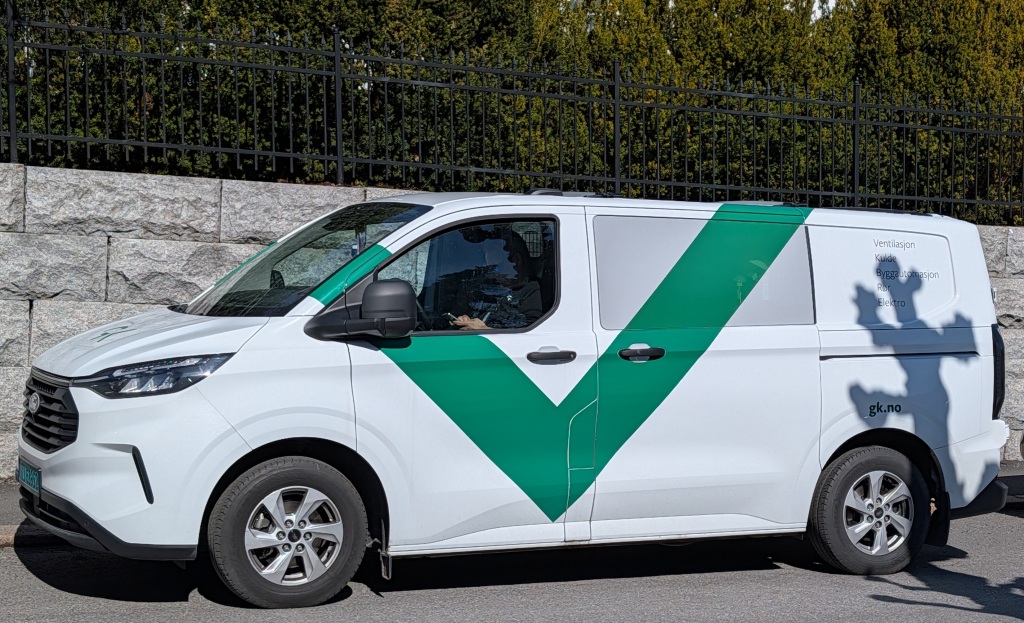
On second look however, it turned out to be nothing more than the shadow of a nearby tree trunk.
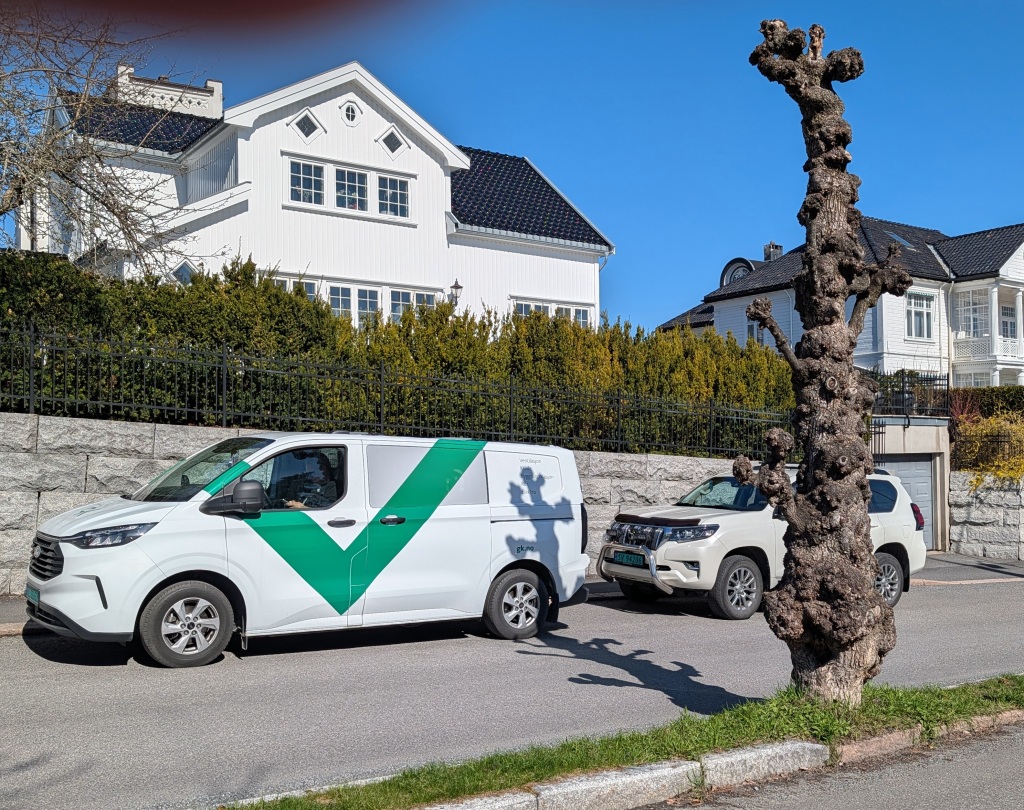
When I arrived at the pier in Oslo, the weather was still good (it would be that sunny for the rest of the week, but I didn't know it then) and there was a two hour boat tour along the fjord leaving half an hour later, so I went on that to see the scenery in the inner Oslo Fjord, sit back, and relax.
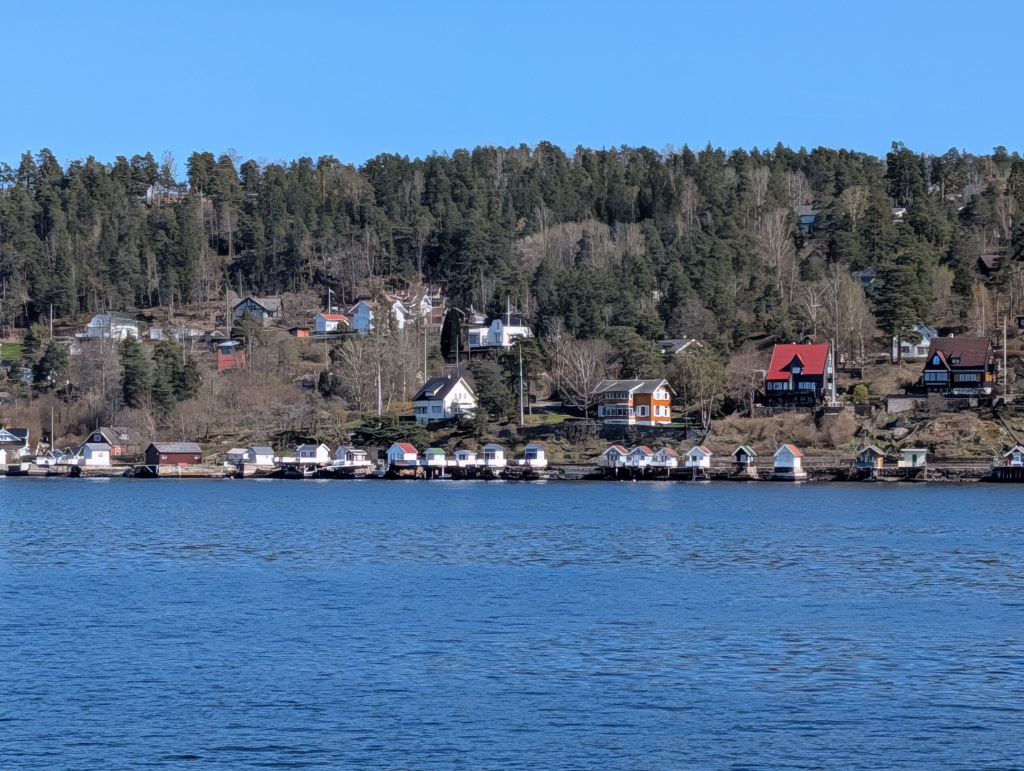
Back on land, I decided to have a look at the other Oslo sculpture park.
The most famous one is, of course, the Vigeland Park (or, going by the official name, Frognerpark).
I had been in Oslo only once, 28 years ago, and had only half a day available. And the Frognerpark is what I had visited then. (Though, to my surprise, when I looked up what I wrote back then, I found "I was a bit surprised that a place like this is relatively unknown. ... The first time I heard about it was when I bought a book about Oslo when I found out that I had a one day stay there and wanted to know what to see. " Obviously, it was much harder to find out about things in the days before Wikipedia.)
In any case, I had been to Frognerpark, so I went to Ekebergparken.
While in Frognerpark the sculptures are (almost) all naked humans by the same artist, Ekebergparken has a wider variety. The area near the entrance from the tram station has some 'traditional' looking human statues.
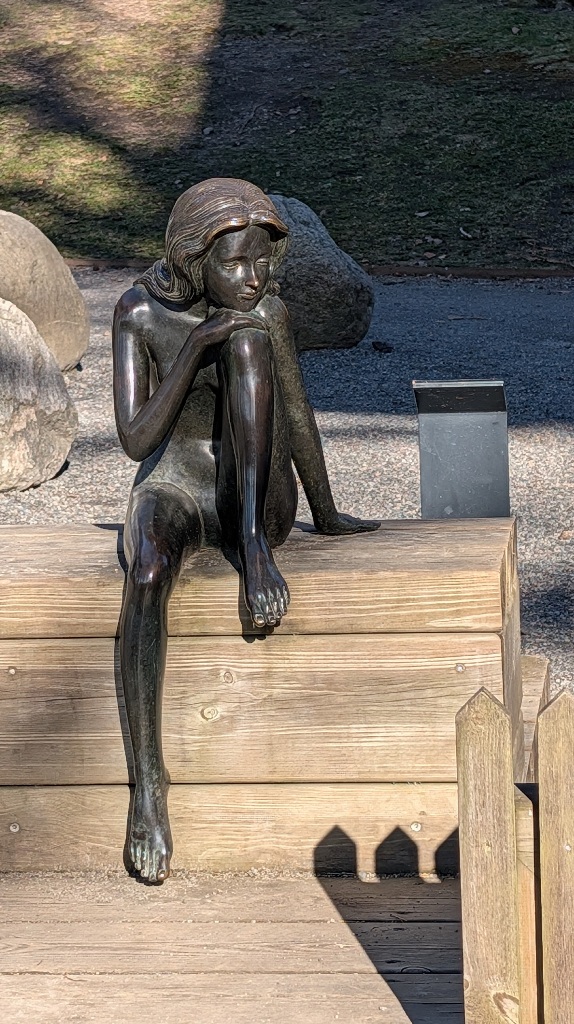
But even here, some of the 'traditional' looking sculptures are representing modern life.
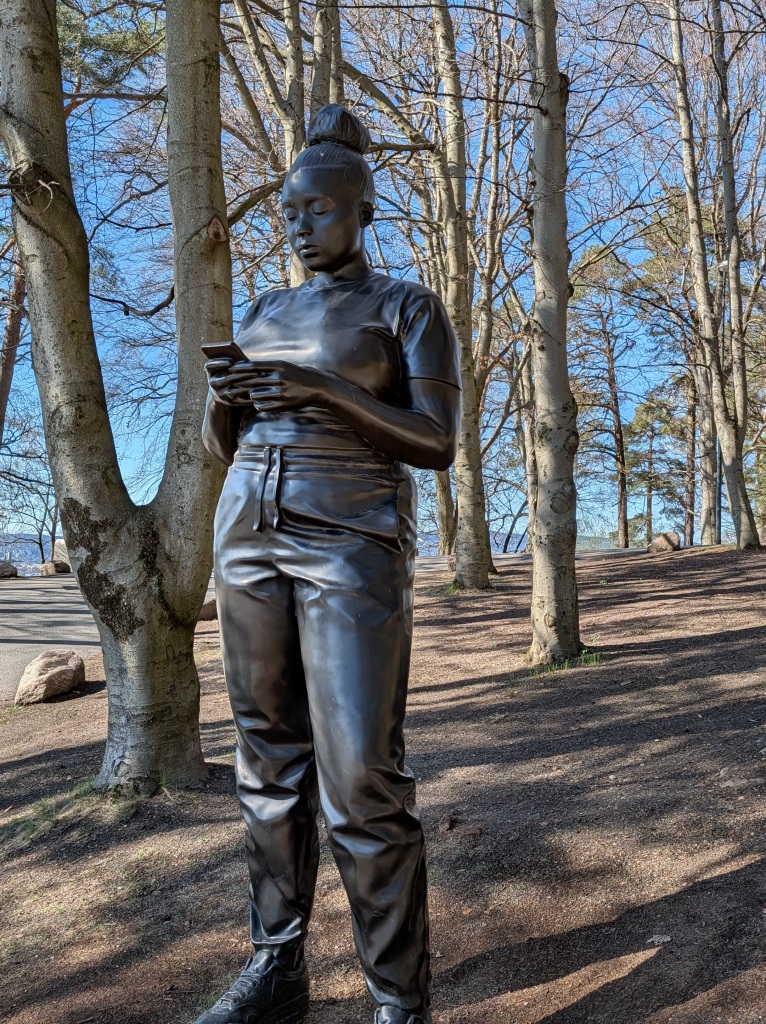
And sometimes engaged in activities that aren't often found in classical art.
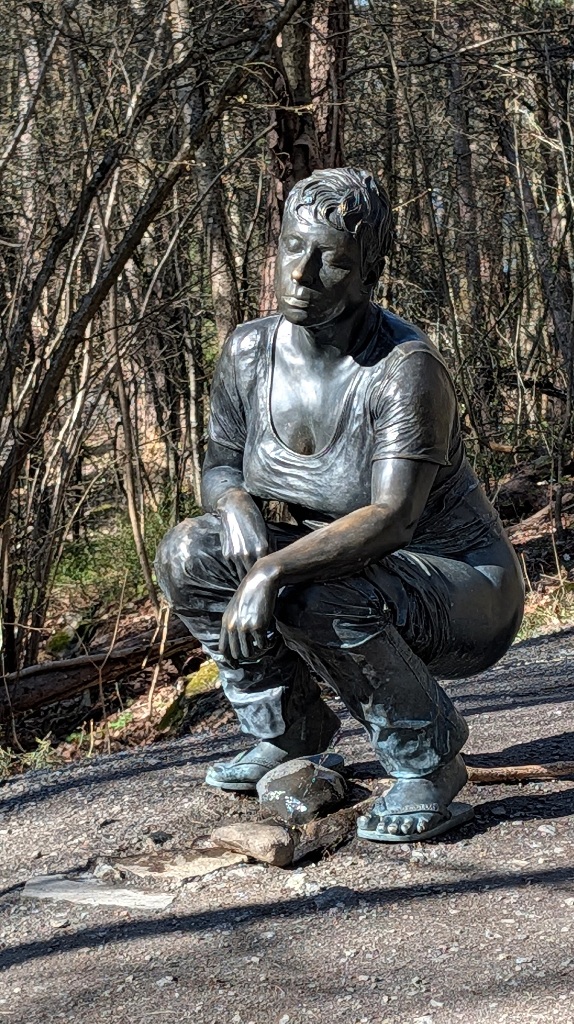
(This one is actually a fountain, so from time to time, there's water flow coming from the sculpture.)
Another sculpture almost goes all the way around - looking contemporary while harking back to ancient times.
Like this walking woman.
The idea behind that is that ancient marble statues weren't supposed to be white.
Initially, they were painted (however, how lifelike is debateable). And as the paint faded over the centuries, they were 'cleaned' and became the white marble sculptures as they are now known.
So this statue (although bronze and not marble) is painted in semi-realistic colours.
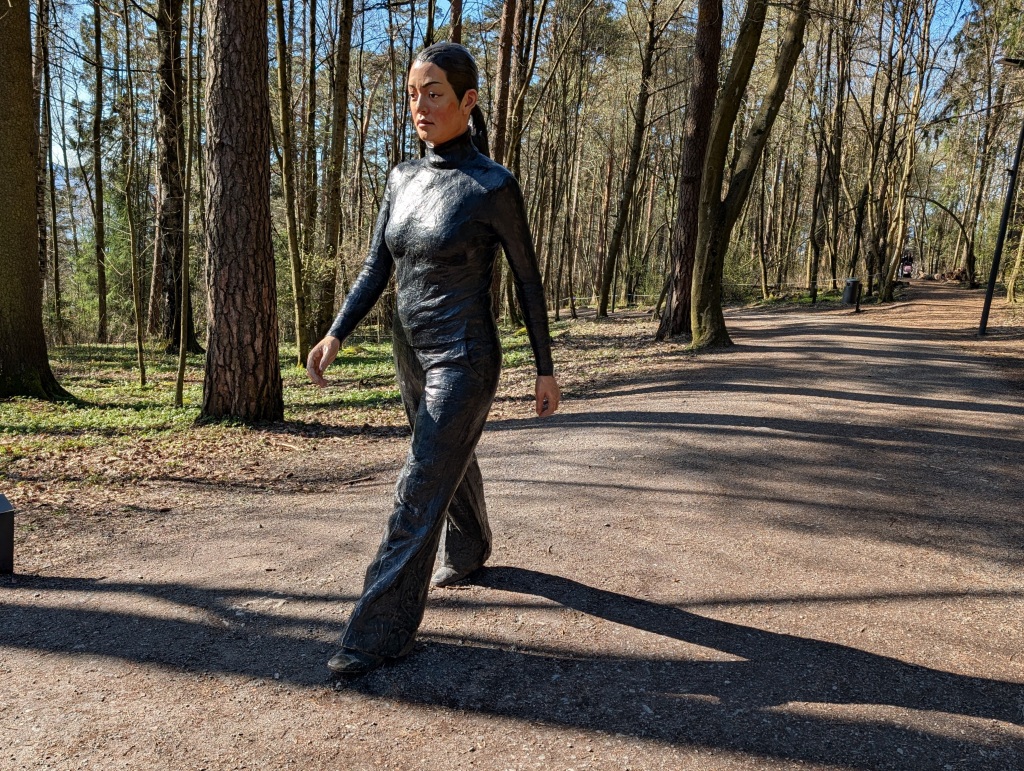
She also eschews traditional poses or a pedestal, but seems to be frozen in an everyday activity, like walking through the woods.
Close up, she's not quite realistic, mostly because the sculpture is oversized. At 2.20 meters, she's larger than most people. At least a head taller than me.
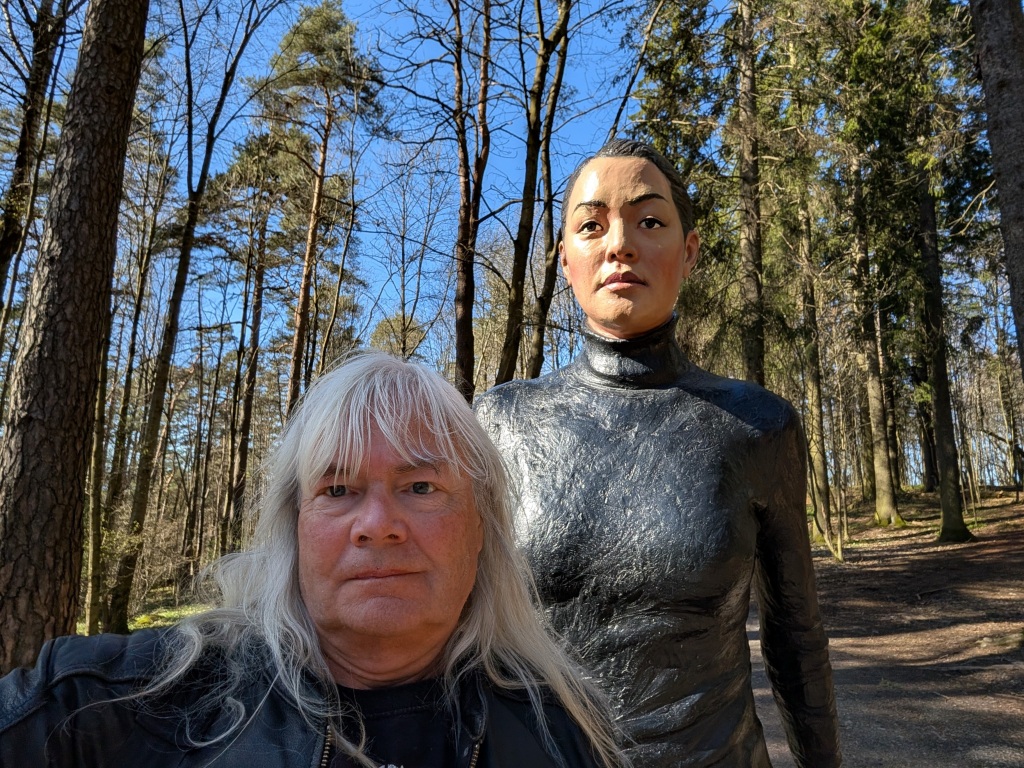
From some distance, however, except for her lack of movement, she doesn't look out of place in her environment.
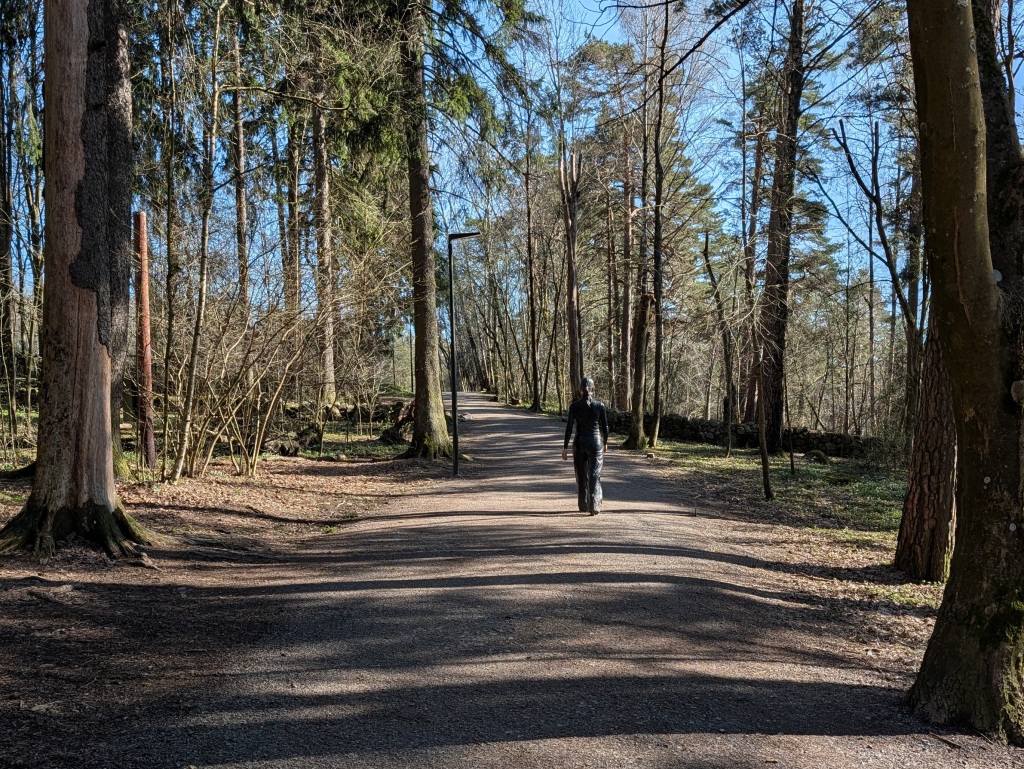
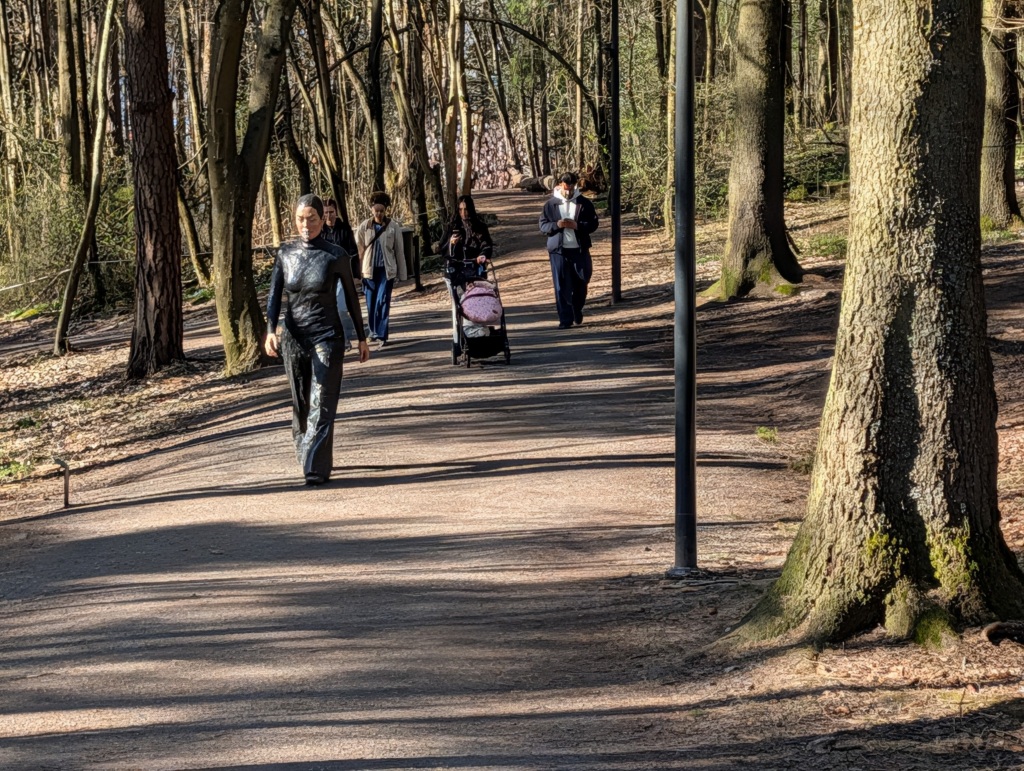
While the walking woman, being painted, puts a twist on the appearance of traditional marble sculptures, two other sculptures play with the image of marble statues in other ways.
One sculpture looks, at first glance, like a regular marble sculpture of an angel.
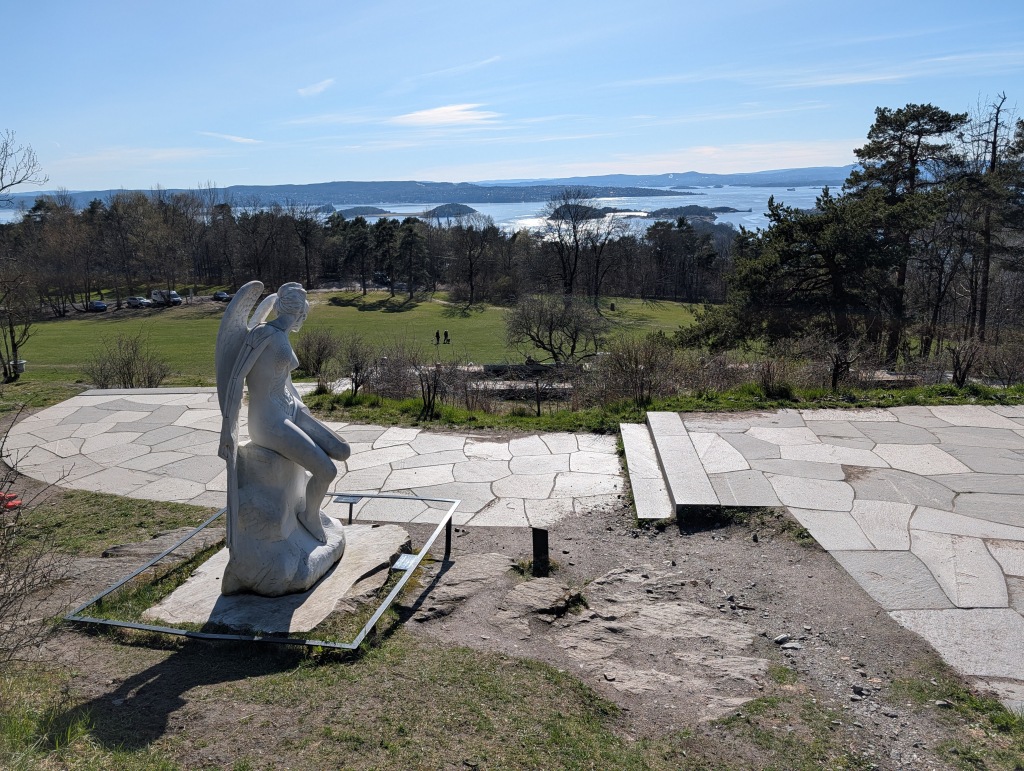
From close up, it looks more like something from an anatomy book, showing an angel that's unexpectedly human underneath. (Including, from the right angle, the ankle of the angel.)
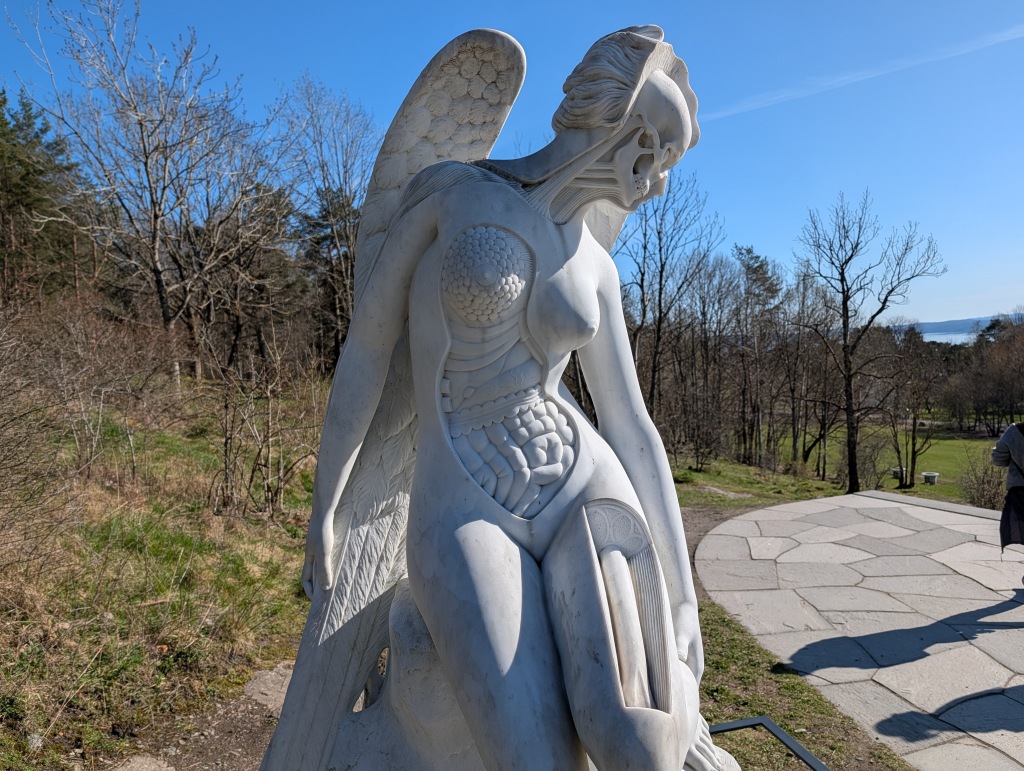
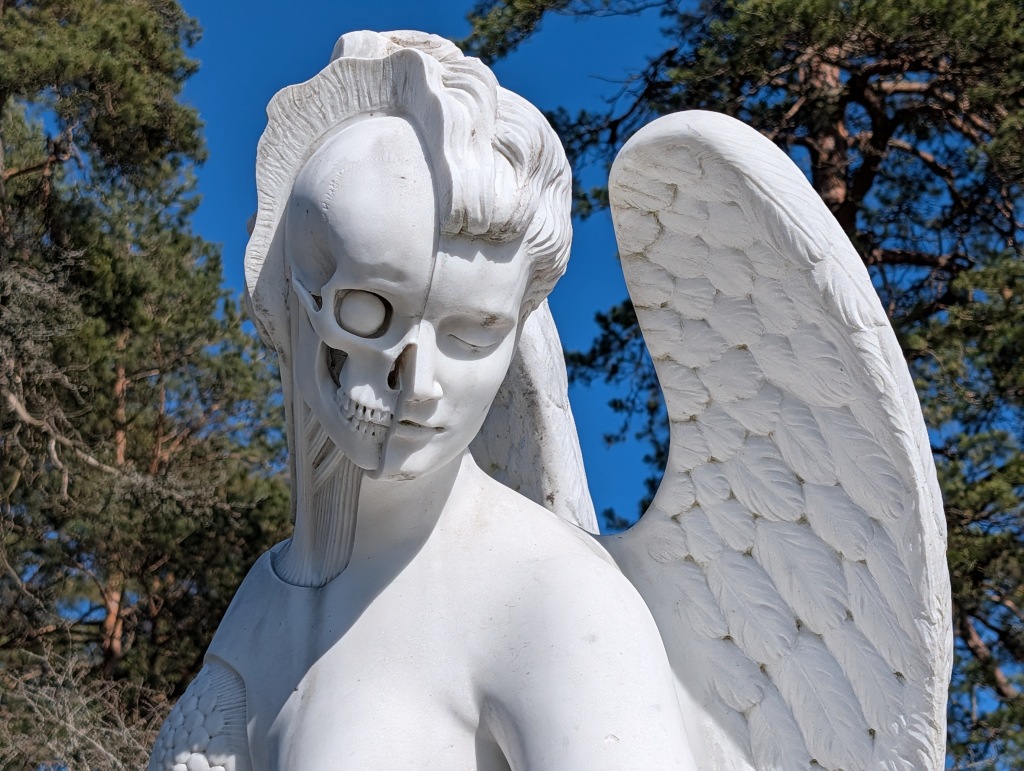
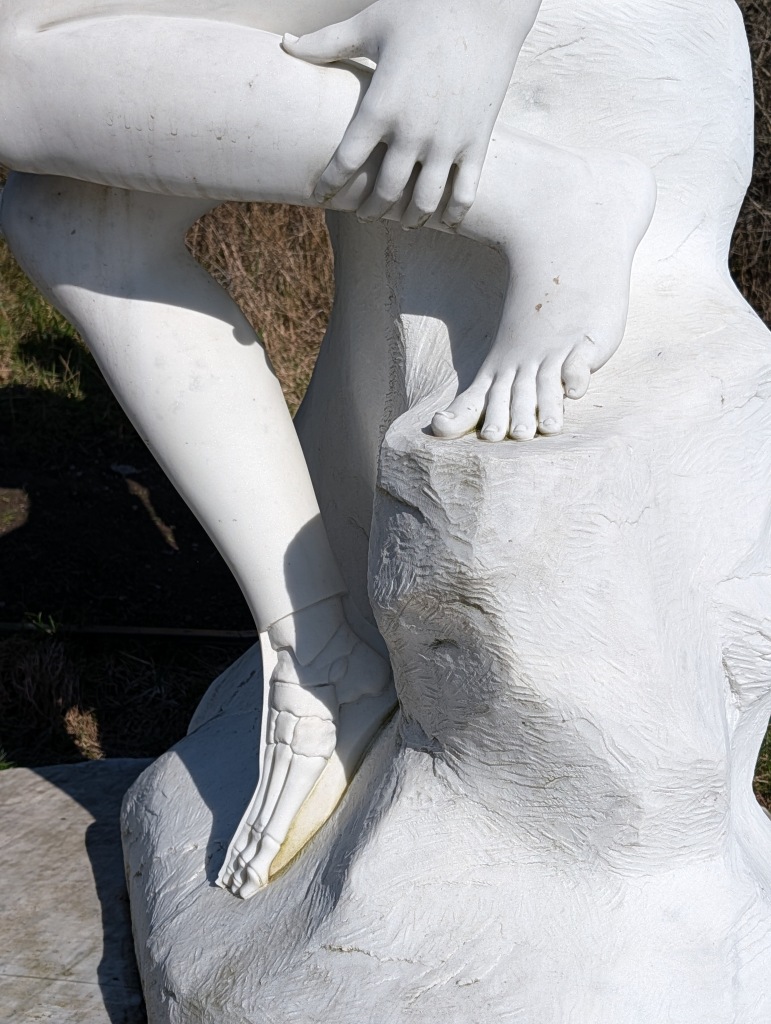
Close to that, in a much darker way, there's a sculpture revealing even more anatomy (well, bone structure).
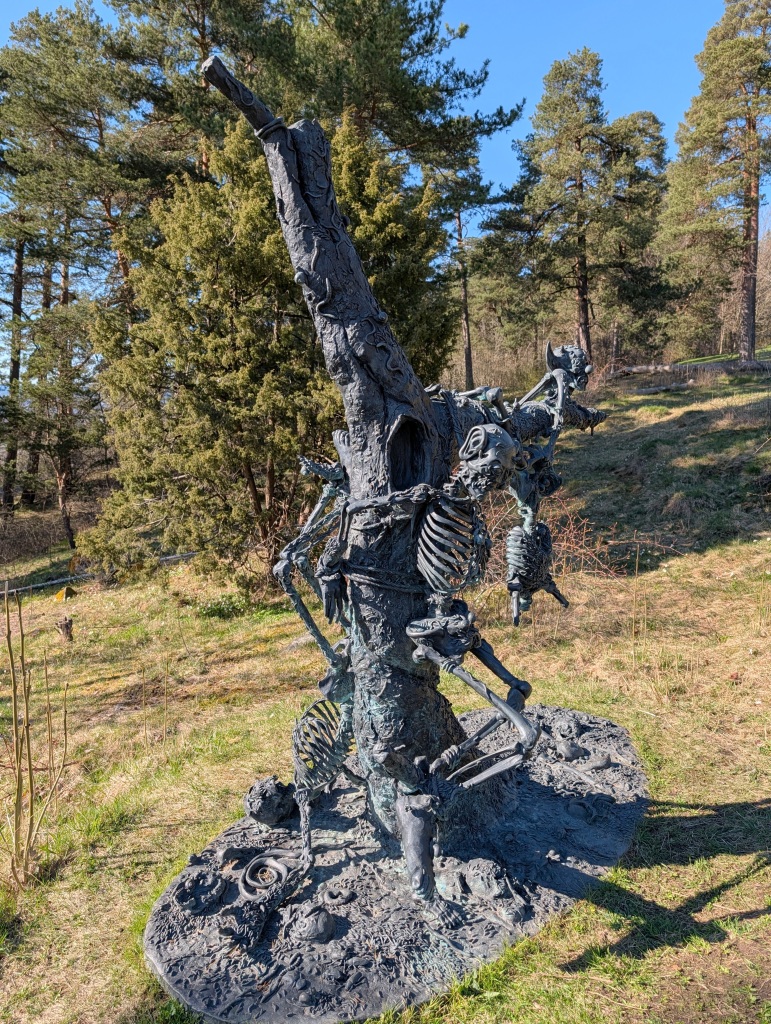
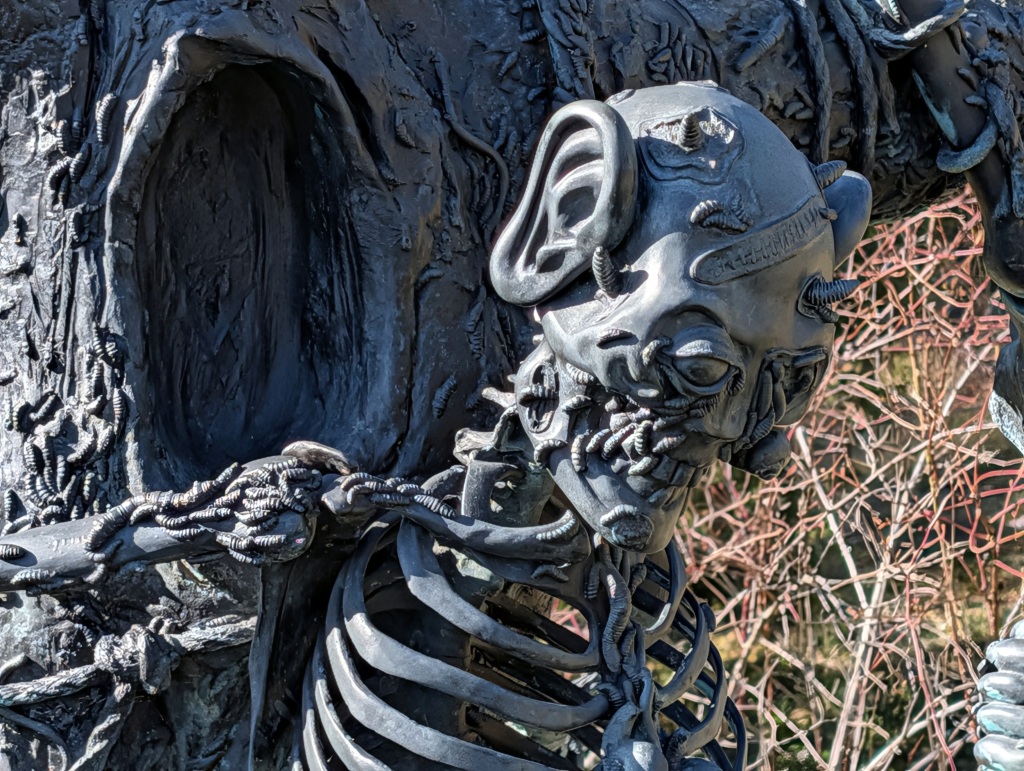
That's not the other sculpture playing with the perception of marble sculptures I mentioned.
It's a sculpture of a levitating woman, right out of a magician's performance. Playing with the idea that marble is solid and heavy, while a levitating woman (at least as the trick pretends) is weightless. (The sculpture also looks a bit like something from a tomb.)
(Reading up on the sculpture, I was surprised to notice that it isn't actually marble, but cast in bronze.)
Another sculpture played with perspective.
While it looked like a giant head from one side, it was flattened and looked oddly stretched from other viewpoints.
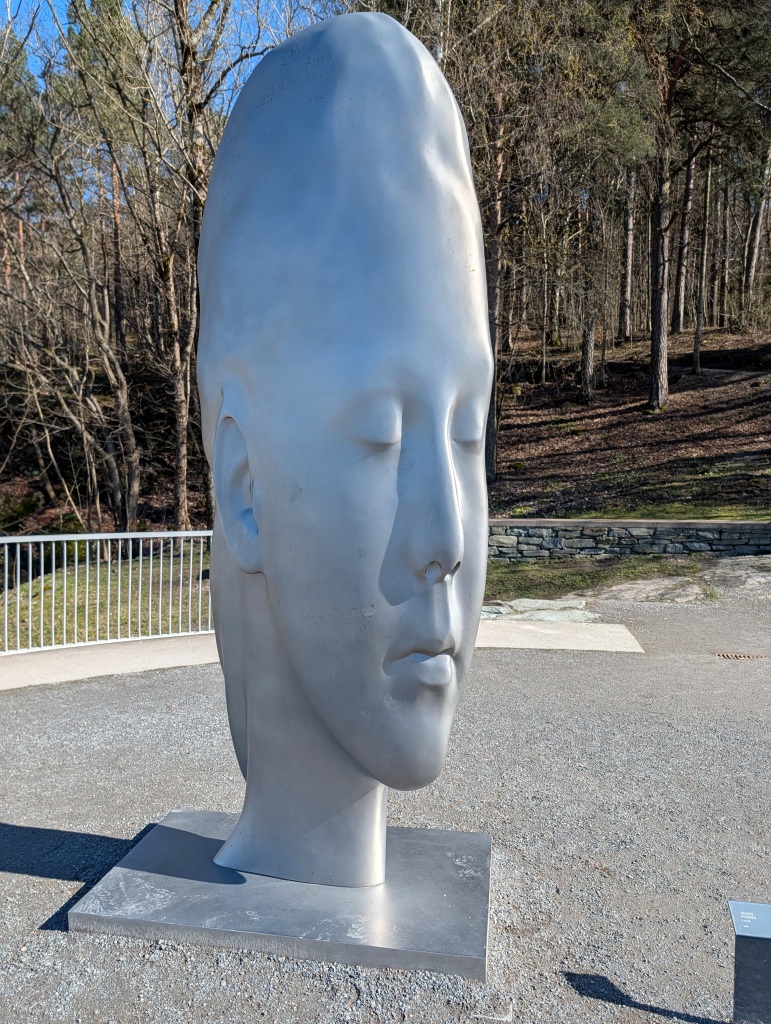
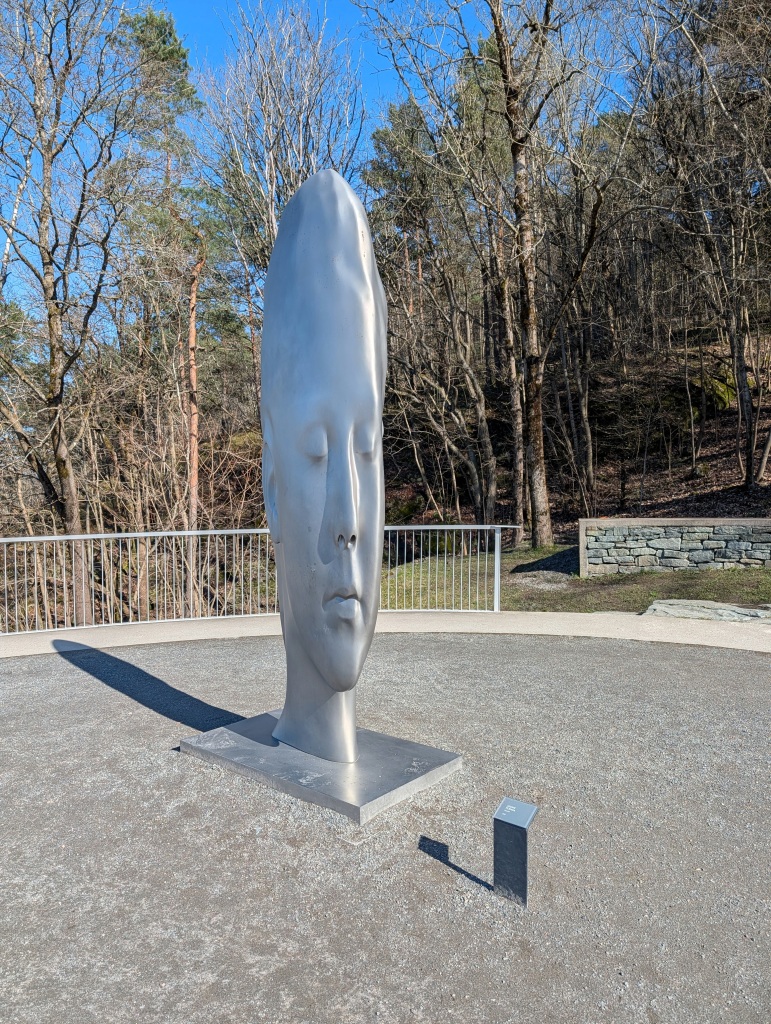
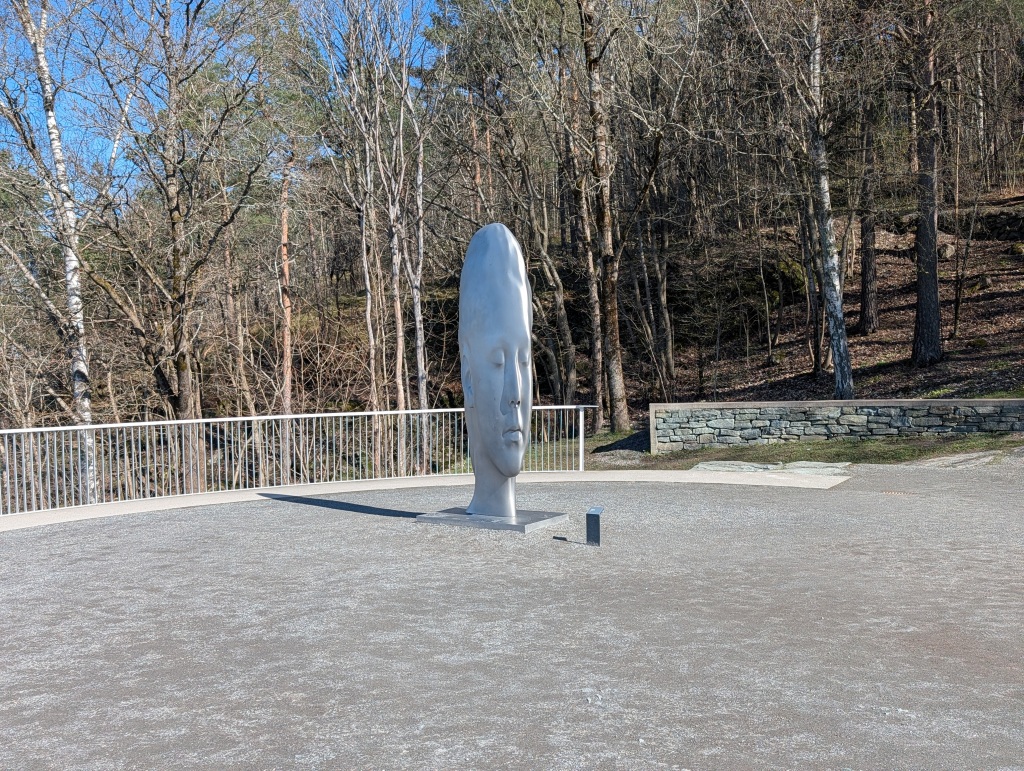
There were some more 'typical' sculpture garden works, by which I mean sculptures that are symbolic of something, but without being clear of what.
Like this marble face on a column, which wouldn't be out of place in front of an insurance building. Or airline headquarters. Or a university.
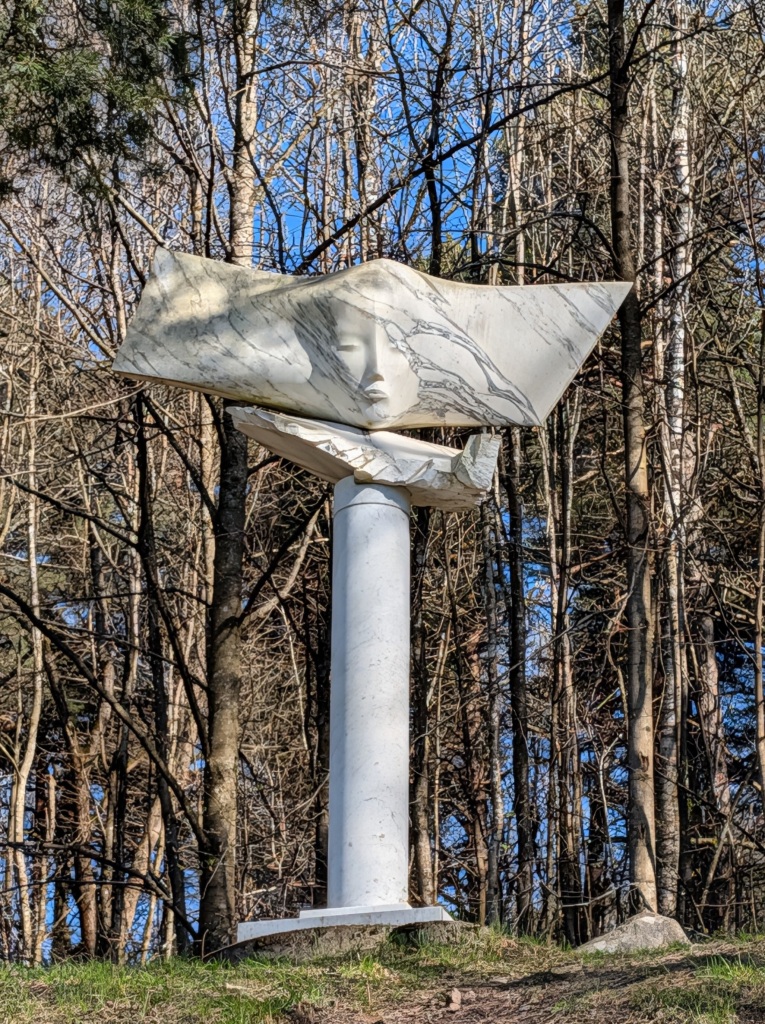
Or this something that is worshipping or bowing to or subjugating itself to some alien or demon.
While probably not the right thing to put in front of a parliament building or the headquarter of a shipping company, it would fit right in front of any university of the arts or an opera house. The sculpture seems to have some sort of meaning, but then shies away from anything specific. Even the description states "The ambiguity of what is taking place is of great importance for the artist."
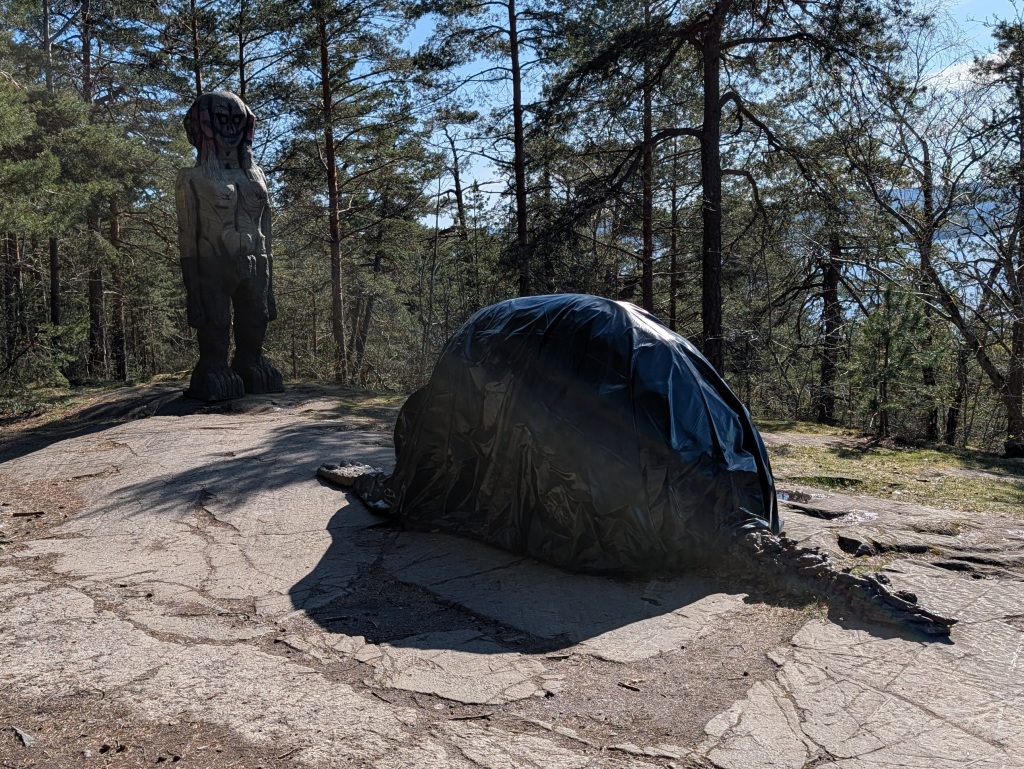
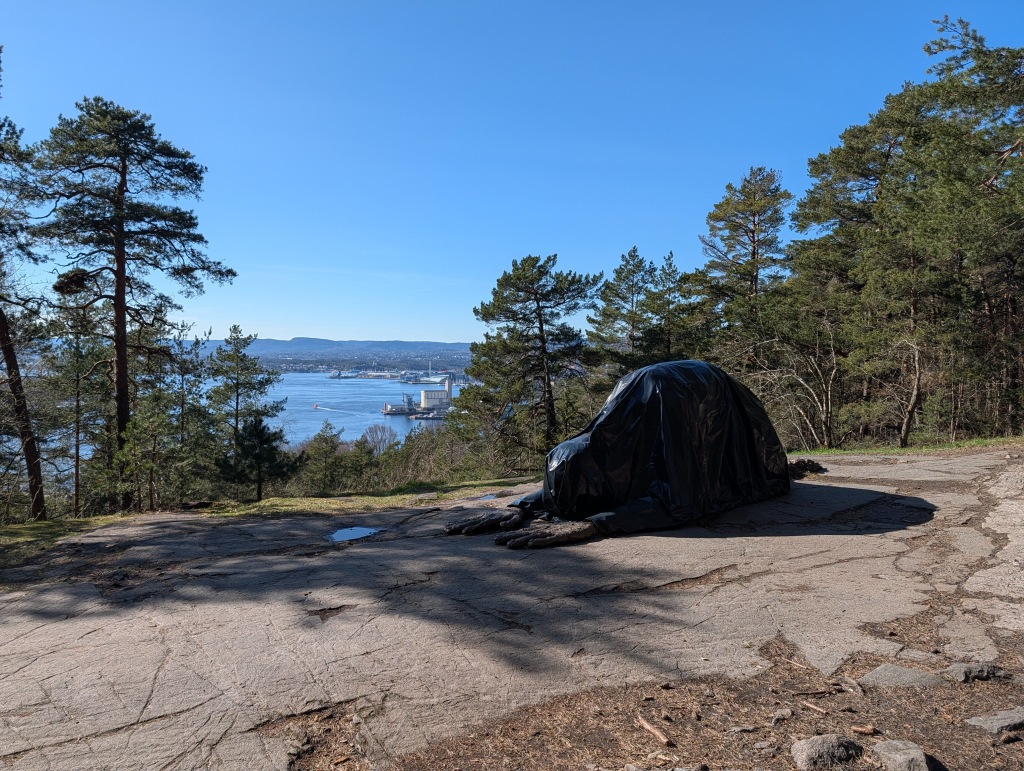
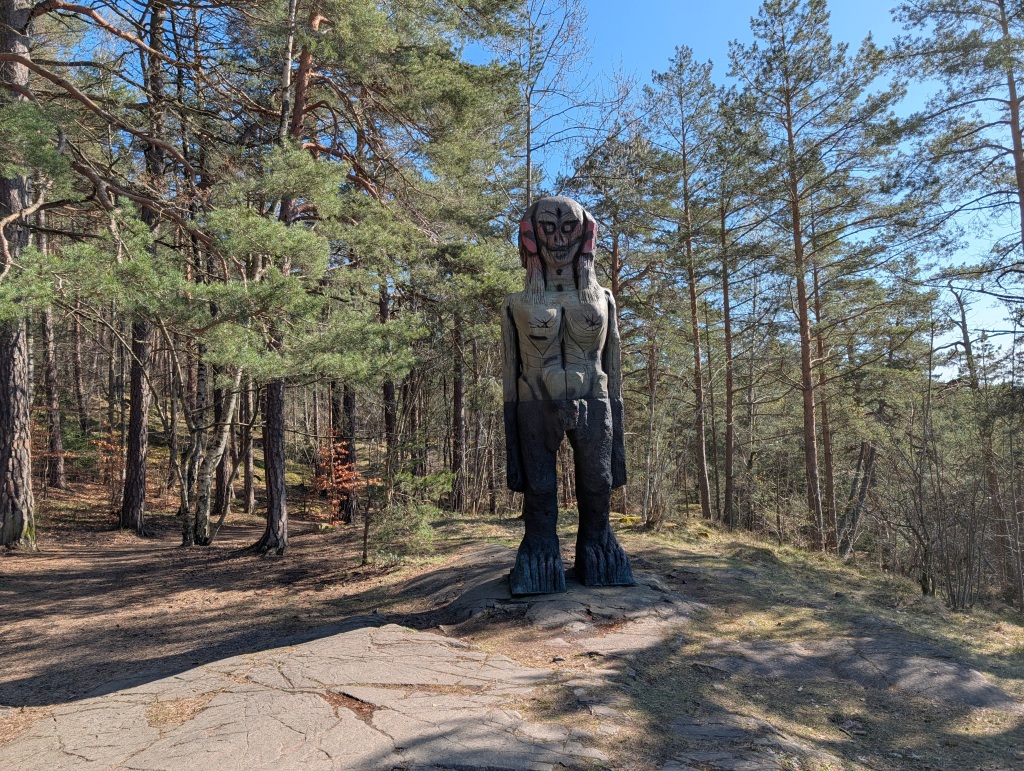
Not all exhibition pieces are static.
While there are some that act as (kind of) fountains, like the squatting sculpture mentioned earlier or the colourful birdlike creature nearby, there's also something that looks a bit like a cave entrance consisting of a number of screens, showing various animated faces and scenes. There are also two steel "spirals" dancing with each other.
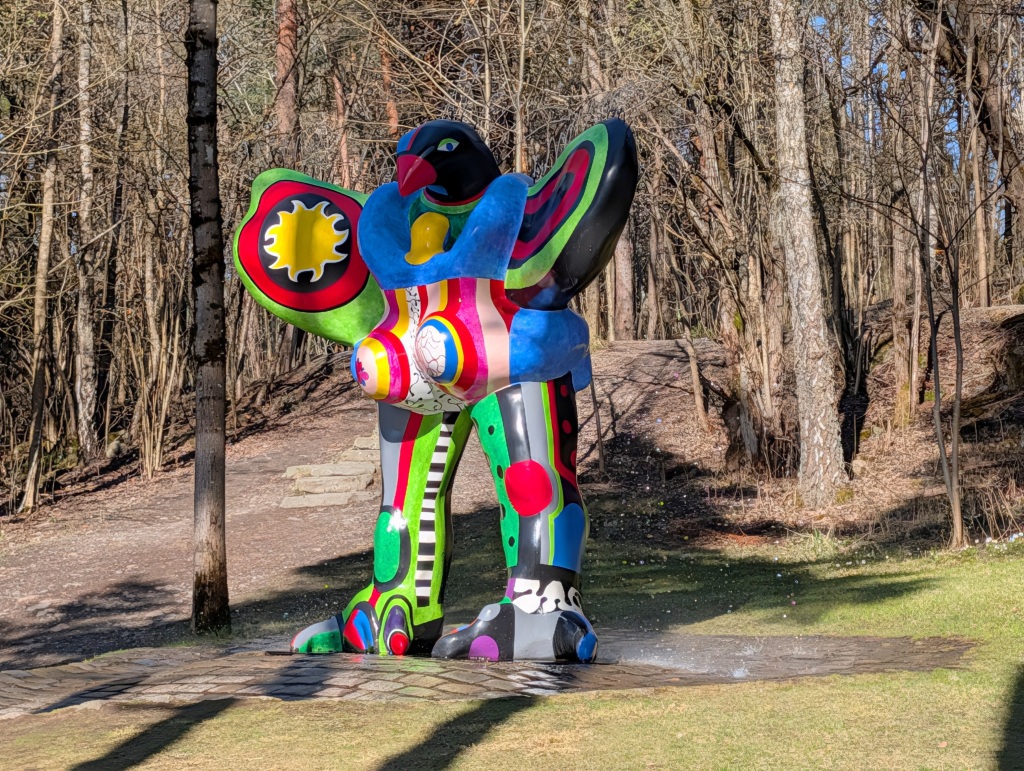
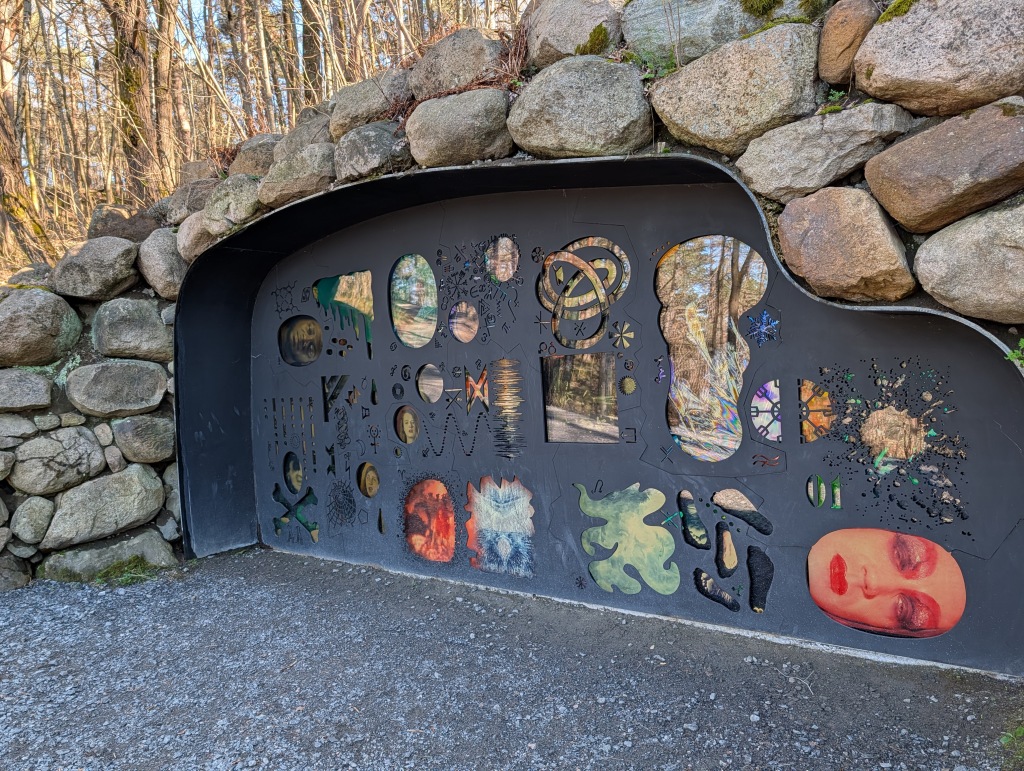
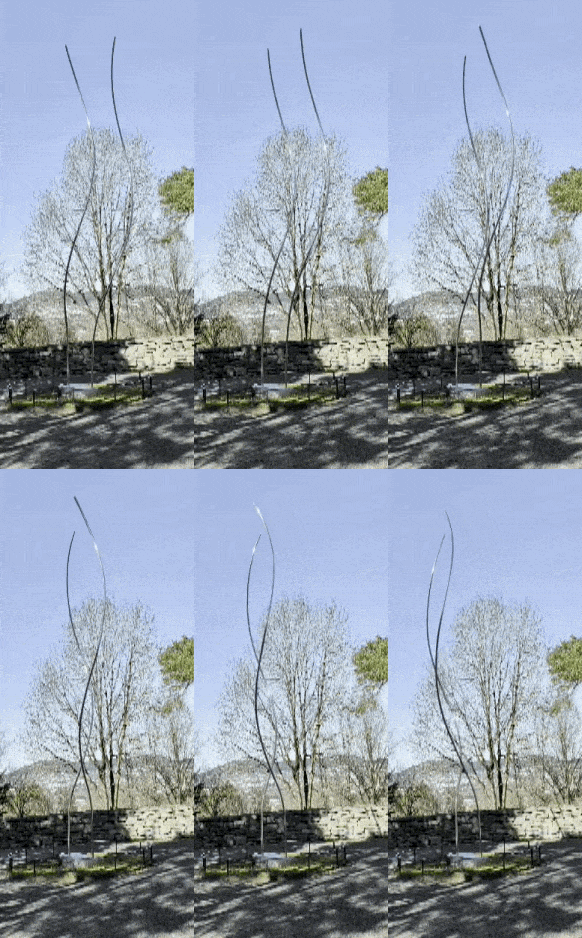
And in one case the activity isn't so much by the artwork, but by its non-human visitors. This refers to a sculpture that consist of a set of bird feeder boxes, which (I don't know whether that's filled by a curator of the sculpture park or by the general public) contain bird feed. When you pass by, you scare away the birds for a moment, who quickly return when you're gone, creating some interaction between the visitor and the 'customers' of the artwork.
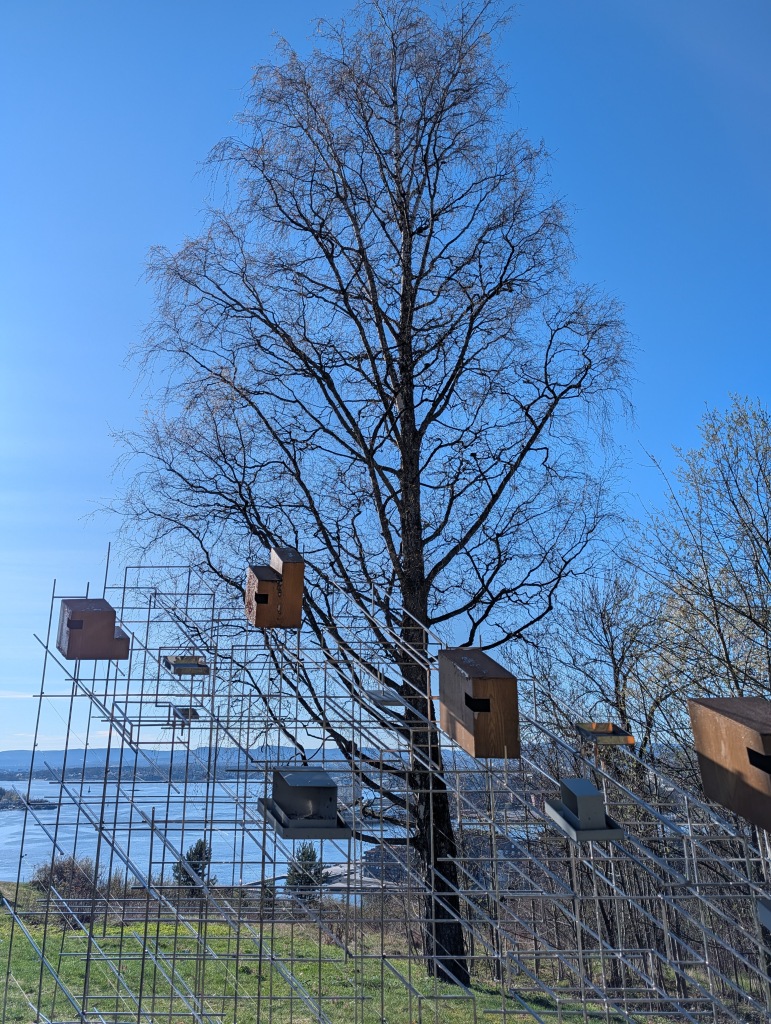
All in all, there's a lot of variety in art styles.
Some of them have, as someone described it, "adult undertones with playful humor", such as the Santa figure (technically not in the sculpture park, but on a traffic circle outside it) or a reclining yellow male figure with exaggerated body parts and, not far away, a chrome sculpture of Marilyn Monroe, reduced to, well, shiny curves.
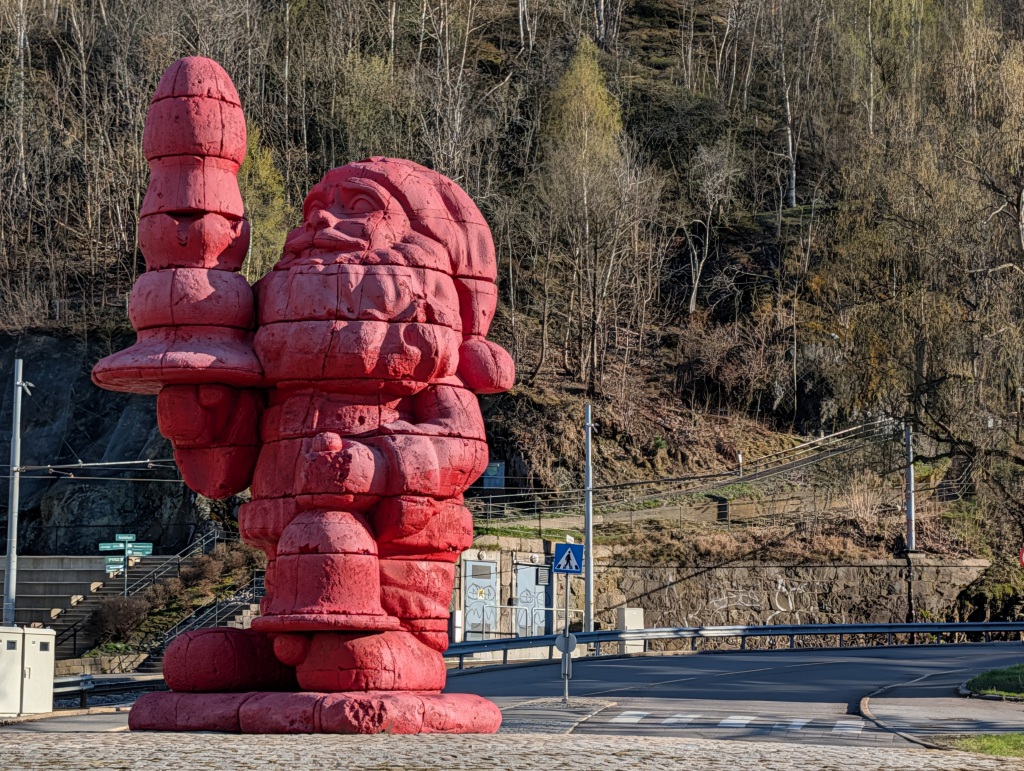
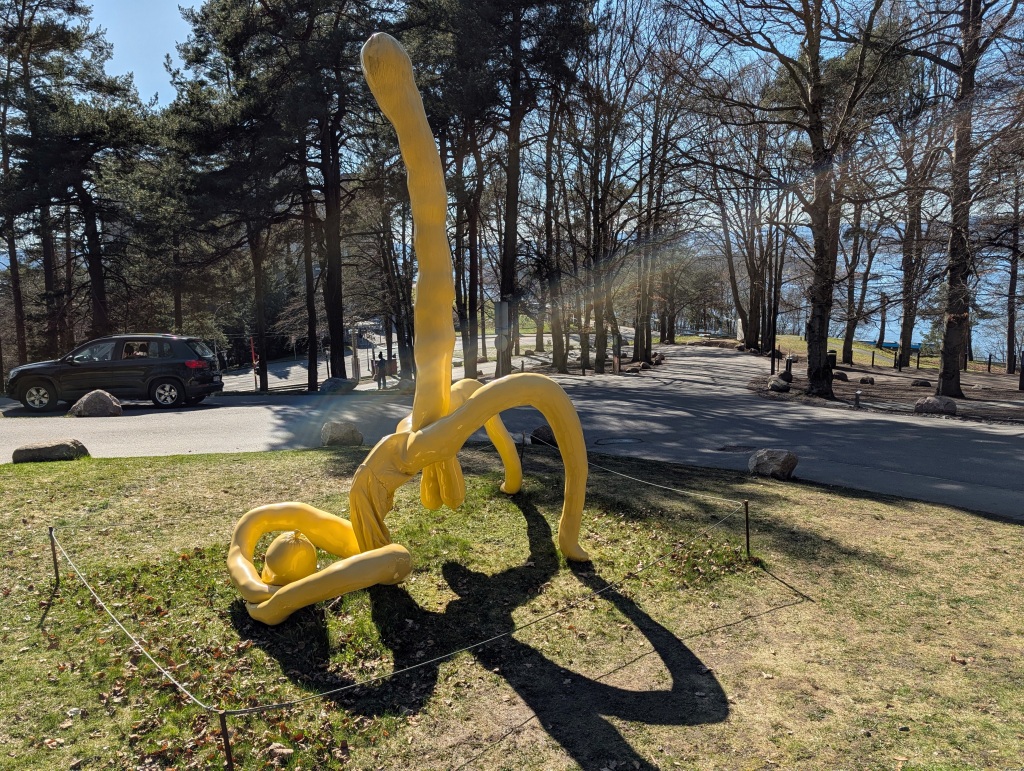
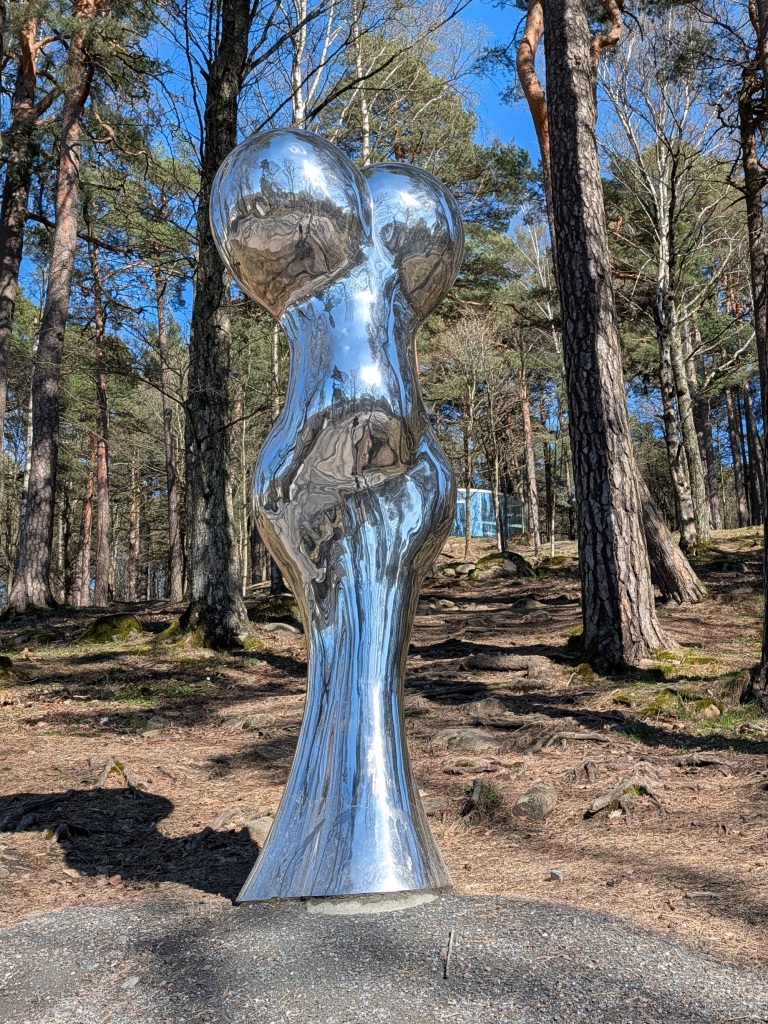
Some of the works in the park are environments you can enter, like a transparent circular pavilion, a metal shape that can only be entered by a small entrance and contains a shiny udder-like object. Or the "Nordic Pixel Forest", which consists of thousands of 'leaves' with embedded LEDs, which slowly change colour, accompanied by a soft soundtrack.
The idea seems a bit silly, but there are enough 'leaves' in that area of the park that you are properly surrounded and get drawn into the experience. It must be nice to be there during sunset, but I didn't stay that long in the park.
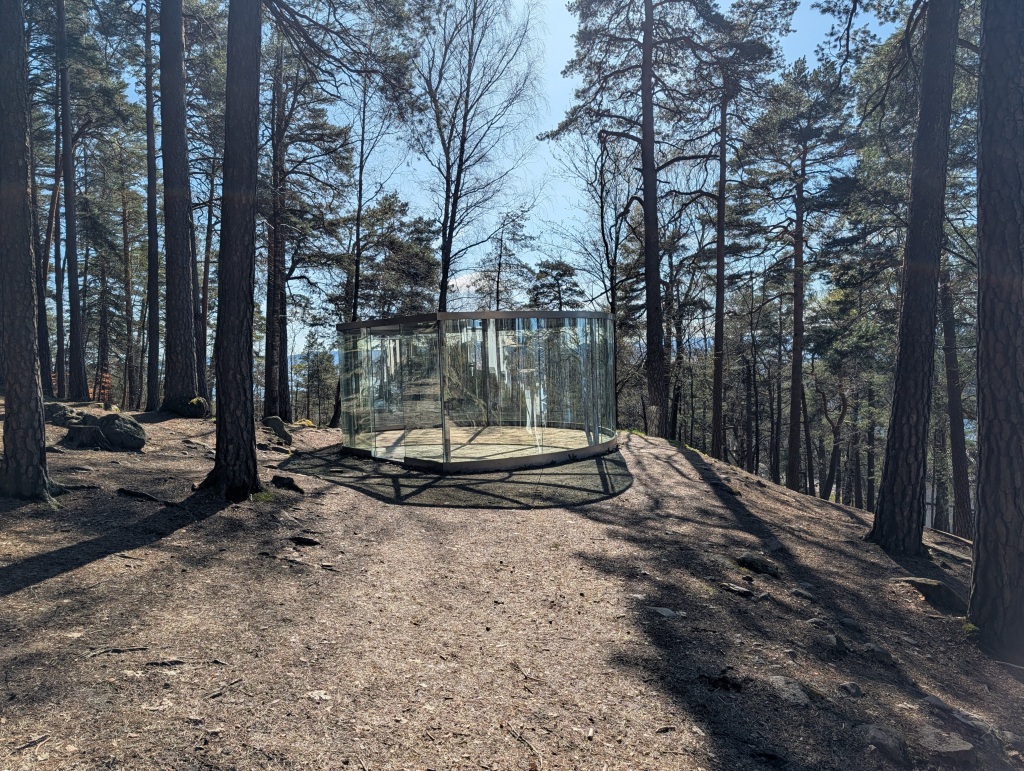
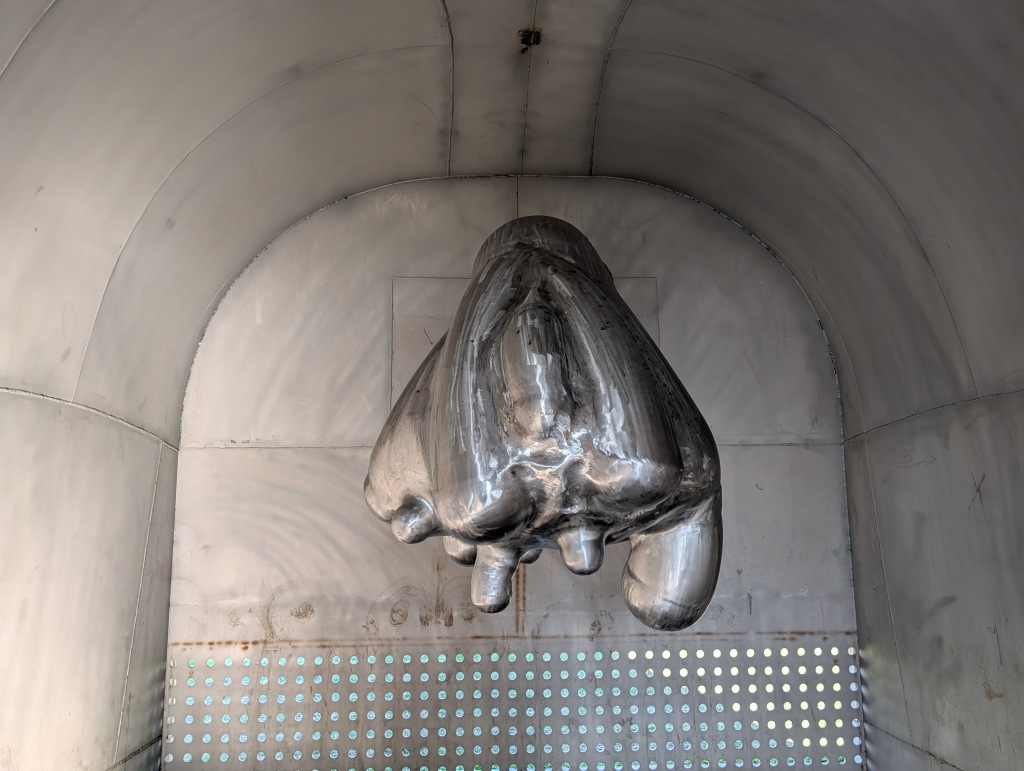
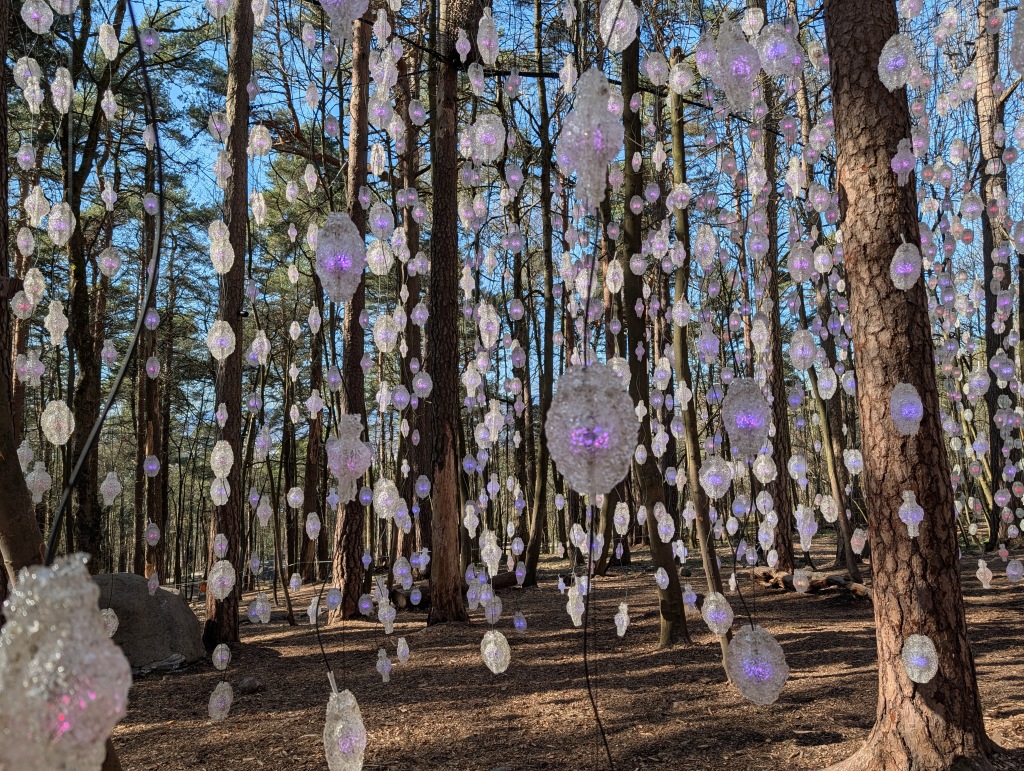
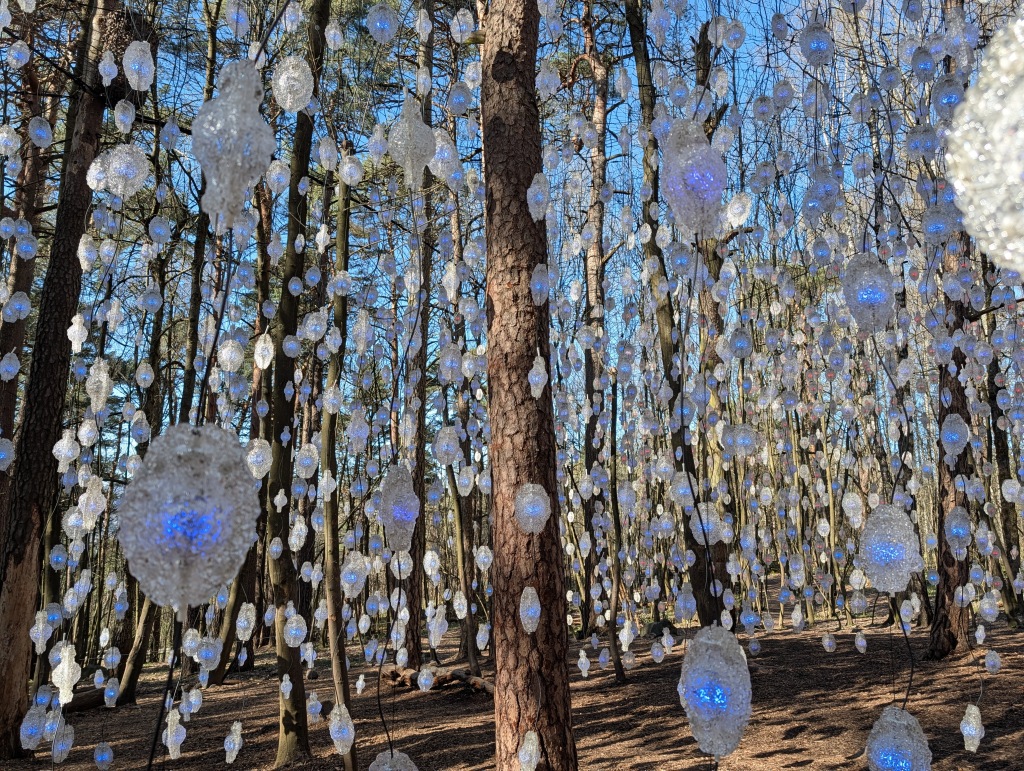
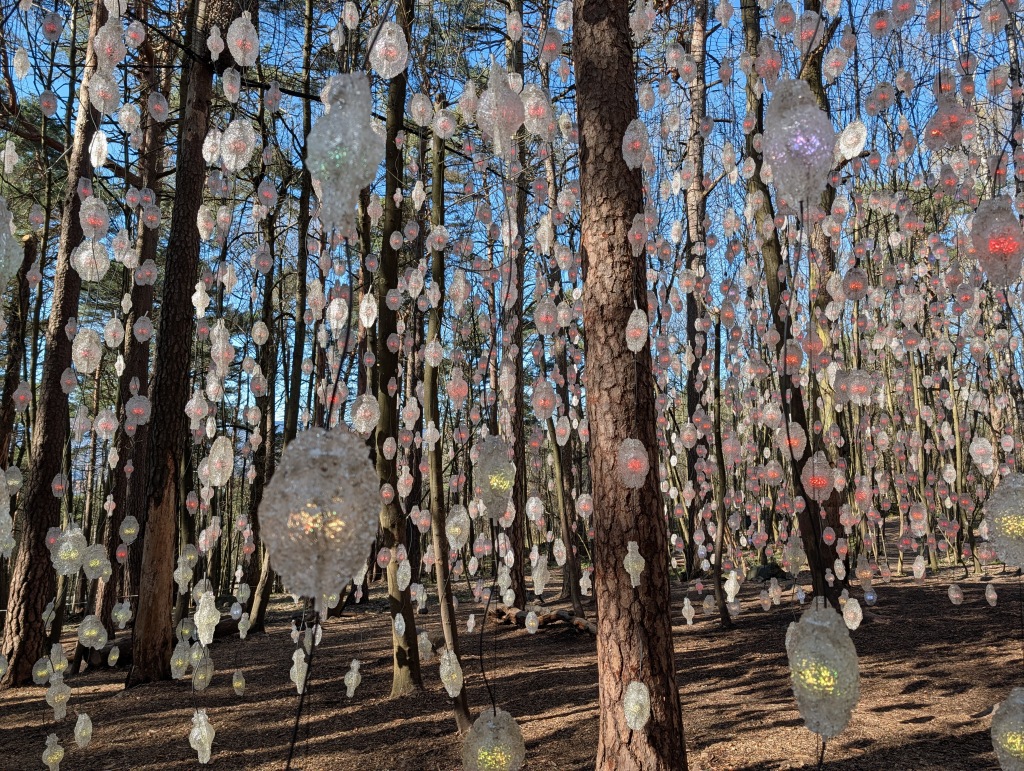
There were also some sculptures 'hidden in plain sight', like these chrome balloon shapes between some trees, which reflect enough of the trees to not be immediately obvious.
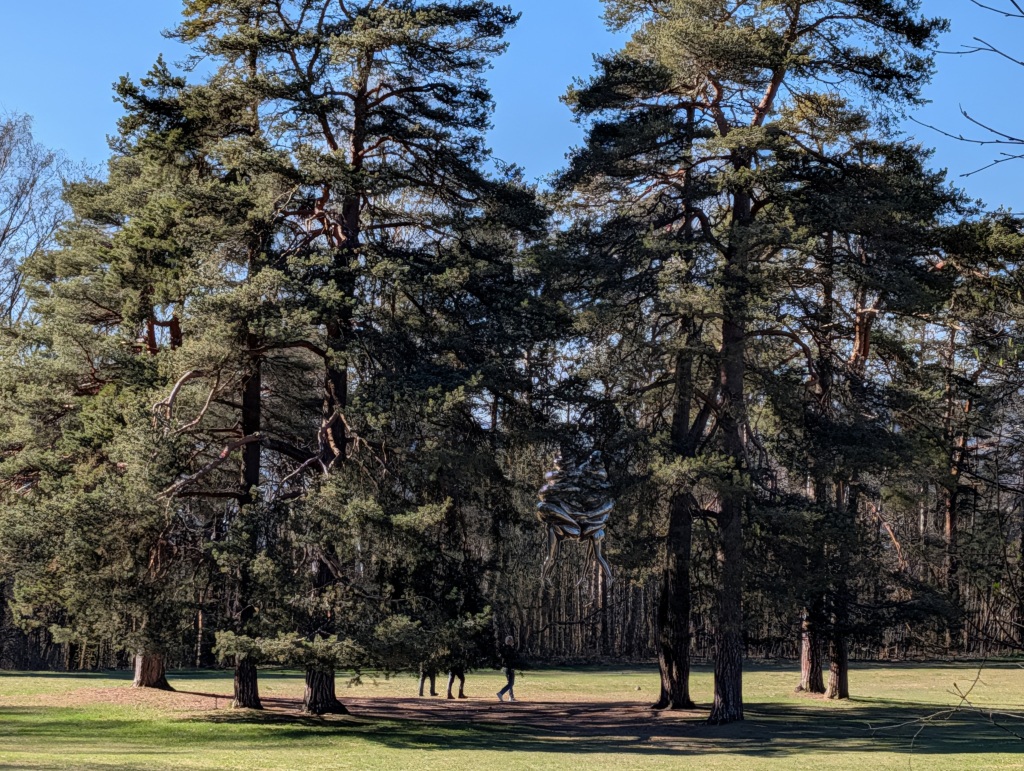
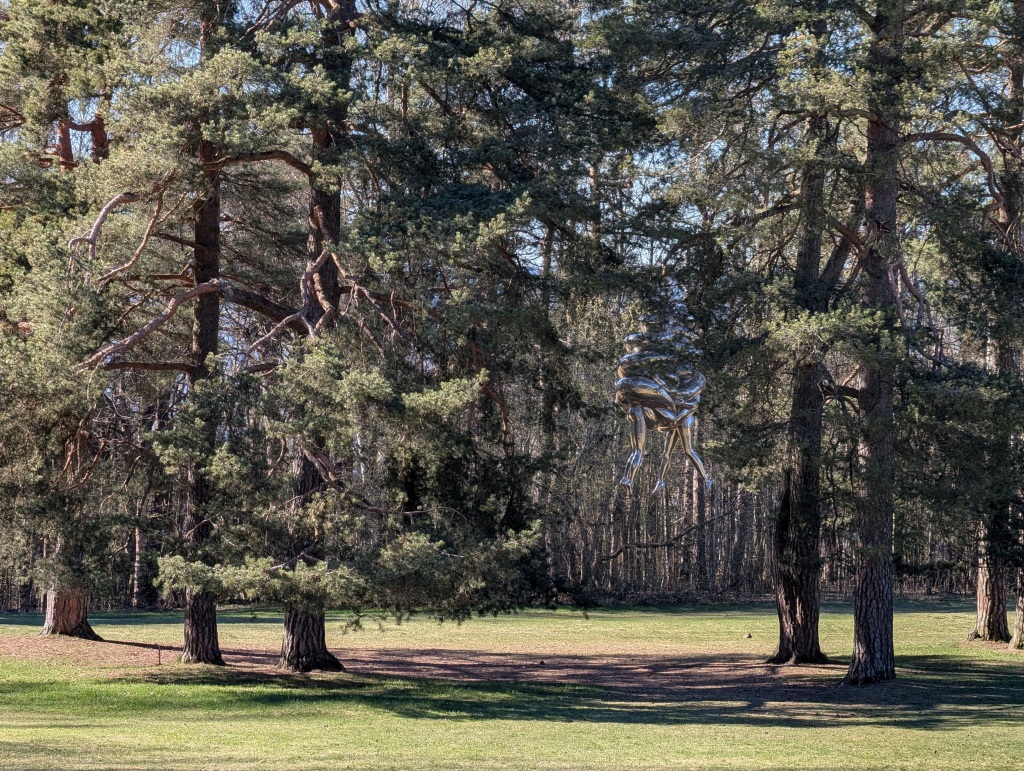
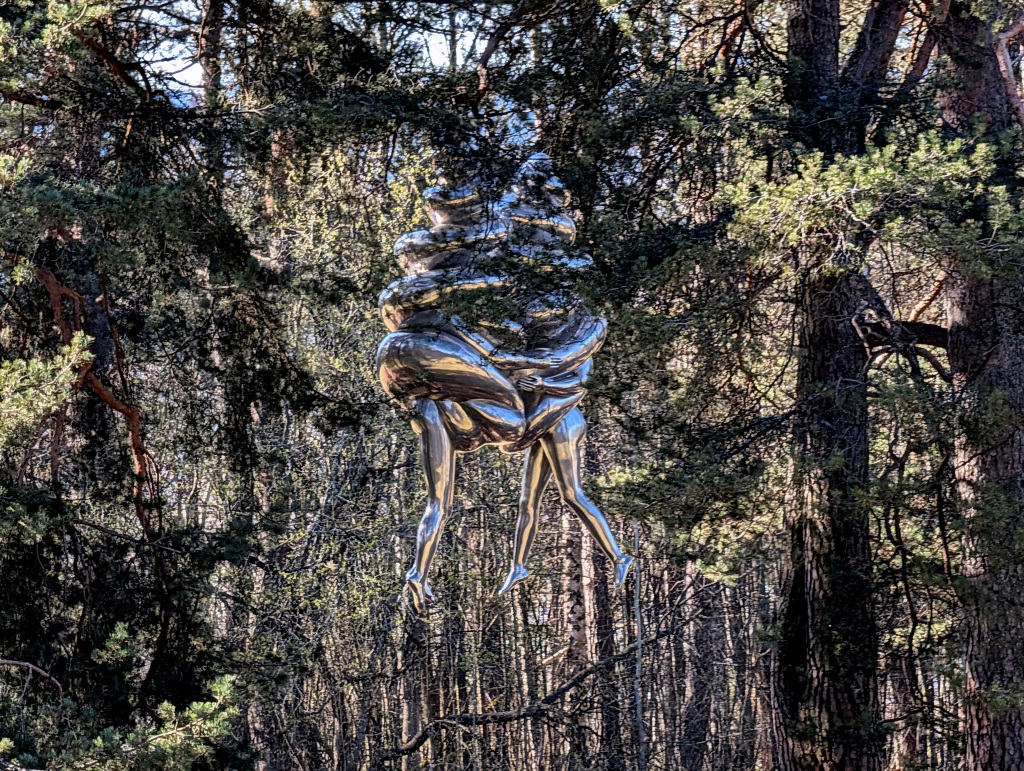
Not obvious (during daytime) was a "clothing line" strung through the forest, from which white underwear was hanging. At night, lights in the underwear are turned on to illuminate the path in the park.
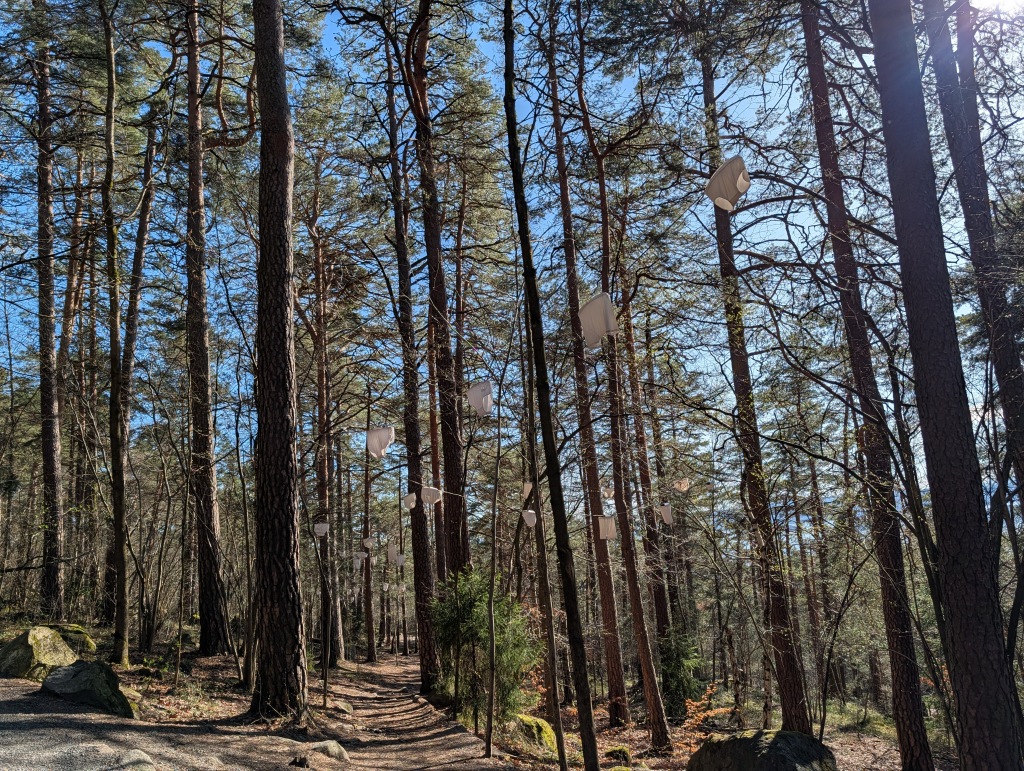
There isn't any "correct" path through the sculpture park, no signposted visitor trail that leads past all the artworks.
So, it's a bit of a journey of discovery walking there. And while I did see a couple more sculptures, I have missed a few of them. There are also some (mostly environments) that are only accessible at certain times or on guided tours.
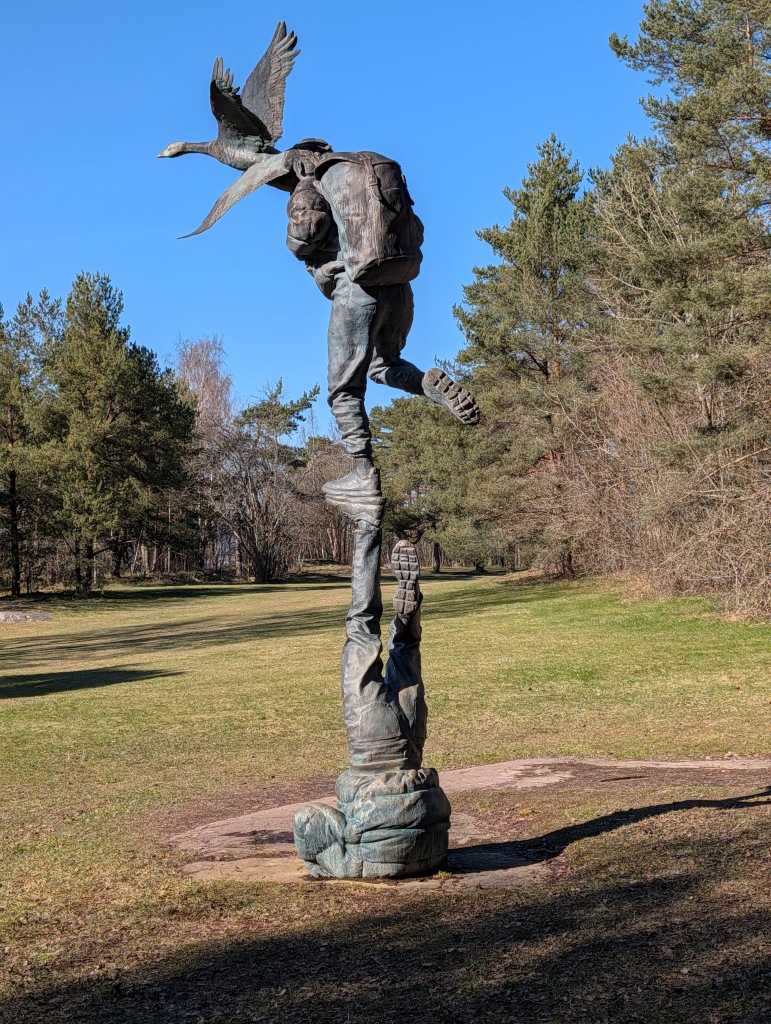
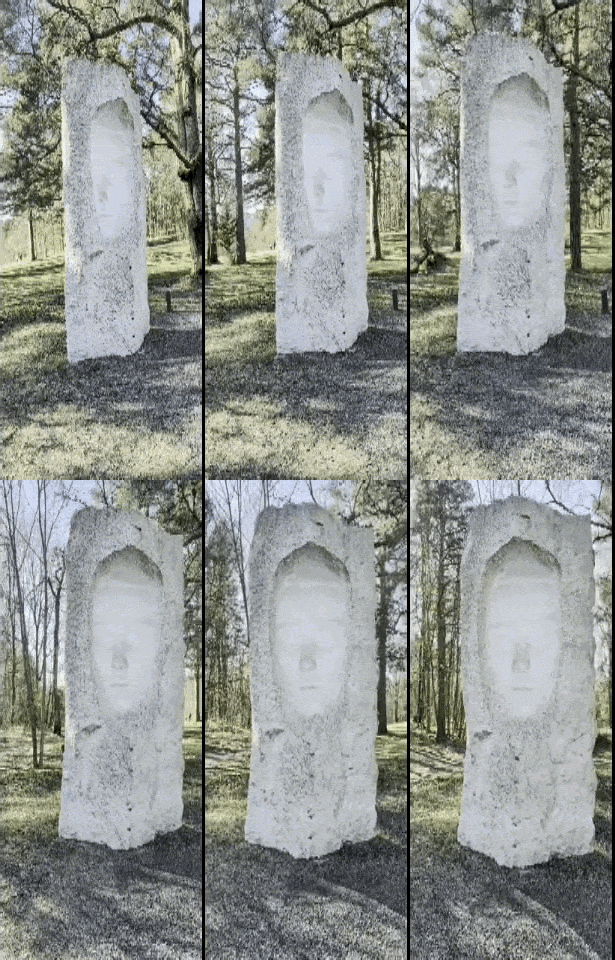
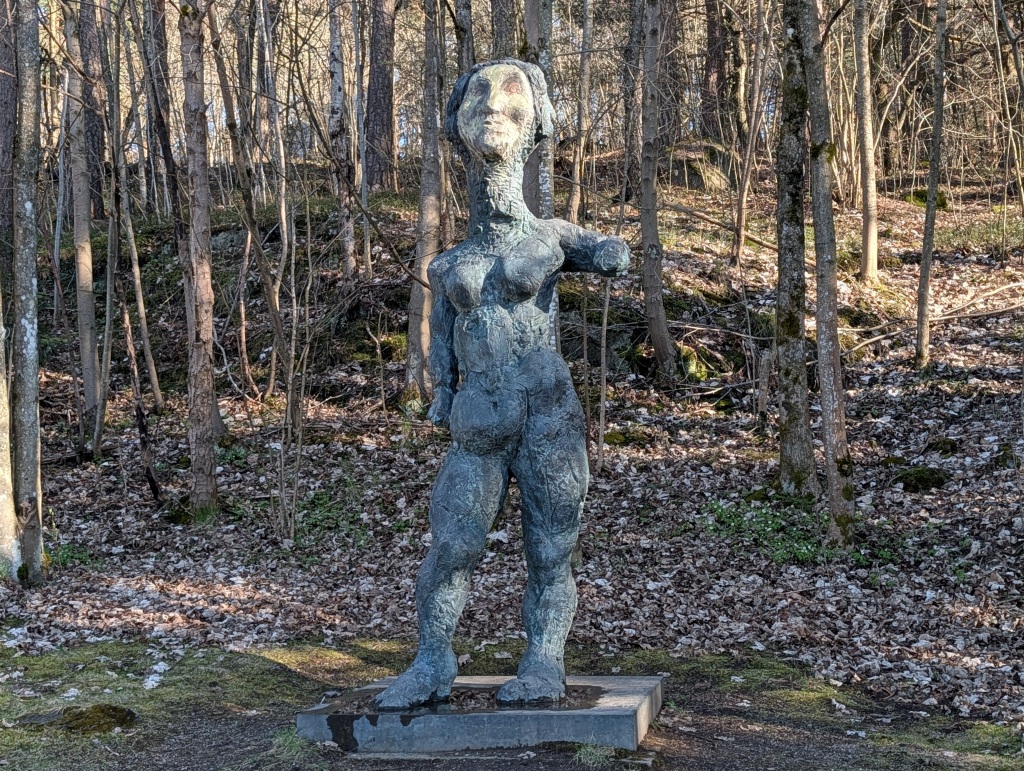
An added bonus of the park is that it has some good views of Oslo and the Oslo Fjord, including a bench that probably offers the best view of the city.
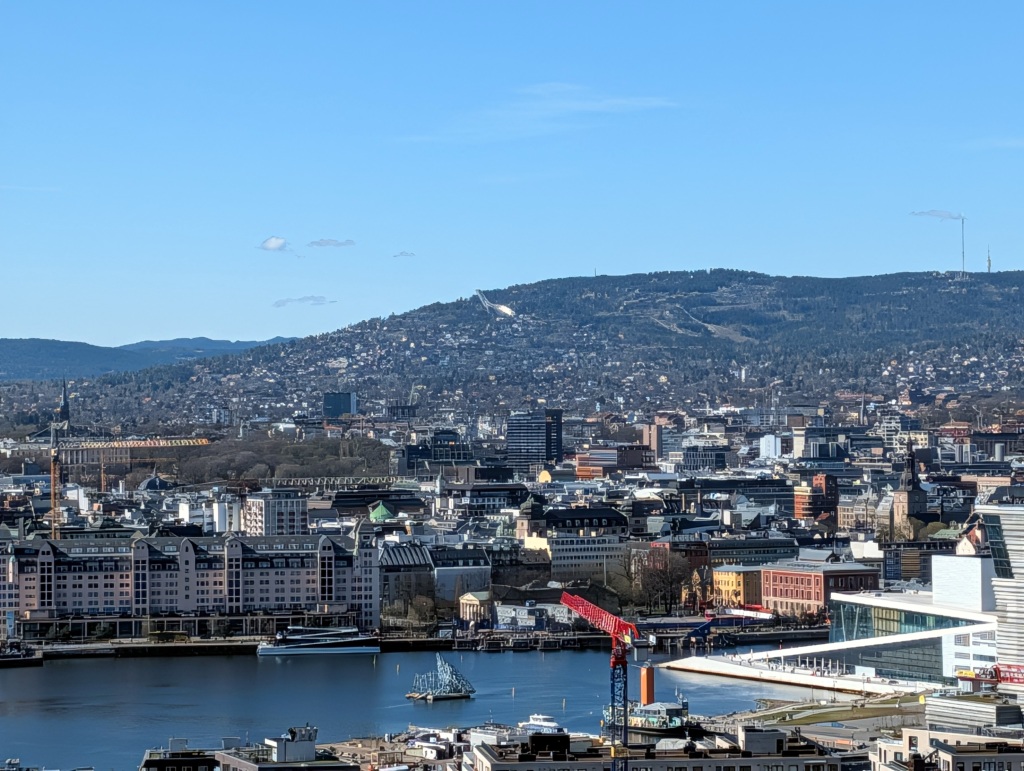
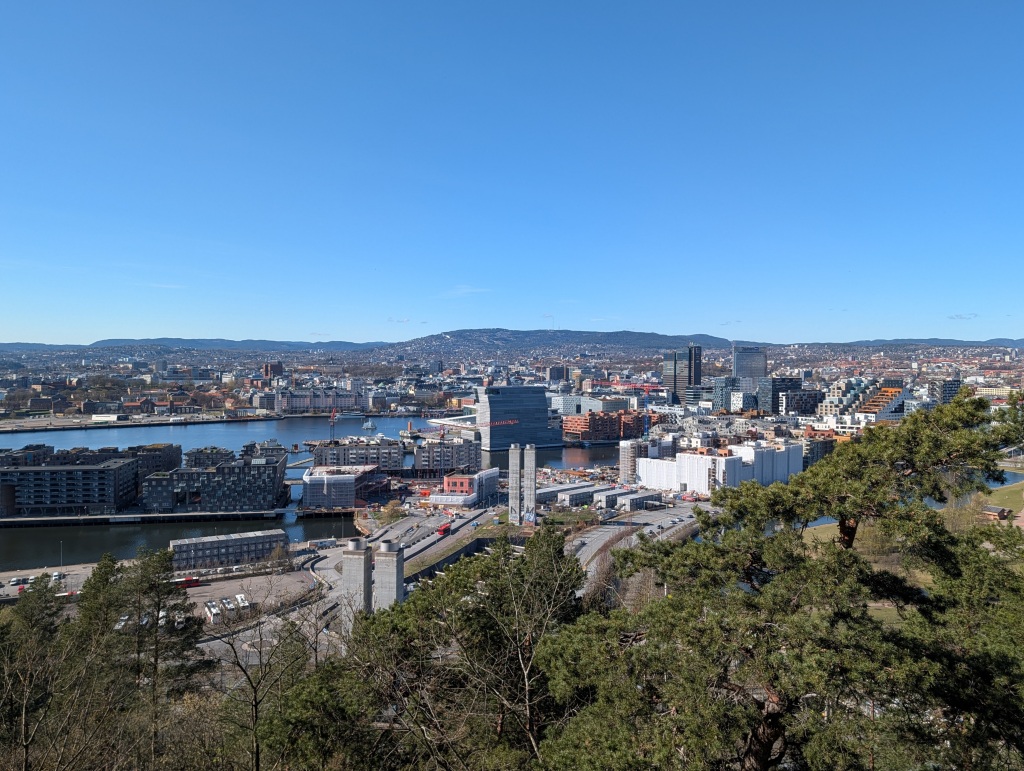
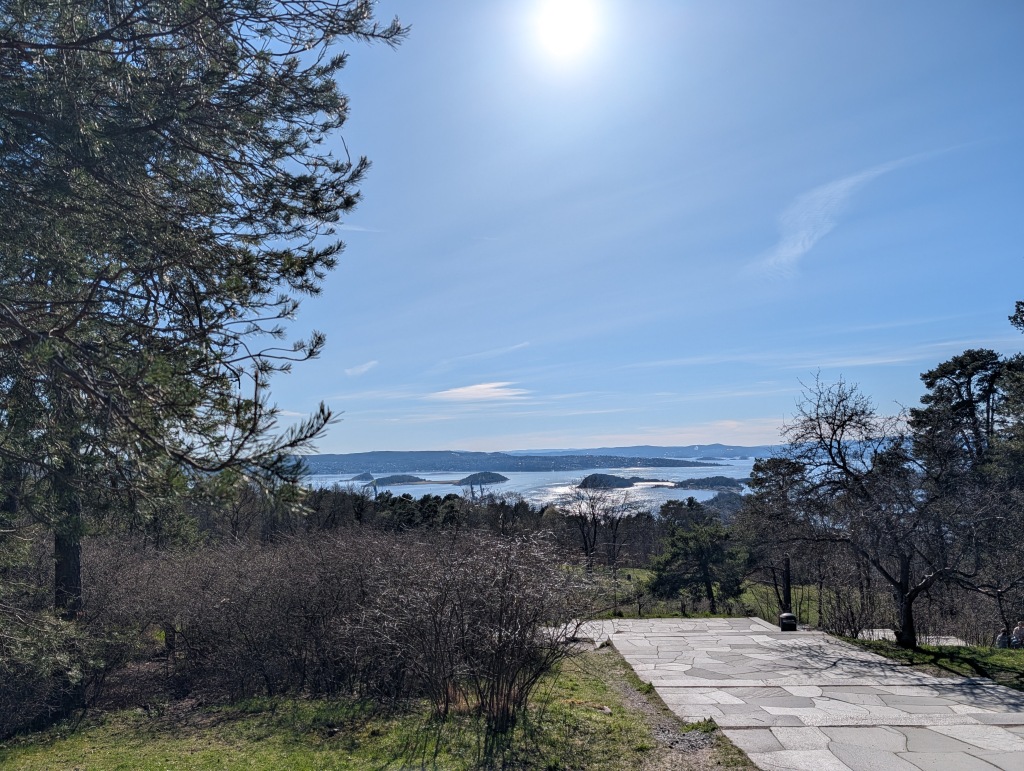
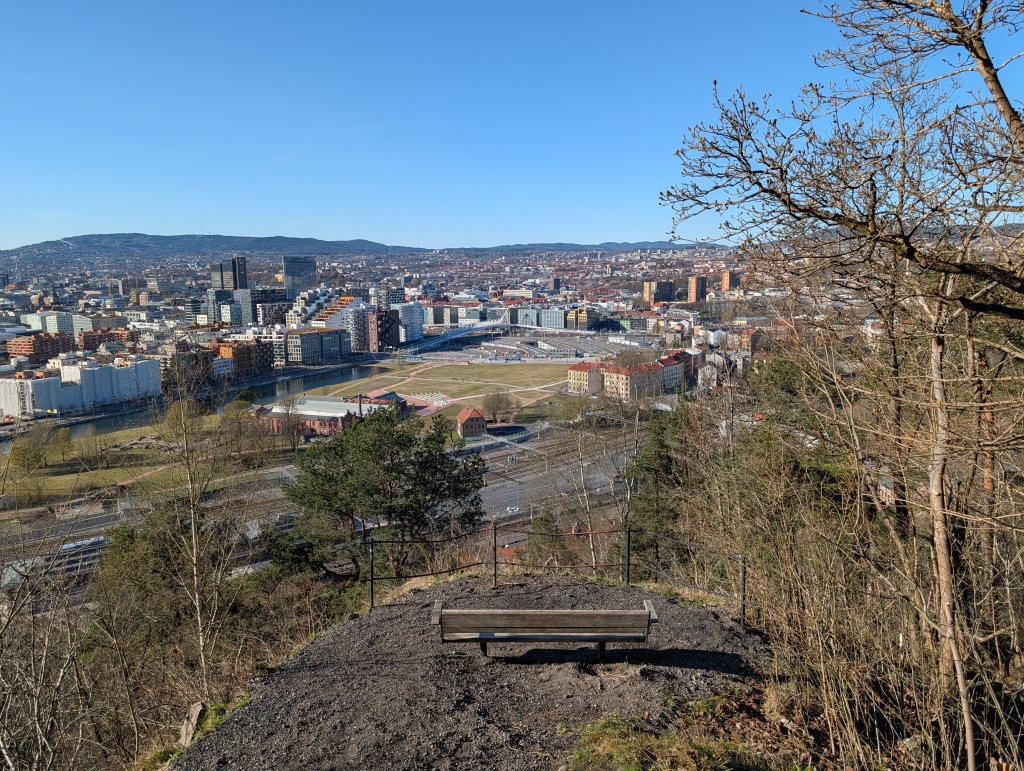
Next day I went to a museum a bit further out - the Norwegian Museum of Science and Technology in Kjelsâs.
If the number of museum visits seems unusually high for me - the reason was that there is a thing called the "Oslo Pass", which is, while more expensive, easier to use (for tourists) on public transport than regular public transport tickets. (Mostly because it offers a flat-rate that includes almost all public transport, while the regular tickets require to 'check-in' every time you board a train or a ferry.) And the "Oslo Pass" includes free entry to most museums. So, I visited more of them than I usually would, although the Fram museum and the science museum would have been on my list anyway.
When I went there, I wasn't sure what to expect.
Their web page mostly covers family activities and events and it's not that clear what is actually on display. There is a mention of items in their collection, but that's right next to the description of their photo collection and historical archives. So, it wasn't obvious how much (if any) of their collection was on display and much would be in some depot, only accessible to serious researchers.
Also, most of the pictures on the museum web page showed groups of school children in various science activities. I wasn't sure whether this was mostly aimed at teaching school classes or whether it was aimed at the general public.
I needn't have worried.
While there were a lot of (sometimes cool looking) activities for classes, including what looked like a makerspace with 3D printing and other tools, there are also a lot of 'regular' exhibition pieces around.
Thematically, they are widely spread. From watches and industrial woodworking tools, via cars, planes, trains and bikes to computers and electronic musical instruments.
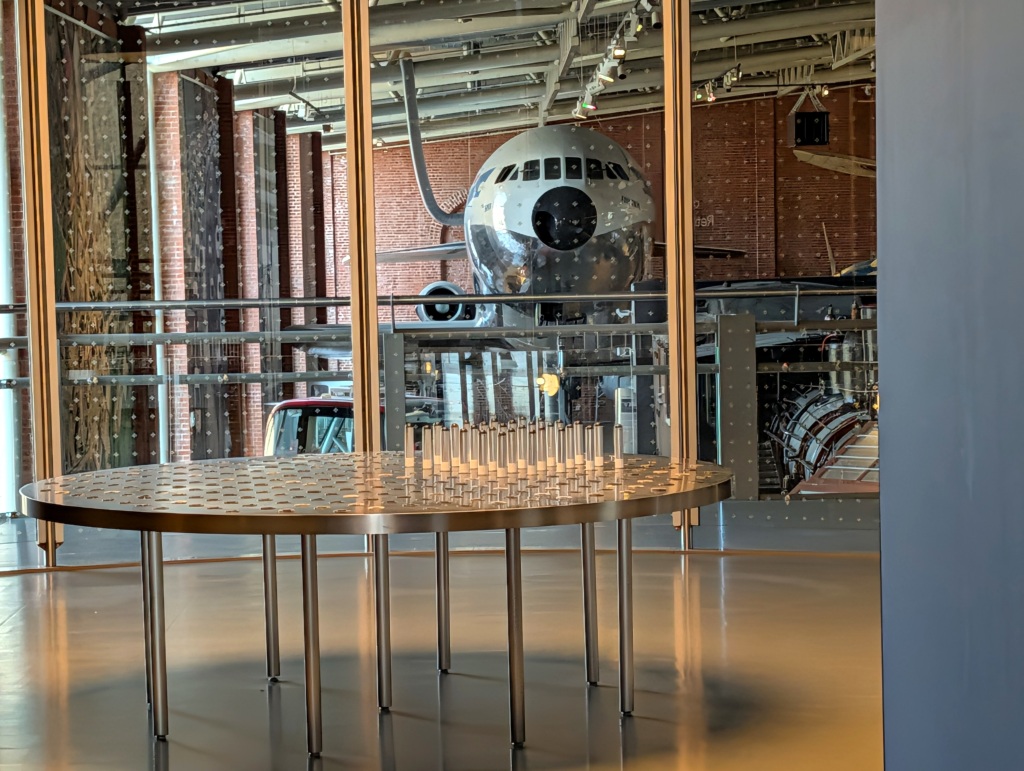
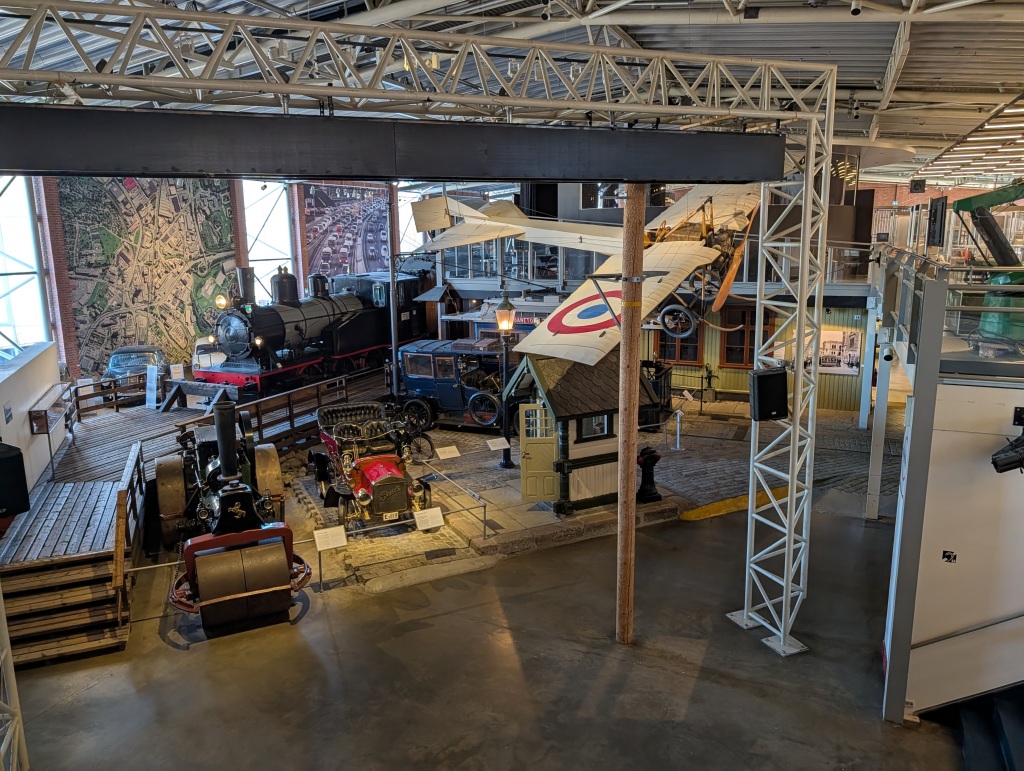
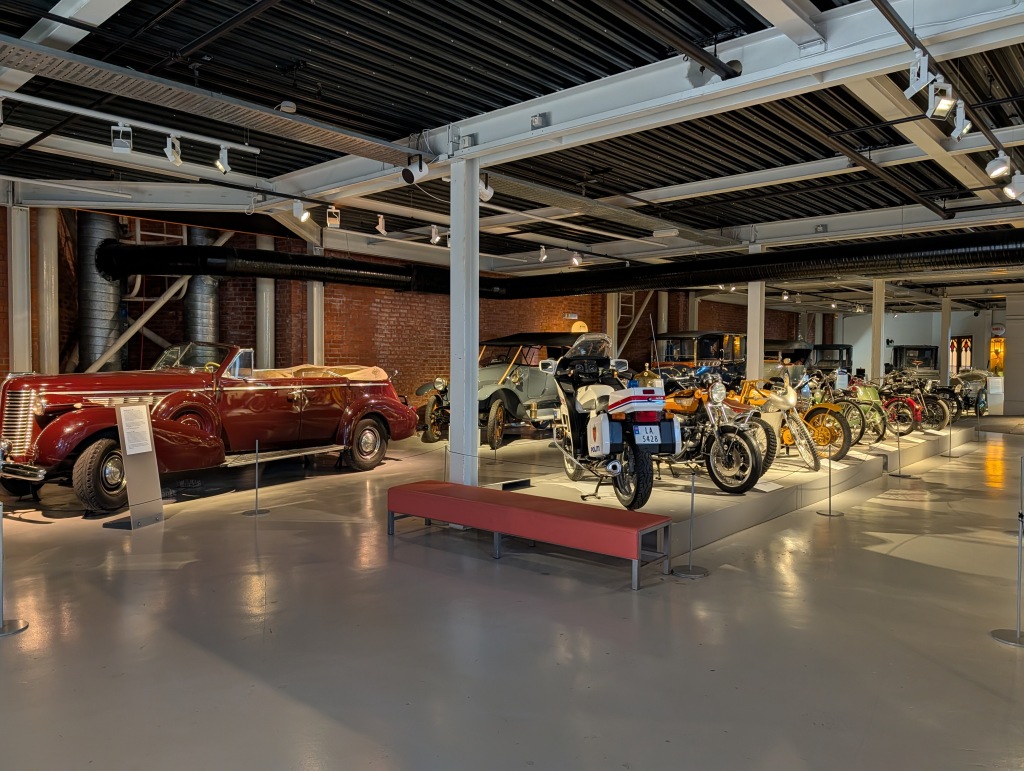
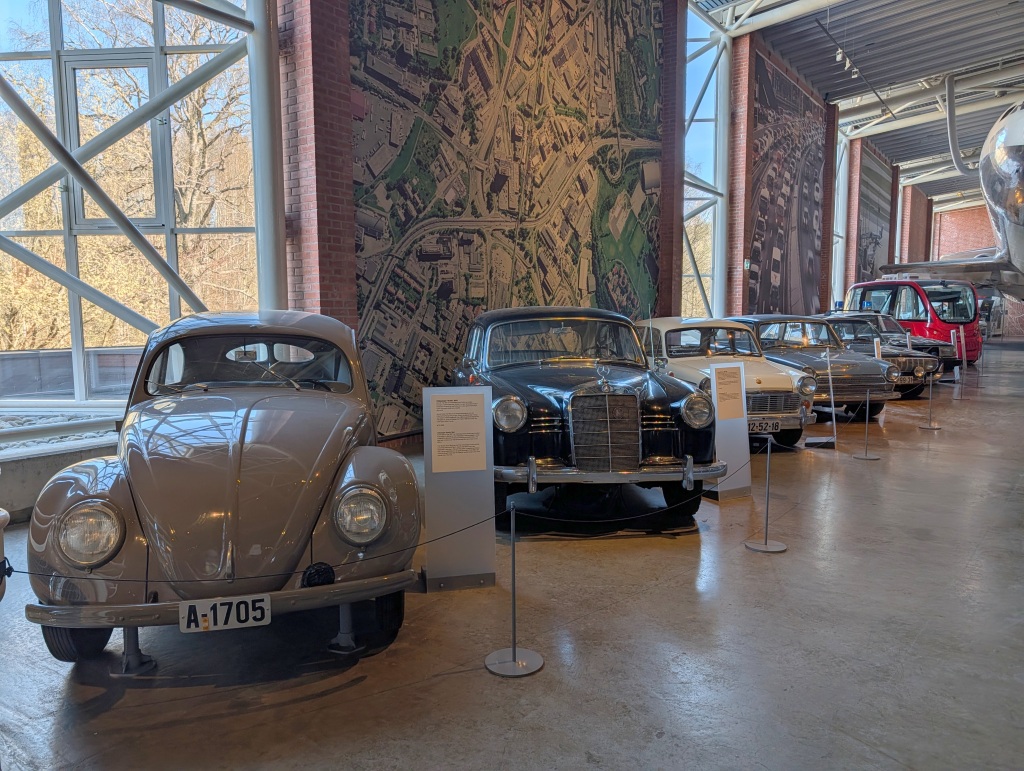
As so often with tech museums, there was an exhibition about computers. And while I don't have a Cray, there were a few display cases of early home computers where I went "I've got one of those. And one of those. And I think I have one of those at home as well..." With technology it's sometimes strange how fast cutting-edge stuff becomes museum pieces.
Worth a special mention is this Loening C-2 "Air Yacht", an airplane with an unconventional design, which I had never seen before. Somewhat akin to a Coupé de Ville car, which were popular around the same time the plane was designed, and harking back to horse coaches, the driver (well, pilot) was on the outside, exposed to the elements, while the passengers were riding in a closed cabin. In the museum, I hadn't even noticed that it was a seaplane. From the back it looks mostly like a regular plane, without any obvious floats. Only from the front, the shape looks odd, with the float not so much integrated in the plane's shape, but looking a bit tacked onto the front. Weird thing.
Something that I liked a lot is that the department of electronic musical instruments has two soundproof boxes where you can play (around with) some instruments, including a drum set, a Theremin and a PPG Wave synth (although the last one has a plastic shield over the controls, so you can play the synth, but you can't play around with the sounds).
The unexpected not-really-an-exhibit thing in the museum was the floor in one of the rooms (I think it was a room with old printing presses). It looked like wood panel flooring (and technically it was), but these weren't flat slices glued to the floor, they were rectangular wooden logs placed side by side.
They weren't attached to each other or the ground below (though, admittedly, I didn't try to pull any of them out) and there were small gaps between them. When you walked across the floor, the logs all shifted a bit underfoot, making the whole experience somewhat unusual.
There was one more thing in the video department that was simple, but fun.
They had a camera and a video screen, but the individual lines on the screen were time-delayed by different amounts compared to the live image.
So when you turned around, your head stopped first, while the rest of the body spiralled in a moment later. Simple effect and easy to explain, but visually exciting.
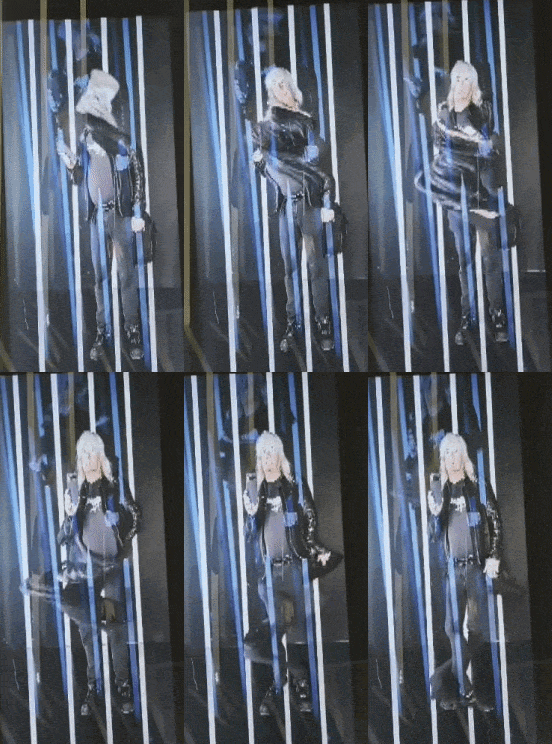
After the museum, I went for a walk along the Lysakerelven, a small river between Oslo and the next county, Akershus.
It isn't obvious from the pictures, but the river runs between two suburbs, so it's like a 100 meter wide stripe of wilderness between family homes. While you are walking in the river gorge, it feels like you are out there somewhere in rural Norway. And when you take the path a few meters up, you're right in a residential area.
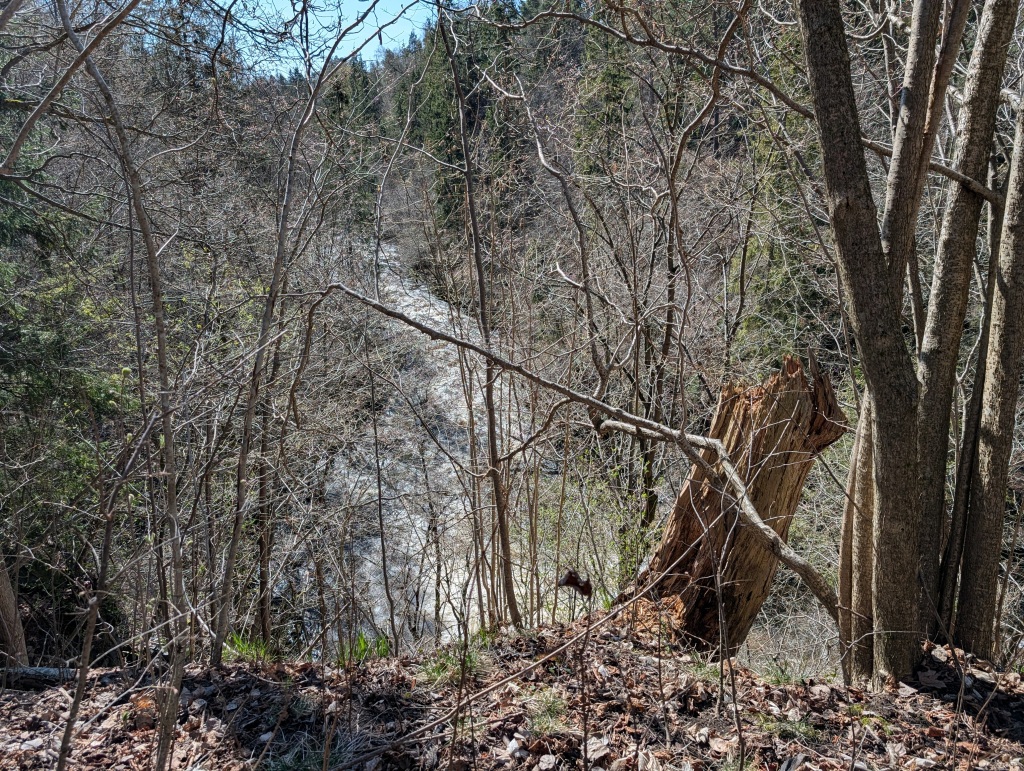
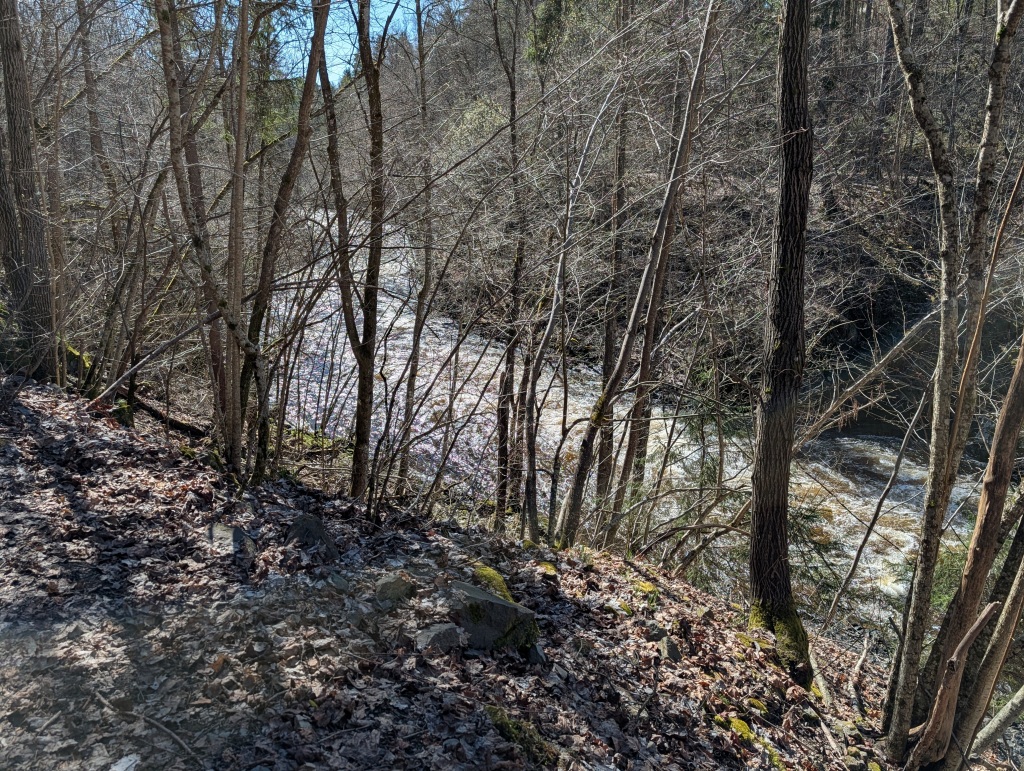
Next day, it was time for some more museums and art appreciation.
After going head to head with a chrome diver, I visited the Museum of the Nobel Peace Prize. (No pictures from there, though. 'Peace' is somewhat difficult to exhibit or to photograph.)
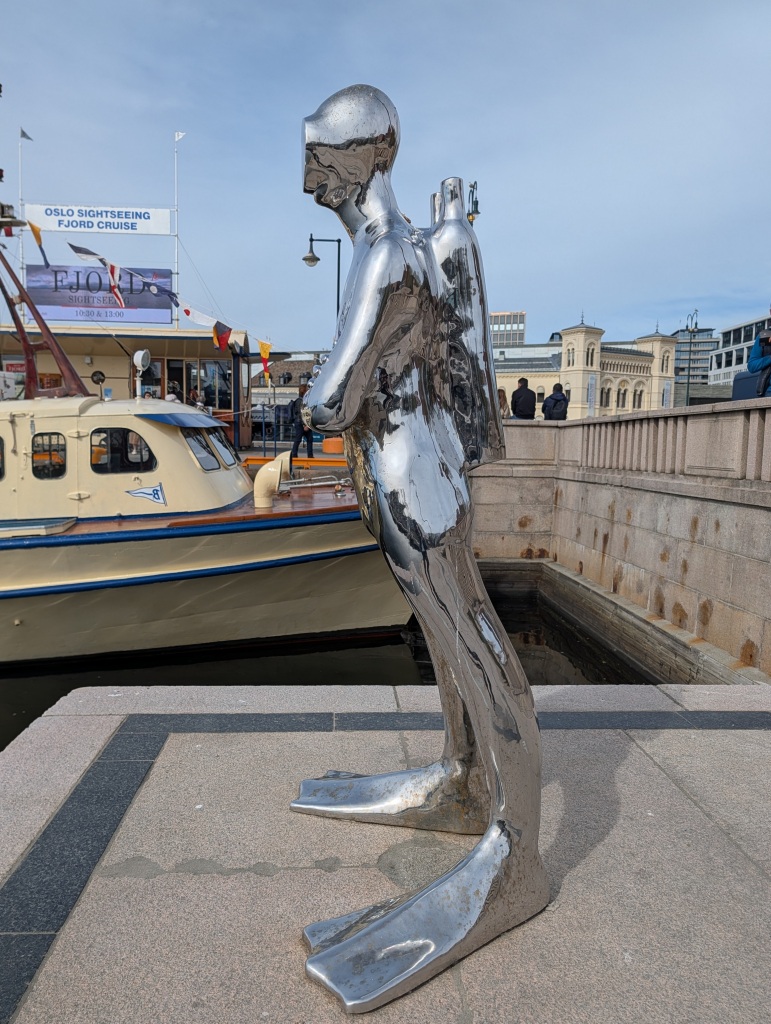
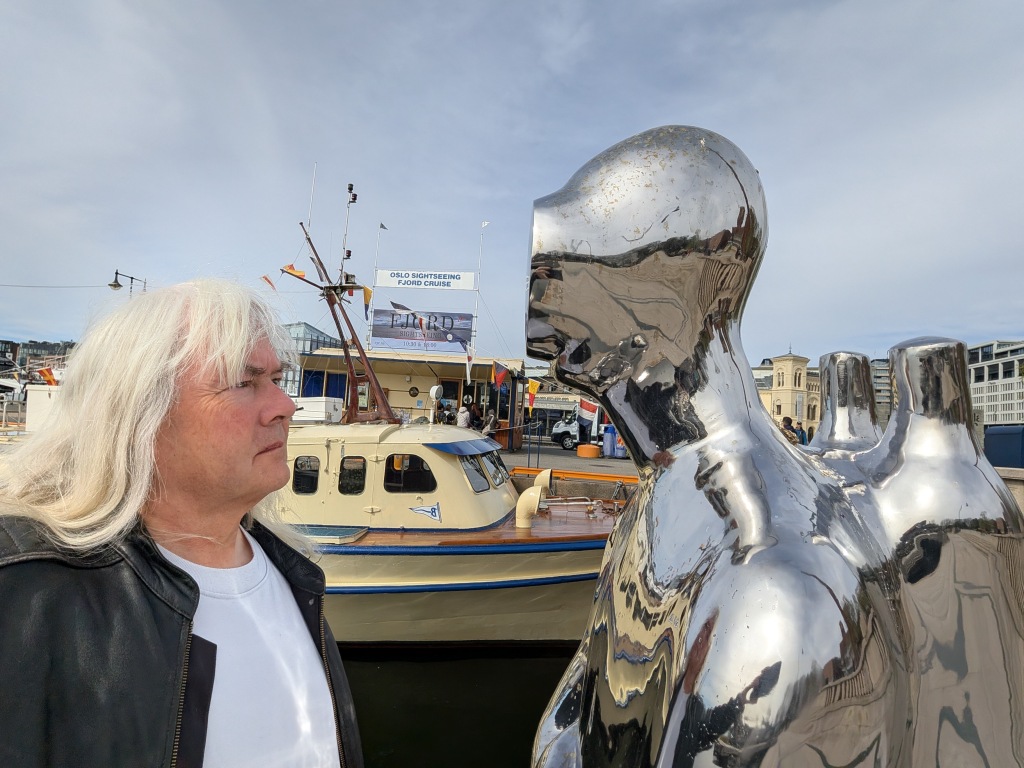
Then I went to the Astrup Fearnley Museum Of Modern Art, which was a mixed experience, between 'cool' and 'they got funding for this?'.
The current exhibition, Grammars of Light, was a big disappointment. Mostly consisting of a few lights with meaningless drivel to sell them as an art experience. You could go to any lamp store for a better experience. Most of the works didn't even create an interesting environment.
Of course, you can put a number of white lights in columns and dim them slowly and randomly.
But statements that this "creates associations that extend beyond the strict seriality and phenomenology of minimalism", that "we are pulled into affecting scenarios that open space for the unknown and blur the distinctions between interior and exterior" or that "Perception is impacted in unexpected ways, and essential questions are raised about how we see the world as a thinking, feeling body" are not only a bit pompous, but they are also so vague that they could apply to almost anything. The door of a bus "affects scenarios that open space for the unknown and blur the distinctions between interior and exterior", but I wouldn't put that into a museum. (Ok, there are busses with doors in the transport museum, but that's not what I mean.)
But there was also the permanent exhibition and that had more interesting artworks and installations.
My favourite exhibit was this room.
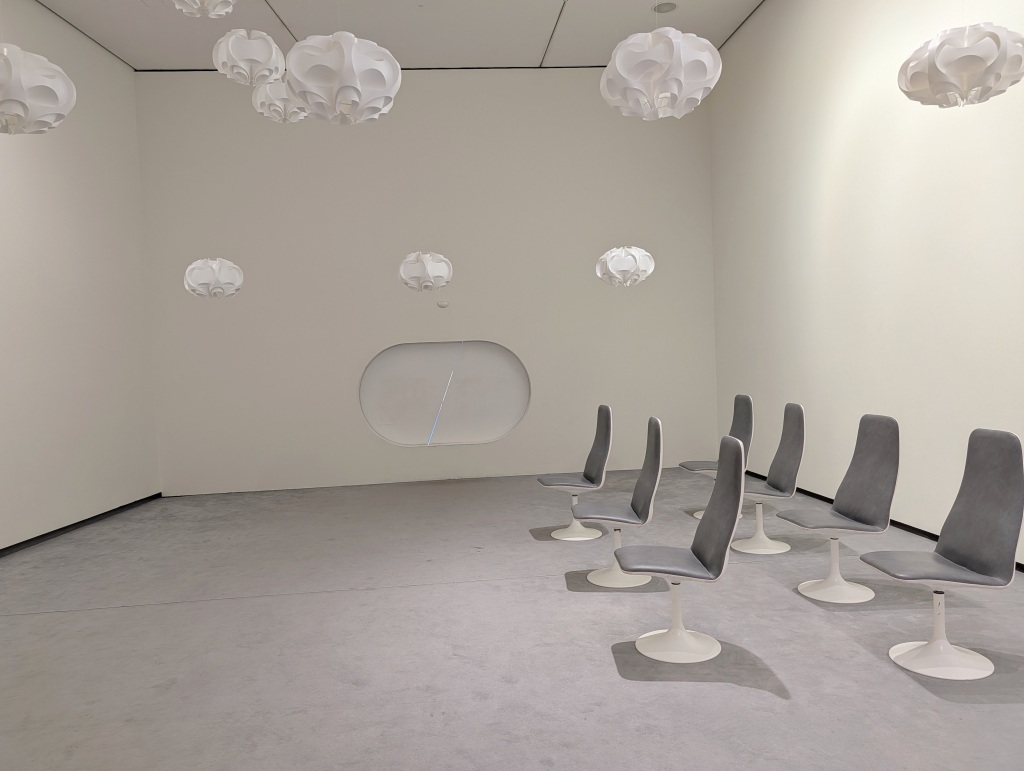
It doesn't look like much. Maybe a bit like an abstract representation of the inside of an airplane, with grouped seats facing in one direction and an oval shaped window at the side. All in shades of white and grey.
From time to time (I think it might be motion detector controlled), the 'window' opens.
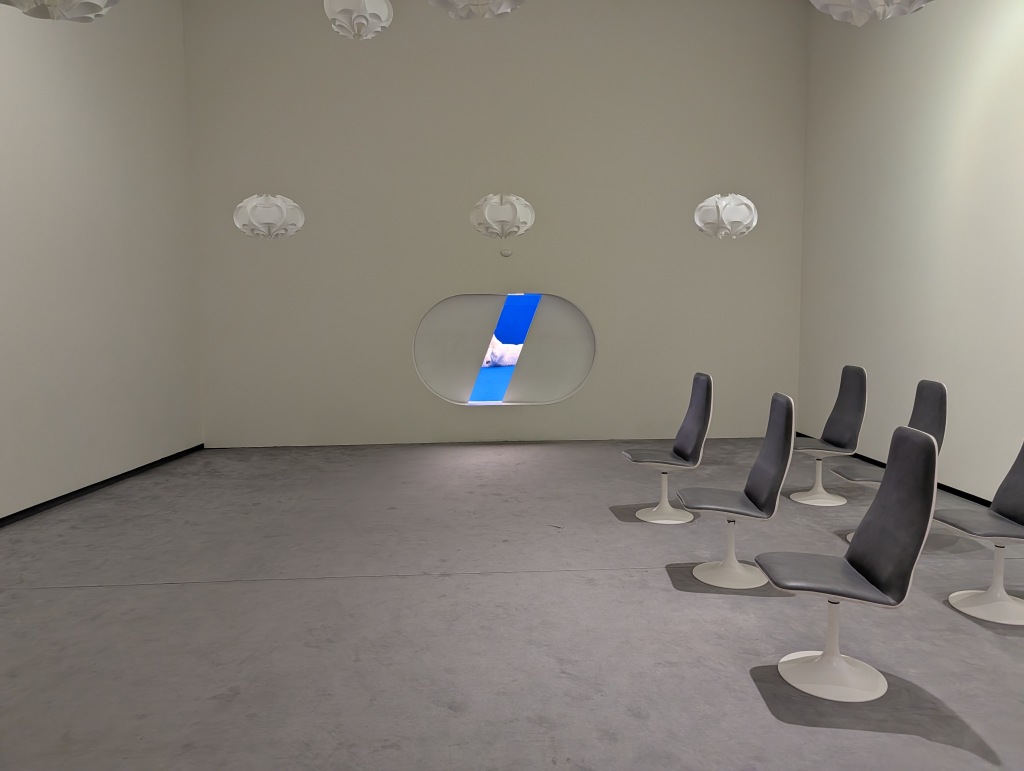
And on the other side is a bright blue room with diffuse light, soft white shapes at the walls. And a unicorn in some sort of pin-up pose.
While I wouldn't dare to assign a specific interpretation to it (and not even consider stating that "perception is impacted in unexpected ways, and essential questions are raised about how we see the world", even though this seems much more fitting here than in regard to the work it was attached to, similar to "open space for the unknown and blur the distinctions between interior and exterior"), I liked the experience. The monochrome blue was somewhat reminiscent of a blue sky, with the white decoration of the walls acting as 'clouds', which seems like an abstraction of the view you might have from an airplane window. While, on the other hand, the window that opens only for a short time and the unicorn in an odd pose, seems a bit like a peep-show reference.
The whole environment looked cool and the strong colour in the blue room made a stark contrast to the other room.
An experience worth visiting the museum for, if you don't have to pay for it.
There were two other odd things I noticed while walking around in Oslo.
One was a group of public toilets, painted in the colours of the flag of France and featuring the labels "Liberté, Egalité, Fraternité".
There doesn't seem to be a specific reason for that (they have been created to celebrate one hundred years of Norwegian independence, but that doesn't really explain anything), but then again: Who needs a specific reason?
The other one is this bell. It is located at the harbour in front of the Oslo city hall and seems to be hanging there just for decoration.
But it turns out that there's a story behind it. And a feature.
It used to be one of the bells in the city hall, but somehow out of tune with the other bells (although I have no idea how a bronze bell can get out of tune). In any case, it was removed and stored somewhere for a decade, before someone decided to get it out of storage and back to the city square.
The cool thing about it, however, is the small, unobtrusive foot pedal in the lower right of the picture. Anyone can press the pedal to make the bell ring.
After I found that out, I recalled that I had been passing through the area two days earlier, heard a bell ring, looked at my watch and noticed that it was some random time (13:21 or whatever) and not some full hour or quarter of an hour, as I had expected. But I didn't pay any further attention to it at the time.
In retrospect it's a bit surprising how rarely the bell is heard. I would have expected tourists (and kids) to keep ringing the bell almost constantly, but it seems to be sufficiently unknown (and the foot pedal sufficiently obscurely placed) that not too many people ring the bell.
While it could be a massive annoyance, it turns out to be a fun little Oslo quirk.
That was the last day of my visit in central Oslo.
I headed out to the airport in the evening, where I walked around a bit and thought I'd seen some art on the side of a building.
It's an airport, so why not decorate one of the buildings with the tail of a plane? It seemed like a plausible piece of airport art.
Only when I looked it up later and tried to find out more about the plane used, I learned that it was still in service, had landed in Oslo two days before I went there and left five days later.
It wasn't an art installation at all, but it was a plane that was in the hangar for check-up or maintenance and didn't fit into the hangar.
One thing near the airport (outside one of the airport hotels) that really was an artwork (and not some painted moose with sunglasses) was this red animal on skis.
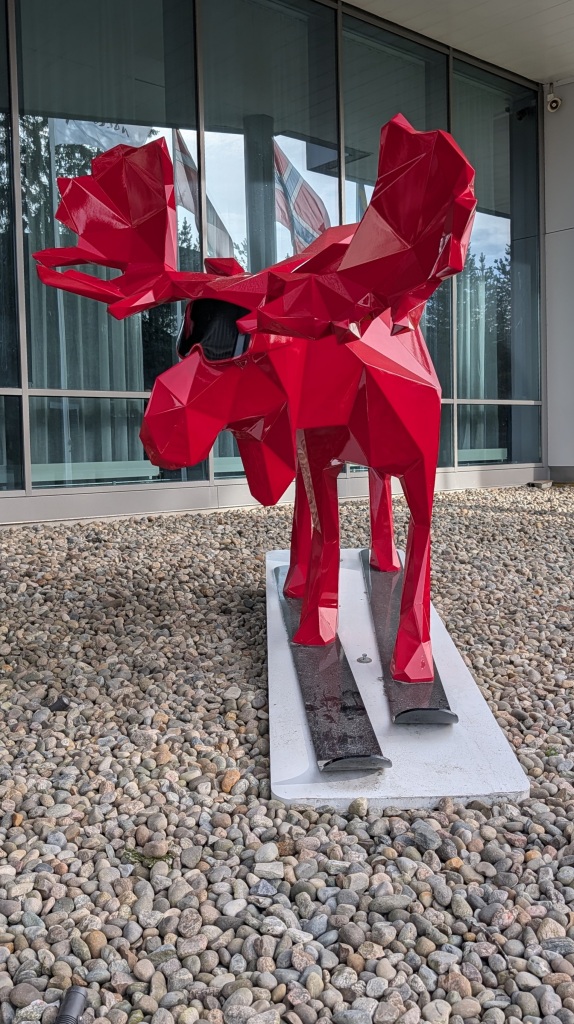
On the other hand, when you start seeing moose on skis, you might as well make use of the fact that you are at an airport and fly home.
Which I did. (Although a slightly longer way than expected, as the airline had cancelled the direct flight and I had to fly to Copenhagen first, before flying home).