I was in Thessaloniki and Barcelona in two consecutive weeks. And there isn't that much to say about either of these trips (with no pictures of the potentially more interesting activities), so I decided to combine the two trip reports.
Usually, I try to schedule some vacation time when travelling, so I have some spare time at the location. As this was my fourth trip to Thessaloniki in three years, however, I was running out of things to do in the area. Especially as November isn't tourist season and many potential activities weren't available.
The only thing I managed to do was to visit the Olympic Museum there.
Which turned out to be surprisingly interesting, given the constraints the museum has to work with.
Basically, it needs to cover all the Olympic Games since 1896 in a consistent and equal manner.
This means there's a rigid structure forced onto the main exhibition.
For each of the Olympic Games there's a large info table listing statistical data for the event (number of countries participating, number of athletes and so on), followed by a short text about the event itself and notable details.
All fine and well presented, but ultimately the same information can be easily gained by having a look at the Wikipedia page for the event.
More interesting are the things presented under the info texts, which are objects relating to those specific Olympic Games.
There's a reasonable amount of variety there, such as Olympic Torches, programs, entrance tickets, commemorative pins, official results books, postcards, coins, mugs, athletes access passes...
Unlike the football museum in Madrid, which is mostly a collection of worn football shirts, the Olympic Museum presents a much wider range of artefacts.
But the need to treat all Olympic Games equally and in chronological order enforces a 'same-ish' looking presentation style. It also means that they will need to restructure their exhibition concept in 12 years or so, as there's only place for about three more presentations in the same style.
As the 'time line' presentation of the Olympic Summer Games does not allow for much creative deviation (and while the presentation for the Winter Games was much smaller, the structure was similar), the more interesting things to look at were other, less structured, parts.
One of them was the "Greek Athletes" section, where various contestants from Greece had donated some of their (usually signed) gear.
As this covered many different sports, there was more variety in the things on display.
For example, at one point, I was wondering about something that looked like an industrial climbing harness. It was much too heavy for any sports climbing event. (And sports climbing won't become a proper Olympic Sport before 2028 anyway.) It turned out to be a sailing harness. So, there were some exhibits that surprised me...
Another thing I didn't know is that there is something like an 'Olympic Winner', which is not the same as the Gold Medal Winner. There's a special diploma for the first eight in any competition. (I assume that this came from running events where there are usually eight finalists and they wanted to give some sort of award to everyone making it to the finals. For most events that have some sort of point scoring (whether that's long-jump or archery) something like the 'Top 10' would make more sense. But for those it's diploma for the best eight as well.)
And, at least according to the Olympic Museum (and who am I do argue?) all these are "Olympic Winners" (although I couldn't find confirmation for that elsewhere).
There was also a section about the ancient games and the early history of the modern games, which was less rigidly structured than the timeline of the modern games themselves.
I admit I had never wondered why Pierre de Coubertin started the modern Olympics.
After all, he wasn't Greek and he wasn't a sportsman.
So why was he the one to revive something that happened in Greece two thousand years earlier?
This can now, of course, be easily googled for or found on Wikipedia, but without the exhibition, I wouldn't have gotten the idea to ask the question.
Another thing that was, essentially, trivial, but got me thinking, were the timelines for the various sports over the years.
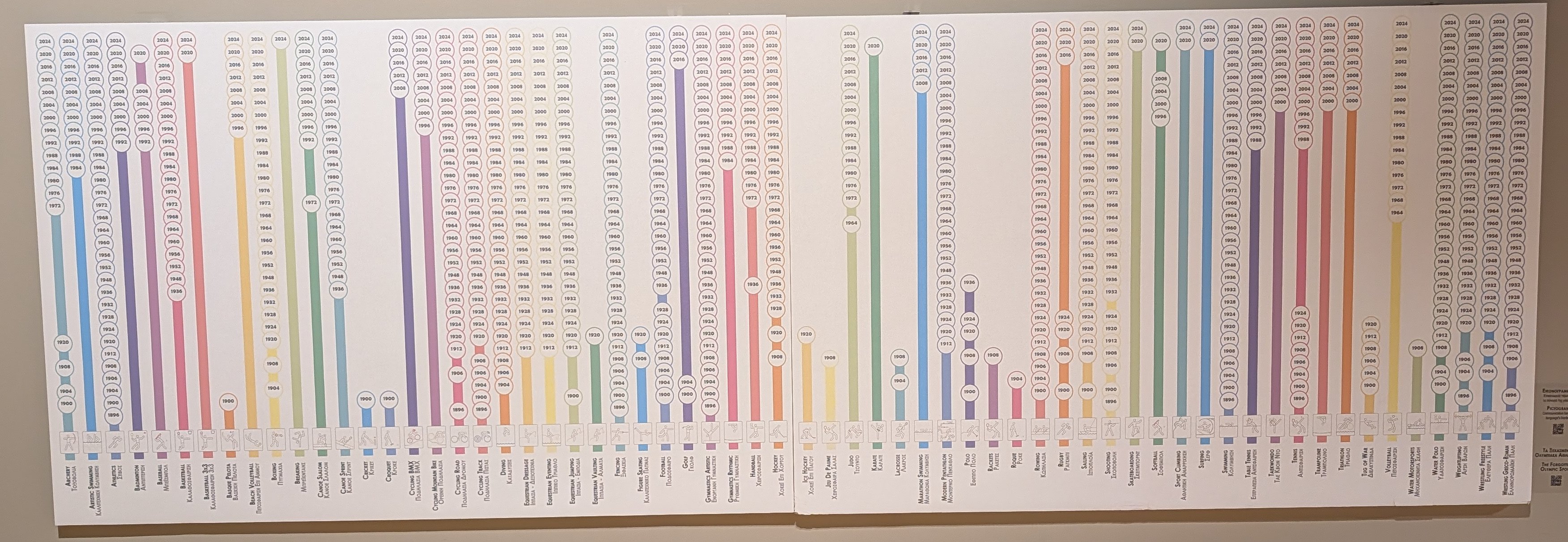
For most of the sports, the timeline is as expected. The sport gets included in the Olympic Games at some point and then continues to be present from that time on.
And, mostly during the early years, some sports made a one-time appearance and then quickly vanished again from the games. There's a strong implication that the Olympic Games were still in a 'trying things out' phase and some events simply didn't work well in that context or failed to be sufficiently popular. Cricket and croquet made an appearance in 1900, as did Basque Pelota. In a similar way, Roque (which I had never heard about, but seems to be a variant of Croquet) was a one-hit-wonder in 1904 and rackets (some early form of squash) in 1908.
All sort of expected.
But there were some interesting oddities.
As the Olympic Winter Games didn't exist yet, ice hockey was an event during the regular Olympic Games in 1920.
And water motorsports were an event in 1908, the only machine-powered event ever in the history of the games.
There are also some surprising gaps, where sports were popular early on and then dropped from the games for decades before re-appearing in more recent times. Most noticeable with golf, which was part of the games in 1900 and 1904 and then dropped until 2016, more than a hundred years later.
While not quite this extreme, rugby vanishes from 1924 to 2016, tennis between 1924 and 1988, and archery between 1920 and 1972.
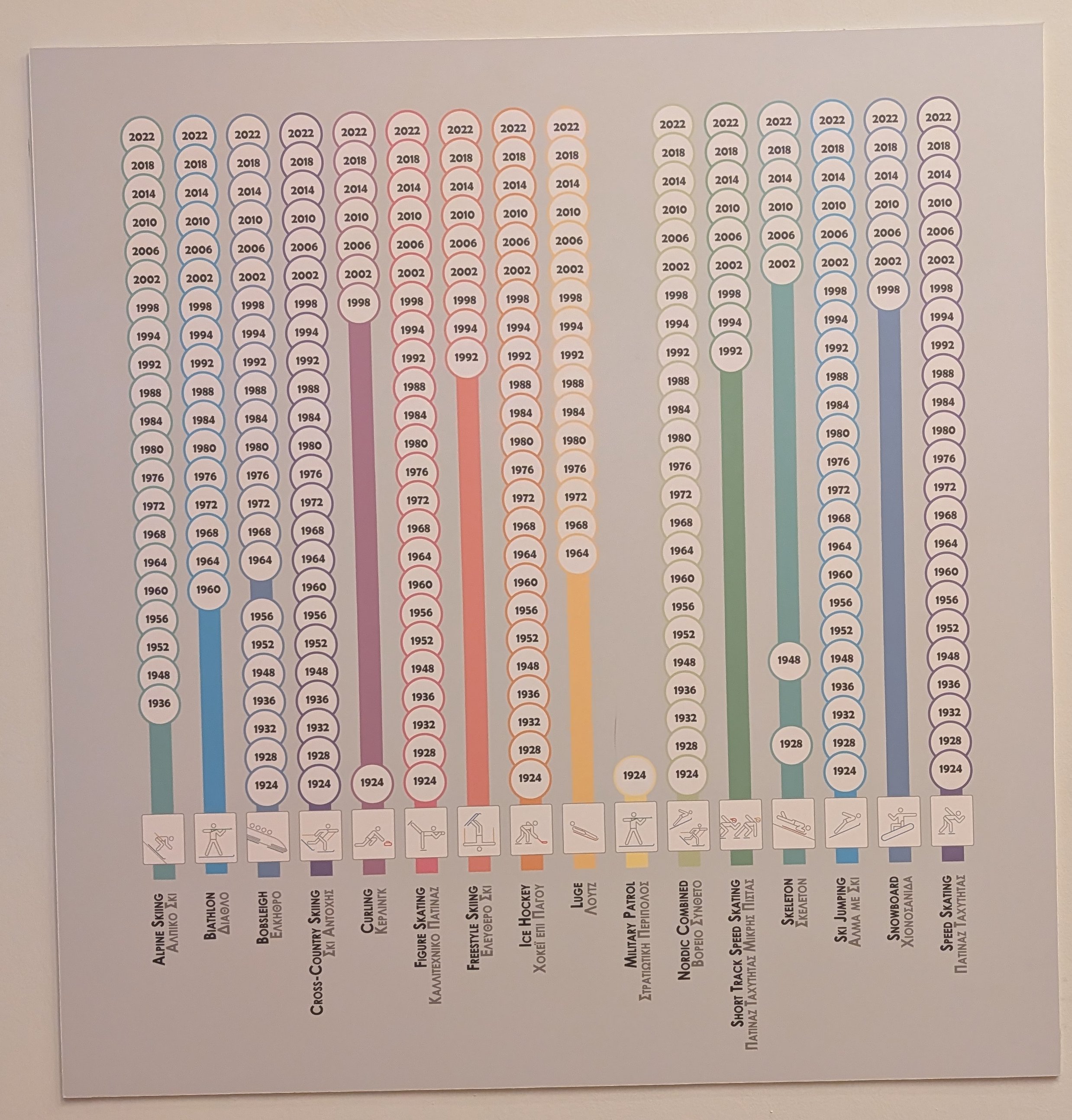
For the winter sports, due to their shorter history and lower number of events, there are only two obvious oddities - curling, which was absent between 1924 and 1998 and skeleton, which appeared in 1928 then took a 20-year break until 1948, decided that it wasn't really worth making an appearance before coming back for good more than half a century later in 2002.
And the only event that made only a single appearance (back in 1924) was 'military patrol', a precursor of biathlon. (Although the latter didn't become part of the games until 1960.)
That's essentially it about the current, mostly static, exhibition on the ground floor of the museum.
There are plans to add more multimedia and interactive content in some rooms on the upper level, but this is still work-in-progress (which is partly related to the reason why I was in Thessaloniki).
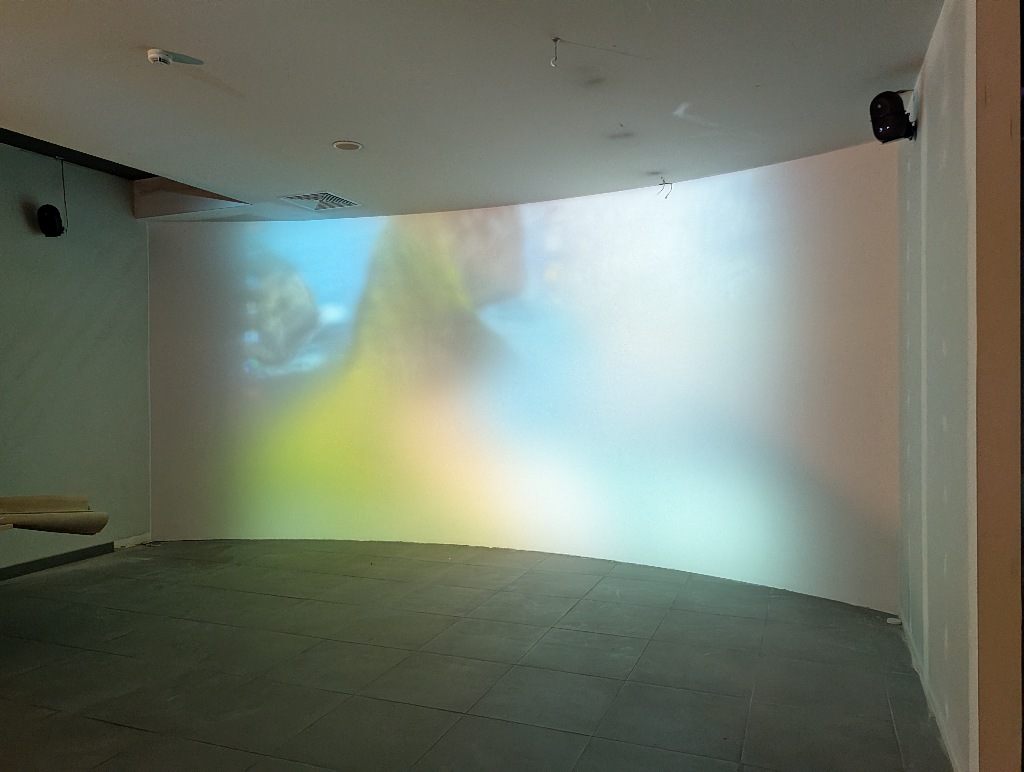
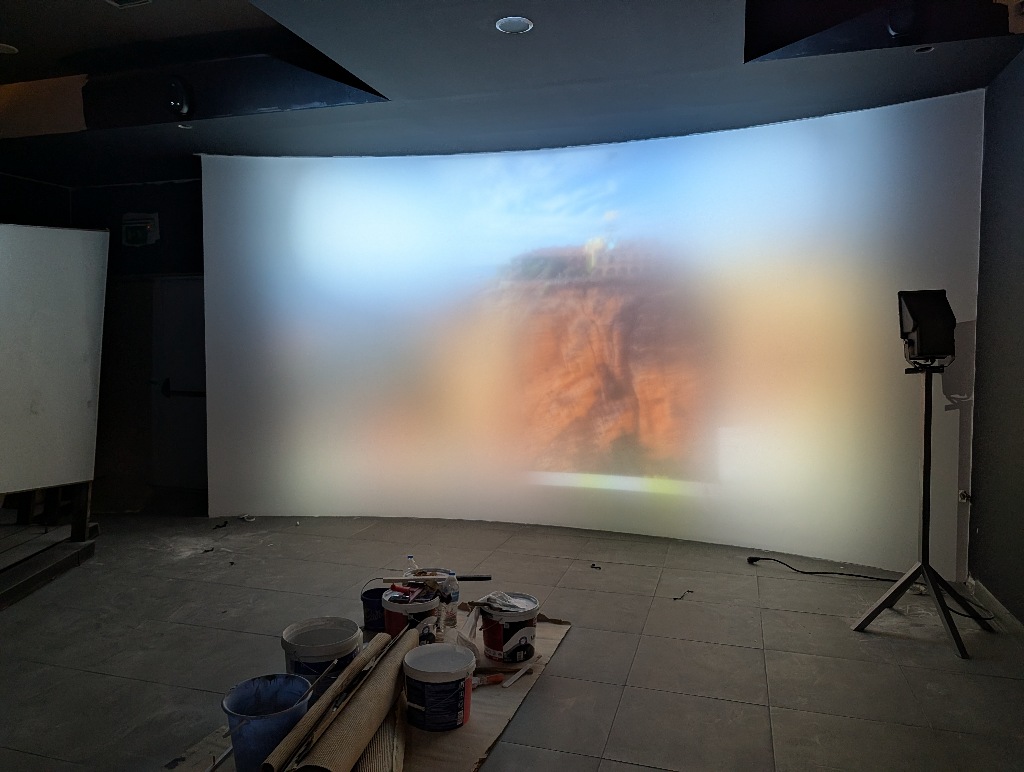
The blurring on the screen hasn't been added to hide any confidential information. It's just that the projector had only been recently installed and there was a translucent plastic cap on the lens to protect it from dust and splashed paint. The image is some common Windows background image and has nothing to do with the Olympics.
My flight home was late in the afternoon, so I went karting again.
There's a good karting track about halfway on the way to the airport, so it seemed like a good opportunity to do something active before sitting around in the terminal for two hours, followed by sitting in the plane for another two hours.
(Part of the reason why I sometimes go karting on the last day of a trip is that airports are noisy. And so are karts. Hence, kart tracks are sometimes in the same area as airports, making it a convenient stop along the way. The main reason, however, is that karting is (usually) fun.)
It had been raining the previous night. But that had stopped in the morning. When I reached the track, there weren't any wet patches. The asphalt was darkened, as it was still slightly damp, but that's all.
If you drove with a car down a street that looked like that (which was what I did when driving to the karting track), you wouldn't change your driving style at all.
I was the only one at the track. Few people go karting on a Thursday morning (at least that was what I thought until a week later).
So I had the track to myself.
Which turned out to be a good thing.
The track was incredibly slippery.
It felt like driving on ice.
Kart tires (at least those usually available on track karts) have no profile and are completely smooth.
But even though I knew that (and could see it on my kart), I was surprised how little traction they gave.
The first one or two laps I kept spinning around at almost every corner. (And was glad that there were no other drivers to crash into)
After that, I drove much slower and carefully, bur usually still lost control at least once per lap.
It was an interesting experience, as it required to adapt to the track and drive a different line than usual and I finally managed to drive a few laps without spinning the kart. But that meant going slow and carefully. (Which is usually not why I go karting. To drive carefully, that's what the rental car is for...)
I had driven on that track a couple of years ago and my lap times were around 38 seconds.
This time, my best lap time turned out to be 94 seconds.
Lesson learned: Avoid kart tracks that are even slightly wet.
(Or maybe specifically those that are only slightly wet. I was karting the previous year when some massive rain started and there was water all over the track. While I had to approach the corners slower and more carefully, I only ran off the track once. I had to be a bit more careful than on a dry track, but the kart was more controllable on that wet track than the kart on the slightly damp track in Thessaloniki. Although I didn't pay attention to the type of tires on the previous track.)
While I had no days off in Thessaloniki, I had a few days off in the Barcelona area.
So I went karting.
This time not because it's near the airport, but because the track seemed interesting
At 1340 meters the track is quite long. (For comparison, the track at Thessaloniki was only 550 meters.)
The track is also integrated into the landscape.
Often kart tracks are, essentially filling a parking lot.
They are located on a large, concrete or asphalt flat rectangle. With the track designated by painted on markings and tire barriers on the sides. Every part of the track is flat.
The track at Castellolí, which was the one that I was heading for, is in a mountain environment. It was also custom built as a kart track.
The track not only goes up and down. Some of the curves are even banked.
It's an unusual track, which is also wide in some parts (up to 14 meters). This allows for a number of different approaches to most corners, so it's fun to find out which one seems to work best. (Generally, you approach a corner from the far side. But on a track this wide, that might add more distance than the advantage in cornering speed is worth it.)
It is fun to drive.
And popular.
While the Thessaloniki track was deserted on a Thursday morning, I was lucky to see a group of about twenty people leaving when I got to the Castellolí track.
Especially as they offer competitive racing as group events for companies or stag activities. And these include a warm-up phase, a qualification phase and a subsequent race. If one of these events is going on, it can take an hour before a session for individual drivers becomes available again.
But that group had just finished. I had less than ten minutes to wait until I could have a go.
There were six other drivers already waiting. (As I already mentioned - unlike the track in Thessaloniki, where I was the sole customer on a Thursday morning, this track was really busy. But the track was dry and it's a well-known track.)
It was obvious that I would not have one of the top times.
That's mostly because I'm not a good (kart) driver. I don't drive often. I drive for fun. I weigh to much (in karting, lighter is better). And, despite appearances, I don't drive at the limit. (There is a certain amount of self-preservation involved. Even though, as the t-shirt of one of the employees at the track in Thessaloniki said: "Karting - because soccer, baseball, football, basketball, golf and tennis only require one ball".)
But the real indicator that I wouldn't be doing well in comparison was that some of the other drivers had brought their own racing overalls and helmets - a strong hint that they weren't doing this for the first time.
Anyway - the track was great and it was a lot of fun driving there.
As the track wasn't flat, it wasn't always possible to look far ahead. Especially the part going up to the main straight was good. You need to go full speed for the straight. But you can't see the track ahead. And there's a corner right at the highest point. It's not much of a corner and you can go through it at full speed. It still takes a few laps in order keep going full throttle.
And then the straight is slightly downhill and ending in a slight corner. And at that point you want to go full speed. But at the end of the corner, there's a tight S-corner, more like a zig-zag, and you need to break hard before going through it. But when?
Fun to drive.
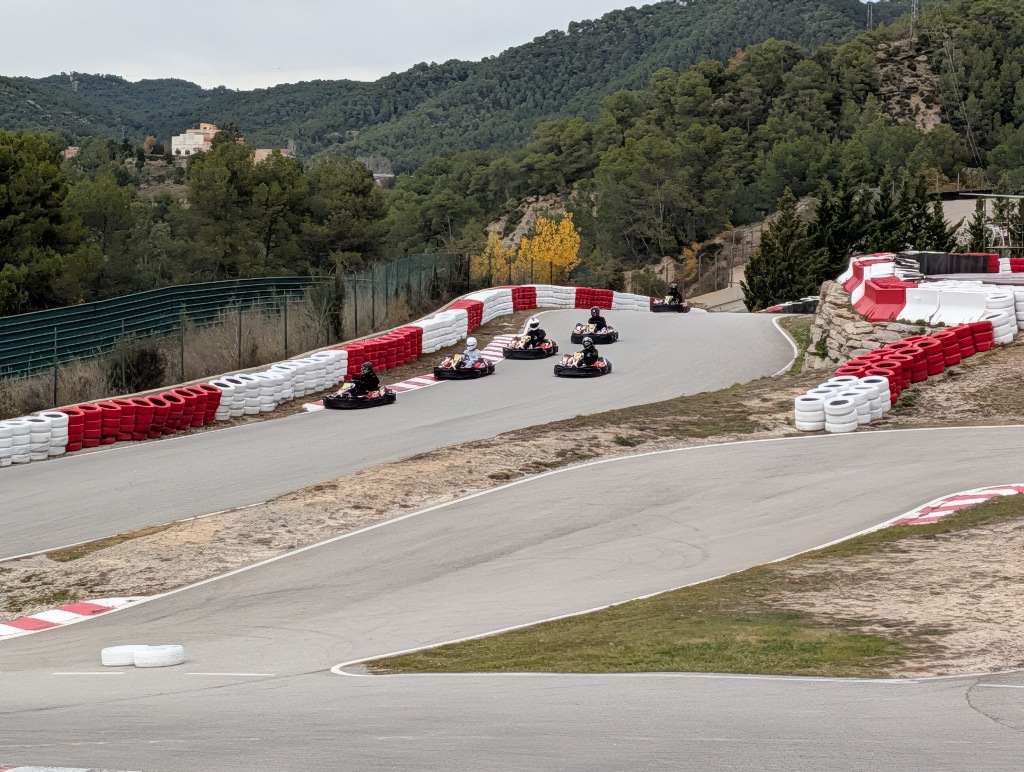
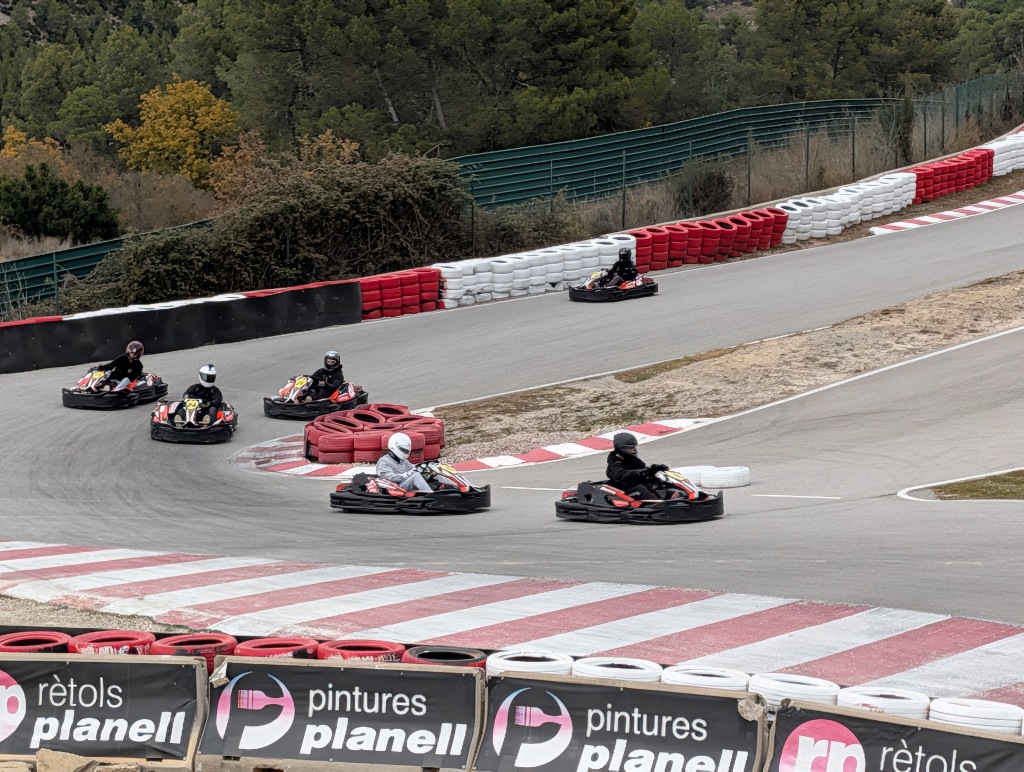
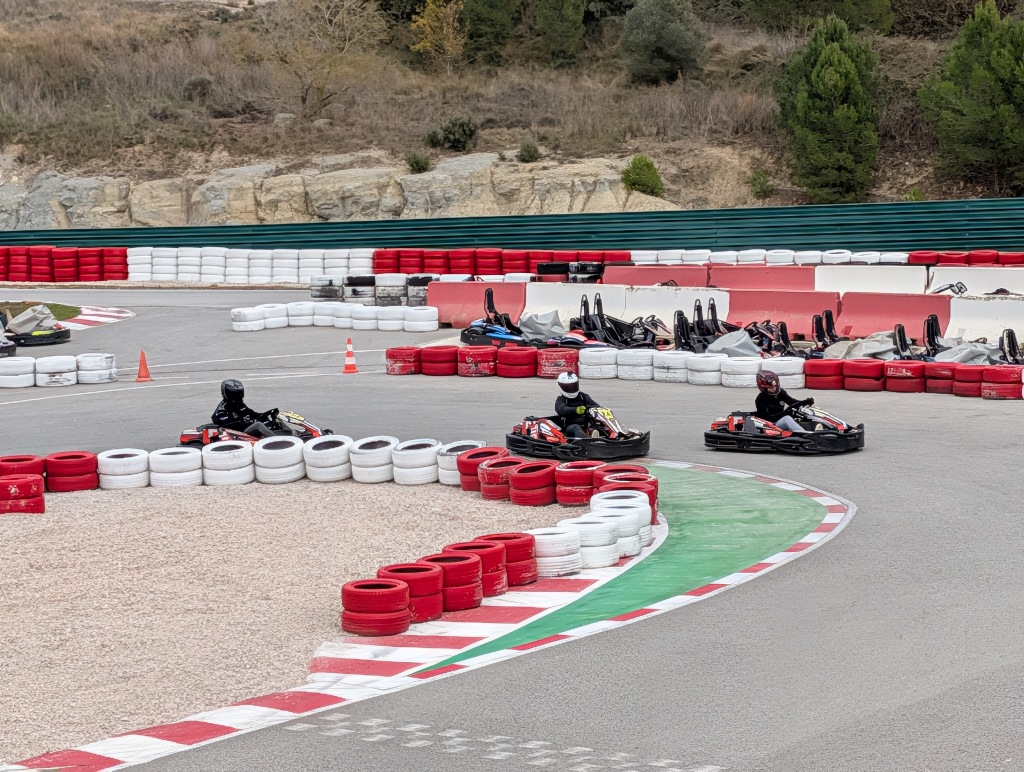
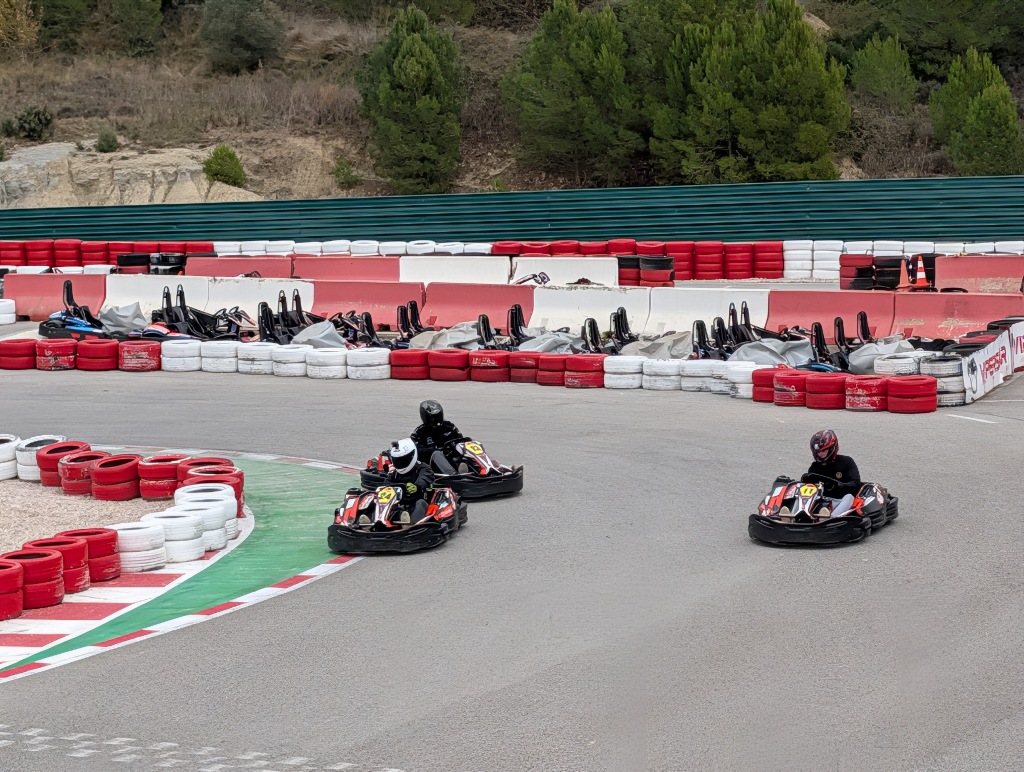
As expected, I didn't end up fastest, but I was closer than I had expected.
The best driver was amazingly quick, at 56.874 seconds for the best lap. Even his buddies didn't come close, with slightly more than 60 seconds (two were within two thousands of a second compared to each other, the next one was barely 3/10th of a second behind. While my best lap was 62 seconds, it felt like a reasonable achievement.
I don't know the current track record, but it seems that in 2022 it was at 55.925 seconds. So the guy going fastest that Thursday morning was driving within one second of the lap record. So being five seconds slower than that still felt good. (Even though I ended up on fifth place in this random group of seven people.)
Karting is fun.
And easy to do, as it doesn't require much physical effort, except for some arm strength.
Better than walking.
Which was the next thing I was going to do.
Not far from Castellolí is a place called Montserrat.
It features a well-known abbey built on the side of the mountain.
I wasn't interested in the abbey itself. But next to the abbey is one end of a funicular. And that takes you higher up the mountain. From there a number of paths go back to the abbey (and other places).
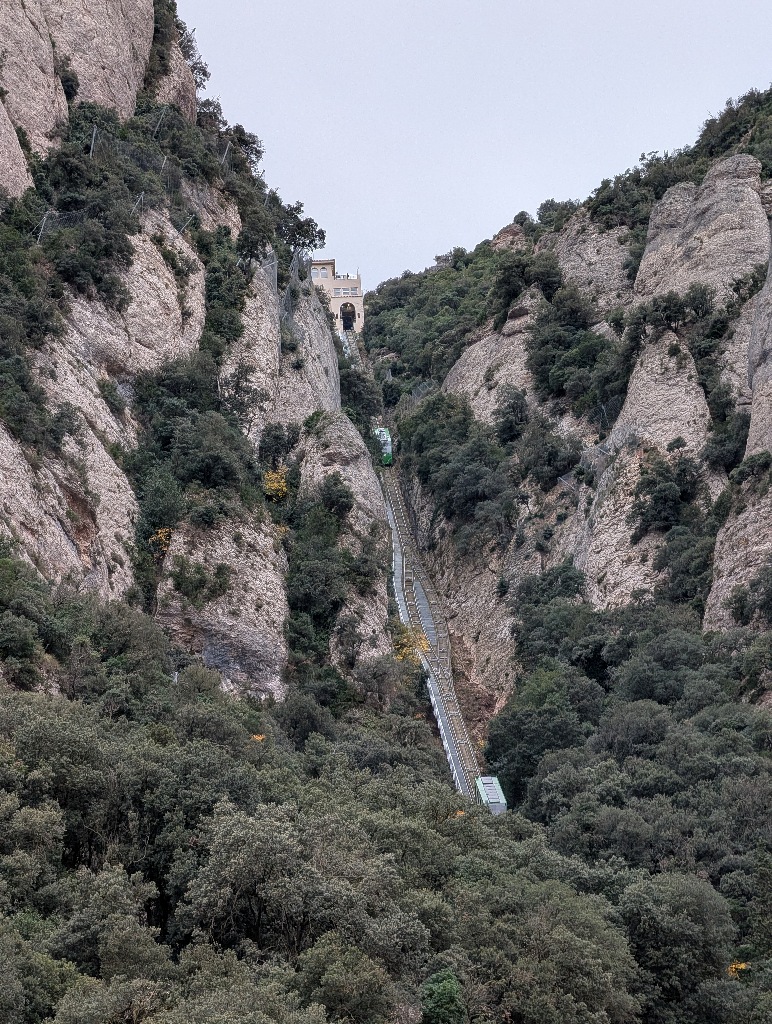
I didn't want to walk the 250 meters uphill, but taking the funicular and walking down from the top seemed like a good idea.
It turned out to be trickier than expected.
Not the actual downhill walking, which was fine, although a bit tiresome.
Looking at the map that is posted on site, there are two options to get back down to the abbey. A short 'trail 3', marked in red, and a combination of the purple 'trail 1' and the green 'trail 2'.
I went for the longer combination of purple and green and started to walk along the 'obvious' trail.
After about a kilometer something seemed wrong. I was increasingly heading for the side of the mountain opposite of the abbey. Unless there was a mountain pass coming up soon, there didn't seem to be any possible way to get back to the abbey, short of walking all the way around the mountain range.
I went back to the funicular station and found a much smaller trail that seemed to be heading mostly in the right direction and started to follow that.
It turned out to be the right path. And ultimately it took me back to the abbey (and, more importantly, to the car park).
The tricky part is that the trails are well marked, but not with useful information.
I had expected purple markers and the number '1' painted to some trees or rocks along the way.
But all there was were info signpost, telling you locations along the trail.
Which means that there was a signpost stating "Sant Jeroni 1h 00m" or "Santa Anna 0h 20m". But no information on which trail you were on.
You needed to know where the places on the signs were to figure out whether you were heading the right way (and of course the signposts weren't anywhere near the map with the colour codes and the path numbers).
At some point, the first trail I had been using had a sign for Collbató. That's when I looked it up on a map and noticed that this was a town on the other side of the mountains from the abbey.
As I intended to go via path 1 and 2, there was the issue that there wasn't any sign for the abbey.
Officially, trail 1 goes to Sant Jeroni. I didn't need to go all the way to that, but a bit before reaching that, trail 2 forks off to the abbey.
But all the signs along the trail point to Sant Jeroni.
So unless you knew that this was the end of trail 1 (and not, for example, Sant Benet), there was no way to find out whether you were on the trail. (It would have helped a lot if the signs would have had the trail number of color on them.)
And even when I found the trailhead for the green trail 2, signs continued to be confusing.
There are different paths back to the abbey. And while they were signposted, they were signposted with places along the way.
At some point there is a choice of going to Montserrat via "Drecera deis Tres Quarts" or via "Camí de les Aigües". But no indication at all which path (if any) was the 'green trail'.
I don't mind following the path based on signposts to destinations.
But I felt cheated by the map at the starting point, which clearly listed trail colors and numbers, making me assume that they would somehow be indicated along the trail. (Even more annoyingly, there are indications about which path you are on printed on some of the signs. But those are for long distance hiking trails, which aren't represented on the local info maps. So you know that you are, for example on yellow-white PR C-19 or red-white GR 172 without any hint on how they relate to the trails that are shown.
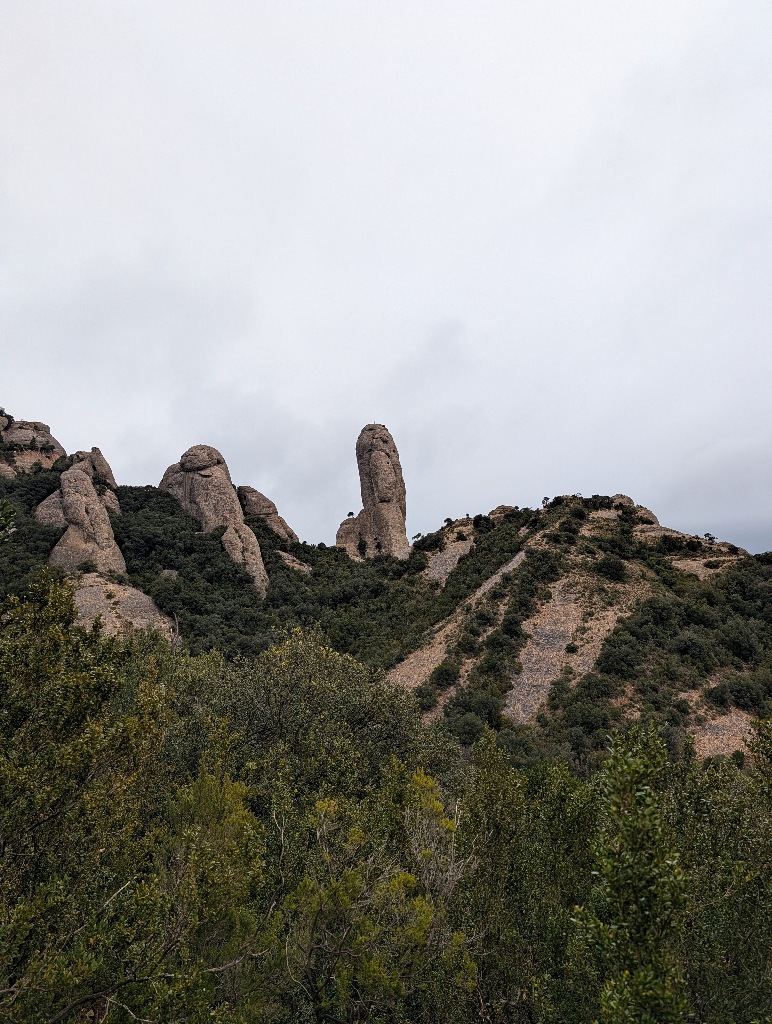
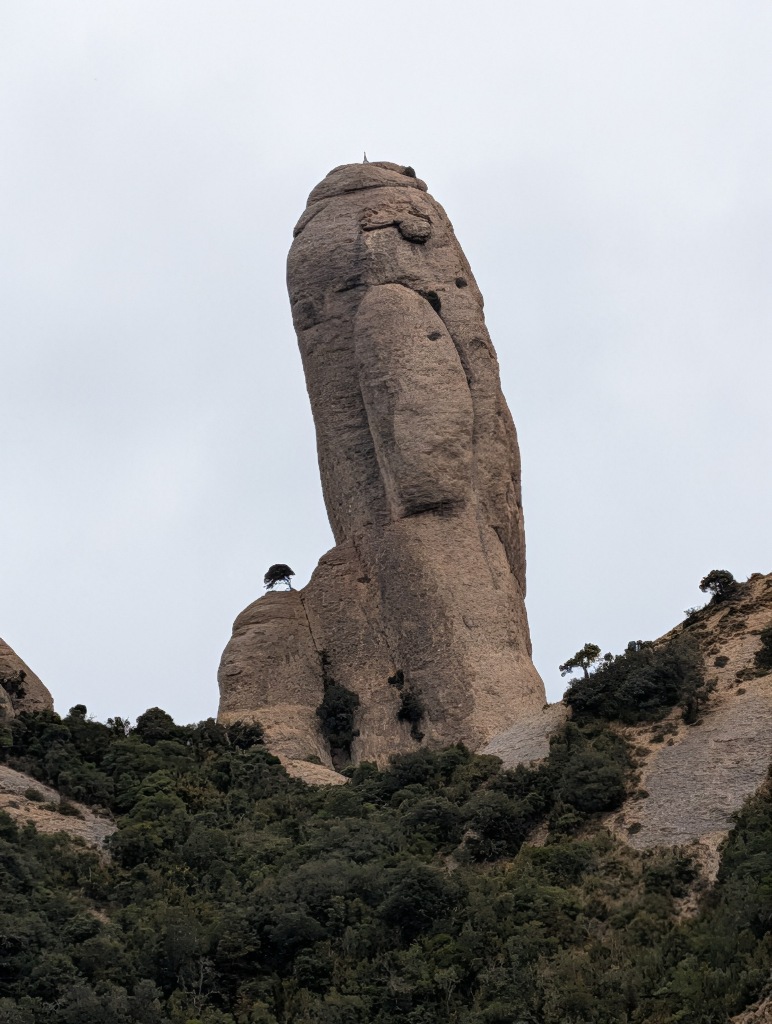
Despite the oddities of sign posting (about which I spent more time writing the previous paragraphs than being confused by them along the trail), it's a good walk with great views down the mountains. Even on an overcast day.
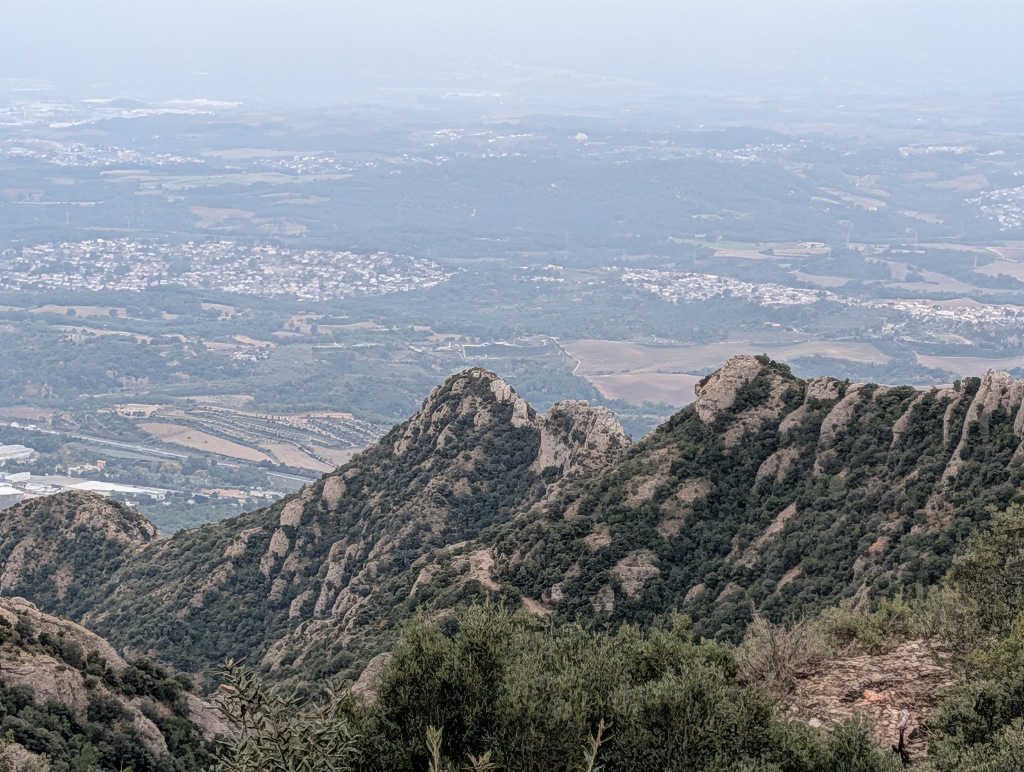
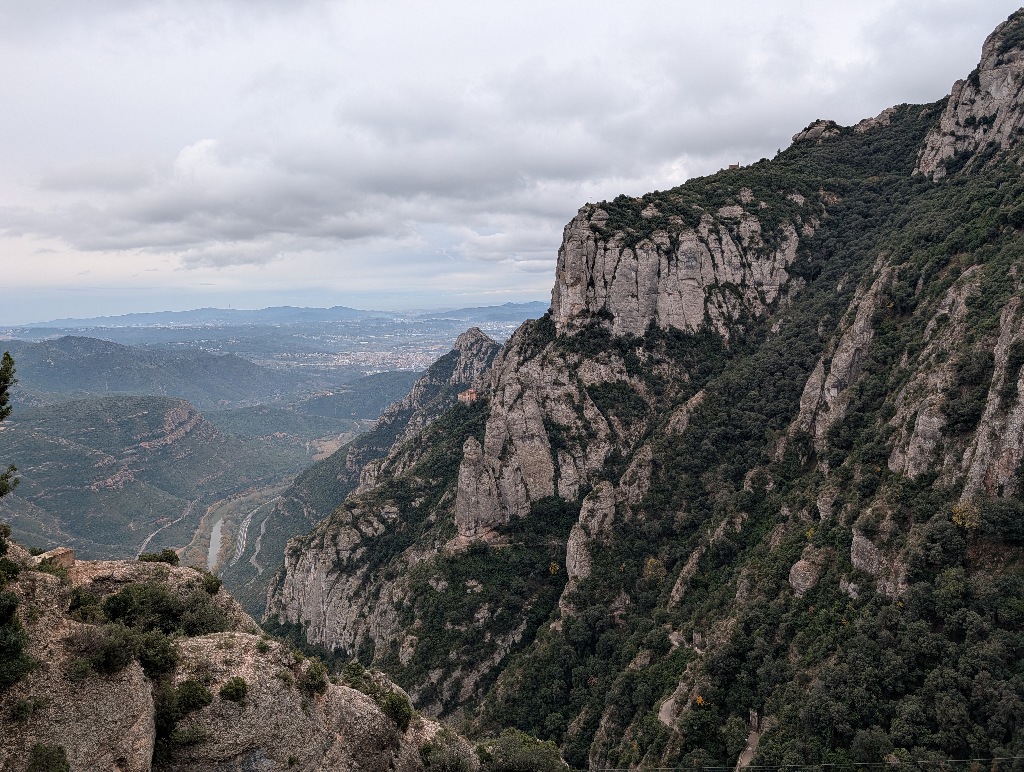
Even though, at some points, the landscape itself seems to tell you off.
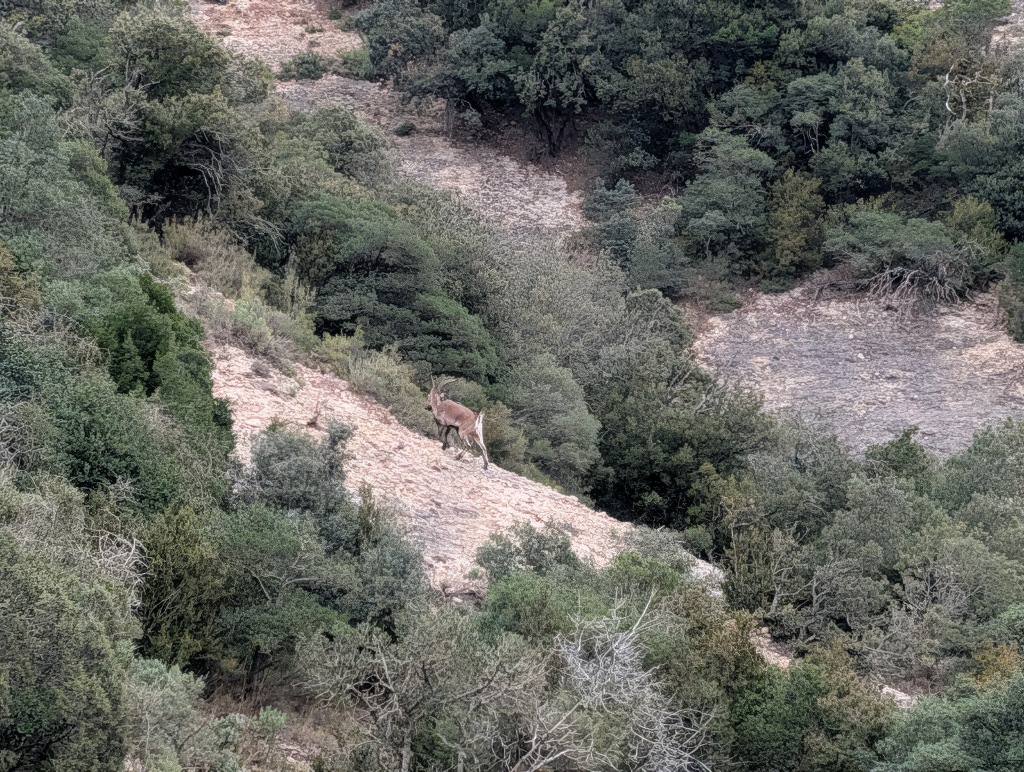
Along the way, I spotted some animal, going its own way. Possibly an ibex.
Ultimately I manage to make my way back to the abbey.
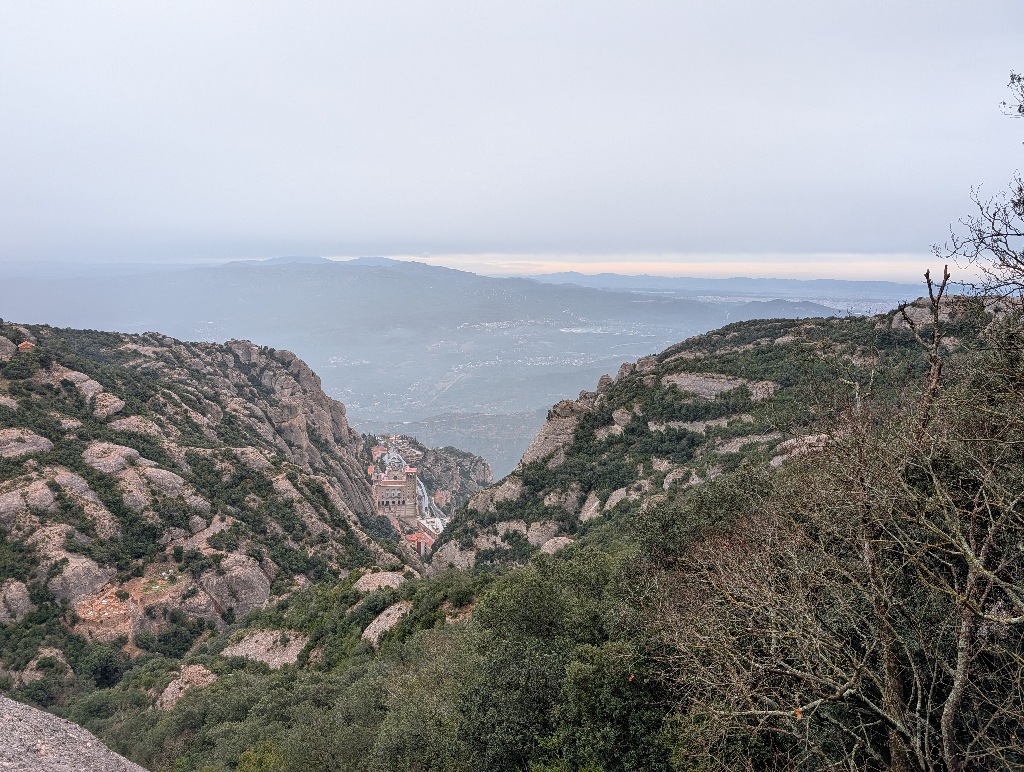
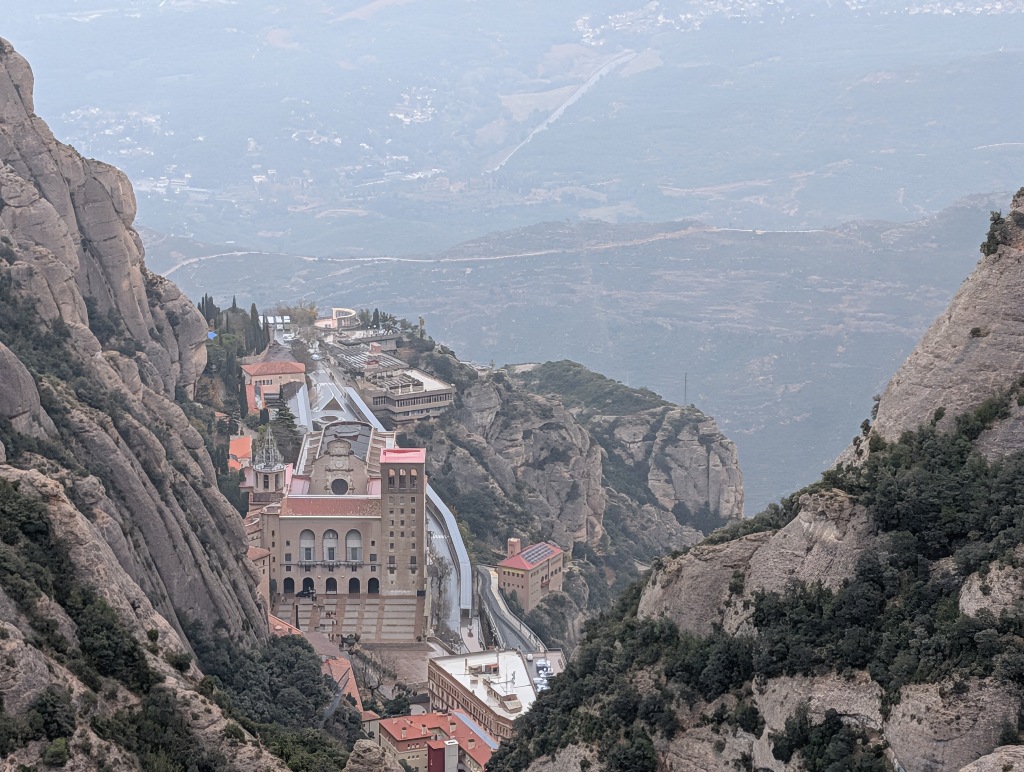
And while walking downhill is certainly less exhausting than going uphill, it is still tiring.
Which I didn't care about that day, but might have influenced what happened the next.
I wanted to go on a Via Ferrata again, this time near Centelles.
The fact that there are no pictures of a Via Ferrata here, is already a hint that this didn't go well.
It didn't go badly either. I simply didn't get far.
Part of that was that I didn't properly pay attention.
While I knew that the Via Ferrata of Les Baumes Corcades has some difficult sections, not suitable for beginners, there is also a simpler route for beginners.
And the beginner's route is mostly horizontal, along the side of a cliff.
As I was happy with the Via Ferrata near Madrid, which was mostly horizontal, but struggled with the Via Ferrata in southern Italy, which went mainly uphill, the horizontal bit here seemed manageable and fun to do.
I had read that the total altitude difference here was more than 300 meters (a lot more than I was willing to attempt). According to the map of the trail, however, it seemed that most of the climbing was in a section at the end of it. There was a climb up to the summit of mount Puigsagordi. But that was an optional add-on. It was possible to do walk back to the car along a path without going up that mountain. Which also seemed to have some of the technically more difficult sections.
So, it seemed all fine. So far.
What I didn't pay attention to was that you need to go straight up before the horizontal traverse.
And that was a lot more up than I was able to do.
The first bit, visible from the starting point, is one of these parts that consists of giant staples drilled into the cliff wall.
Essentially, you're climbing up a 25 meter ladder. Leaning slightly backwards in (short) sections. With unevenly positioned rungs. That don't have much surface to stand on.
Once you get to the top and are able to look over the ledge, you find out that there's a second one. Longer and with less evenly attached rungs.
And I couldn't go on.
While standing on the upper staples and waiting to go onto the ledge, my legs were starting to shake and getting all wobbly.
I was, essentially, feeling fine. I was neither exhausted nor afraid of the height or the situation.
But my legs were clearly telling me that they didn't want to go on.
Luckily, along that ledge was one of the 'exit routes', so we stopped the tour there and walked back to the parking lot.
Possibly, I might have been able to climb up the second 'ladder' as well. And after that, it would have, indeed, after walking a bit further up along a trail, been the start of the traverse.
But I knew that I my legs were already tired now. At the end of the second 'ladder', it would be worse.
Getting like that to the fun bit, would almost ensure that it wouldn't be fun at all.
Doable? Maybe.
But it would be more about 'making it to the end' than about enjoying the activity.
I had a day off and wanted to enjoy it. No point in torturing myself.
In the end, I wasn't sure how much of this was due my general lack of fitness and how much was due to my legs being tired from walking around Montserrat the previous day. In any case, climbing up the equivalent of a 50-60 meter ladder doesn't seem like a good way to start a fun activity anyway.
Ultimately, the main issue is that I didn't pay attention to the details and only looked at the pictures of the traverse. And implicitly assumed that all the long ladder sections were part of the final section up to the top of the mountain. (On the part which I wouldn't do anyway.)
So this didn't work out the way I hoped it would. Still - a fun morning out in the mountains. With a lot of easy walking around the local towns for the rest of the day. On flat ground.
The next say, I did something that I already had wanted to the previous year (when I was in Barcelona around roughly the same time of the year). See the Circuit de Barcelona-Catalunya racing track.
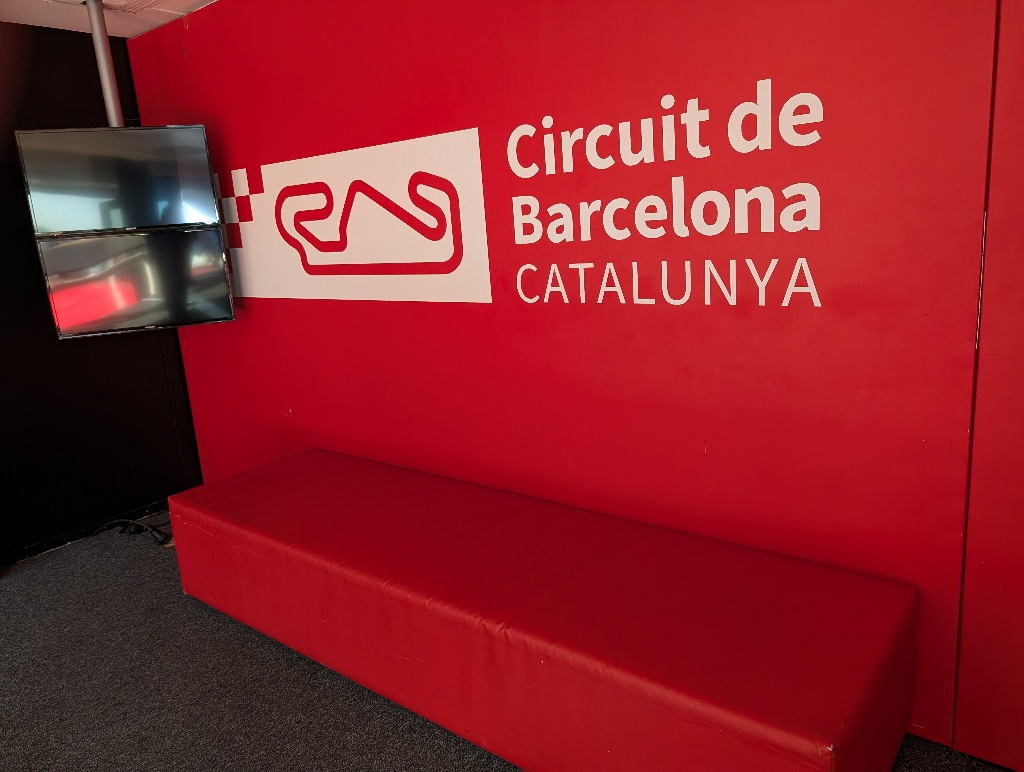
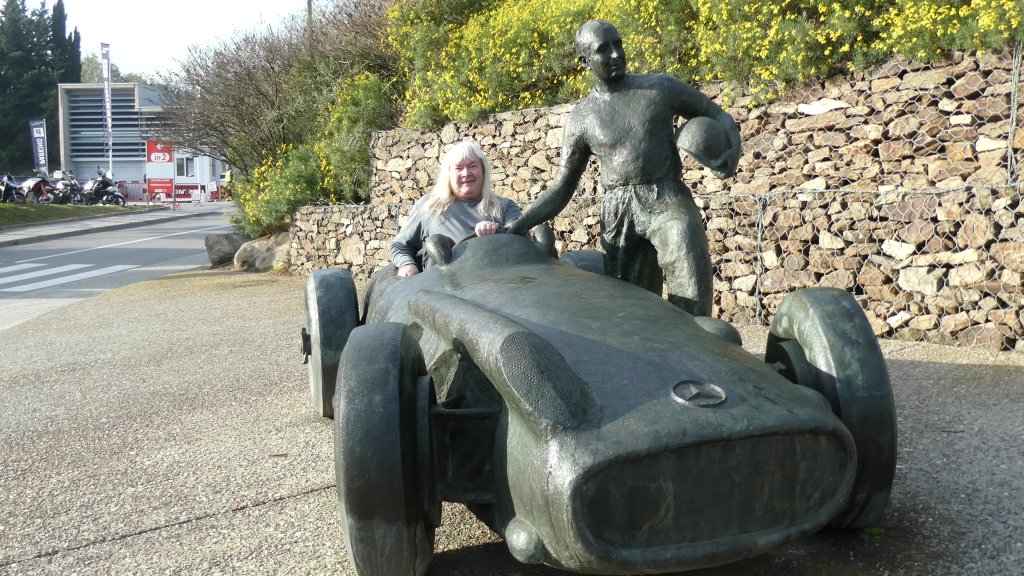
The previous year, I had planned to visit the circuit and had already booked a ticket for a guided tour. (Mostly to take a specific picture of me sitting in a bronze sculpture, but I also wanted to see the track.)
However, a few days before I went there, I got a mail stating that the tour was cancelled. The Moto GP Grand Prix was supposed to happen that weekend in Valencia. But there had been a flooding in Valencia. So they moved the event to the Barcelona track. And as there would be a race going on that weekend, they couldn't offer a tour and had to cancel it.
Ultimately, I did manage to take the picture I wanted (even with the race going on at the same time), but it wasn't easy (details are here, after the "Update: Well, it's five out of six now." heading).
And I didn't get to see anything of the track.
As I was in the area again, it seemed like a good idea to do it properly this time.
This time, they didn't cancel the tour. But it was surprisingly difficult to get to it.
Partly because they were rebuilding some of the infrastructure.
I tried to get to enter the circuit from the side that I used the last time (from the south-east). But all the former parking areas had their asphalt surface broken up and removed. There were fences all around and all the entrances to the circuit were barred and locked.
I tried to drive to the other side of the circuit, but all the access roads were closed.
Some of them had security people guarding the access and I was told that I couldn't get to the circuit, as there was some event going on. And unless I was part of the event, I couldn't enter.
The fact that I had a ticket for a guided tour (which hadn't been cancelled) didn't help.
I then drove to another access road.
Which looked even more locked. The first checkpoint had a mobile barrier. It was obviously there to allow people who were part of the event to get in. And keep people who weren't (like me) out. The second barrier was a line of heavy plastic blocks across the road. Quite definitely saying "this road is closed". The guard standing next to it seemed less like someone regulating the access to the site. He seemed more like someone to make sure that nobody moved the road blocks aside and sneaked in that way.
I stopped asked him where I needed to go for the tour and which entrance I could use. And to my surprise he said "Right this one." and started to move the road block aside.
So, I managed to get to the actual entrance of the circuit. Even though it was much more difficult than expected.
On the other hand, I got to see the circuit in action, which is a definite bonus.
It turned out that the event (or 'festival' as one of the gatekeepers called it) was, essentially, a track day for GP cars.
Usually, track days at racing circuits are open events, as they want to attract as many drivers as possible.
But this track day was organized by an external racing company, who had rented the track exclusively for that weekend. And as it was, essentially, their private company event, nobody else was allowed to get to the circuit without their accreditation.
Except for those who were there for a guided tour.
But not all the guards had been briefed on that.
The tour itself (once I managed to get to it) included the media centre, which had a surprisingly good location right above the pit lane.
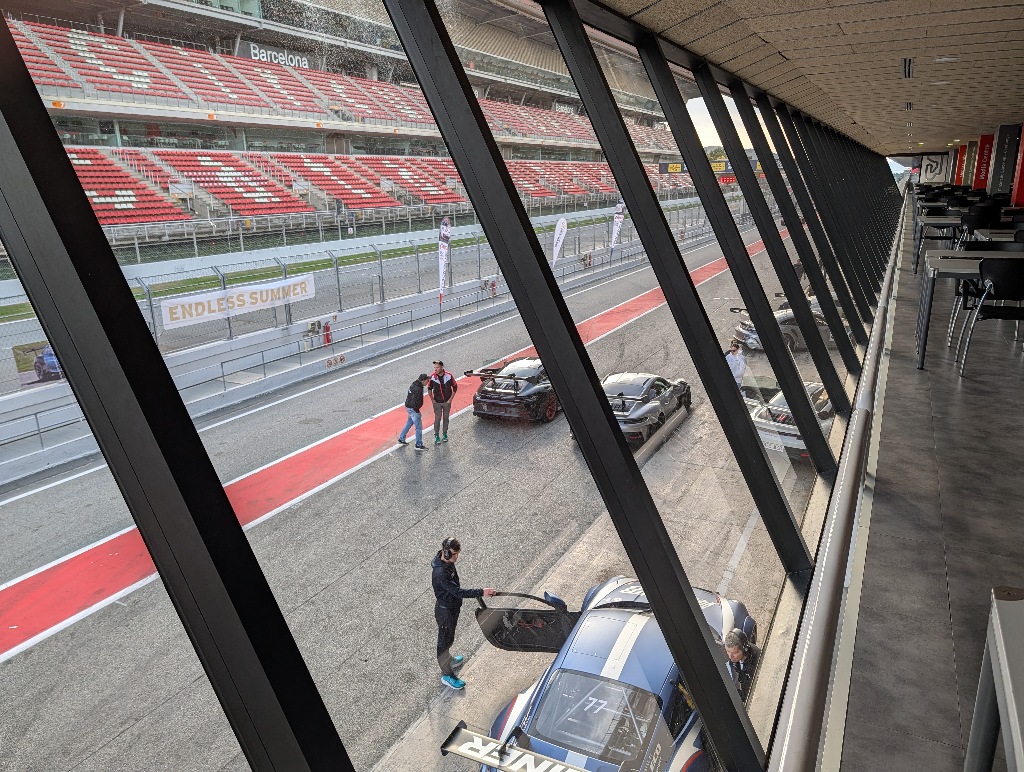
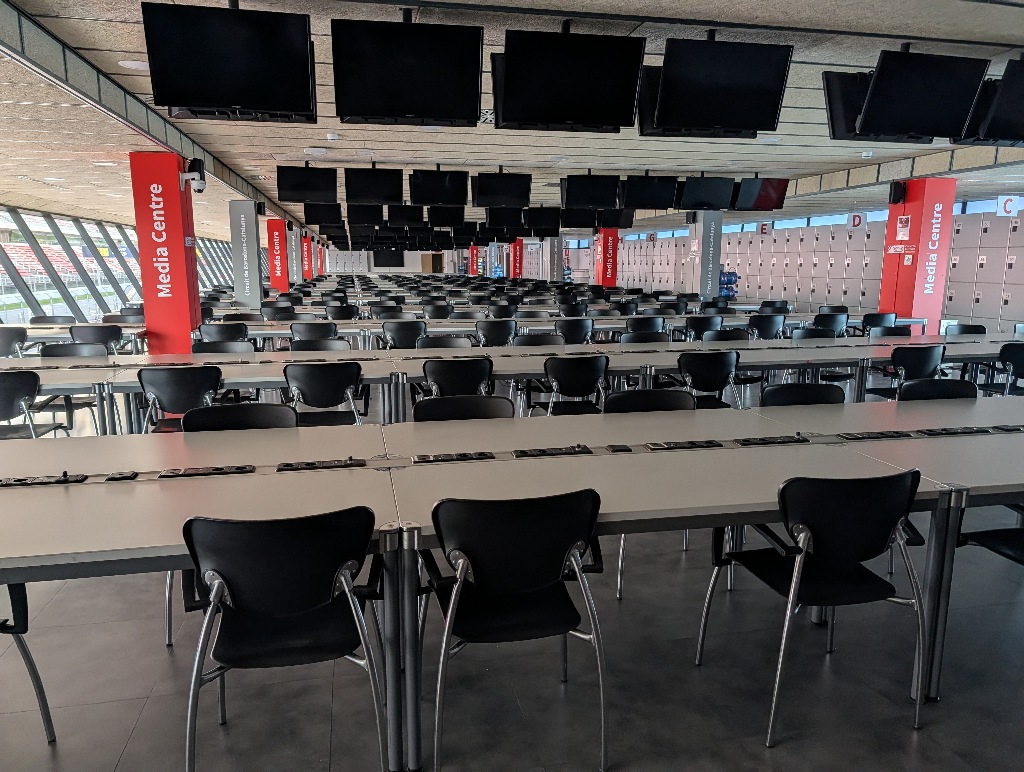
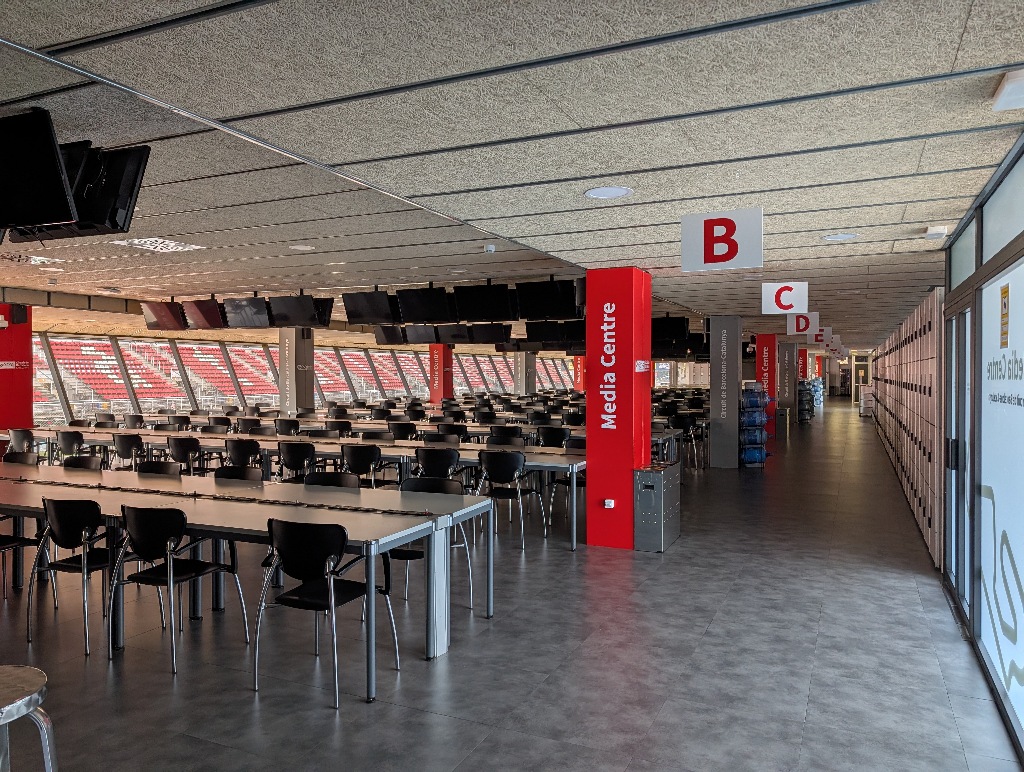
The location was unexpected, as the media centre is mainly for sports writers (the TV commenters are usually sitting in glass boxes along the upper parts of the stands opposite the pitlane). And the sports writers don't really need to see what's happening in the pitlane, as they will be looking more at the info screens and their laptops most of the time, anyway.
Directly above the pitlane, especially with the slanted windows, is a prime location for VIPs. On most tracks, that's where the 'paddock club' is usually placed, which is the most expensive place to watch a Formula 1 race, usually at prices of 6000-10000$ for a visitor during that weekend. Using the area directly above the pits for journalists is unexpected.
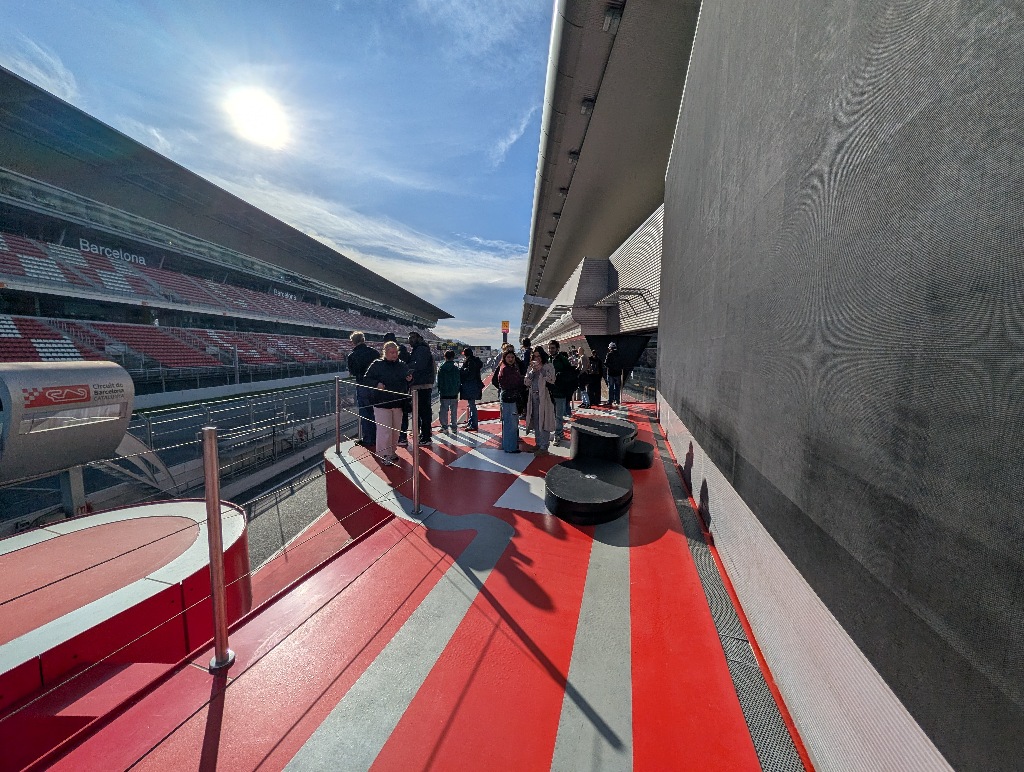
In addition to the media centre, there was also a visit to the podium, which is shaped like the track itself.
Next stop was the control room with monitors showing feeds from all the cameras along the track.
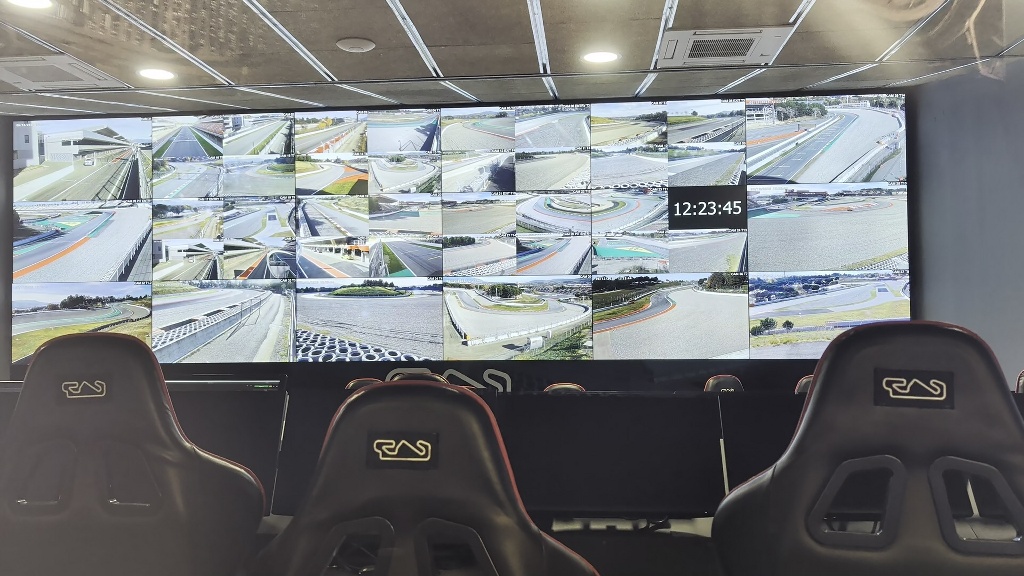
Usually, this would be switched off at the dime of guided tours. But as it was a track day and the track was in use, race stewards were monitoring the screen, in order to react to potential accidents and mandate yellow or red flags.
As there weren't that many GP cars active at the time (as the clock shows, it's 12:23:45, so most teams and drivers were heading for a lunch break), it was easy to follow individual cars along the track and figure out which screen showed a track segment next to the one on another screen.
Finally, there was a visit to some of the viewing stands and an opportunity to see some fast cars going around the track (something that is usually not part of the guided tour).
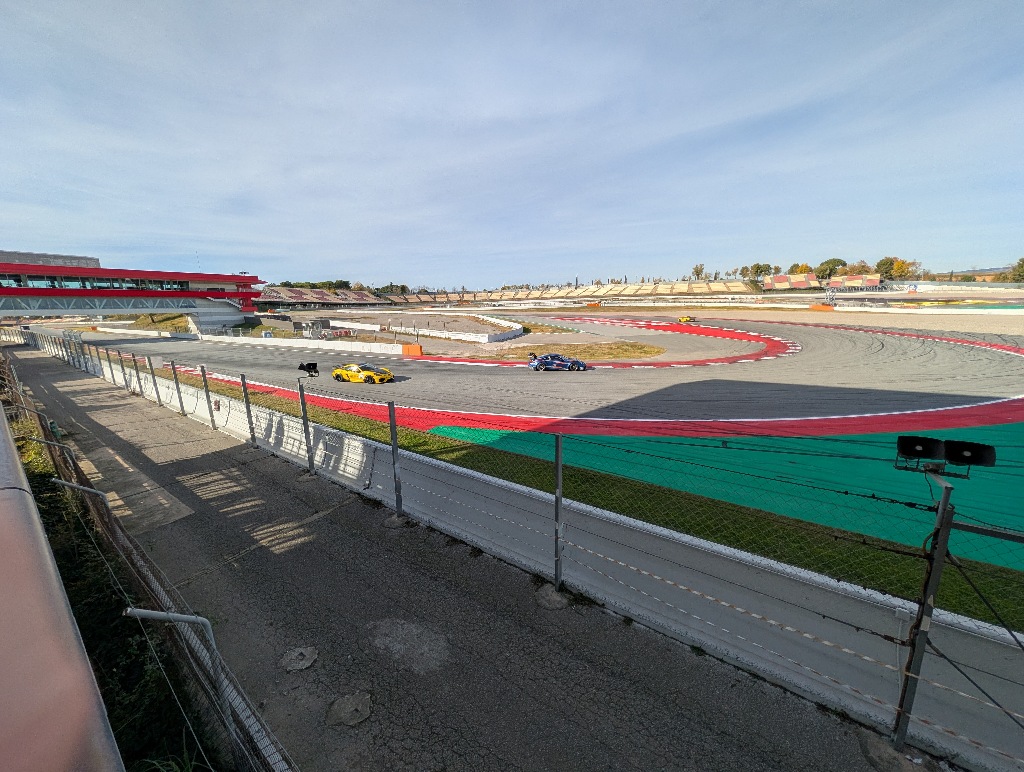
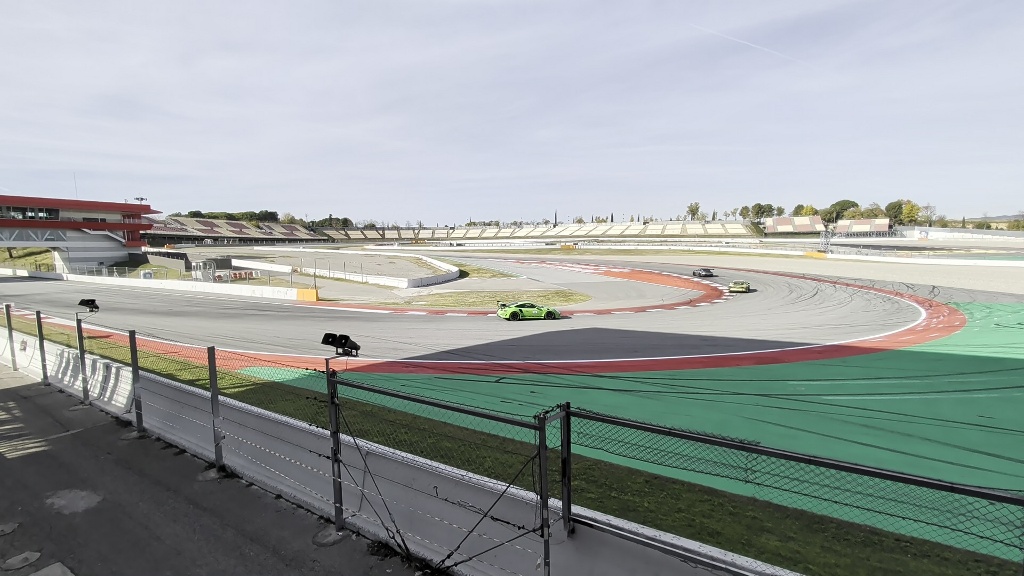
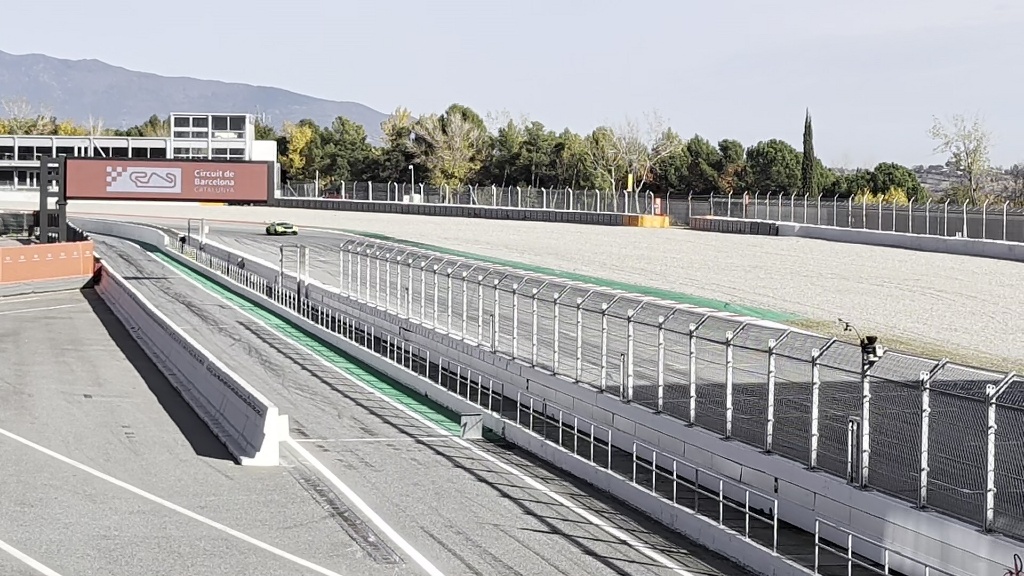
After the tour, on my way back to the car, I had another photo stop at the bronze sculpture.
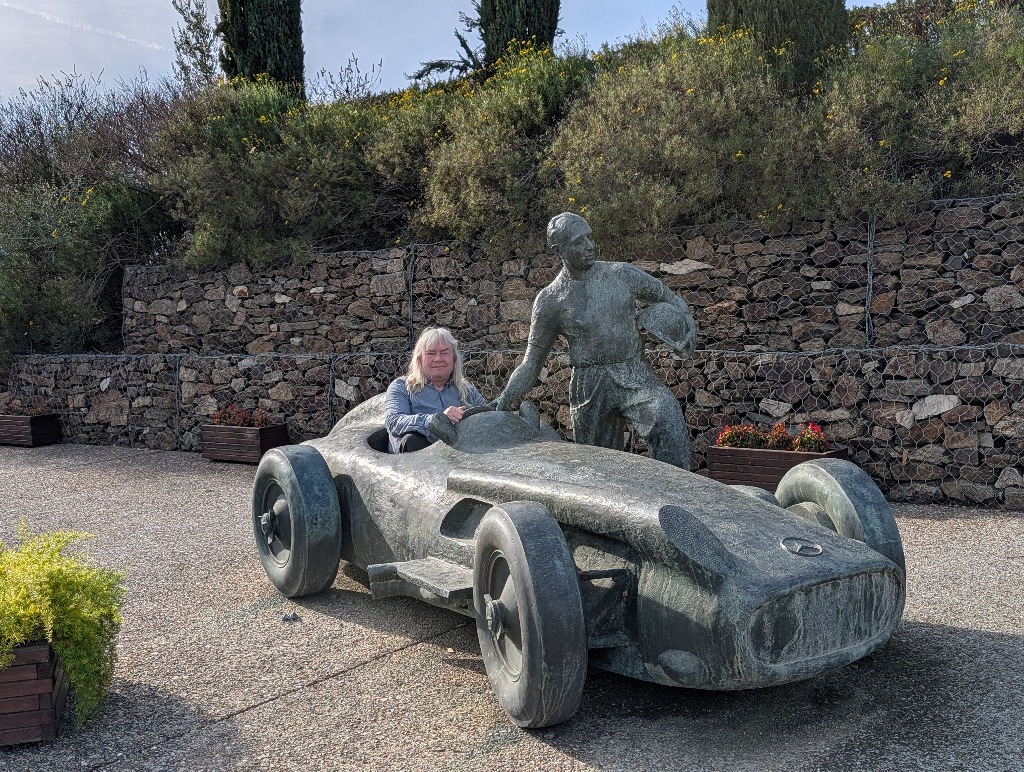
Though I already had the one from the previous year (this one), it didn't hurt to have another one. After all, as far as I can determine, the one in Barcelona is the original. The other versions are, supposedly, the replicas.
Though this is a bit unclear. According to Wikipedia, the sculpture in Monaco is the original. But according to the Mercedes Benz Museum web site, the one in Barcelona is the original. As the artist who sculpted it, Ros i Sabaté is a Catalan artist and it has been created on behalf of the Catalan automobile club, and as none of the references from the Wikipedia page actually states that the Monaco version is the original, I think the claim that the one at the Circuit de Barcelona-Catalunya is the original statue is the most likely one.
And that's about it for these short trips to Greece and Catalunya.
My flight home on the next day was late in the afternoon.
After checking out of the hotel, I had some time to spare, before I had to drive to the airport.
While I hadn't really planned for more karting, it turned out that there was a kart track not far from the airport.
So, I went for a couple of laps there.
There wasn't anything special about the track. Essentially it was a large "U" with only one left turn and all the rest going right. It was also a short track of about 400 meters with lap times of less than 30 seconds.
But it was fast, well maintained and fun to drive. (Even though I kind of doubt the accuracy of their timing. My lap time was below 26 seconds (one of the other drivers had one of 24 seconds). And the track record is, supposedly, 23 seconds. Admittedly, the track layout is simple and there aren't that many places where you can gain or lose time. It seems unlikely, however, that I drove that close to the lap record.)
In any case, it was a fun activity toward the end of the trip and better than sitting around in an airport terminal.