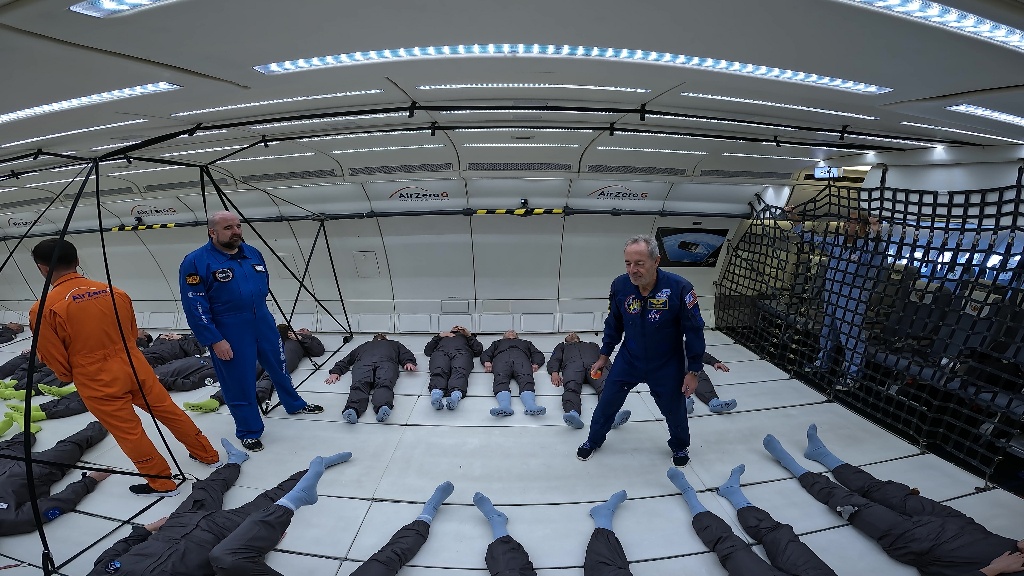
I decided to lose a lot of weight - quickly.
It can probably be said that it was a lot like a diet - technically it worked, it was seriously expensive, and the weight lost came back in almost no time at all (with a bit extra weight on top, but that, fortunately, only for a short time).
In any other aspect, it wasn't like a diet at all.
While I did lose a lot of weight, I didn't lose any mass.
Anyone with a basic understanding of physics should already have
figured it out (and it may also help to remember the heading of this):
I went on a parabolic (or Zero Gravity) flight.
Which means that you get properly weightless, but it's only for 22 seconds on each parabola. It's still a lot more "air time" than on a rollercoaster. But barely enough time to do anything cool beyond "hey, I'm floating!".
As there's a lot of backstory, you can either read on or use this link to jump ahead to flight preparation or this link to the flight itself.
Getting on the flight turned out to be more strenuous than being on it.
There used to be two companies offering "free-floating" parabolic flights for tourists.
There are also other companies that are technically offering weightless flights and weightlessness, as all it takes is an airplane that can fly a parabolic curve. Which isn't that hard. Even a brick follows a parabolic trajectory when thrown. (I was tempted to add "if you throw it hard enough", but, ignoring air resistance, it's also a parabolic curve if you lob it forward slightly. Everything thrown in gravity will fly in a parabolic trajectory.) But the issue with such flights is that you can't do much. There are people doing parabolic flights in a Cessna. But that means that you are sitting in the passenger seat, seatbelt fastened, as there's not enough space to float around. You might briefly suspend a pen mid-air in front of you for a few seconds. But that's about it.
For proper tourist flights, you need a reasonably large passenger jet where you can remove most of the stuff in the passenger cabin to provide enough space to float around. (And even then, it's a bit crowded. But that's mostly for commercial reasons. It would be fun to have the plane to yourself, but then the cost would be about a quarter of a million euros.)
If you put 40 tourists on board, the price per passenger comes down to "affordable" (though still not cheap). But those people take up some room.
An Airbus A310 (there are fewer than two dozen of them still flying passenger services) used to have about 225 seats . You need about 50 people on board (two instructors for every 10 tourists, plus photographers (and an astronaut)). They need to be seated during take-off and landing, so there still need to be 50 seats installed. So, you can remove 175 seats to provide "floating space'. Divide that by 50 people and you have 3.5 passenger spaces of free space for each person on board. That's essentially one row of three seats and half of the center aisle.
It's not as cramped as it sounds. That's partly because the instructors and photographers are mostly standing. They don't take up that much room. And there definitely aren't any luggage lockers over your head. And in Zero-G, you're more interested in up and down than in moving sideways.
It's still not like you can "fly" from one side of the plane to the other (or down the length of the plane) without bumping into someone. But it hits a "sweet spot" between still making the flight "affordable" and keeping it fun.
There used to be three companies running parabolic flights for tourists.
(At the start of 2025. There used to be a Swiss company, but that went out of business about a decade ago. And there's one in Canada, but that's only for scientific experiments, not tourists.)
But in early 2025, there were only three: one in Russia (and travel to Russia is a bit frowned upon at the moment), one in the US and one in France.
The US company seemed to be the most interesting one, as they did fly fairly regularly (every few weeks), had short waiting lists (usually only the next flight was booked out, so you could generally fly less than a month after booking), they started from different places (Texas, Florida, California, Colorado), all worth combining the flight with a short vacation, and booking was easy (essentially: Give us money and we'll take you on board).
The European company seemed a lot more complicated.
First of all, they only offered flights about two or three times a year (usually in blocks where they did two or three days of flying) and those fill up fast.
Right now (in February 2026), if I wanted to do it again, there are two flights in August this year (fully booked) and the two flights after this are in April 2027. Those have free spaces, but they are more than a year away.
Also, they require a medical. While the US company essentially had the usual "adventure activity" form, which essentially states "I know I'm doing something that's potentially risky, so if anything goes wrong, it's my own responsibility.", the European company requires an ECG and a certificate from a doctor.
More annoyingly, once you reach 65, a regular ECG won't do. You need a stress ECG instead. (Which, essentially, was the physically hardest thing of the whole experience. The flight itself was easy.)
Additionally, their timing is weird.
You need to do the stress ECG within 30 days of booking.
Coincidentally, there was a minor uproar in the local news recently that the average wait time for an appointment with a specialist is now 36 days.
So if you book now and then try to schedule an appointment with a cardiologist, then, on average, you will get your stress ECG and certificate about a week too late.
On top of that, the ECG can't be older than a year by the time of the flight.
If I wanted to book for April next year, I would need a stress ECG within the next 30 days. And another one after April this year.
Even more reason to go to the US.
More flights, more interesting places to start from, no medical check.
(I think they had a statement somewhere along the lines of "If you can walk the boarding stairs
up into the plane, you'll be fine.")
But when I decided to do the booking (in June 2025), the flight schedule for the second half of 2025 hadn't been published yet.
And after finishing the flights that were scheduled for June, the new schedule still wasn't up.
And then they published an update that they lost their "flight certificate'.
Which they removed shortly after that and stated that they were "completing routine maintenance" for ensuring "the highest standards of safety and performance". And that their flights were "temporarily paused".
I had been hoping that they would start flying again, but as, two months later, the "routine maintenance" was still going on, things didn't look good.
(Yes, there is something called a "D-Check", which is the longest and most thorough check for an airplane. And that can take, for older planes, up to a year to complete. So maybe they are simply doing a D-Check. But it's a bit worrying that there hasn't been any update or even tentative date for flying again. And a D-Check isn't something you do ad-hoc. If they knew it was coming, they wouldn't have planned to publish the flight schedule for the second half of 2025 in June.)
In any case, it didn't seem worth waiting when and whether they would ever fly again.
It was time to look somewhere else.
So: Goodbye USA. Hello France!
Which turned, in retrospect, out to be the right choice. I have been on a parabolic flight. And the US company still has their flights "temporarily paused" due to "routine maintenance". But I had been a bit worried that they would bounce back and announce their new flight schedule right after I had made my booking for Bordeaux.
Booking was a bit weird, but that was only due to their medical requirement. The rest was straightforward.
But you need to have your ECG within 30 days after booking (so you can't check whether you are fit enough and then do the booking). And it's difficult to get an appointment with a specialist (they prefer a cardiologist to perform the stress ECG, but it's not strictly necessary). As I already mentioned, if you make a booking and then start looking for a doctor, it's likely that you won't get the medical certificate in time.
The whole thing is even more complicated, as the certificate can't be older than a year by the time of the flight. By now, the next available flight is in August 2027. (Which is an indication how fast the available spaces are going. When I started to write this, four days ago, there were still places available on the flights next April. But they are gone now. Probably an effect of the three February flights this year. After people come back from such a flight and tell others about it, those are likely to want to do it as well. It's that amazing.) If I wanted to book right now for that flight, I would need to get one medical check in the next 30 days. But that will be almost one-and-a-half years old by the time of the flight. And no longer valid. I would need to get a second medical check.
So I scheduled my stress ECG about 40 days ahead (to be fair, it had more to do with convenient timing for me than with the availability of the doctor). And then I had ten fairly stressful days looking at the booking page and hoping that nobody else would book the remaining spaces on those flights during that time. (I think there were still spaces available on two of the February 2026 flights at the beginning. And by the time I booked, only one of the flights still had free spaces.) As far as health goes, those ten days of nervous waiting were probably tougher on me than the stress ECG or the flight itself.
But things worked out well. At 30 days before the scheduled ECG, there were still free spaces on the flight on the 26th of February. I booked that, had my stress ECG a couple of weeks after that, got my medical certificate and was ready to go.
And from that point on, everything was easy.
As an additional precaution, I had my doctor prescribe me two different anti-nausea medications (with different active ingredients).
They strongly recommend taking anti-nausea medications before the flight. Without it, roughly 50% of the people on board will get travel-sick, but with medication, that goes down to less than 10%. (I have no idea how accurate those numbers are, but that's the info given.)
I usually don't get seasick (or motion sick when playing VR video games), so I don't have experience with anti-nausea medications. And finding out during a Zero-G flight that I had an adverse reaction to the stuff seemed like a bad time. So, I tested both medications beforehand, and found out that I didn't have any negative reaction to them at all. I was good to go.
Off to Bordeaux.
Even though I would have preferred going to Denver or Los Angeles, I didn't want to go to Bordeaux and do nothing but stay at the airport hotel, go on my flight and fly home again.
So, I added some days (though, in hindsight, I should have planned for more) for sightseeing in the area.
My first stop was Arcachon.
It's not far from Bordeaux and on the Atlantic coast.
Well, technically it's not. It's in a bay (Arcachon Bay) and thus sheltered from the Atlantic Ocean. But that's close enough.
In any case, I didn't go there to visit Arcachon itself, but mostly to go to the Dune of Pilat, which is the highest dune in Europe.
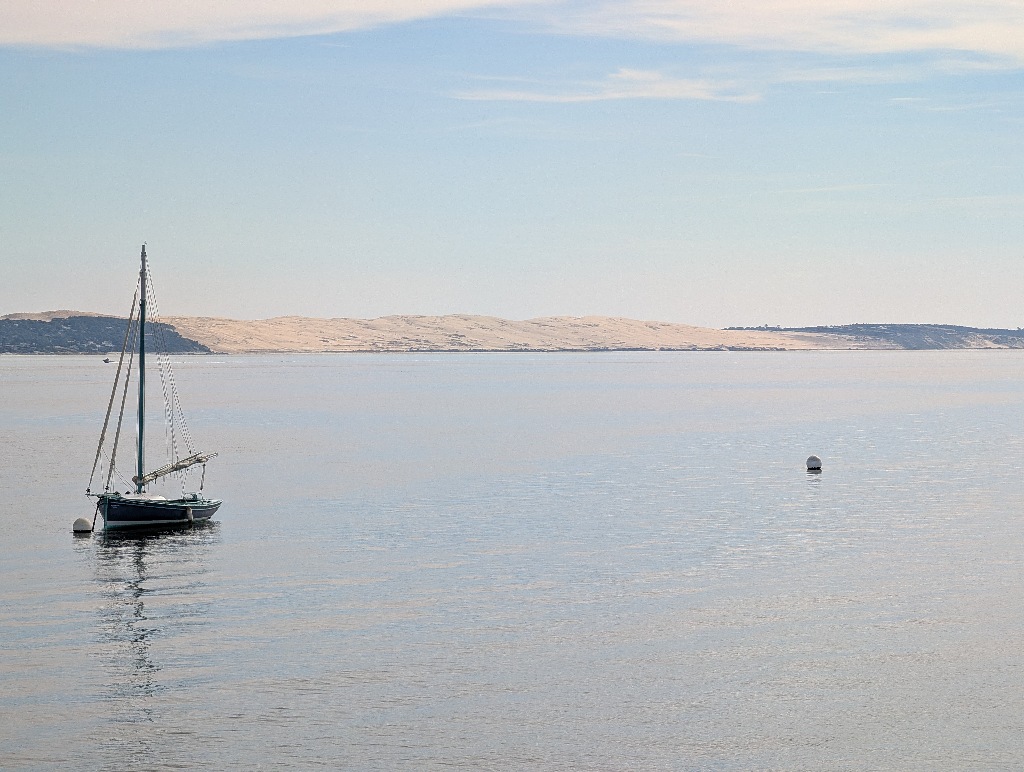
While it doesn't look like much from the other side of the bay, it is 106 meters high. It's a bit of an uphill struggle to get on top of it.
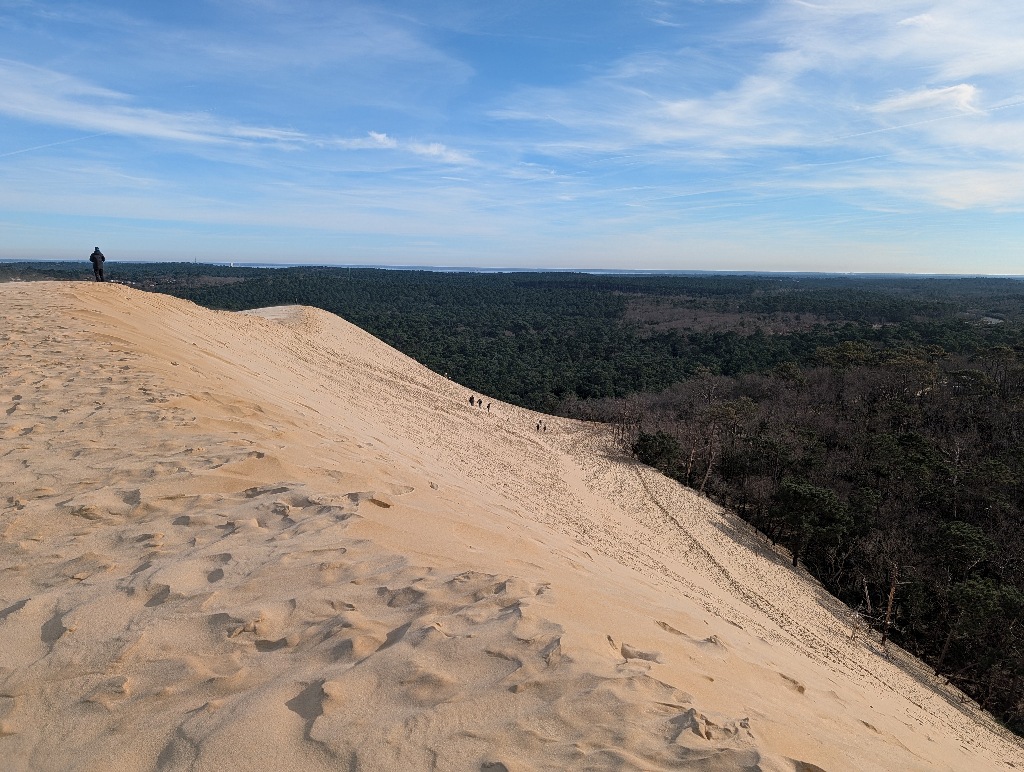
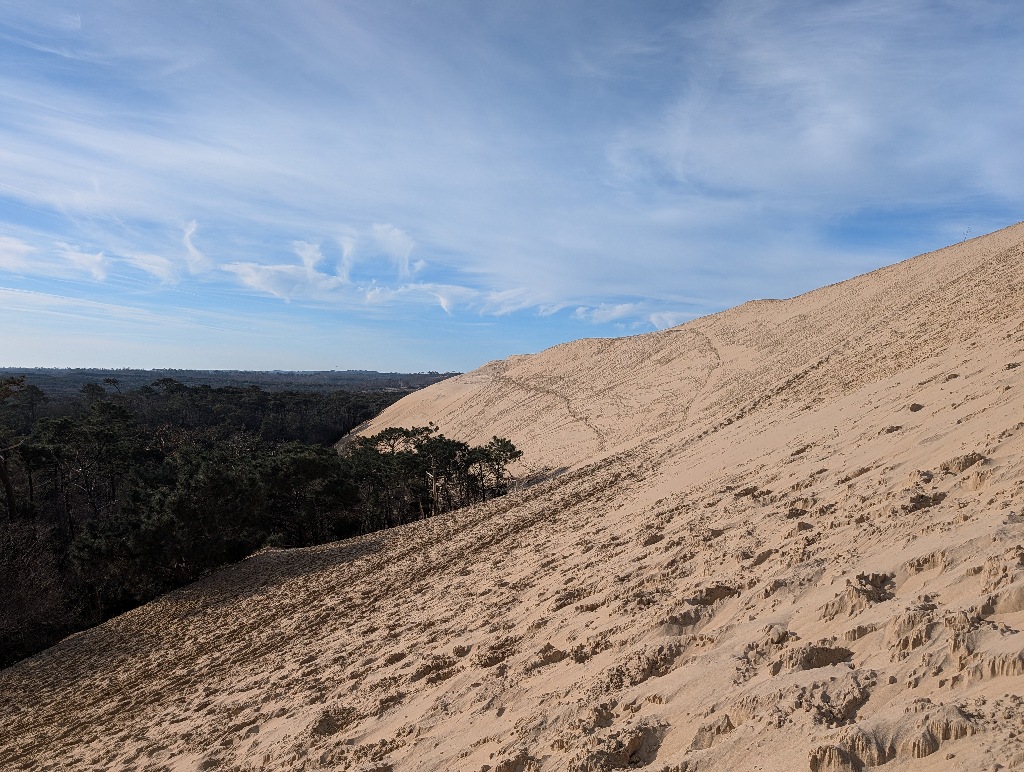
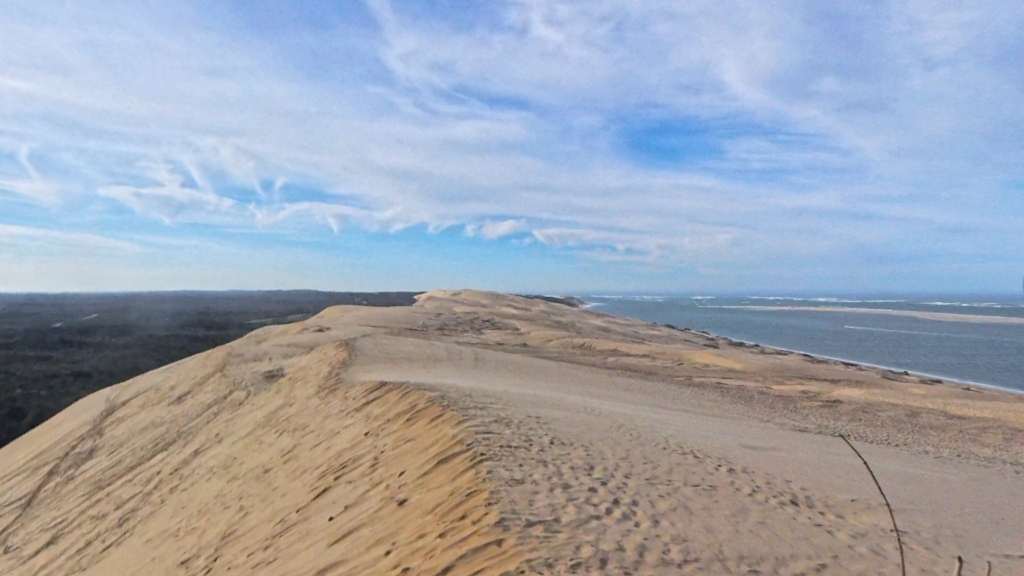
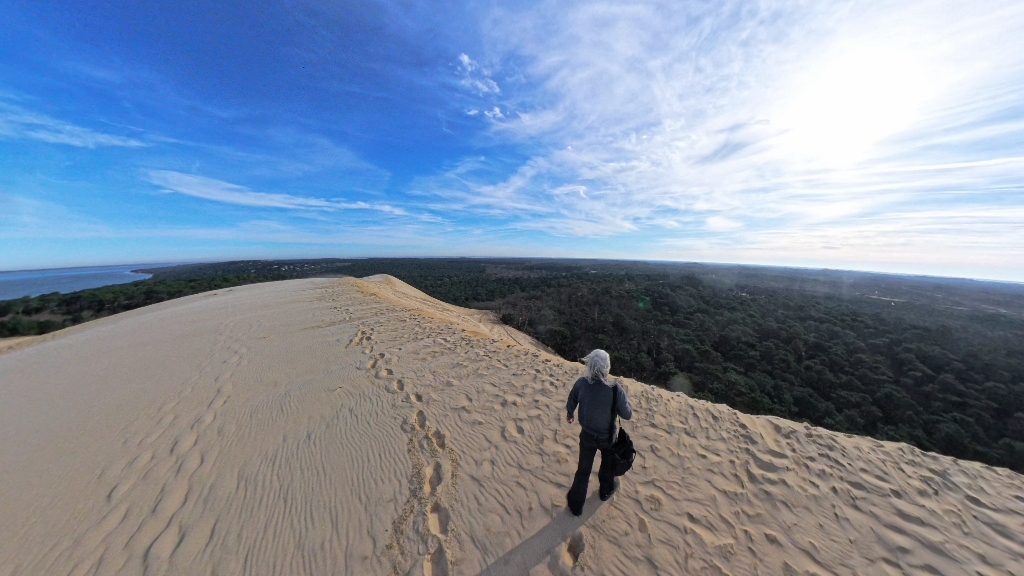
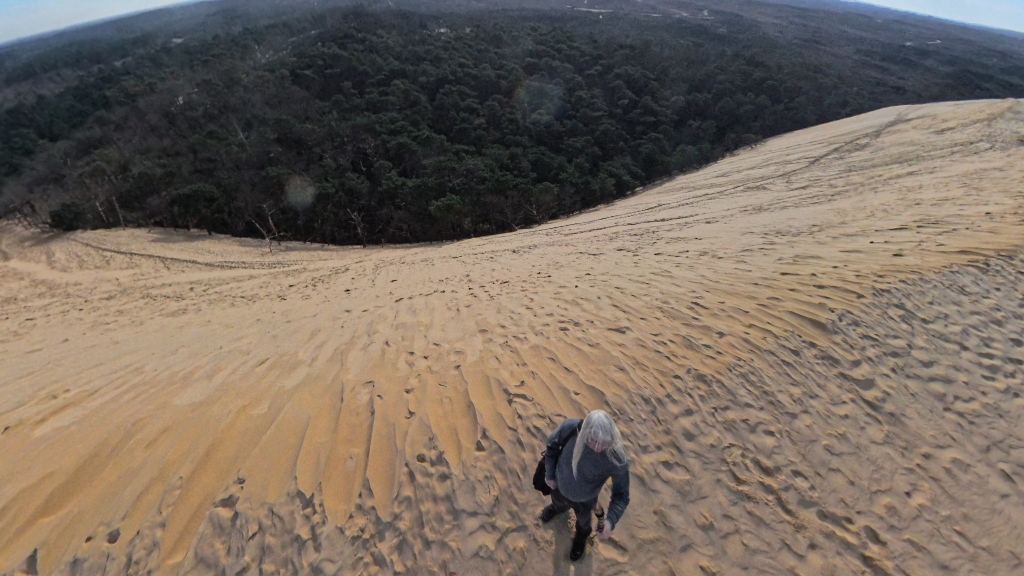
Especially in February.
It's not like the dune gets higher during winter.
But during the main season, which starts around April, they build a wooden staircase on the dune.
In February, however, you need to walk up in deep sand. Which is a bit exhausting.
There is not much else to say about the experience.
It might be the highest dune in Europe.
In the end, it's not much more than a pile of sand.
Time to move on.
I had considered doing some kayaking (the hotel had some brochures for that), but the companies offering that were still closed due to off-season. So, I didn't.
Mentioning the hotel...
Something I liked about the hotel was (surprisingly) the elevator.
They had only two floors above the lobby. There was, however, more space on the elevator panel. Which they filled with some fun buttons.
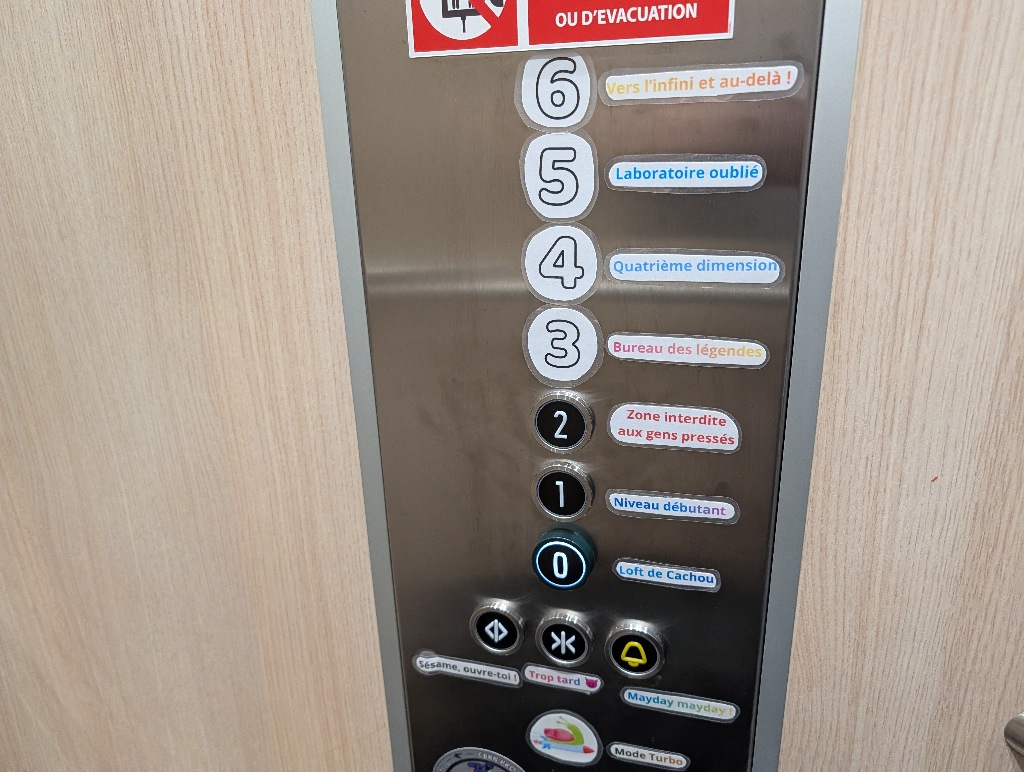
I don't read French, so I needed to run this through a translator. The buttons say:
Not a big thing. But I like it when hotels have a bit of personality and not every hotel in a chain looks the same. (Although I would be annoyed if it turns out that all hotels in the chain have the same elevator button labels...)
As I didn't get to go kayaking, I took the regular ferry service across Arcachon Bay to Cap Ferret.
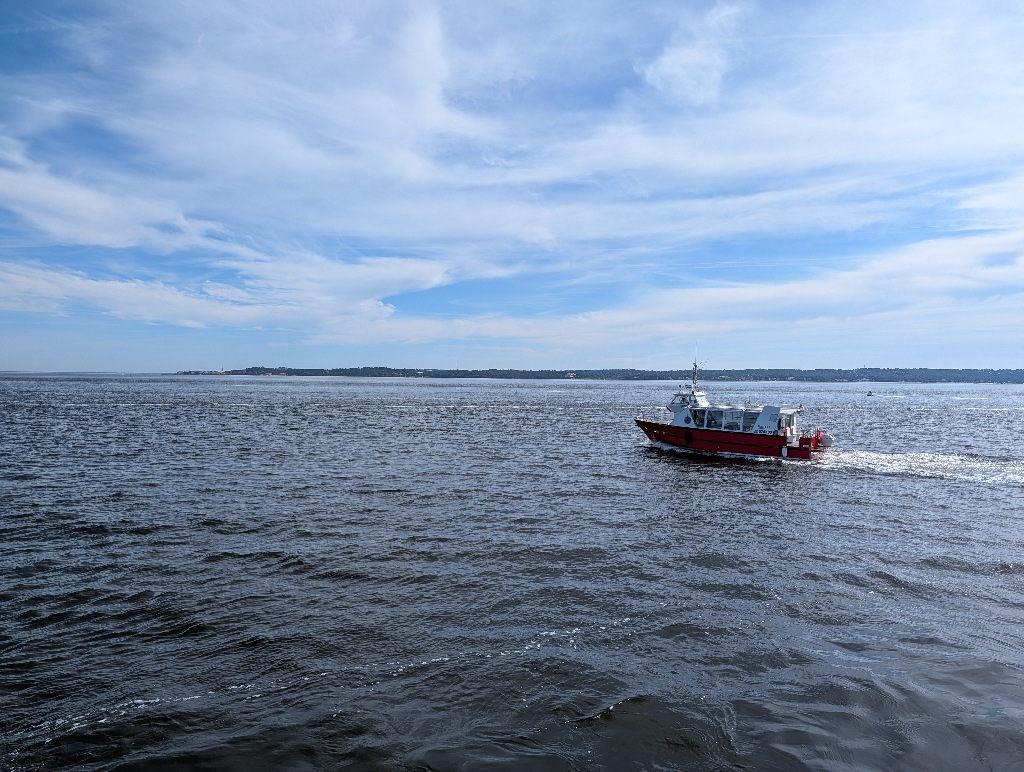
There wasn't any real motivation for going there. Except for having nothing else to do.
It turned out to be more art related than expected. (OK, that's one and a half artworks seen. Still more than expected.)
A week earlier, I had, for no particular reason, seen the Banksy movie.
One of the persons that was mentioned in it was a "graffiti" artist named "Invader".
I put the "graffiti" in quotes, as I am not sure whether the term applies to what he does.
He doesn't use paint. And he doesn't do name tags. Or other writings.
He uses ceramic tiles.
He usually does pixel art, reminiscent of sprites in early computer games. Starting with Space Invaders. Hence his pseudonym.
And when I arrived in Cap Ferret, I did see this mosaic at the ferry pier.
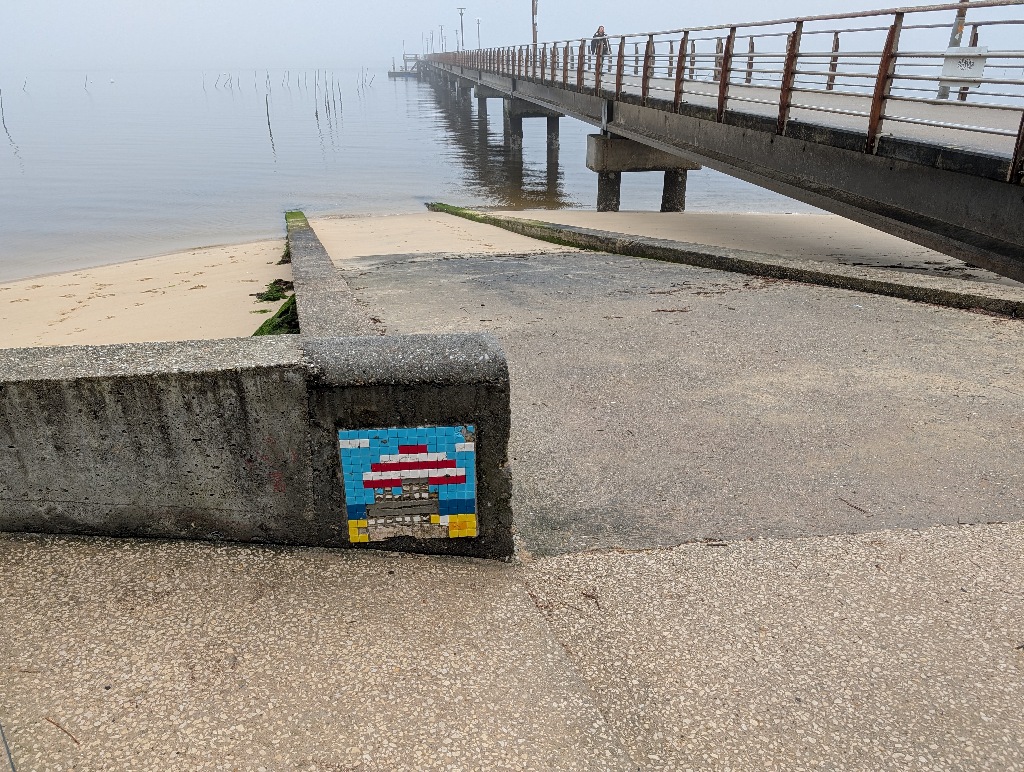
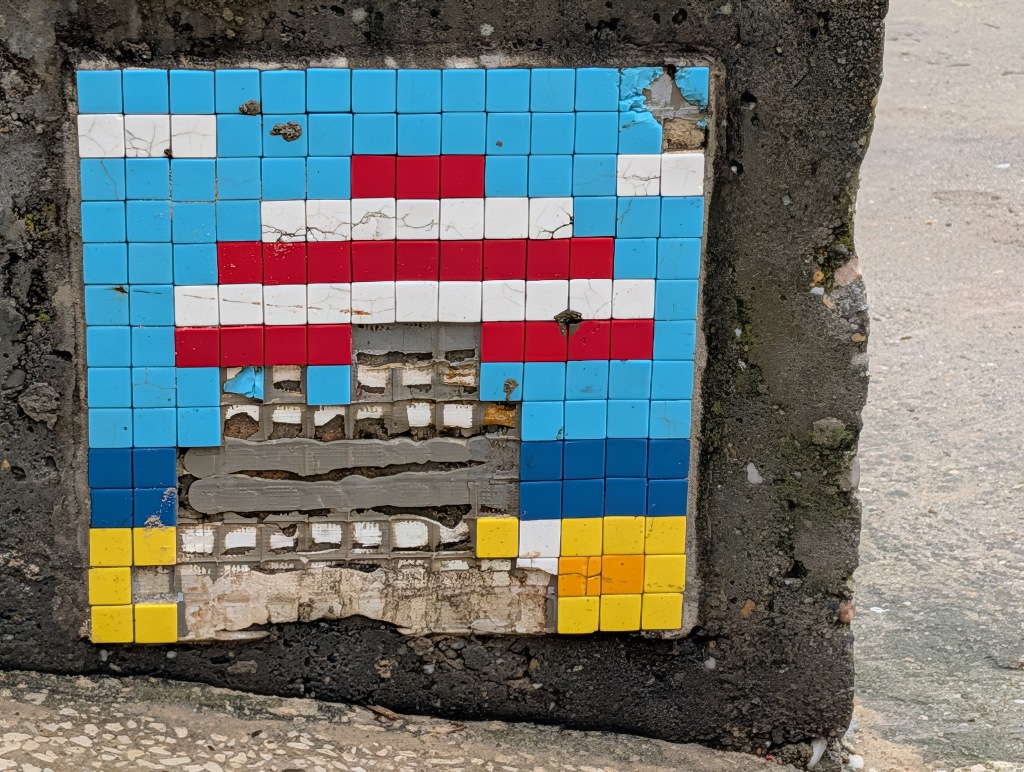
At first, I thought it was some cute image that was put there by the local tourist office. Or maybe the ferry company. Or one of the nearby businesses.
A cute and colourful little mosaic to brighten up the place.
I remember seeing that and thinking: "Ah, that's the kind of decoration that Invader took his inspiration from." Especially since I remembered that he was from France. So I assumed that such small mosaics are a feature of many seaside towns. And that he combined the basic idea with the iconography of video games for his street art.
It turned out that I had it all the wrong way round.
If you paint the missing tiles back in (badly), it looks like this:
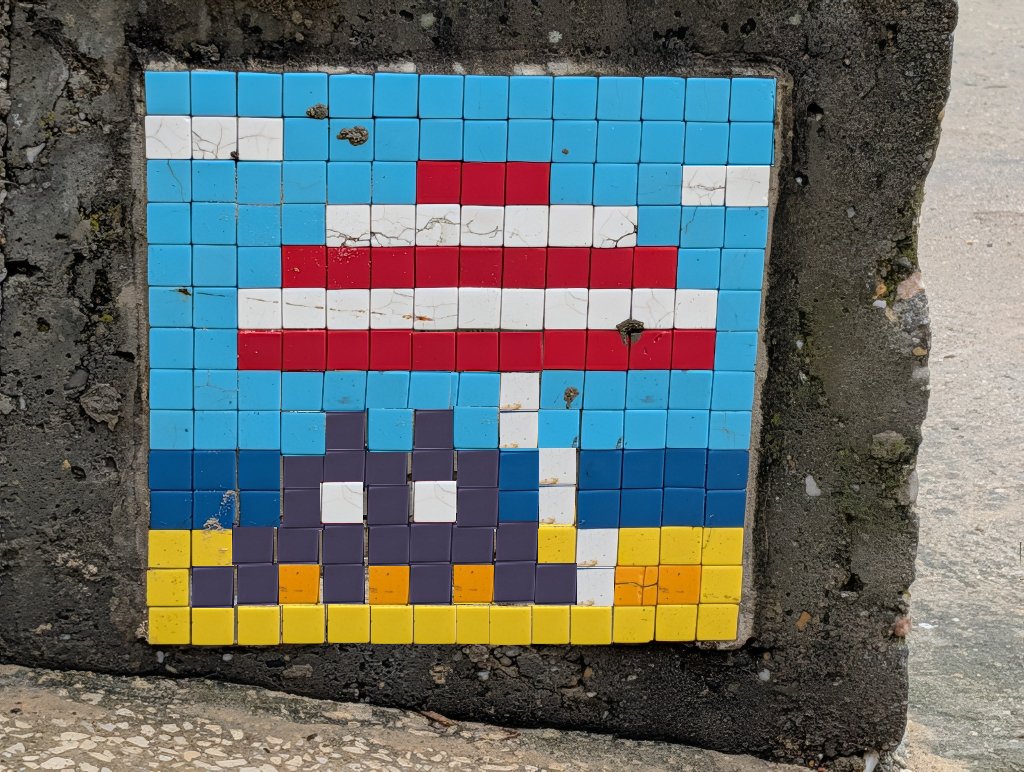
It is not a local mosaic that Invader took the ideas for his street art from.
Cap Ferret has street art that looks like Invader art, because it is Invader art.
I started looking for other works.
There is a web page showing some of them, but without naming the specific location. I had to go by context clues in the pictures. At least the mosaics are often in locations with many visitors, so some of them were easy to spot.
In the end, I only managed to spot one more mosaic. And that was easy to find. I only had to turn around, as it was right above an ice cream shop by the pier.

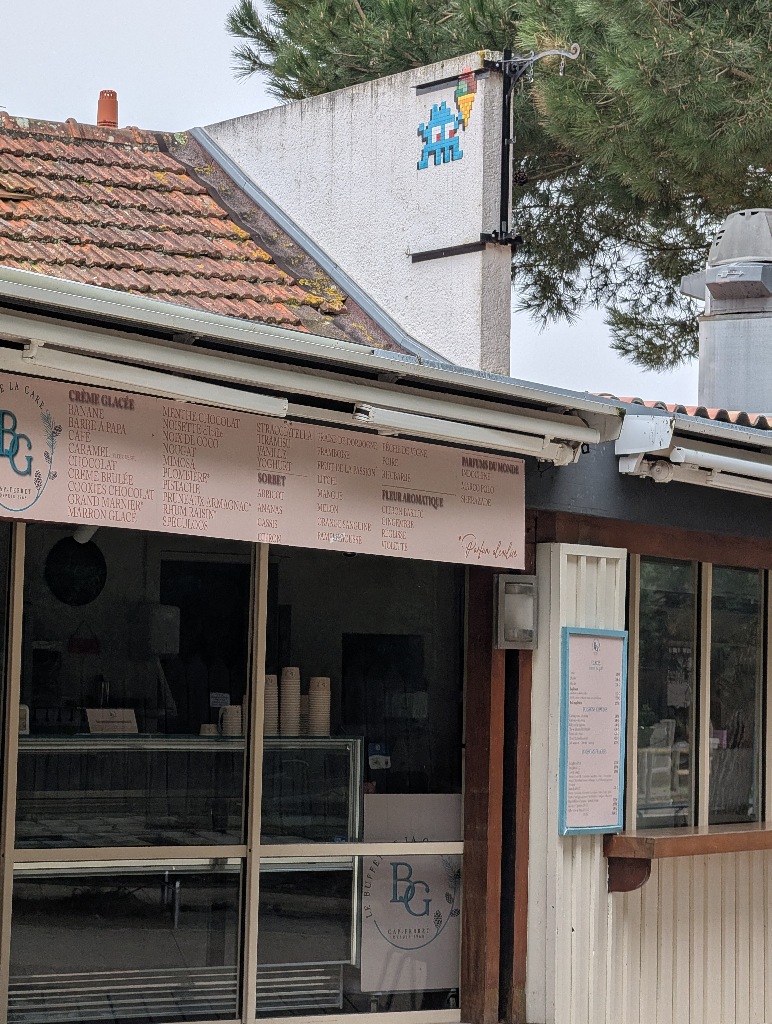
There could have been another one nearby as well, as there used to be one at the other end of the pier, but I didn't find it. It could be on a place that I didn't look at, but I doubt it. It's probably gone for good.
Definitely gone was one close to the lighthouse. The only thing remaining is a small piece of one of the tiles. (It used to show a space invader surfing a big wave.)
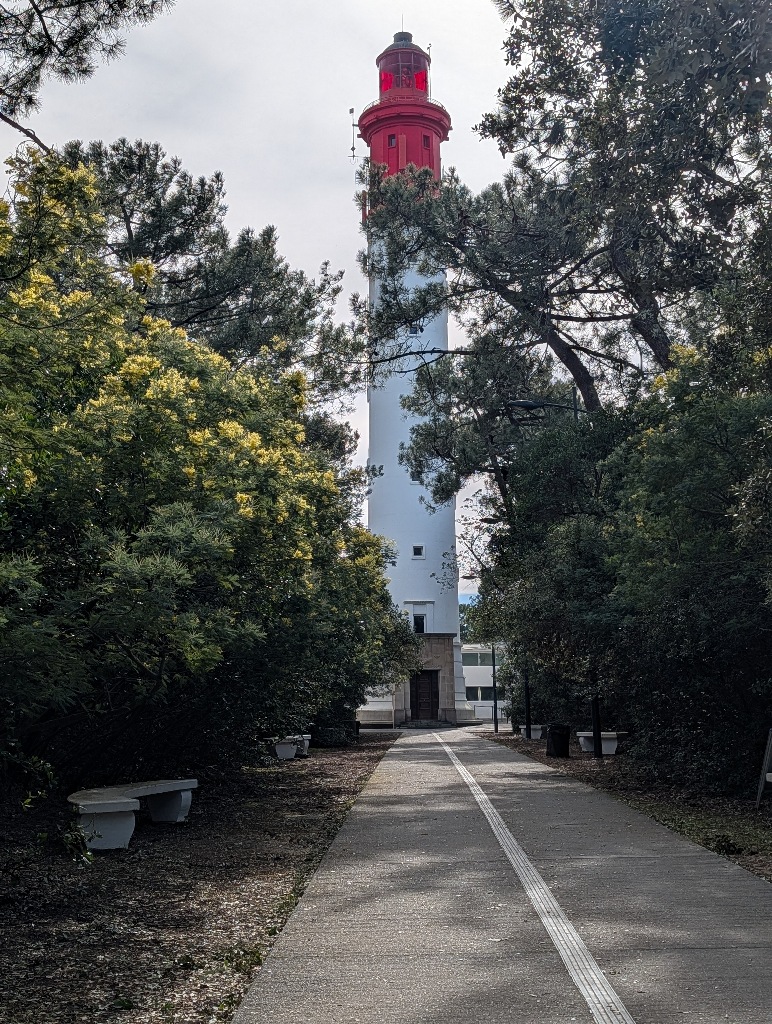
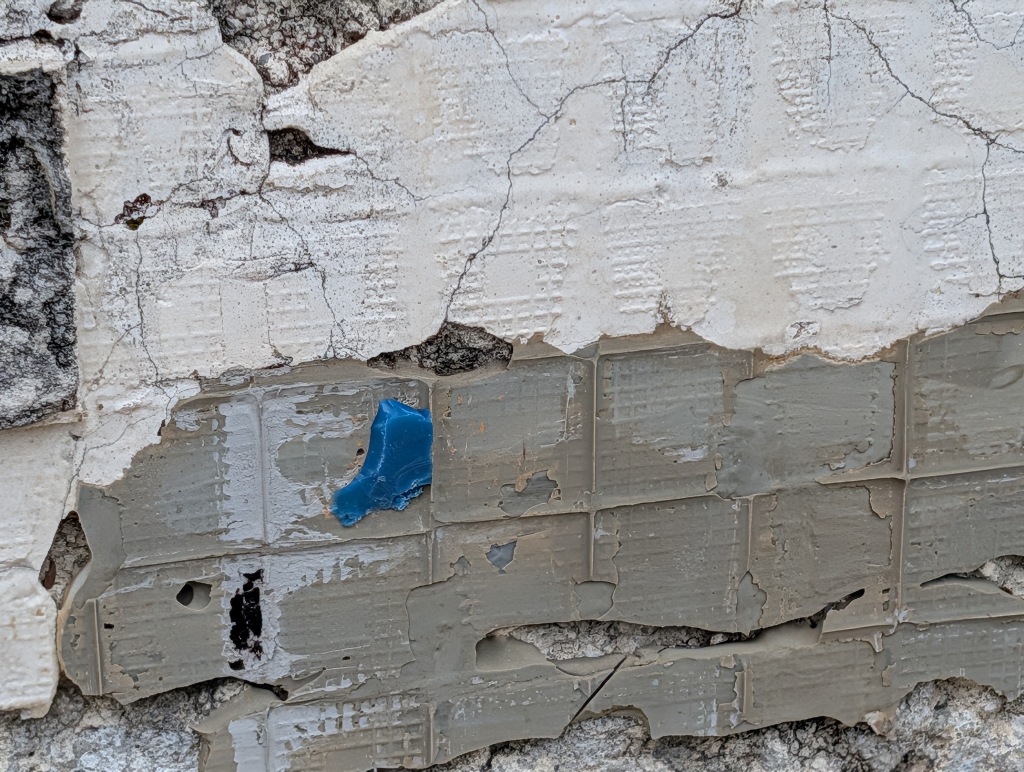
So, ultimately, it wasn't much exposure to street art.
Although it was a surprising encounter, as it wasn't street art as I expected it and where I expected it.
I expect street art in ugly places. Run-down inner cities, desolate apartment blocks on the outskirts of cities, industrial areas, on noise walls along streets and train lines. These are the typical homes for it.
A prospering beach-side village and popular summer vacation spot seems a strange place for street art.
Oddly enough, there don't seem to be any Invader mosaics in Bordeaux. And Bordeaux, while being a nice place, has a lot of somewhat desolate areas that seem like typical places for graffiti. (And there are many of them in those areas.)
There is, however, a sculpture, named "The Spaceship", located in a (mostly former) harbour area in Bordeaux.
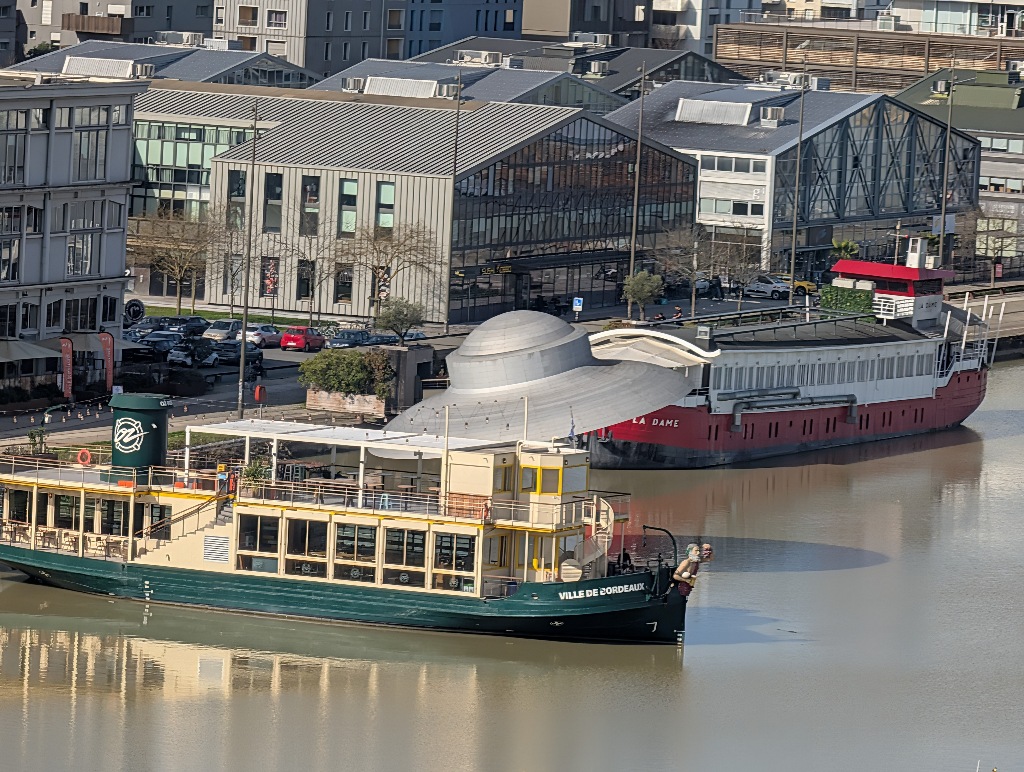
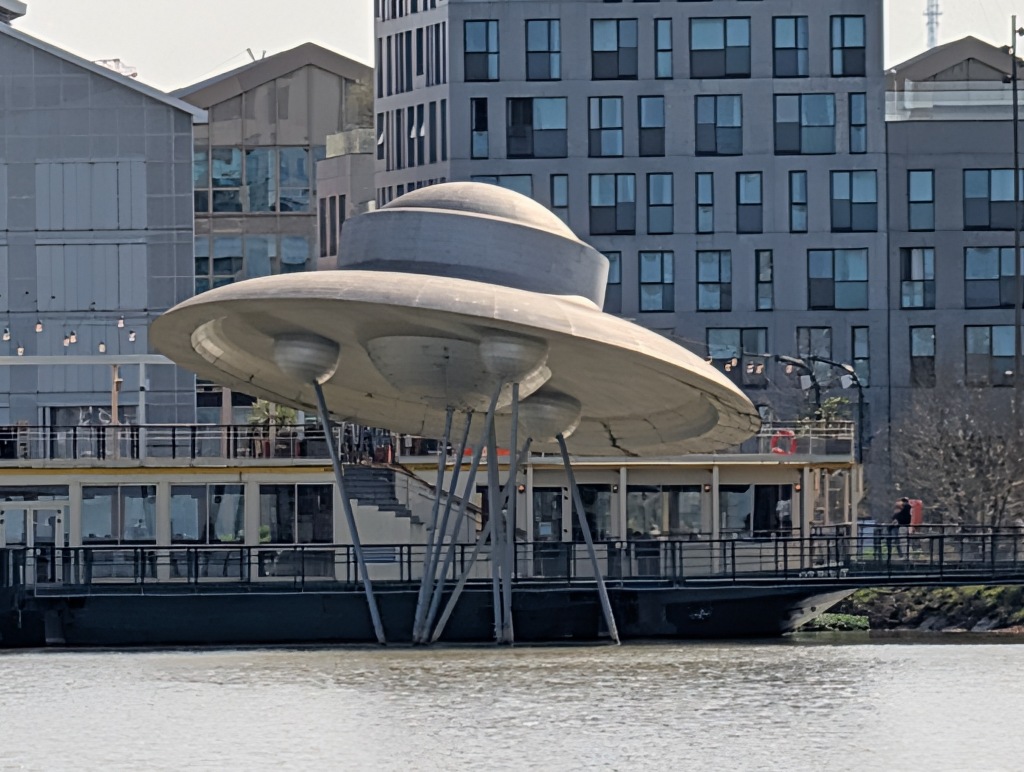
Maybe the "official" space invader has scared the mosaics away...
The main reason for visiting that area of Bordeaux wasn't the spaceship. It was the wine museum.
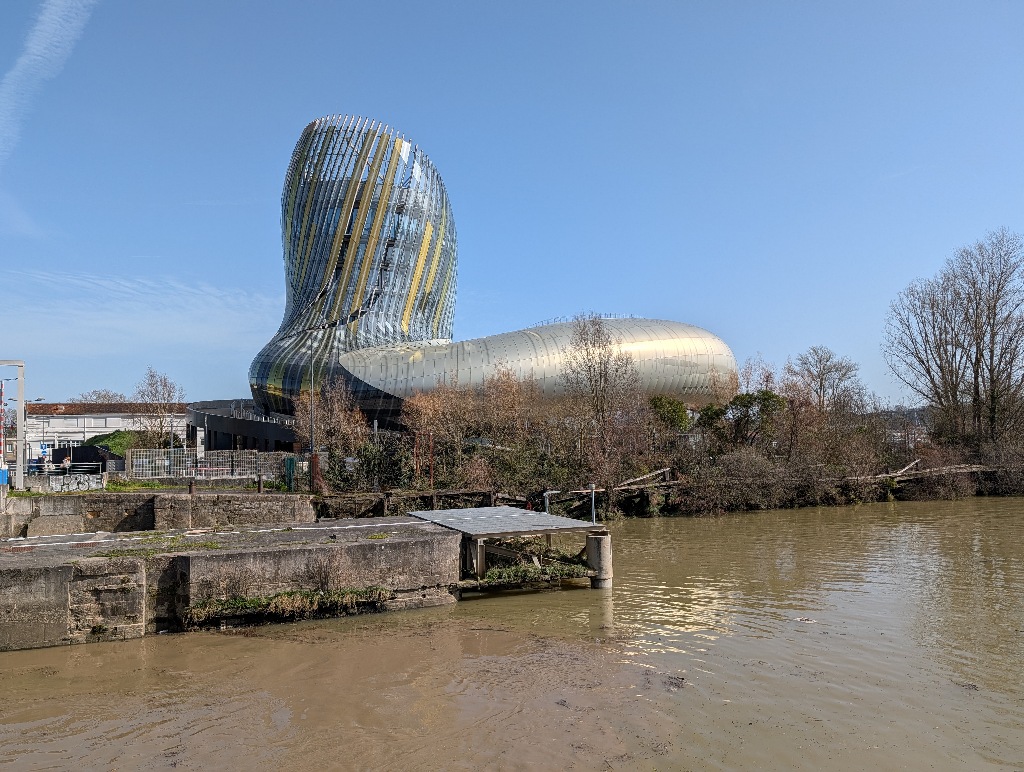
If there's something connected more than anything else with the name Bordeaux, it's wine.
So it makes sense that they have a museum dedicated to it.
I wasn't sure whether I would like it, as it's mostly a multi-media exhibition.
You could base a wine museum on historic tools for wine making and consumption, like wine bottles from Greek amphoras to modern plastic bottles. Or wine barrels from different times and regions.
But the wine museum in Bordeaux doesn't really do that.
There are some traditional artefacts. But there are few of them. And they feel more like decoration than exhibition pieces.
Most of the exhibits are multimedia presentations.
Which I, usually, don't like.
My taste in museums is that they either should preserve and present historical artefacts. Or they should provide an experience you can't (at least not easily) have at home.
If it's little more than a bunch of monitors standing around or an audio guide telling you things, then, regardless of how clever or interactive it is done, I might as well watch that content on my computer at home or use an app on my tablet.
I don't have to go to a museum for that.
(I know that the economics won't work. People pay for museum entrance (which pays for the content
production), but wouldn't pay much, if anything, for a museum app with the same content. But that
does not mean that I like that.)
And the Bordeaux wine museum has a lot of video content.
But it's presented well enough that it does not feel that much like viewing videos at home.
One of the tricks that help with that was unusual shapes.
They had videos about the developments in the Bordeaux area projected onto a relief map of the area, getting away from the flat, rectangular look of regular videos. (I had seen something like this in the mountaineering exhibition in Lecco (at Lake Como) used with good effect as well.)
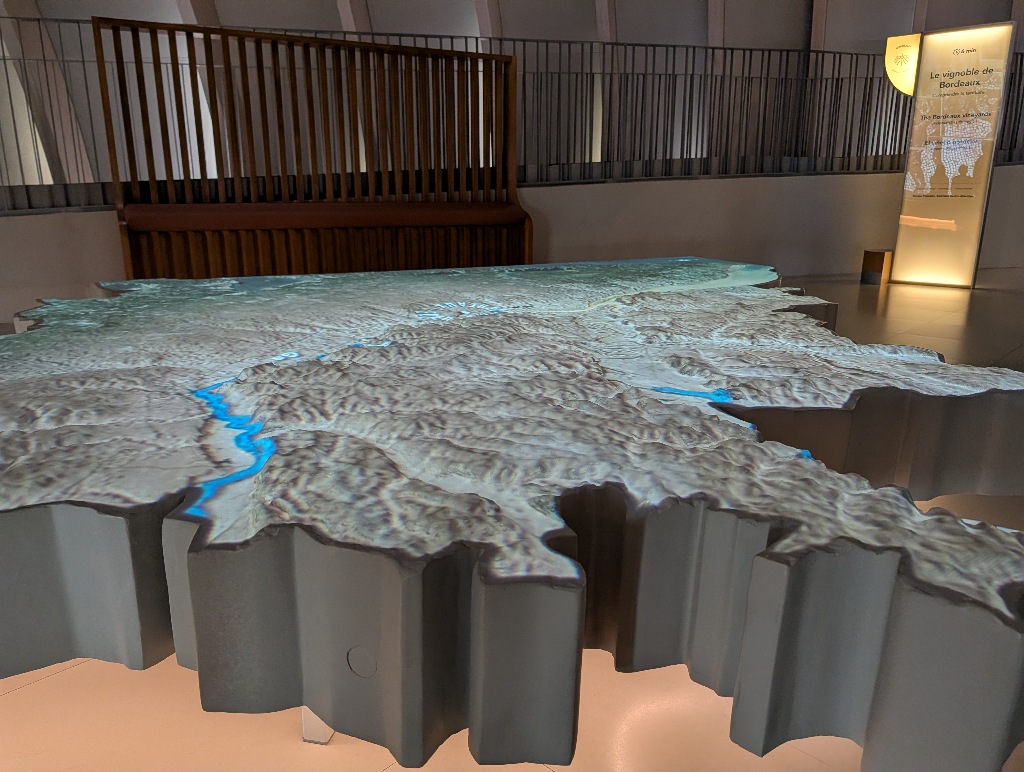
There was a similar approach to vine cultivation in different environments.
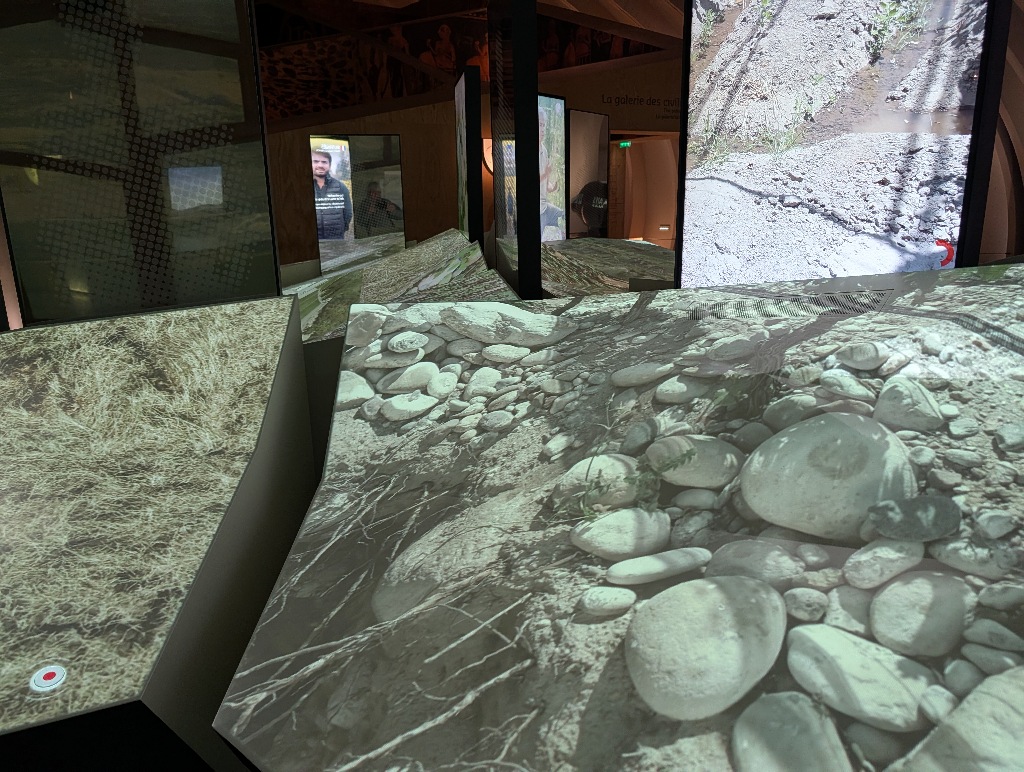
As vines are generally grown at the flanks of hills, they used slanted (and folded) panels as projection surfaces. While there wasn't any direct match between the video shown on the surface, not even a matching scale, it helped to bring across the idea (there are different kinds of surfaces on hillsides with different characteristics) and still didn't look like a regular video screen.
They did a similar thing with experts talking about aspects of wine buying and consumption. While those were simply videos shown on a monitor, they placed the screen in "portrait mode" on a chair (showing the person from the waist up), opposite a chair for the museum visitor. This helped a lot with the illusion that you were sitting there, with the expert sitting in the chair opposite to you, explaining things.
For some of the historical background, they used little dioramas, with videos overlaid as "holograms" using a tilted glass screen. Most of them could have been regular monitors, as the effects didn't make much use of "virtual depth". The projected actors mostly stayed in one place or only went left-right. But it still looked different from looking at a regular screen.
It also helps that the video sequences are short and to the point - usually not more than a minute or two.
When you start one of them, you don't feel like you've given permission to read the whole Wikipedia out to you.
Though the headphones are incredibly uncomfortable. They give you an audio device that you can place over RFID markers, which then starts the video and you listen through the headphones. But the headphones are (probably for hygienic reasons) essentially plastic clamps you put on your head. It's probably no coincidence that the manufacturer states in the data sheet that they "contribute to maintaining hygiene", have been "selected to be easily cleaned" and have a "good resistance to intensive use and to falls", but does not mention anything about comfort. Fortunately, the audio devices have a regular headphone jack. If you happen to have some old pre-Bluetooth headphones with you, the museum visit will be more enjoyable.
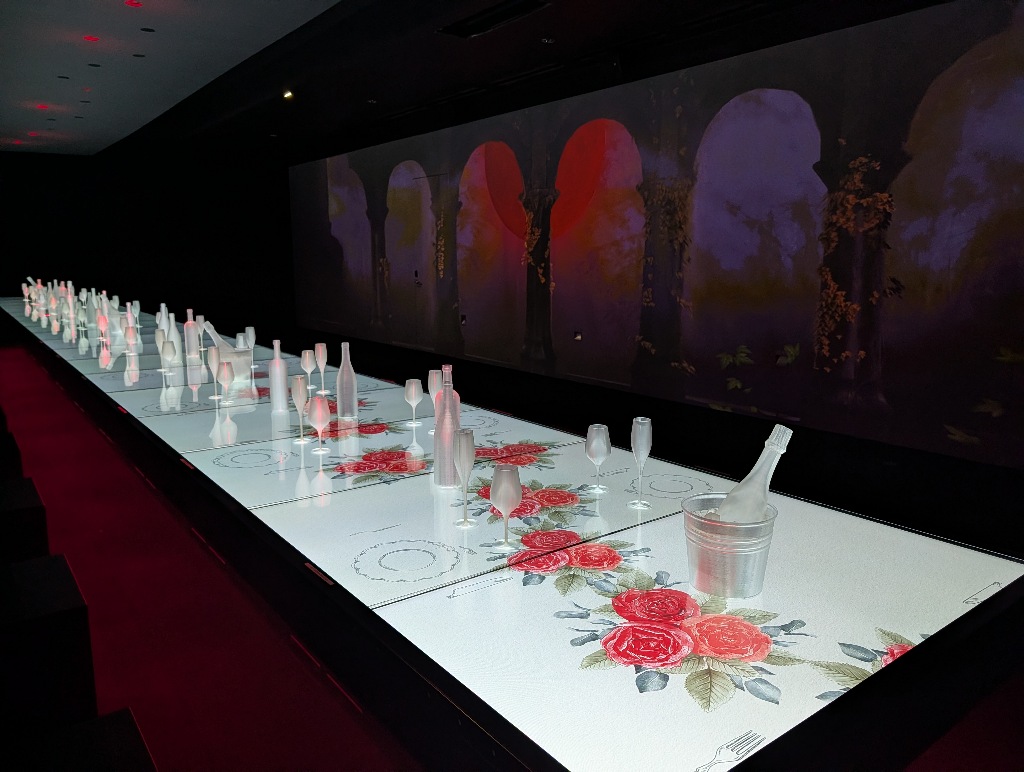
At the museum, they also had something I would describe, for lack of a better term, as a "mood room".
It had a table, made from video monitors with wine utensils, like bottles and glasses, in the center. And projection walls to both sides.
The idea behind this was to illustrate situations where you would drink wine.
Like celebrating the New Year, sitting on a beach or in a fish restaurant by the sea. Maybe watching the sunset or attending a wedding. All with appropriate music. Not a big attraction, it seems (I was the only one watching it), but still a neat idea.
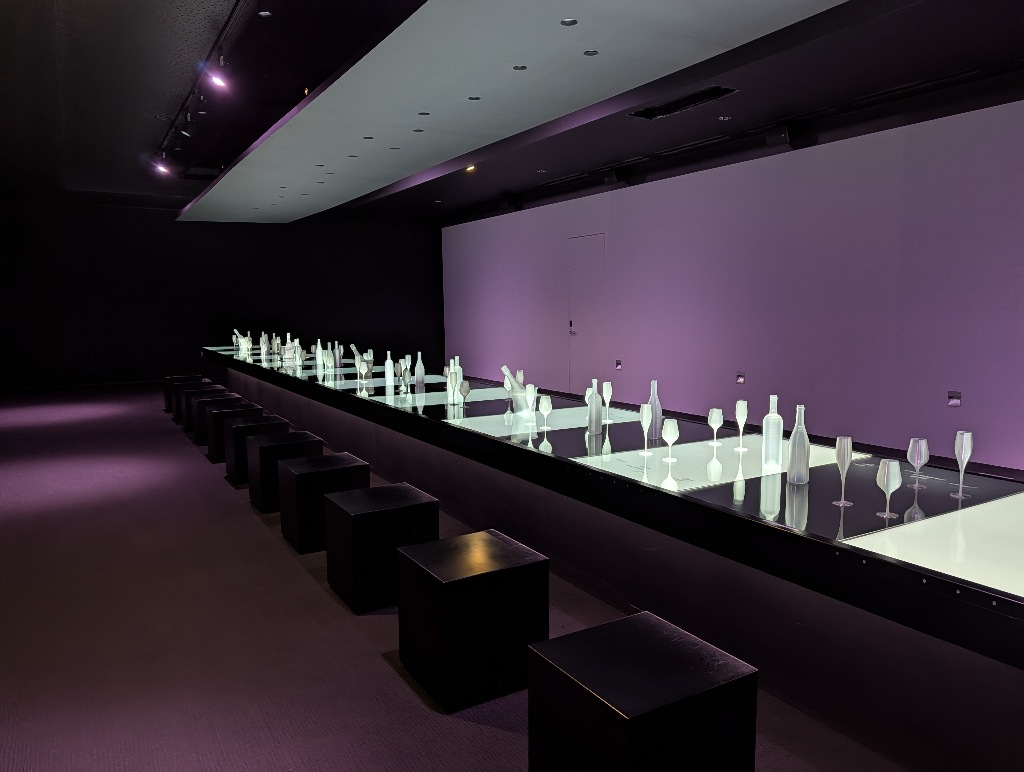
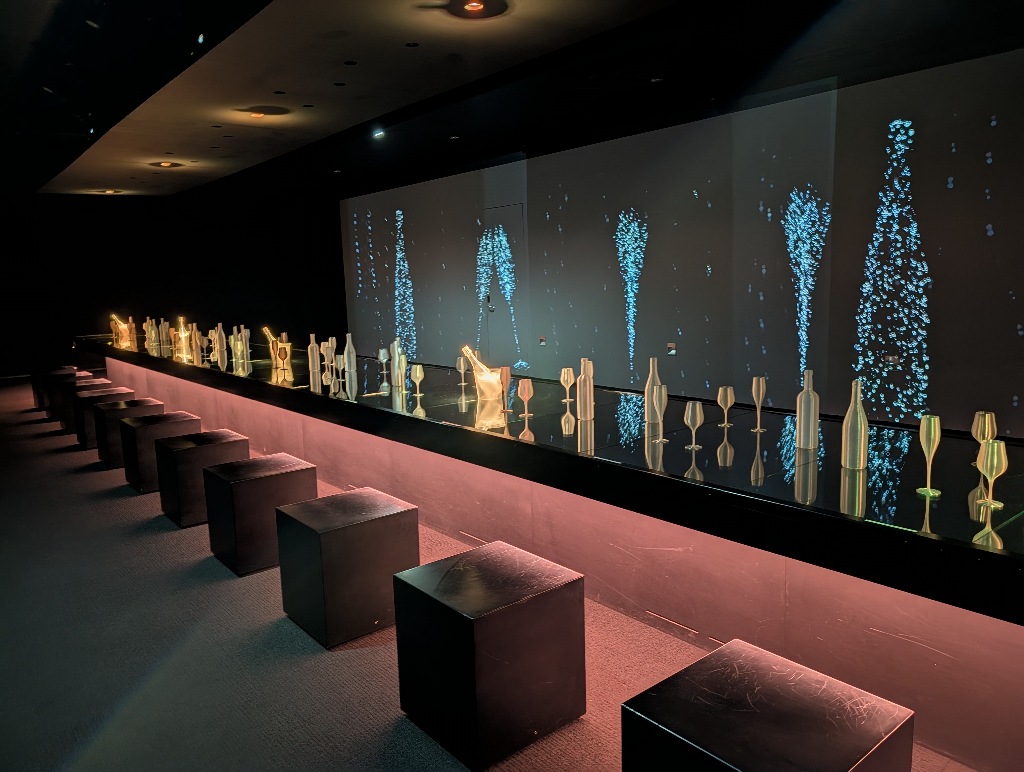
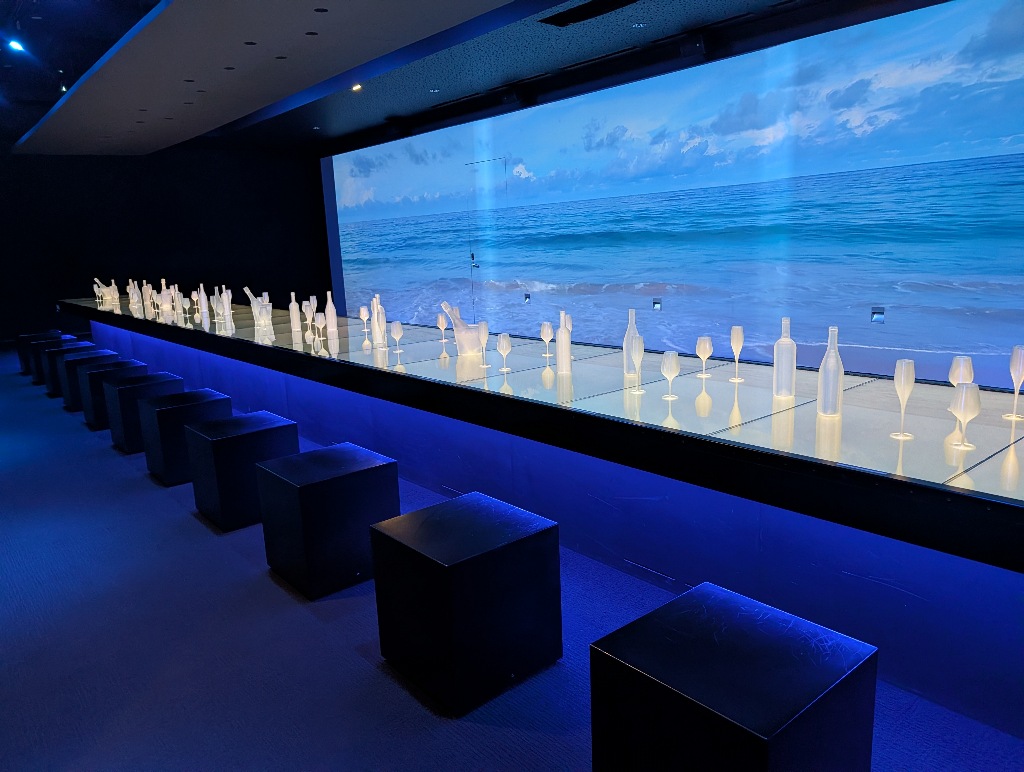
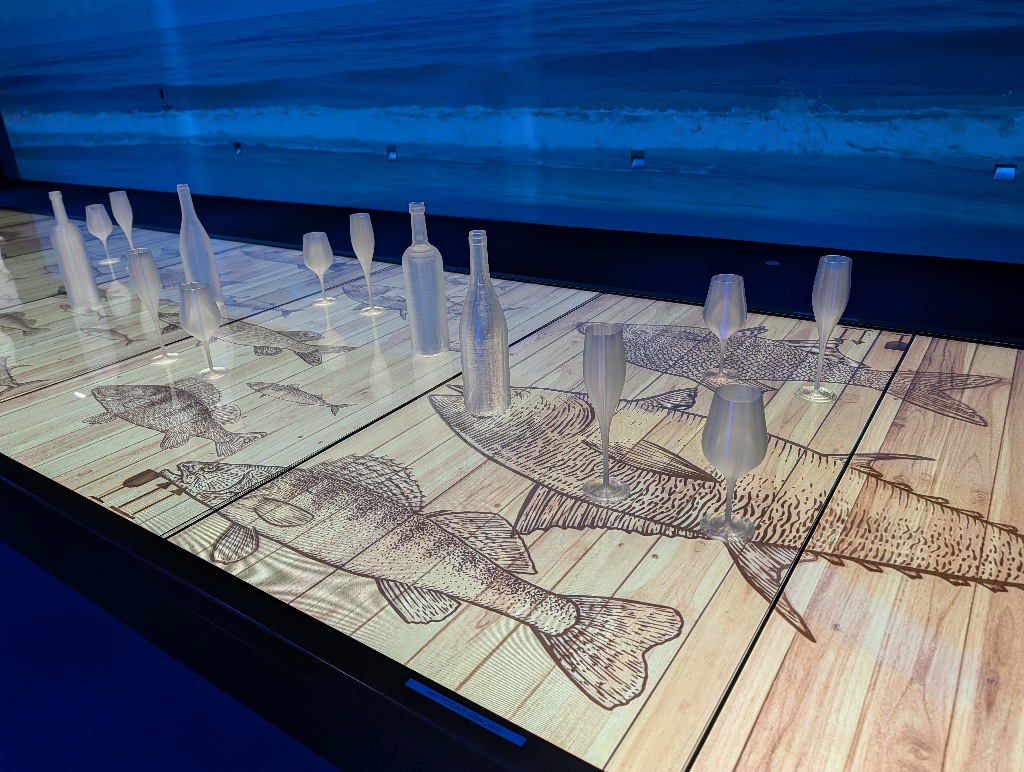
In addition to the visual elements, they did address other sensory aspects, such as smell, by putting in tables with glass domes containing things with different smells. And a little rubber bulb and a metal cone. You could press the bulb and then smell whatever was present in the glass dome.
Which is a clever idea. On one hand, it's something you can't easily do at home. So it is an incentive to visit the museum. And having the smell "blow" in your face is somewhat more fun (and less weird) than sniffing the objects directly.
Though I doubt that you smell the actual objects in the glass domes. Sometimes the smell was a bit too intense for the objects presented. I had been wondering whether it's really the air blowing over the object or whether the scent is artificially blown into the glass domes. And then I've seen some older pictures of that part of the exhibition, where you don't have any objects under the glass domes, but small monitors showing the objects. And since I assume that you didn't get the same smell of warm electronics everywhere, the smell is presumably independent of what is shown.
Given that the museum was ultimately one big multi-media presentation, I still liked it a lot.
It's modern. It's clever. It's stylish. Multi-media doesn't simply mean "both, audio and video". And the museum was about something I am interested in. (I'd probably be harsher if they did a similar exhibition about basket weaving.)
It also helps that the entrance fee includes a glass of wine, served in the bar at the top level of the building, which has a good view of northern Bordeaux.
But that was pretty much all the sightseeing I was going to do.
Now it was time to prepare for the main reason for going to Bordeaux - the Zero-G flight.
The evening before the flight there was a dinner for all participants, preceded by an information meeting.
The airplane is divided into four "free float areas", with ten clients per area.
Correspondingly, we were divided into four groups: Moon, Mars, Jupiter and Saturn.
The "planets" were the groups with the French speaking customers, the "Moon" group (in which I was) was the English-speaking group.
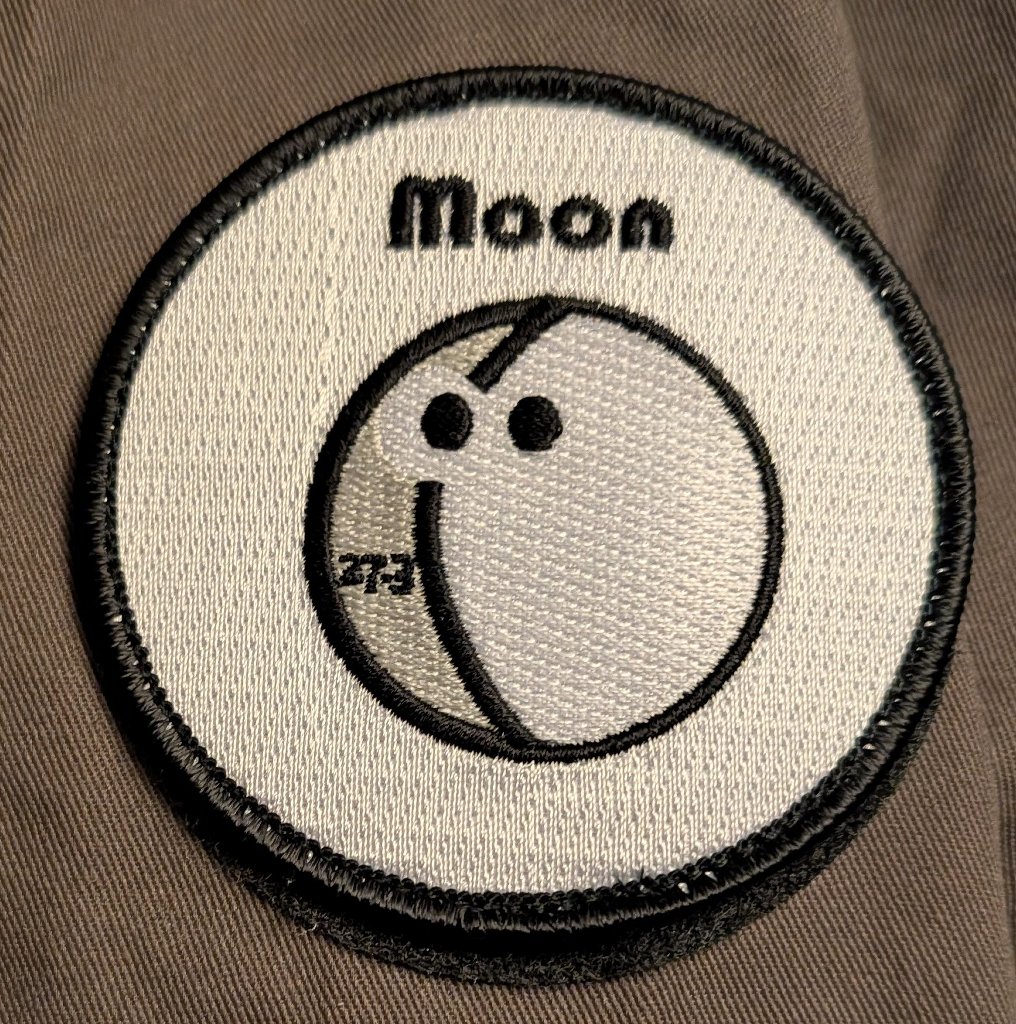
The "Mars", "Saturn" and "Jupiter" groups had a combined meeting (conducted in French).
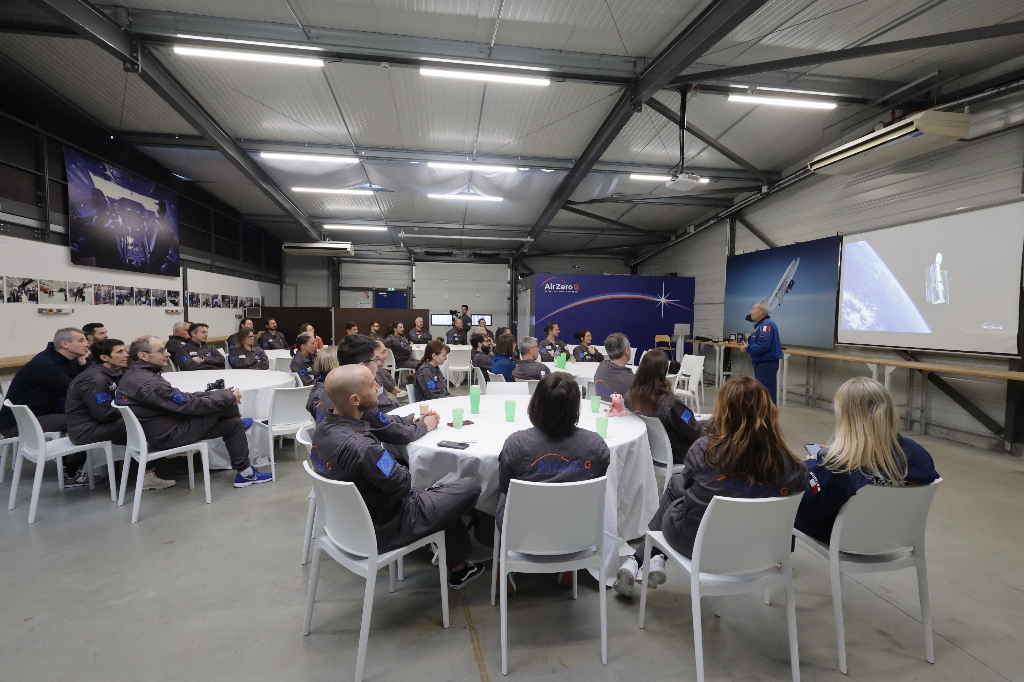
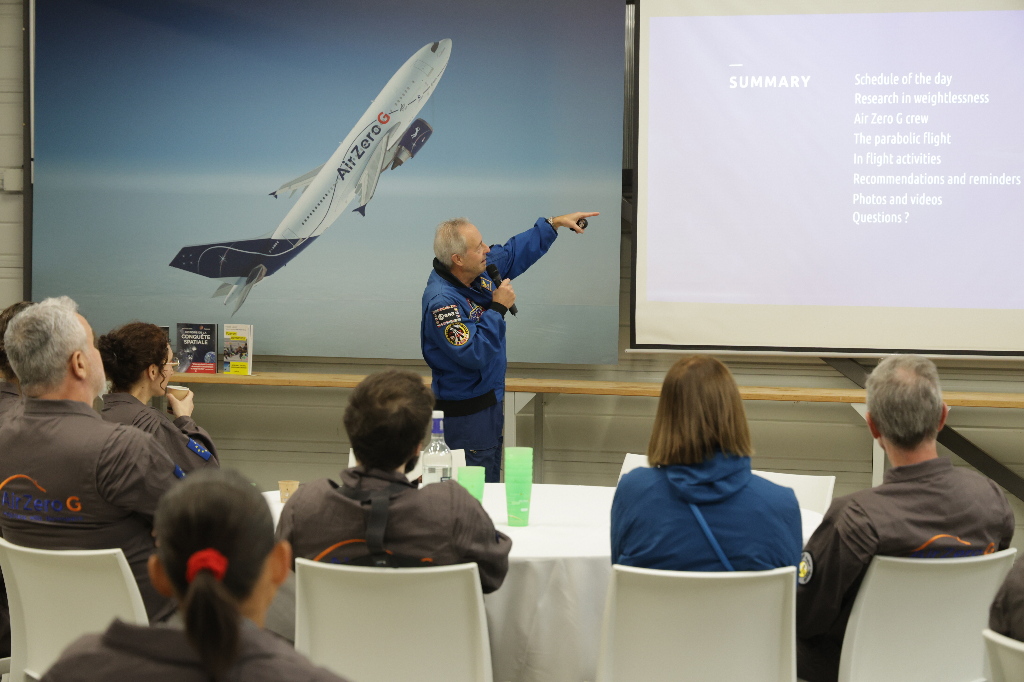
The "Moon" meeting was in a separate room (which was called "Earth", hence that logo in the background).
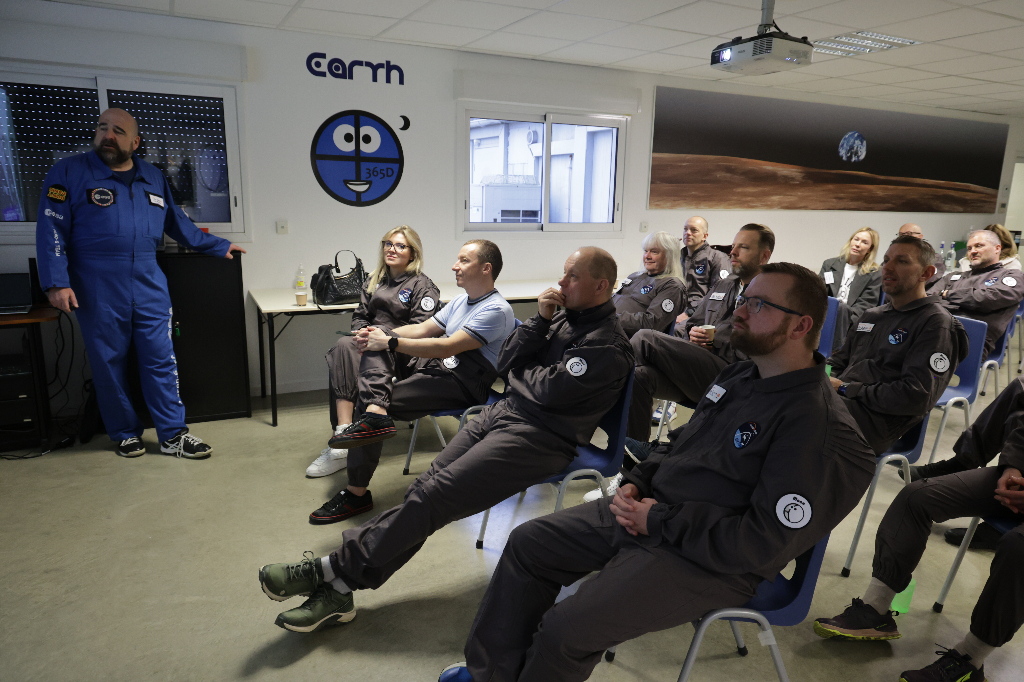
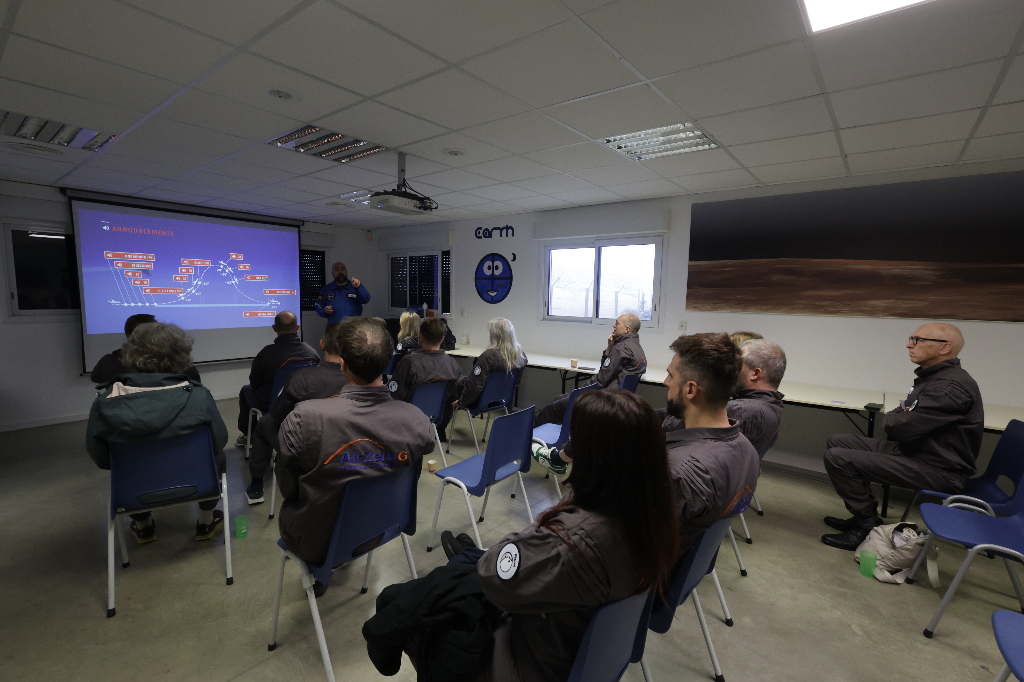
Our instructor was Neil. (Easy to remember - somehow the combination of 'Moon" and "Neil" is a memorable one. A match made in heaven (kind of...) Although, for different reasons, there would also be a good match if his first name had been Keith.)
Neil has one of the coolest jobs a scientist can have. (I'm not talking about shepherding tourists - I'm talking about his regular day job.)
He supervises the scientific and technological experiments done on the Zero-G plane when they do their non-tourist flights.
Why is that cool?
Because experiments in zero gravity are exciting by default. (If they weren't cutting-edge, you'd do them on the ground. You don't go through the effort of designing and building an experiment that can be performed in 22 seconds, unless that really matters.)
And they cover a wide range of domains.
In science, there's always the risk of getting stuck in your specialist subject. And working more and more in an ever decreasing area, missing out on what happens in other fields. You can read the literature, of course, but that's not hands on.
The other thing is that zero gravity experiments are actual experiments. They aren't computer simulations or generalizations of existing data (though that comes later). You don't need to be in zero gravity for running a program. You go there for finding things about and getting the data.
[Although that actually might include computers. One of the issues with zero gravity is that there is no convection. A heat sink on a CPU will quickly turn into a hot piece of metal with a fried CPU under it. That won't happen in 22 seconds. But it's something that needs to be considered when designing processors for satellites.]
Supervising zero gravity flight science experiments allows you to see many different areas of science. And, even better, he can be nosy about them.
As his job is to ensure that the experiments can be performed safely, he can go into any detail of the experiment and ask questions. (Which, for a scientist, is a dream job.) And since he needs to make things safe, he can also be hands-on about it. (Sitting somewhere and evaluating submitted proposals for experiments might provide the same information, but would be boring. But he can help in designing the experiment. And will be there when "science happens".)
Am I slightly envious? Absolutely.
And "keeping things safe" isn't as trivial as it sounds.
It's not simply about having everything securely tied down.
He told us of one experiment about the making of metal alloys in zero gravity.
Not only was it necessary to heat two different metals to melting point and have the machinery to mix them up safely. As the metal wouldn't cool down sufficiently before gravity set in again, the alloy structure needed to be X-rayed during the same parabola. Hence, there was also the need to install an industrial X-ray machine on the plane.
Just try to get on any regular airline and tell them that you want to bring an oven on board in order to melt some metal during the flight and see what their reaction is...
Enabling experiments like that and ensuring that they can be conducted safely is surely an interesting task.
But that's his regular day job.
For now, his job was to get us equipped for next day's flight. Give advice. And answer any questions.
Then we got our jumpsuits - intentionally a bit baggy. In Zero-G, you want to move your legs and your arms freely. It's better if the clothing isn't restrictive.
We also got our colour coded socks.
While each group (Moon, Mars, Jupiter, Saturn) had a corresponding logo on the arm of the suit, it might be tricky during the flight to see that (as the arm might be turned away from the instructor and it takes a moment to turn around). So, every group had a designated sock colour. Moon had a pale blue-grey, Mars was orange, Jupiter was yellow and Saturn pale yellow-green (or "dark lemon lime" as my colour name list calls it).
Writing down the last sentence, the usefulness of the coloured socks became obvious. I went through a batch of pictures from the event, trying to find out which colour went with which group. On every picture, it was immediately clear what group it was, as the socks were always visible somewhere. But it usually took three or four pictures to find one where the badge was readable.
Then Neil explained the physics behind the flight.
Which turned out to be amazingly interesting and educational. And humbling.
For all the wrong reasons.
Because I've been thinking for a long time about going on a zero gravity flight. I had more than half a year of anticipation after I booked the flight.
And I still got the whole thing fundamentally wrong.
I'm not amazed that I was wrong. (It's not sufficiently rare that I am wrong that this would be interesting by itself.)
But it felt like a lesson on "how scientific progress is made" in a nutshell.
I am aware that the next bits are going to be boring.
However, I was fascinated by the process, so I'll write it down anyway.
What I got wrong was how a parabolic flight works.
My "thought experiment" for zero gravity was that of a falling elevator.
If an elevator falls towards the Moon (I'm choosing the Moon here, as, for now, I want to avoid adding "assuming no air resistance" everywhere), everyone in the elevator will experience zero gravity. (Up onto the moment where the elevator hits the surface...)
My assumption was that a Zero-G flight would be mostly like that.
Except that it's heading towards the Earth and there's atmosphere.
And the part about hitting the surface.
You fly a plane high up, point it towards the ground and let it "fall down",
Obviously, you want to pull the plane up again before you hit the ground.
Also, you will need to add some speed when heading down, as there will be some air resistance. The plane will not fall without anything but gravity acting on it (which is the definition of free fall). It will need some extra thrust to even out the air resistance.
If you do that properly, everyone in the plane is weightless.
I first assumed that you would go as high as possible for that. And then "fall" down as long as possible. While giving you a decent safety margin to pull up.
An Airbus 310 can fly at altitudes up to 12.5 km.
Assuming that we don't go lower than 2.5 km, that's 10 km of free fall. Which gives about 45 seconds of weightlessness.
But all the info material about the parabolic flight stated something about 22 seconds of weightlessness. Why not 45 seconds?
But then I got the obvious answer. The plane shouldn't fly faster than it is able to do safely.
If you want to "free fall" for 45 seconds, your speed at the end would be about 1500 km/h.
That's more than the speed of sound.
And an Airbus is not built for supersonic flight.
Even if it (structurally) might be able to survive that speed, it would need (to counteract the slowdown due to air resistance) to be able to accelerate to that speed. Which it can't.
The maximum flight speed of an airbus needs to be figured in.
For an Airbus 310, that's about 900 km/h.
Calculating back from that, it turns out that you reach that speed after about 3.2 km of free fall (or, in an atmosphere, the same distance with some additional downward thrust). Which, surprisingly, isn't a lot of altitude loss. No need to fly to the maximum altitude and then head down until the last (safe) moment. If you go to "only" 8 km altitude, there's still about 5 km to get the plane back to normal flying.
More importantly, when you free fall 3.2 km, that takes about 25 seconds.
As it probably takes a moment of transition from flying straight ahead to flying straight down, this matched the 22 seconds of zero gravity that the brochure stated.
It all made sense. The math and the physics worked out. My "mental model" of how we would achieve zero gravity was correct.
Except for one little thing I didn't quite understand.
How do you do lunar gravity flights?
In addition to the zero gravity parabolas, we also would have one "Mars gravity" and two "Moon gravity" parabolas.
Which can be easily done in the "falling elevator" scenario. Slow down the elevator a bit and the people inside will fall slightly faster than the elevator, making them "drift" towards the floor of the elevator. Which, from inside the elevator, seems like a force, pulling down (which feels like, well, gravity).
Using a plane, Mars and Moon gravity can be easily achieved by flying down slightly slower.
It all still made sense.
Except: Wouldn't the gravity "point" towards the front of the plane?
In lunar gravity, wouldn't 60 (or so) people all end up on the cockpit door?
And wouldn't any attempt to try anything in low gravity be hampered by everyone sliding down towards the front of the plane?
The only way that it could conceivably work with perceived gravity acting towards the floor of the plane, would be if the plane "fell down" in its normal horizontal orientation. But then there would be massive air resistance (as the wings would act as large air brakes). There also wouldn't be a way for the pilots to accelerate their plane downwards (to make up for the air resistance), as the engines point the wrong way for that. They would also need to "stop" the plane in mid-air to make it fall down, as otherwise it would simply glide forward.
I didn't understand how lunar gravity (towards the floor of the plane) would work.
It is hard to explain why I was so fascinated by what happened. But for me it is the best "this is how science works" scenario that ever happened to me.
Because my mental model was the wrong one for the situation.
But it had been so useful so far. It made sense. Explained everything. And came up with the right numbers.
Then there's that tiny little thing that doesn't fit.
You think there's something trivial you might have overlooked and that this can surely be resolved by modifying the mental model a bit.
And then you find out that you, essentially, are in a cul-de-sac. Which took you far. But won't take you any farther. And need to reverse conceptually and head down a different alley of thinking.
Neil explained where I was wrong using the example of a hamster in a hamster ball (instead of a free falling elevator).
What I assumed was happening was this:
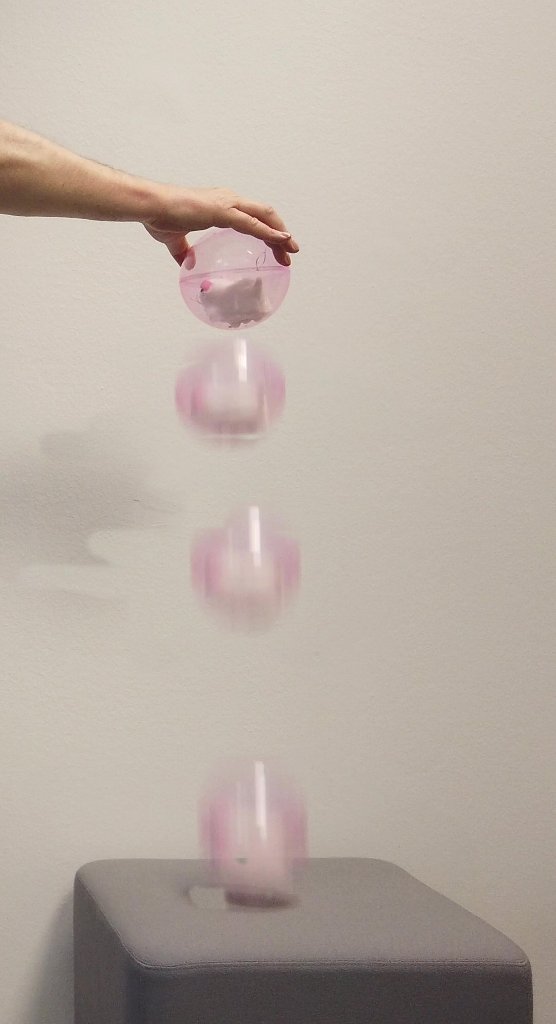
What actually was happening was that:
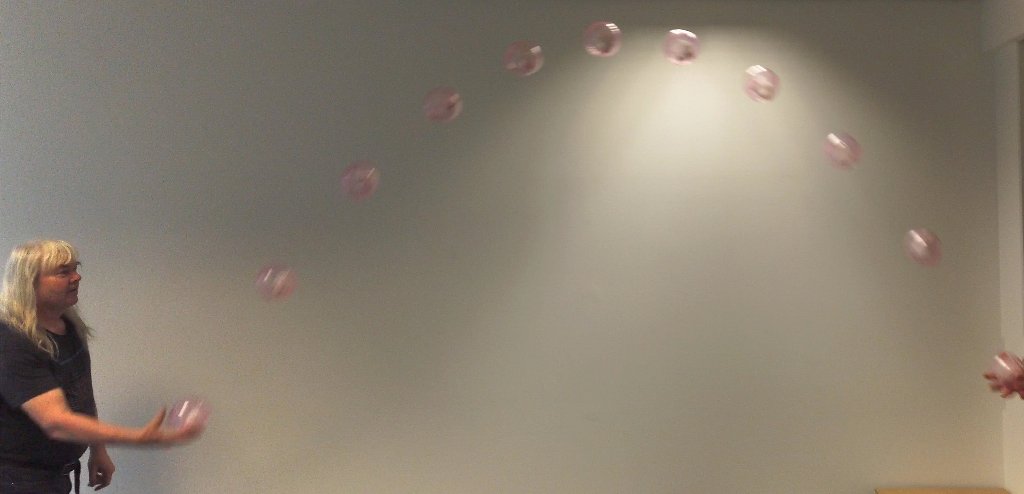
If you throw a ball with a hamster in it, the ball will be accelerated while you throw it. But once it leaves your hand (for the moment assuming no air resistance - so let's assume we throw it on the moon and the hamster has enough air in the ball to survive), everything will fly in the same (parabolic) arc. And the hamster will be weightless relative to the hamster ball.
For achieving zero gravity within the plane, it doesn't matter whether it flies straight down or in a parabolic arc.
If the plane flies slightly "higher" than that parabola, then passengers in the plane (following the parabola) will perceive gravity in relation to the plane. (Which is the same as for the "falling straight down" scenario.
But, unlike in the straight down example, the perceived "center of gravity" in such a situation is (more or less - this is simplifying things a bit) the center of the parabola. And since the plane doesn't fly along the arc in a horizontal orientation, but "rides" the arc (essentially as a tangent to the arc), the perceived "downwards" direction is towards the floor of the plane.
So, everyone can bunny hop on the plane, without drifting into the cockpit door or the side of the plane.
Problem solved. It all makes sense now.
Presumably, I should have been paying more attention in the first place. There's a reason why Zero-G flights are called "parabolic flights" (I had known that, but assumed that the parabolic flight curve was nothing more than the easiest way to get up again to the needed altitude for the next drop, like swinging up again on a garden swing. Which, admittedly, isn't parabolic at all, as the ropes with which the swing is attached does not stretch. But that wouldn't apply to a plane, so it might still be a parabolic arc on the "lower end". But that's not what the "parabolic flight" refers to.)
Once I understood that the flight was not going straight down, but along a parabola, the whole thing made more sense. Including the "hypergravity" before weightlessness.
Before getting weightless, the gravity is at 1.8 G, so you weigh almost twice as much as usual. I had implicitly assumed that this was an effect of pulling up before dropping down. And it was only because they wanted to have as little time as possible before the next zero gravity phase. And that they might level out a bit (getting to regular gravity) before going to zero gravity.
But, taken the "throwing a hamster in a ball" image, it was clear why that wasn't the case. As long as the ball is in the hand and the arm makes the throwing motion, it is accelerated and there is hypergravity on the hamster. It might not be 1.8 G, but the hamster is clearly experiencing the push. The moment you let go of the ball, gravity drops to zero. There is no moment of "now we're letting the ball fly horizontally for a moment of regular gravity" involved. It can't be. There's nothing that would turn that into an upwards arc. Anything doing that would require an external force acting on the ball, which would induce hypergravity again.
So, gravity has to go from hypergravity to zero gravity (almost) instantaneous.
Switching mental models explained a lot.
A bit annoying, however, is that the math doesn't work out that cleanly.
When I assumed that we'd be falling and the maximum speed would be 900 km/h, that neatly translated to a falling time of 25 seconds, which matched the actual time of zero gravity well.
But entering a parabola at 900 km/h at a 45° angle, will make the parabola last 36 seconds. Or, entering it at 50° (as they do on the actual flight) would extend that to 39 seconds. And going straight up (and falling down again) would bring back the problem of where the gravity would be "pointing" at the beginning and the end of the parabola, but would yield 51 seconds without gravity. (Well, it had to, as it's essentially the free-fall scenario twice, in different directions. If that took about 25 seconds, twice of that would be about 50 seconds.)
As the plane flies up to get into the parabolic arc, it loses a bit of speed. According to a diagram, the speed is 685 km/h when entering weightlessness. But at 685 km/h and 45°, the arc would take 27 seconds to complete. At the 50° angle used, it would be 30 seconds. (Straight up 38 seconds.)
The 22 seconds of zero gravity during the parabola is nothing more than an arbitrary value resulting from the way they fly the arc.
Which is slightly frustrating from a science point of view. We have the simplified model (dropping the hamster ball), which provides reasonable results when the numbers (maximum speed of the airplane at the end) is put into the formula. And we have the improved model (which explains how we can have lunar gravity pointing towards the floor), where the resulting time in zero gravity is mostly arbitrary.
Sigh.
Science sometimes is that way...
Moving on to other aspects of the flight.
The plane they are using for the flight is an Airbus 310. Not really a new model.
There are only a few of them still in passenger service. Most of them by rather obscure airlines in Afghanistan or Iran.
The actual plane they use was built 37 years ago. That's old enough that it was originally ordered by the GDR airline Interflug.
Later it was bought by the German government and used as the official government plane during the Merkel era. It was replaced by an Airbus 340 about 15 years ago and sold to Novaspace (the company operating the Zero-G flights), which, in turn, used it to replace their older Airbus 300 (which is now located on a parking lot outside Cologne airport).
I don't know whether any of the salesmen involved, given that it was Angela Merkel's official plane, made some "sold by one careful lady owner who only used it on special occasions" remark.
But, in general, official government planes are flying much less than regular airliners.
Which means that the A310 they bought was in fairly good condition.
And they are trying to keep it that way.
While most regular airplane maintenance schedules are based on the hours the plane was flying, some of them are based on the number of starts/landings.
And for the zero gravity flights, they count every parabola as a take-off/landing pair. And while we did less of them, a scientific flight has up to 30 parabolas (plus the actual start and landing at Bordeaux).
So the plane gets a lot of maintenance. (As Neil was remarking: "Sometimes the mechanic takes a look at it and says "What is this thing doing here again? The parts I put in last time haven't even gotten dirty.'") Some of them are probably slightly ridiculous, as those checks that are based on start/landing cycles are presumably those that look for issues with the landing gear - which is safely folded in during the parabolas.
Checking the plane often is still a good idea.
While everything is still within the regular safety limits for the plane, a flight angle of 50° is likely to put more stress on the wings than a regular flight.
One indication of this is that they couldn't do it with a modern Airbus.
An Airbus A320 could easily fly the same arc. But it doesn't let you. As there's no reason ever to do a 50° climb with a passenger plane (and the plane is "fly-by-wire"), the flight computer won't let you do it. You can pull the flightstick all you want. The plane will assume your jacket accidentally got caught on the stick. Or that you fell over and lean against the stick. (Actually, it won't assume anything of the sort. It just won't do it, whatever the reason.)
The Airbus 310 has a flight computer as well. And it doesn't like a 50° climb either. But as the plane is controlled mechanically (well, hydraulically), there's nothing it can do but whine and complain. There will be various alarms going on in the cockpit, but the pilots can simply ignore them and fly the parabola anyway.
Which will create an interesting issue in a couple of years. Even with intensive maintenance, the A310 will reach the end of its lifetime at some point. And what then? Currently, they are in negotiations about how the flight computer program can be modified. As usual in such security critical cases, the actual change of the program is probably simple. But the whole thing needs to be officially certified. And that's an immense issue. Especially if you don't do it for a range of aircraft (like all A320), where the cost is distributed across many planes, but needs to be done for an individual plane. (As it's more than unlikely that commercial airline pilots are going to say "50° flight angle? That's something we always wanted. Can we have that on all Airbus planes?")
But that's still a few years off...
At the moment, the pilots still need to fly the plane manually.
There are, surprisingly, three pilots operating the plane at the same time, with a fourth one on standby. All of them experienced test pilots.
And when I say "three of them are operating the plane", that's what they do. It's not like one does the flying and the others read the instruments. One of them is in charge of the airplane roll, trying to keep that steady. One of them (and that's the hard job) is in control of the pitch. This is the critical part of keeping everyone in the back floating without slamming into any walls. And a third pilot kneels behind their chairs and operates the throttle. (I think that during one of the presentations, there was one picture from the cockpit where they had some metal rods clamped to the throttle leavers, so they could be operated from behind the pilot seats. But I am not sure whether I did see that correctly. And if, whether it was a recent picture. It might have been from the earlier A300.)
As the "maintaining the right pitch" part requires a lot of attention, they have the fourth pilot on board, so they can switch the responsible pilot after each group of four parabolas. (It's hard to come up with an equivalent. The best I could come up with is to drive a car on a straight road in the mountains at exactly 100 km/h for five minutes. If the digital speedometer (which, to be fair, should show tenth of kilometers/hour) goes to 99 or 101, you fail. While most experienced drivers would probably be able to do that, it's something that does take attention and is stressful.)
There were a couple of other points made during the pre-flight briefing.
After the start, we probably wouldn't have to wait long until the fun began.
In most cases, they do the parabolas over the Atlantic. And since Bordeaux is about 50 km from the coast, that's essentially just around the corner. Sometimes, however, the weather over the Atlantic isn't suitable and they go somewhere else. (To quote Neil: "We have an airplane. We can go wherever we want.") Then they usually fly over the Mediterranean Sea, which is a bit farther away. There's a longer time on the plane where nothing interesting happens. For us it would be, when the plane reached its basic flight altitude, time to get ready for the parabolas. (In the end, it was 15 minutes after take-off when we did the first arc.)
It wouldn't matter much before the Zero-G experience, as everyone is excited about that anyway. But once it's over, having to sit in the regular seats for another hour or more is a mood killer. (We were back on the ground 18 minutes after the last parabola - still excited about the whole experience.)
Speaking about sitting in the regular seats. The initial and last parts of the flight are (almost boringly) normal. You sit in normal passenger seats in the back of the plane. The usual baggage overhead bins, reading lights, life vest under the seat, emergency oxygen masks - nothing out of the ordinary.
And, for start and landing, all the usual rules applied. Back rests upright, window shades opened, seat belt fastened...
Though on the flight itself, the pre-flight announcement was mercifully short, as some of the usual points didn't apply.
There wasn't any need to worry about things falling from the overhead locker or using a powerbank using the flight. Nothing about computers being needed to be stowed away during starting and landing or bags under the seats in front of us, as we wouldn't have any of those.
The only things we were allowed to bring on board were small things fitting into the breast pocket of our flight suit. All of them being non-dangerous and needed to be pre-approved.
Which meant there also was no announcement on making sure not to forget anything in the seat pocket after the flight.
No announcement about emergency exits by the wings, as there weren't any. (Emergency exits by the wings. The wings were, obviously, there.)
Something we didn't need to worry about was breathing.
Usually, during flight announcements, there is the bit about "In the unlikely case of loss of cabin pressure, oxygen masks will fall from the ceiling."
While there were the regular oxygen masks in the seating area (I presume), there weren't any in the "floating area". But they wouldn't be needed anyway. Mostly because a sudden loss of cabin pressure almost never happens in any case. In our specific case, we wouldn't usually be somewhere where we would need extra oxygen. Our base flight level for the parabolas would be about 6000 to 6500 meters (going during the parabolas to up to 9000 meters, but only briefly). And at that altitude you can still breathe (more or less) normally. You'll be quickly out of breath if you're trying some activity, but it's not a life-threatening lack of oxygen in the short run. For longer exposure, you are likely to get altitude sickness, but as you are in a plane with pilots who are experts in changing altitude really fast, the lack of oxygen is nothing to worry about. (If you get a sudden loss of cabin pressure, that usually means that some important part of the plane is missing - so there are presumably a lot of things to worry about. But not having an oxygen mask nearby isn't one of them.)
And while you won't be long enough at 6000 meter altitude air pressure and oxygen level to get altitude sickness, there is some other sickness to worry about.
Motion sickness.
Almost everyone I've talked to about going on a zero gravity flight, even if they knew nothing else about it, knew that it was called the "vomit comet".
Which was a bit of a concern.
Going on a zero gravity flight is expensive. And if you spend most of it being sick, you won't enjoy it. You could probably have the same experience a lot cheaper by buying and downing a bottle of vodka.
And the best advice about the subject is probably the least useful one: "Don't worry about it." (Which is a bit like "Don't think about pink elephants and you'll be fine.")
After all, the "vomit comet" moniker is well known. And, of course, you worry.
But while early zero gravity flights were probably a bit rough, the main reason of sickness is now (as far as can be determined) anticipation.
If people don't worry about air sickness, they don't get as anxious and they are more likely to be fine. But, of course, with a name like that, everyone worries.
The recommended attitude was to take your pills and don't pay much attention to it otherwise. They provide you with anti-nausea pills, which you are free to take. In their words: "We can't force you to take medication. That would be highly unethical and illegal. But we advise you to do so." According to their experience, without medication about half of the passengers get sick. With the medication less than 10%.
Oddly, it's not the zero gravity that's the problem. It's also not the result of anything in your torso being subjected to high or low pressure.
It's literally all in your head.
Partly because anxiety resides in your brain. But the other main factor is your sense of balance, located in your inner ear, during the hypergravity phase (1.8 G). If you move your head then, it's likely to make you sick. There's a fluid in your ear which flows over some hair cells. And that is the input on which the sense of balance is based. And if you move your head in hypergravity, the fluid "sloshes" much harder over the hair cells, which in turn makes the brain think something is wrong. (To be fair, it isn't that far off the mark. Being in a 1.8 G gravity is seriously wrong anywhere on Earth.) And that, in turn, causes vomiting.
The popular explanation of this is that the neural mismatch between what happens and what is expected to happen is interpreted by the brain as the effect of having been poisoned. And the vomiting occurs in order to get rid of the perceived poison in your stomach.
Which sounds cute and plausible, but seems doubtful to me. It's something that is almost impossible to test for, so its main advantage is that it makes a good story.
In the last two decades, I've been "poisoned" twice. I'm not suggesting that anyone was trying to kill me. I went to a restaurant, had some food that probably wasn't as good as it should have been. And spent most of the night kneeling in front of the toilet. And in both cases, I wasn't dizzy at all. So, we have two cases of food poisoning and the body reacted by ejecting the food. But whatever caused that had nothing to do with a sense of dizziness. While there might be some stuff (alcohol mostly) that hampers your sense of balance and makes you sick, it doesn't seem common enough to create an automatic reaction to dizziness as sign of poisoning.
In any case, the really useful advice was "When in hypergravity, keep your head still. And take your medication. You'll be fine." (Worked for me...)
And, otherwise, do what you would normally do. For example, don't worry about breakfast. If you normally eat breakfast, have a normal breakfast. Don't go to extremes, just because the hotel has an extensive breakfast buffet. But also, don't eat only half a slice of dry toast (unless that is your usual breakfast) because you are concerned about motion sickness. Not that it would matter much anyway. As they pick you up at 7:30am at the hotel and the plane won't leave before 10am, there will be probably about three hours between your breakfast and the first parabola. By that time, most of your breakfast will have passed through your stomach already.
And while we're at the subject of bodily functions (which I mostly would want to avoid mentioning again): Something else to consider is the need to go to the toilet.
It's a good idea to use a toilet before the flight, as there aren't any on the plane. For obvious reasons, they have removed the toilets from the plane, so you can't use them even during the regular portions of the flight. Which wasn't relevant for us, as you are not allowed to use the toilets in a plane during take-off and landing anyway. But if they go to the Mediterranean Sea, you get some more "regular flight". But still no toilet.
They bring some sort of single-use chemical toilets on board (something that you could use for camping, which has some chemicals in it which bind all fluids). But you don't want to use those. They are not nice to use for the situation they were made for. And probably even less pleasant behind a modesty curtain on a plane that is flying funny curves all the time.
On the other hand - if you take your medication, don't move your head in hypergravity and go to the toilet before you enter the plane, you'll be fine. At least I was.
So, I decided to have another glass of wine during the evening introduction and dinner. (After all, the advice was to behave as usual. And we were in Bordeaux, so the wine was good...)
After (regular, but early) breakfast next morning it was time for the "real thing".
Getting to the plane was slightly strange as it was required to be "normal".
The Airbus used for the Zero-G flights is parked near the "back" of Bordeaux airport, almost as far away from the regular terminal as possible.
We would go to the plane through a small door in the fence.
But as we were entering the airfield, the usual rules still applied to us. And, for some reason, they applied the rules for a regular scheduled flight.
Not only did we have to go through security control, but we also needed to have (and show) a boarding pass, as well as a passport.
I am not sure about why either of them. As we were leaving from Bordeaux and heading back to Bordeaux, we wouldn't leave the country, so there would be no need for a passport. And as they could have just ticked us off a list when we when through the gate (a literal gate in the fence), the boarding pass didn't serve any real purpose. As it was a "regular" cardboard boarding pass, it might have been intended as a souvenir, but I assume they would have made it fancier if that was the idea.
It's probably down to general airport regulations - nobody gets on board without identification and boarding pass, no matter what.
At least we didn't have to go through the regular terminal. But as security rules still applied, they brought a security guard and also an x-ray scanner over to where we were.
But that security check was a quick one - after all, all everything had needed to be in the breast pocket of the flight suits, So it wasn't much that needed to be checked (and we had a pre-check the previous evening of things we wanted to bring on board).
In general, they treated it as a regular flight. It felt strange though. Although this is sometimes the case with flights that don't fit the regular pattern. On a flight south from Punta Arenas, a long time ago, the arrangements also felt odd. We were picked up from the hotel with a bus. And all our gear was in the bus. Then we had to leave all our stuff on the bus, go through passport control and security and then go back to the bus, which took us to our plane. Utterly silly from a security point of view, as we could have left all kinds of things on the bus and brought that on the plane. But it made sense from their point of view. As we were leaving the country, they wanted to do a passport control. And as that was the regular passport control at the airport, we had to go through security. Also, they were probably not concerned about anything that we would take onto our plane. But as we entered the "secure" area of the airport to go to the passport control, they might have been worried about anything that we might hand to passengers going on a regular flight. As long as anything suspect stayed on the bus, they didn't care. At the time, the mixture of strict passport control and security, combined with "leave your unchecked stuff in the bus" did feel strange, though.
So, pretty soon, we were out on the airfield, ready to walk to the plane.
Which would be starting without delays.
There was a slight concern about this, as it had been foggy all morning and we might have to wait for the fog to clear. But the fog lifted on time.
But before entering the plane - photo opportunities.
It started with the right stuff.
Or at least, recreating the iconic image from the movie "The Right Stuff".
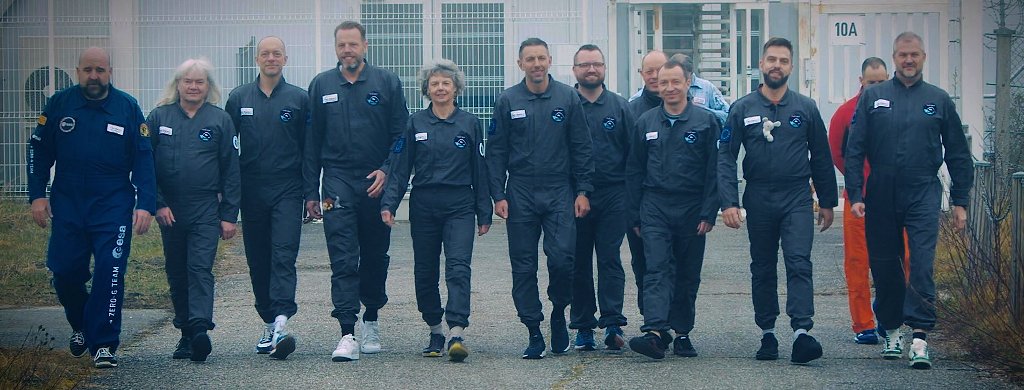
Followed by a group picture in front of the plane.
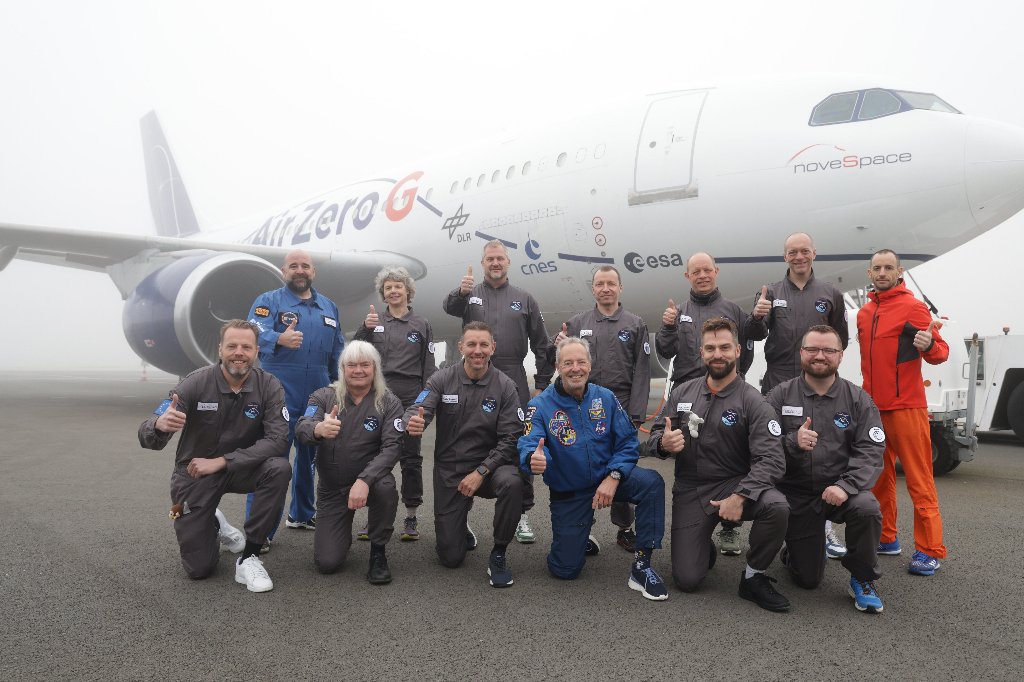
The fog is still obvious, but it's thin enough that we're good to go.
The ten people in the grey flight suits are the customers. The bearded guy in blue is Neil Melville, from ESA, our instructor.
The guy in orange probably has a job title that sounds cool, but, essentially, he's a bouncer,
The "flight zone" within the plane is divided into four areas (for the Moon, Mars, Jupiter and Saturn groups mentioned earlier). Separating the area are only a few cargo straps. To keep the groups together, the guys in orange are placed between the areas to push back people who float into the wrong section.
And, like any club bouncer, they make sure that people from the general "dance floor" section don't sneak into the lounge seating section. Though, admittedly, the other way round. On a zero gravity flight, people want to be on the open "dance floor". Drifting into the aft section of the plane is dangerous, because the moment hypergravity sets in again, you don't want to crash down onto the back or arm rest of an airplane seat.
Another important function of the guys in orange is to make sure that people have their feet pointing downwards when gravity sets in again. If you're floating near the ceiling and the 22 seconds of zero gravity are almost over, it might be difficult to turn yourself into the right position. And crashing head-first into the floor probably isn't good for you.
If they (or the instructor) see someone the wrong way up, they grab them and turn them around.
So, technically, the guys in orange are bouncers and twisters. But presumably that's still not the job title on their business card.
As a precaution, in case someone gets worried because he's upside down and hypergravity is about to begin, Neil has a patch saying "Don't Panic" upside down on one shoulder of his flight suit, based on the assumption that anyone who reads it right-side up is probably in need of some reassurance.
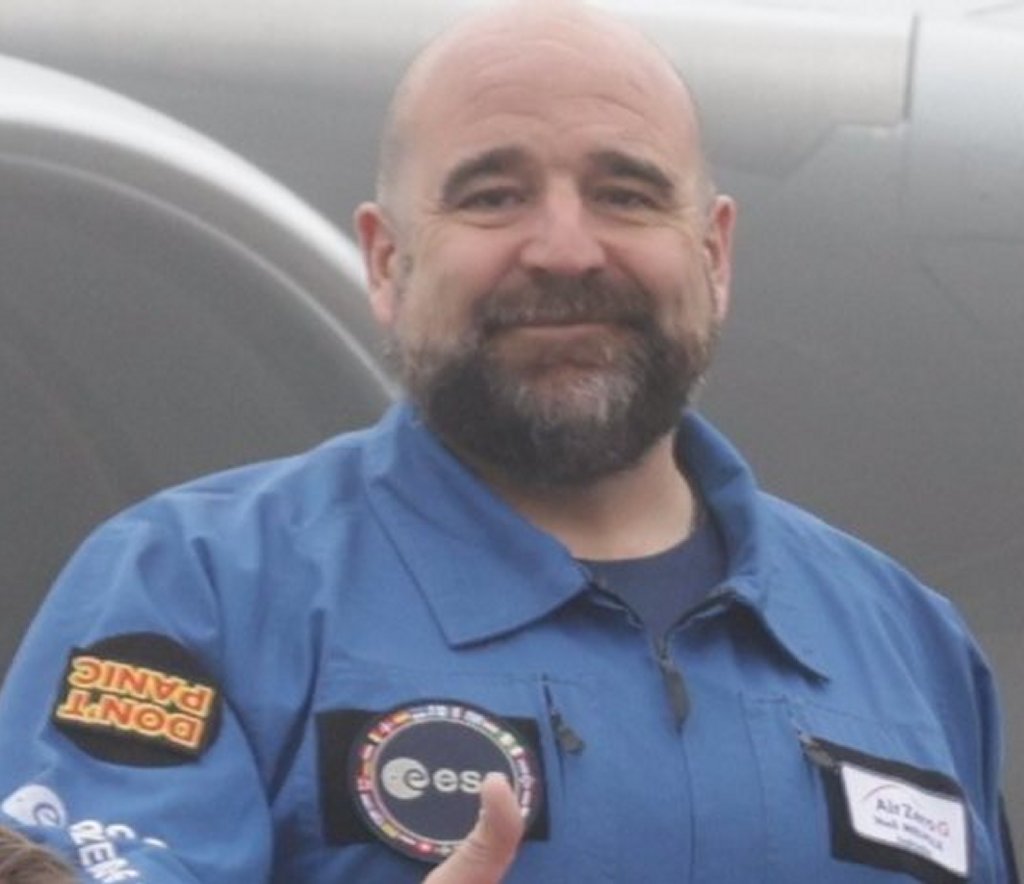
I don't have a good picture showing the patch on the left arm of his flightsuit, but it said "USCSS Corbelan" along the edge and had a stylized W below a picture of two planets. I was reasonably sure that "Corbelan" wasn't any space mission I had ever heard of. But the style and the planet picture looked somewhat familiar. And I guessed they the W might stand for the Weyland corporation. I asked Neil and it turns out that he's a big fan of the Alien franchise. (He even named his daughter "Ripley" - believe it or not... :-) And the Corbelan is the ship from the "Alien Romulus" movie. Which I hadn't seen, so I hadn't recognized the name.
Side remark: I had never noticed that the three triangles in the Weyland logo aren't simply decorative elements. They form (more or less) a Y-Shape behind the W, as the full name of the company in the Alien movies is Weyland-Yutani Corporation.
The second person in a blue jumpsuit, kneeling in front is Jean-François Clervoy, an experienced astronaut who has been on three Space Shuttle missions and spent, all together, almost a month in zero gravity. He's also the founder of the company offering the Zero-G flights in Bordeaux.
He's quite cool and funny, but all his mission patches on his jumpsuit are real ones. No science fiction references on him. (I don't think he needs them - he's really been in space. So why stick with imaginary space travel.) Even the "Billy Bob" patch on his shirt is kind of a proper one (though it presumably started out as a joke). When he was training for the NASA missions, some people had problems pronouncing Jean-François Clervoy, so they settled for "Billy Bob" (which, presumably even the dullest country hick can pronounce) as his nickname. Which then kind of stuck.
That was enough posing for now - time to get on the plane.
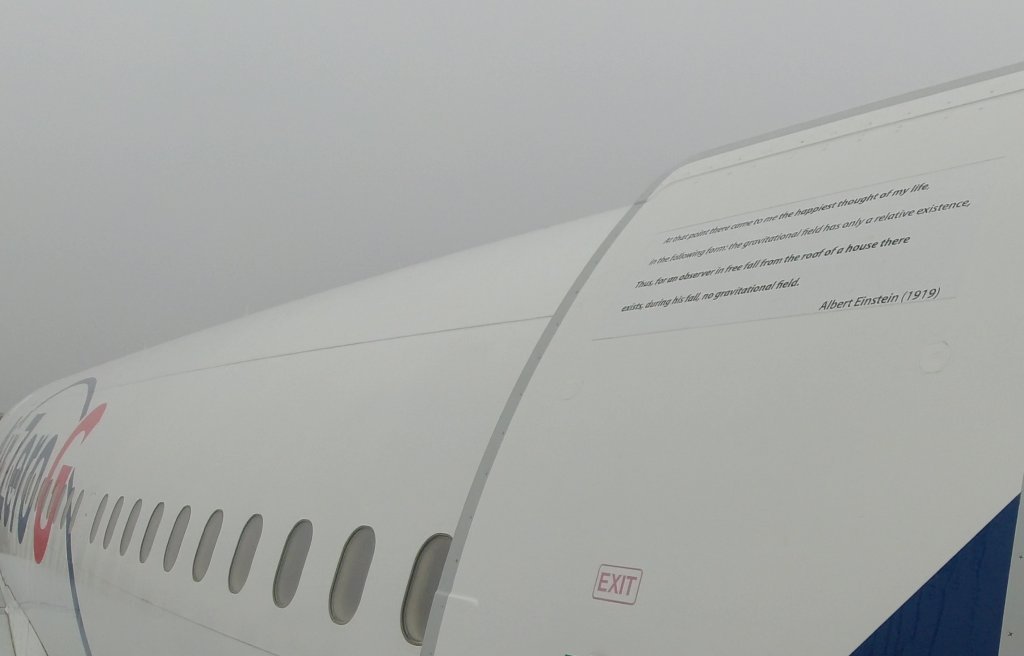
On the door to the plane, they have a quote from the year 1919 by Albert Einstein:
At that point there came to me the happiest thought of my life,
in the following form: the gravitational field has only a relative existence,
Thus, for an observer in free fall from the roof of a house there
exists, during his fall, no gravitational field.
I am not quite sure whether I wanted to be reminded at that point that what I was about to do was akin to falling off the roof of a house, but if that gave Einstein happy thoughts, why shouldn't it give me happy thoughts as well?
During take-off and landing, things were pretty much the same as on any regular flight, except for a slightly shortened pre-flight announcement. But the view of the plane section in front, consisting of the four "flight zones" already looked promising.
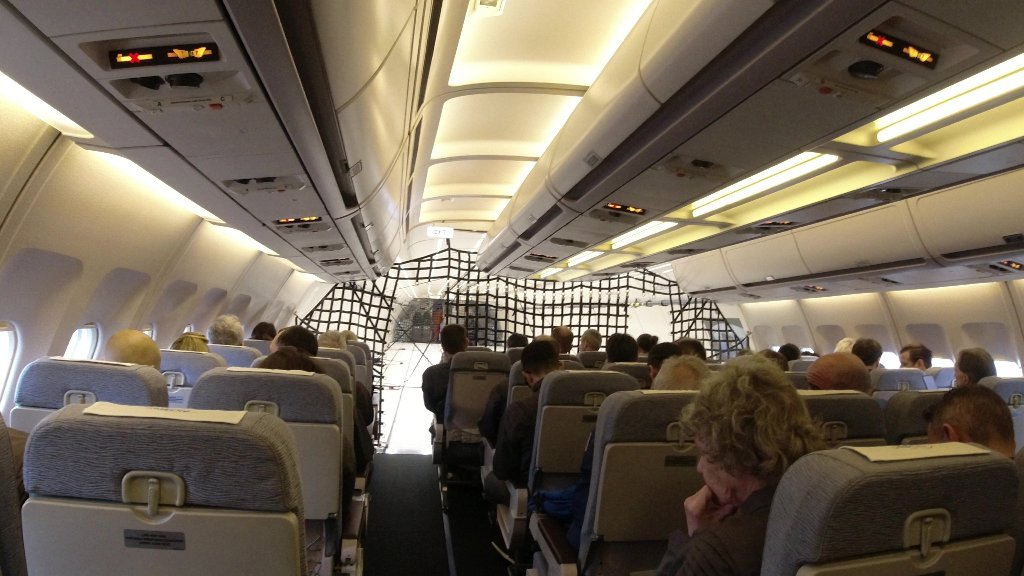
Time for take-off.
And a few minutes later, time to get the shoes off.
In the "flight zones" only socks were allowed. Not so much to keep the floor clean (we got it dirty and wet later anyway). But if you're floating around in an unfamiliar environment and have (initially) only limited control over your movements, it's impolite to kick other people.
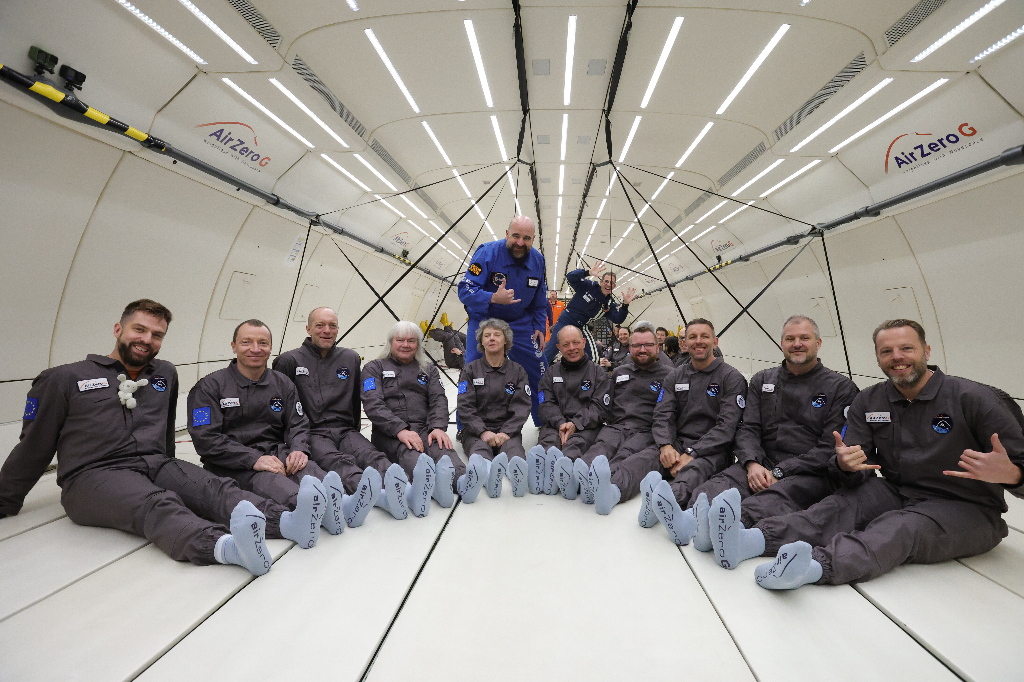
You might still accidentally do that, but then at least you don't get a boot in your stomach.
The boots are collected right after the start and stowed away safely (as you don't want to have shoes, even without feet in it, floating around at random).
Then, finally, it was time to enter the "play area".
Upon entering the section we were in, I noticed a picture of a window looking out from space towards Earth. I didn't pay much attention to it at the time. I thought the idea was simply to add some "out in space" feel to the zero gravity floating.
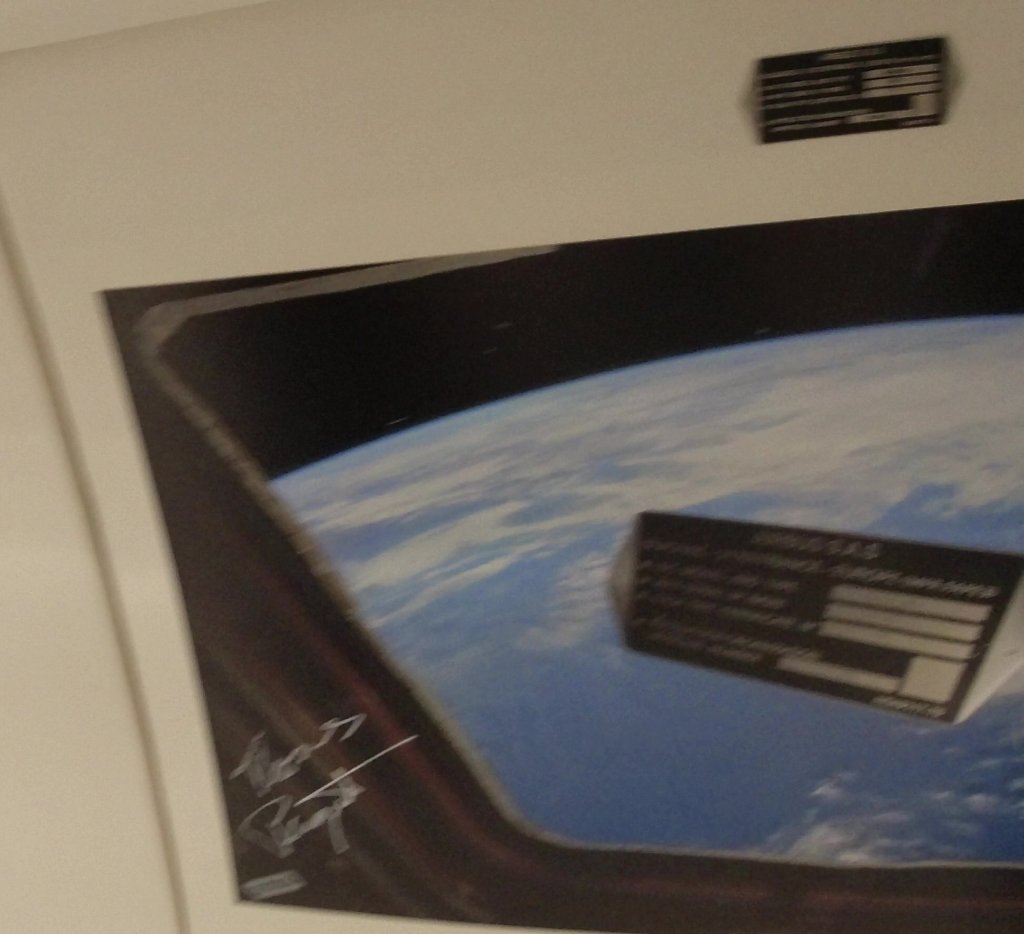
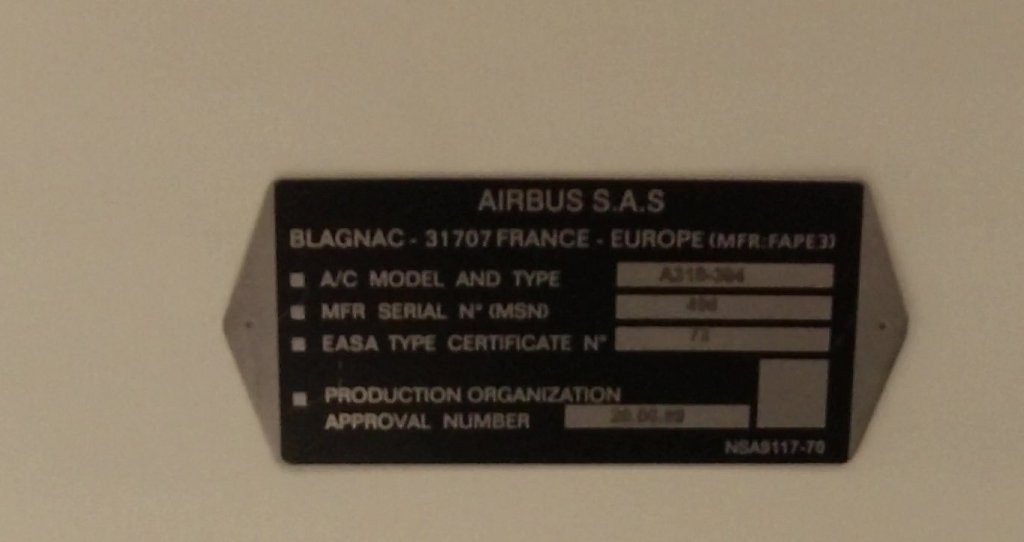
I only found later that it was there for another reason. (That's also why I don't have any good picture of it, just an unfocused still frame from a video.)
The relevant bit is not so much the window view, but the thing obstructing the view.
While the Airbus (obviously) has not been in space, part of it has.
Directly above the picture is the original registration plate of the airbus. And someone has taken that on board of ISS and took a picture of it with Earth behind it. (From the signature on the photograph, I assume it was Thomas Pesquet, who has been to the International Space Station twice.)
After entering the "play area', we got one more set of instructions. Mostly things we might want to try, like "walking up a wall" or making a full circle along the wall of the airplane. Both not as easy as it seems, as most attempts to "walk" somewhere during zero gravity means you're pushing yourself off the surface. If you "walk" on the wall, you're likely to make one step and then float horizontally across the floor. So, instead, you're mostly pushing yourself off with your shoulders form the ground, in order to have the upward (or, as seen from the wall, forward) motion and then use the legs (more or less) to shuffle forward without really making a step.
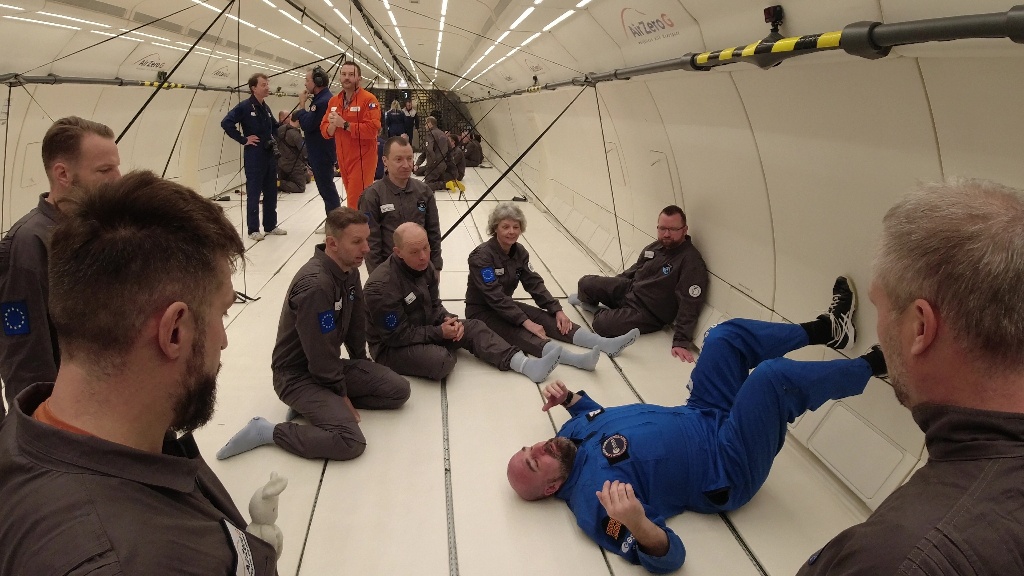
Similar, if you want to do a circle along the wall, it's mostly pushing yourself from the "side" (wherever that may be from your point of view at that moment) to the ground and "crawl forward". Unfortunately, you can't do an upright 2001-style full circle walk - you'd need the proper surface and velcro shoes. (By the way, I'm referring here to the stewardess scene in the shuttle. There's another scene where someone is jogging along the wall of the Discovery, which is actually the opposite thing. In the shuttle, it's supposed to be zero gravity, so the stewardess can walk along the ceiling (strongly implied wearing velcro shoes) as she is not hampered by gravity. In the other scene, the idea is that there is (mostly) zero gravity in the spaceship, but as it is rotating, there is "gravitational pull" to the floor. While that would be incredibly cool to simulate in an airplane, I assume it's not only extremely hard to achieve (I guess that's way outside the normal safety margin of the plane), but would also be a bit pointless. Having the plane rotate along its main axis to create artificial gravity while flying a parabola in order to reach zero gravity seems a rather convoluted way to achieve - well, regular gravity.)
But it would be such a geeky thing to do.
Back to where I was before I got distracted...
We also got a short overview of the order of "special" parabolas.
While for most of the parabolas, we were free to do whatever we wanted, there were four of them with "special events", like the "human wing" or the "Zen parabola" (not the same as a zen parable).
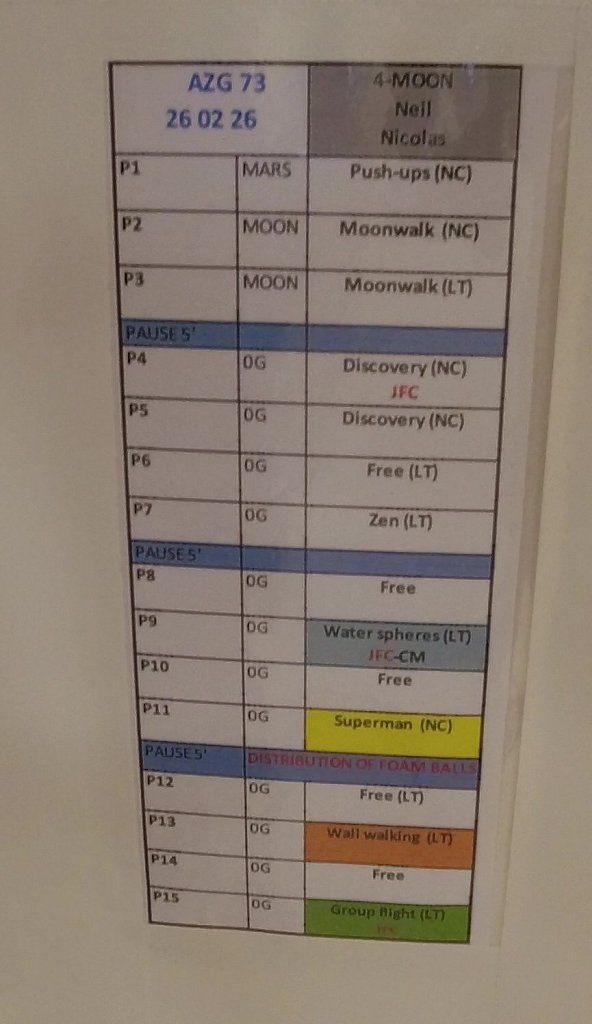
We got our last bit of instructions and then it was time for our first 1.8 G phase, heading into the first parabola.
To ease us in (and also because it's a different experience), we started with Martian gravity on the first parabola. That's about a third of regular gravity. Things are still normal enough that there isn't anything overly weird, but also sufficiently different that you can do things that you can't (or at least not easily) do otherwise. Like doing one-armed push-ups.
I, however, found out that I am much too careful about new experiences.
During hypergravity I had been lying close to the cargo netting that separated us from the seating area. And, unsure what it would be like, I carefully pulled myself up on the netting to try some careful hops.
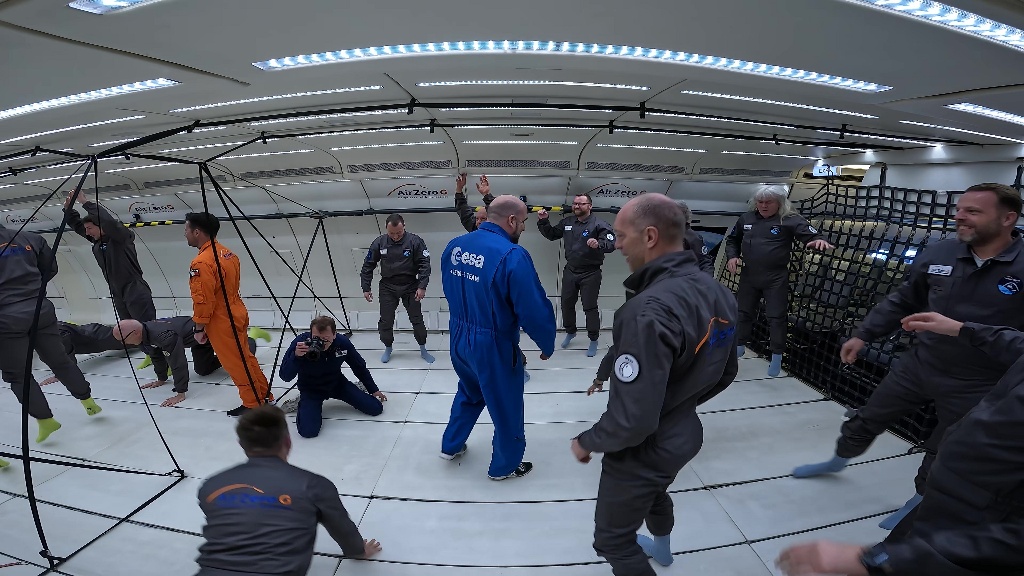
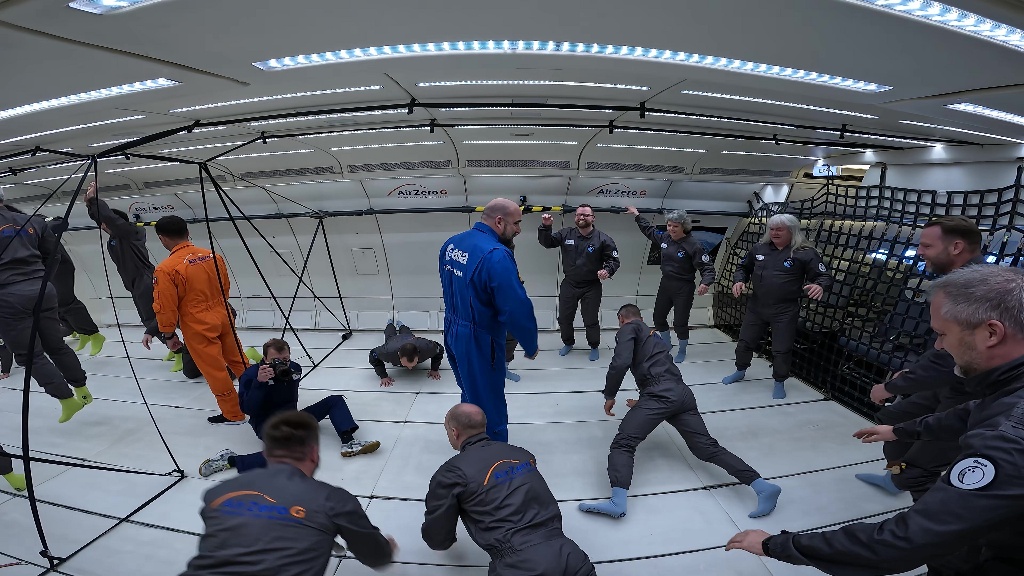
While others were doing their one-armed push-ups or push-ups with both arms stong enough to disconnect from the ground and clap the hands before touching down again, I was still timidly hopping around.
By the time I was ready to do something else, the 22 seconds were already over, and everyone got back on the floor again.
Somewhat strangely, that part (lying on the back during zero gravity) was the strangest phase during the flight. I didn't feel in any way unusual during anything else. But during those segments, it felt like the cheeks were being pulled back toward the ears. It didn't look anything like that, of course, but the feeling reminded me of the "cosmetic surgery" scene in the Terry Gilliam movie "Brazil". (For some reason, that feeling of the face being pulled away appeared only when lying on the back. After one of the later parabolas, I ended up lying face down on the floor and expected the feeling of my cheeks drifting to my nose, but it didn't feel like that at all.)
After Martian gravity, the next two parabolas were Lunar gravity, so about one tenth of normal gravity.
Of course, for Lunar gravity, everyone knows what to do. Presumably everyone knew the movements of the Apollo astronauts on the Moon. So everyone started bunny hopping during that parabola. Nobody tried to do one-finger push-ups or one-finger pull-ups from the ceiling straps. Both would presumably have been possible. But when in Rome... Or, in other words, when in Moon gravity, do what the few people who have been on the Moon have done. Hop awkwardly.
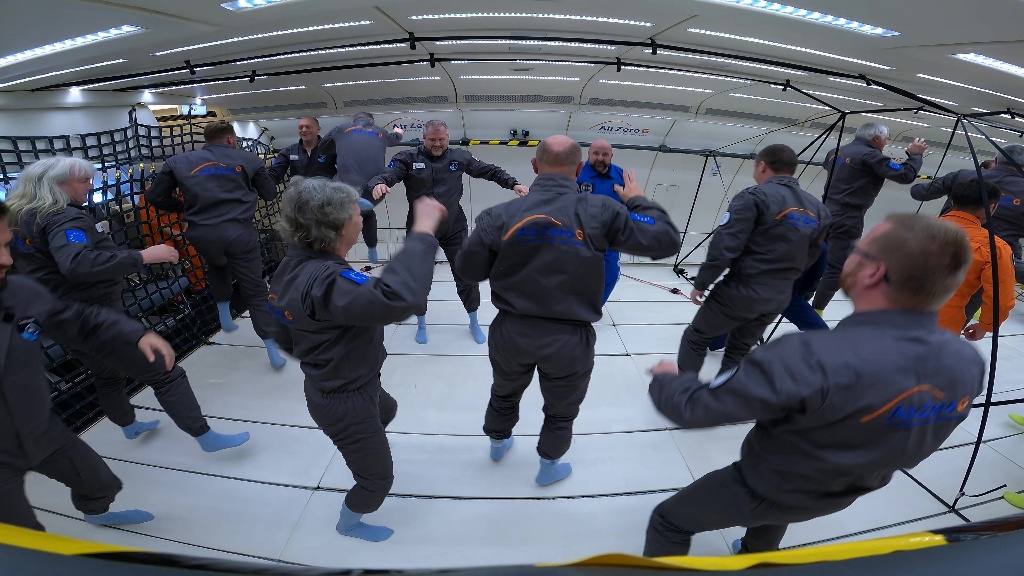
For that, it was a good thing that we did two parabolas with Lunar gravity.
In the first one, everyone was hopping somewhere. As the available area wasn't that big soon everyone was bumping into someone.
On the second go, we were better coordinated. Everyone started from one side of the plane and hopped to the other side, so we didn't get into each other's way.
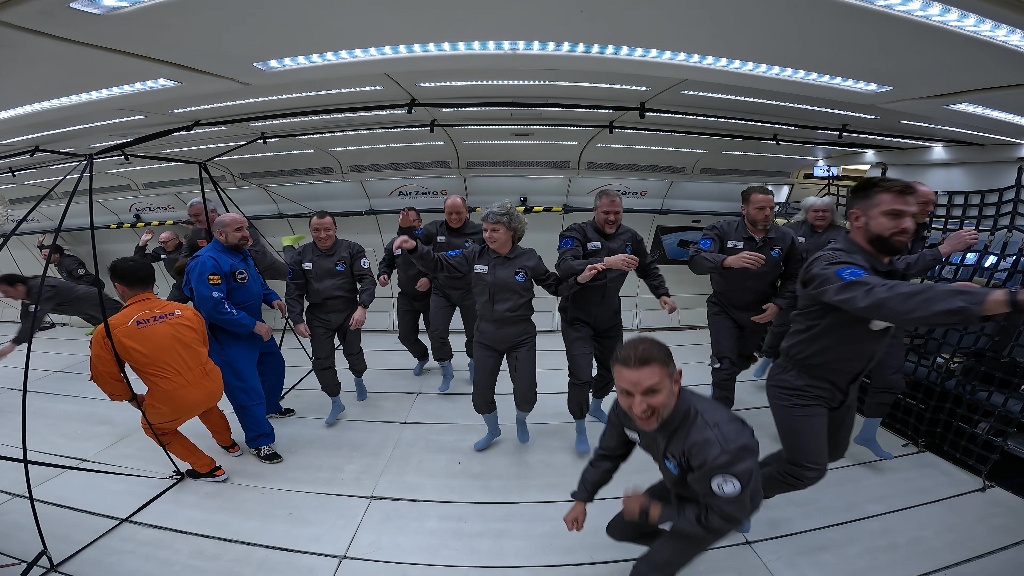
Later on, on the regular flight home the next day, I started thinking about "things that I could have done", if I had only thought about it earlier. One of them was to do a "Moonwalk" (Michael Jackson style) during the Lunar gravity phase. But as I can't do that properly, it was something that I would have needed to train in the weeks before the flight, in order to be able to do it without needing to think about it.
Also, I probably would have forgotten to do it anyhow.
There were a couple of things I had thought about doing, like (very quietly) humming appropriate "song snippets" to myself during the various phases (like "Life on Mars", "Walking on the Moon" and "...and I'm floating in a most peculiar way..."). But during the flight, I didn't remember to do any of that. Also, I wanted to try to propel myself by blowing air. It is well known that "swimming" doesn't work well in zero gravity. If you are stuck somewhere in mid-air and you have nothing to push yourself away from, the usual reaction is that you try to "swim" through the air. Which, kind of, works. As you are in an environment with air (it wouldn't work in vacuum), you can push/pull yourself forward the same way as you can do with water. But it's very inefficient, as air is so thin. An astronaut has tried this on ISS, asking his colleagues to put him right into the middle of a corridor, avoiding any kind of drift. While he was able to "swim" along the corridor, it was slow. He estimated it would have taken him 20 minutes to the end of the corridor. And the ISS corridors aren't that long. In the 22 seconds of zero gravity that we had available, it might have been possible to "swim" a few centimeters. But what about blowing air? Like a (slow) human rocket ship? Breathing in from one direction, then turning the head and blowing the air out in the opposite direction. (Or, probably, even breathing in from the same direction. As breathing in is mostly non-directional (air enters the mouth from all directions), it won't provide much of an impulse.) And then blowing the air out with as much force as possible. A "back of the envelope" calculation indicates that this won't work. As one breath is about a gram of air, and you can blow out at about 40 km/h, that means it would propel something that weighs a kilogram at 0.04 km/h. Or something with 10 kg at 4 meters per hour. It would move me (if noticeable at all) even less than swimming would. (The number don't quite hold up, as that would be the speed gain for one breath. Ignoring air resistance, the speeds (sort of) would add up with each breath. It still wouldn't be noticeable in the 22 seconds available (and air resistance would probably factor in significantly). But it would have been a fun experiment to try out. And it's an experiment that could be done without any equipment. And trying to propel yourself by the rocket power of your own breath seems cooler than swimming. (It only now occurred to me that I could still try the corresponding experiment in water. Go in a swimming pool and try to move backward by blowing out water. While water resistance is much higher than air resistance, the water jet expelled from my mouth would in turn be much heavier than the air I could blown out. And as this doesn't work well in water (while I haven't tried that yet, it seems unlikely that it will), but swimming does, it seems like a good indication that the method of propulsion will work even less in an environment where swimming doesn't work well.)
In any case, it's not about the experiment itself. It's about the fact that I was so excited about the whole experience of the parabolic flights that I completely forgot trying any of this.
Another thing that Neil had suggested was trying to close your eyes and touch your nose with your index finger. It's an experiment in proprioception (the ability to know where your body parts are without looking), which, usually, most people can do. (That's the reason why it's sometimes used as a medical test. If somebody can't do it, it's sometimes a sign for neurological damage (or being drunk).) But, supposedly, in zero gravity it's not that easy. Essentially you don't have sensors in your joints that indicate how much a joint is bent. The body knows (for example) how much an arm is lifted by the effort that the muscles are using. (More or less.) But as the body is accustomed to Earth gravity, the sense of where your arms are is based on "muscle memory" tuned to Earth gravity. Which means that without Earth gravity your sense of where your arm currently is (without looking) is a bit off. And you might miss your nose.
Worth trying that out. But I forgot to do that as well.
No regrets, of course. But if I would ever be in a position to do it again, I would prepare a clear list of what to try in each available parabola, as opposed to having a number of ideas of things that might be interesting to do, without any real plan.
In any case - time to get weightless.
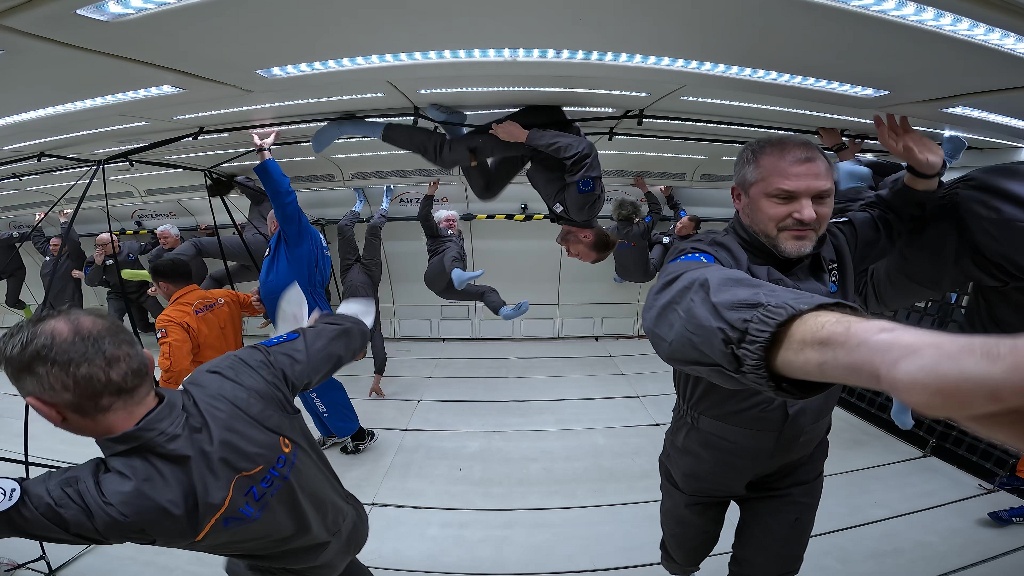
After the first three parabolas there was a short phase of regular gravity, before going to hypergravity and then the next parabola - Zero G.
As I didn't know what to expect, I took things easy.
I wanted to avoid trying to stand up and pushing myself up too hard and pushing myself into the ceiling.
It doesn't work that way. You're weightless, not massless. And if you don't bounce of the floor when you're normally standing up, you're not catapulting yourself against the ceiling in zero gravity. You can if you try to jump, of course. It's like standing in a low doorway. If you jump there, you'll bang your head. But if the you stand up normally, even if you are taller than the doorway, you will hit your head slightly, but that's it.
But I didn't know that then, so I was careful.
If you simply let yourself float, it's surprisingly serene.
It's a lot like lying in a bathtub. Everything is normal and you are simply floating.
There was no special sensation of weightlessness. (Except for the floating, of course.) It didn't "feel" different in any way. While the 1.8 G were noticeable at least in the cheeks, zero gravity didn't have any noticeable effects on breathing or anything else. No dizziness or disorientation.
And then it was "Feet down" and bang - hypergravity again.
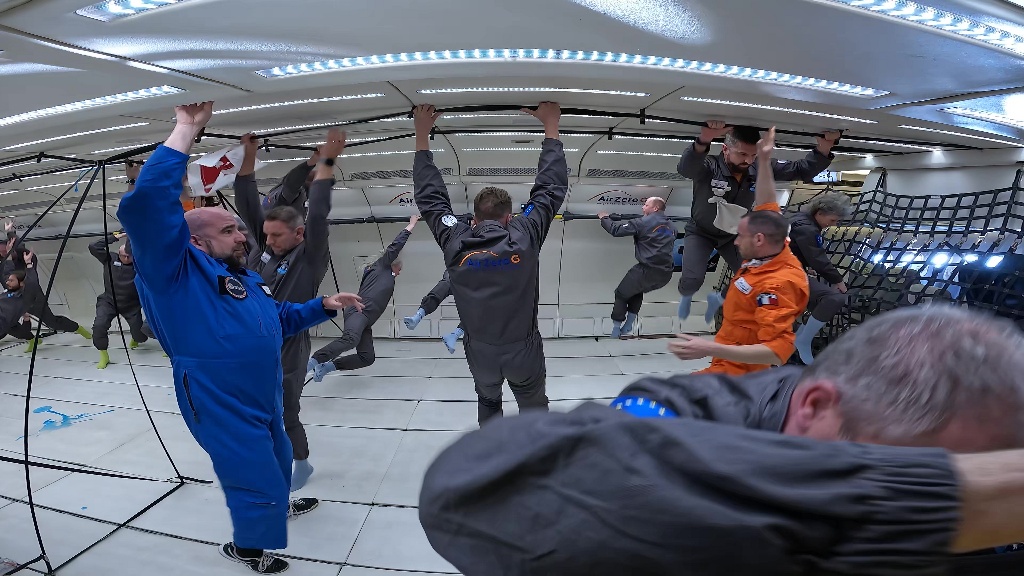
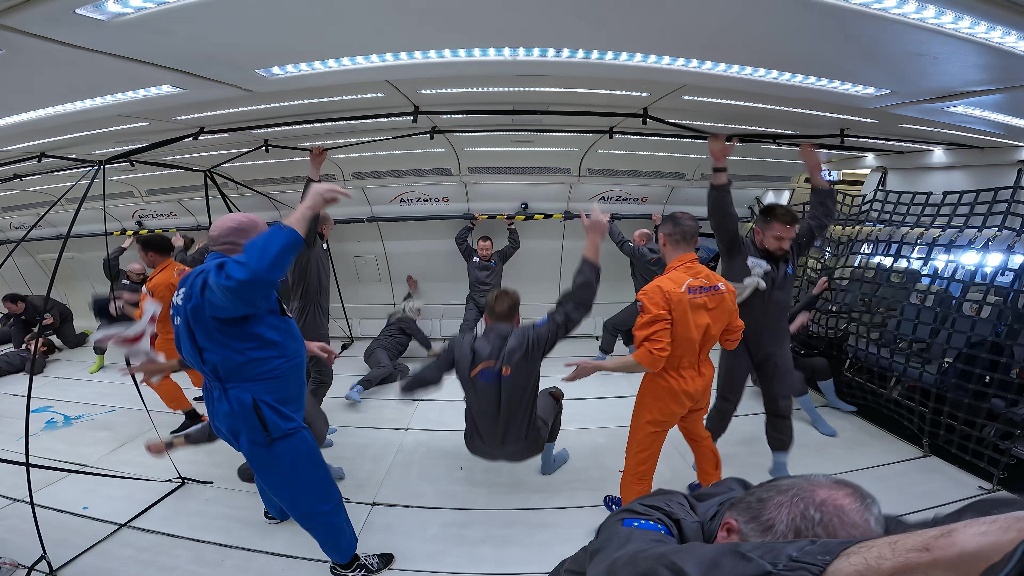
The really noticeable thing was that 22 seconds are even shorter than normal. Of course, 22 seconds are 22 seconds (we're talking about weightless here, not time dilation). But I had been kind of hoping that the excitement and adrenaline would make the 22 seconds somehow "seem longer".
No such luck, though. Quite the other way round.
On the first few zero gravity parabolas, it took me a moment to get up and grab hold of something to give me some control over my actions. And five seconds before the end of the parabola it's "Feet down" and you try to get yourself into a good position (i.e. one that doesn't have your head pointing downwards).
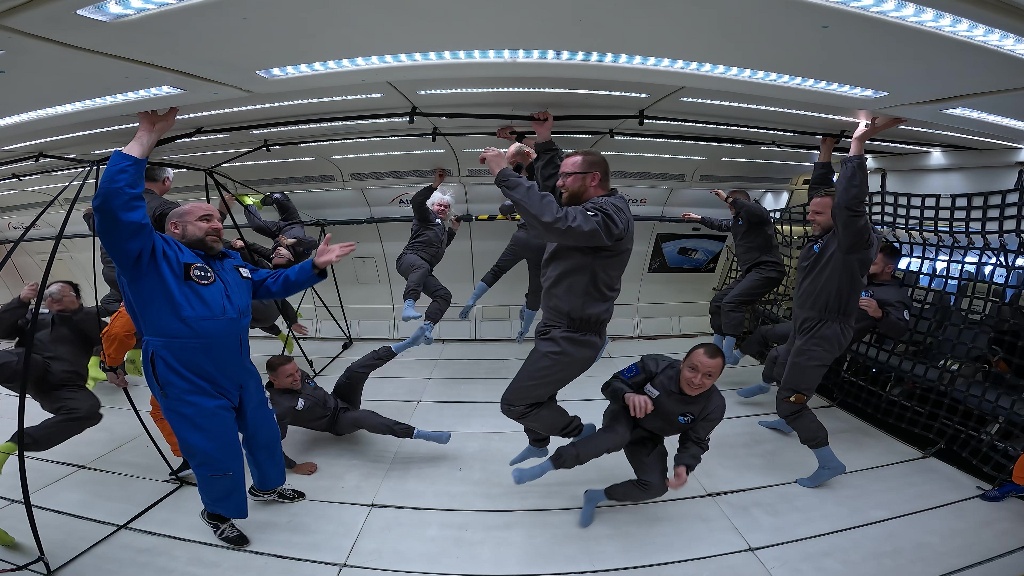
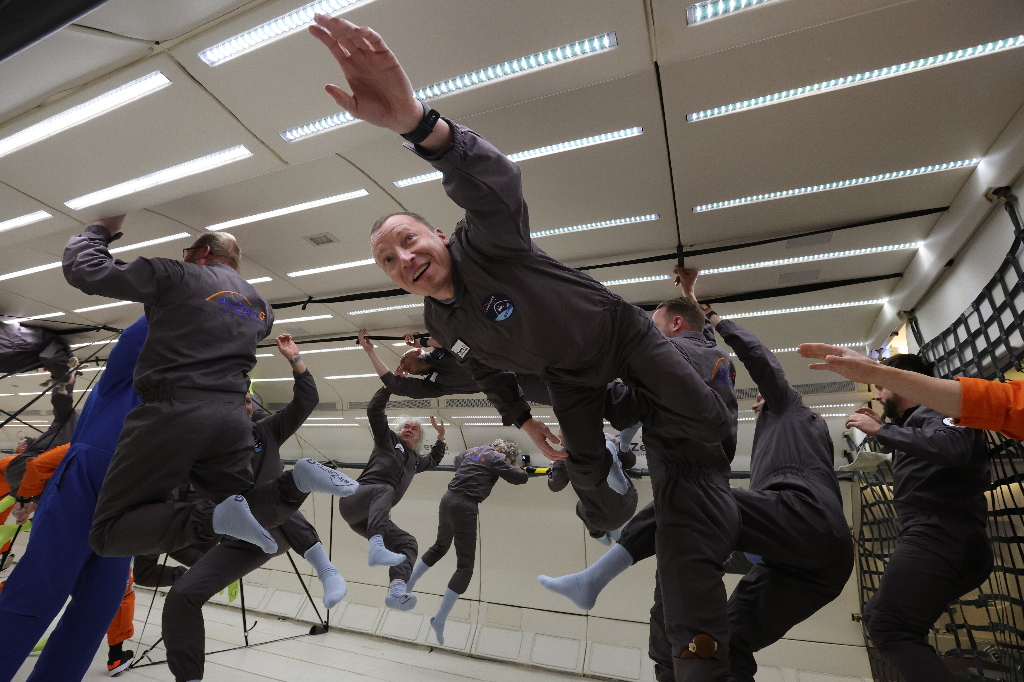
So, realistically, starting from a lying position, you have about 15 seconds per parabola to actually do something,
Which isn't a lot of time,
Just as an example - typing this sentence (up to the next me) took me 26 seconds.
It really helps if you have a plan what to do doing in a parabola. Instead of floating there and thinking "What shall I do next?".
But I got more control over my actions on the next two parabolas, managed to get in a good position a bit quicker and enjoyed it more.
It also helped that I felt fine.
I assume everyone worries about the "one out of ten will probably feel sick" statistics and fearing it might be them. After four or five hypergravity phases and two zero gravity phases, I didn't feel anything unpleasant. So, I went through the rest of the flight without getting nervous about that and got a bit more adventurous during the zero gravity bits.
I remained cautious about the hypergravity sections, lying on the floor and staring at the ceiling (or floor, depending how I fell), keeping the head as rigid as possible.
For the final parabola of the first set of four zero gravity parts, I hadn't planned to be active, though it got a bit hectic at the end. But it taught me a lot about moving in zero gravity.
The idea was having a "zen parabola".
As people in general try to do all kind of things in zero gravity, they might miss out on "experiencing" weightlessness.
The plan was to have an parabola where everyone would simply float around the cabin, not doing anything else.
Essentially a good idea. But...
The plane doesn't always hit the parabola perfectly. Sometimes there's a bit of a "drift" Then there's not exactly zero gravity, but a very small amount of it. And it doesn't always point downwards. (Usually that happens in the first half of the zero gravity part of the parabola, where the plane is still climbing up steeply. And the center of microgravity is often towards the back of the plane.)
When we were all trying to calmly float in zero gravity, all of us drifted towards the cargo net that separated us from the seating area. Instead of calm floaters, we had a blob of ten people, all drifting into the net.
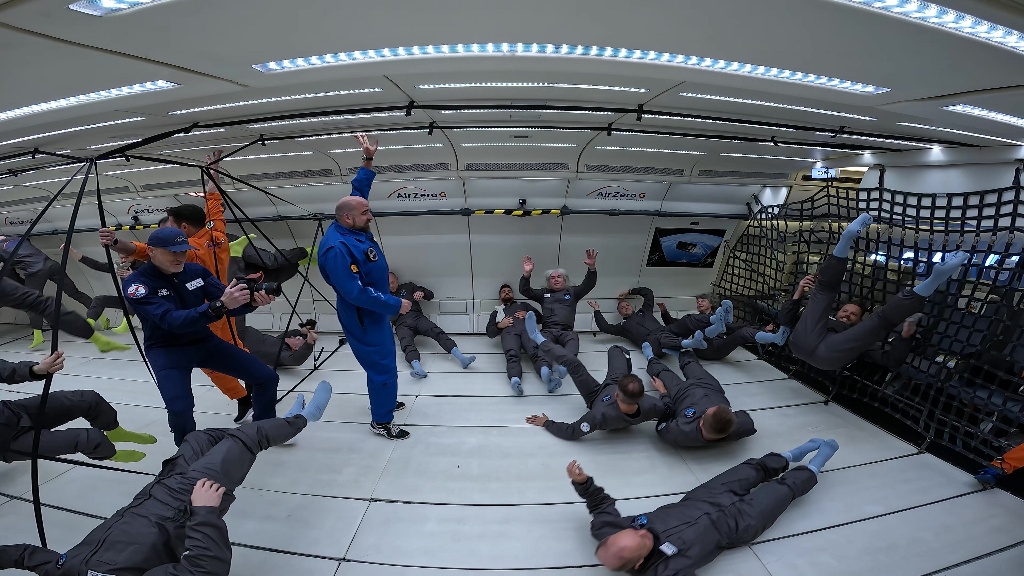
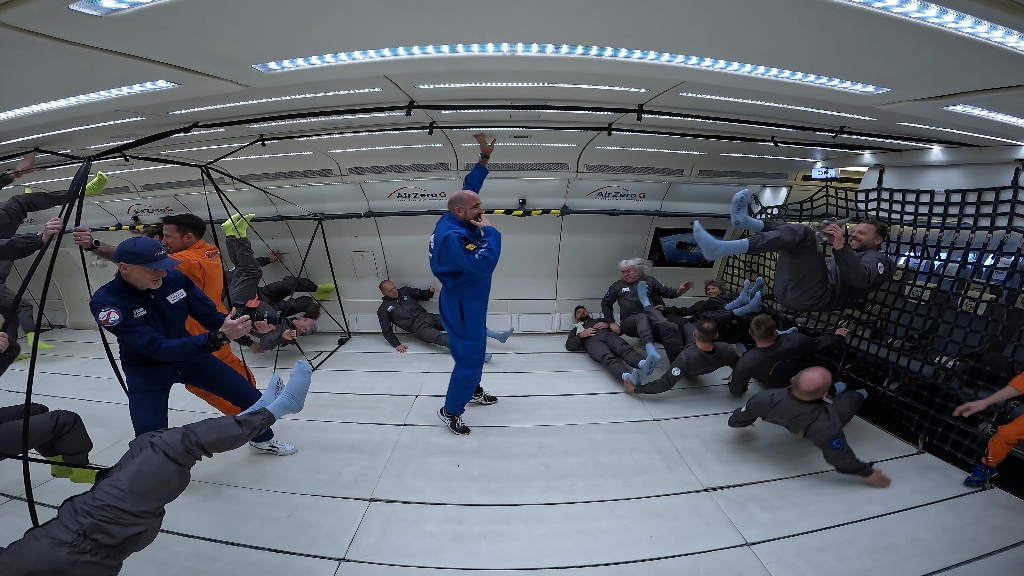
About as calming as a fish swarm getting caught.
As there wasn't much time, there was the call to "spread out!" and everyone tried to get, slightly hectic, away from each other.
I'm reasonably sure that the guiding principle of Zen isn't "get away from everyone else as quickly as possible or people might get hurt". (Though it might explain lone wandering monks.)
In any case, I grabbed one of the railings along the wall and pulled me as fast as I could along those.
Which simply worked.
I hadn't been thinking about it much (I tried to avoid being crushed or, as I was probably the heaviest in the group, crushing someone), but it wasn't much different from pulling yourself alongside a jetty in a canoe.
Had I thought about it, I would probably have worried about overshooting and rushing headlong into something on the other side, but it was easy to stop.
So, I got less worried about movements in zero gravity after that.
It also helped that, when I ended up in a slightly awkward position near the end of one of the parabolas, Neil and one of the bouncers were quickly intervening and getting me to the ground safely.
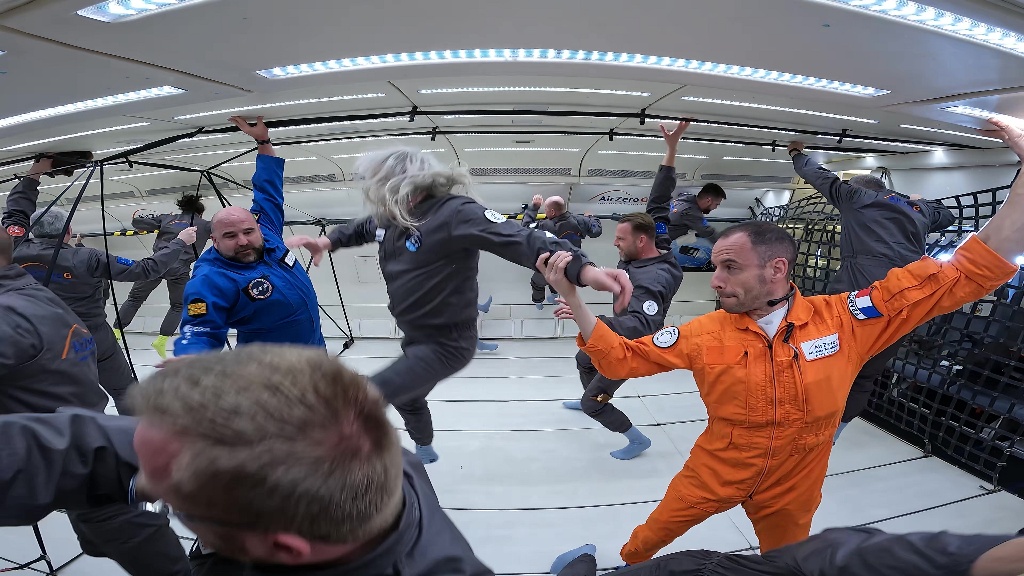
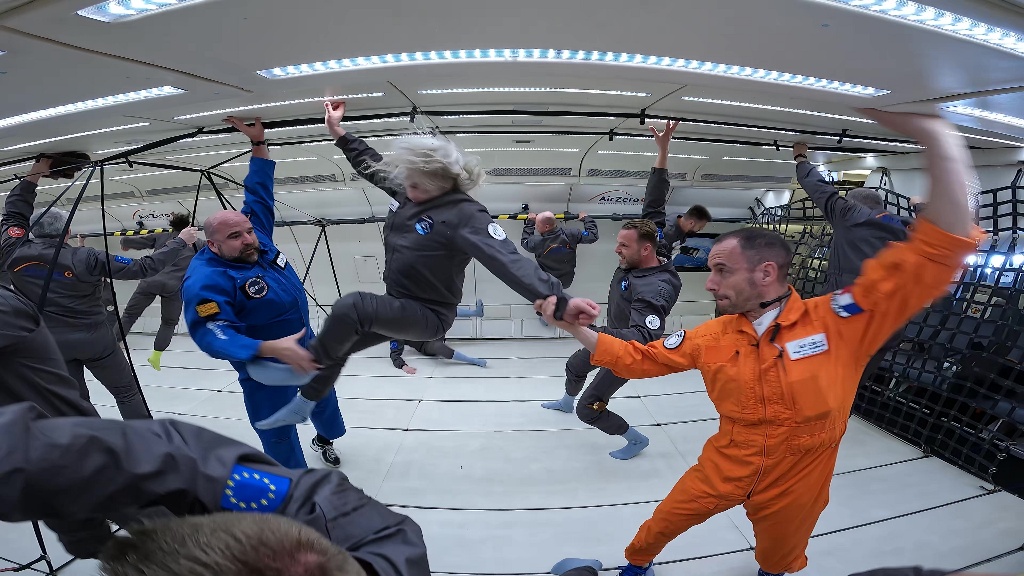
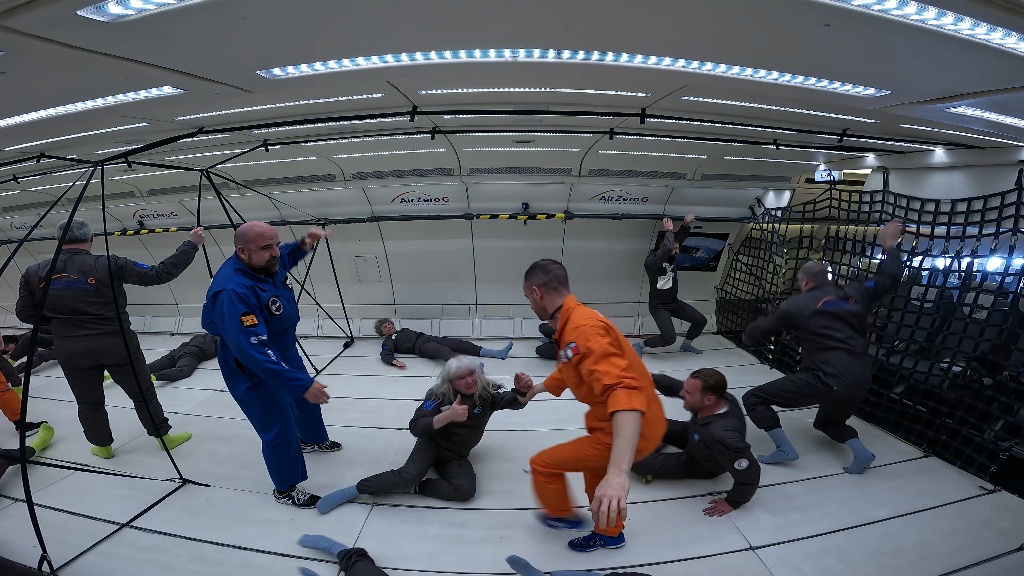
After that, we had another short phase of normal gravity while the plane turned around for another run.
The next one was an "do whatever you want to do" parabola for floating around the cabin, before we had another "special parabola", featuring drops (or, given the size, more like blobs) of water.
It's a well known thing to those who know these things well (to steal a phrase) that water in zero gravity forms spheres due to surface tension. Which then float, as there is zero gravity.
Though it's not easy to demonstrate. (Well, it is easy - although not in the obvious way.)
You can't simply take a bottle of water and pour it out.
Not in zero gravity.
You can whirl the bottle around, so the water gets centrifuged out of the bottle. But then you give it some velocity. And it will splash against a wall, ceiling, floor or person somewhere, before it has time to form a sphere.
Water is also transparent. It doesn't photograph well.
The solution to that was to start out with the water in some sort of easy to handle blob shape. Also known as a balloon. (And they coloured the water with blue food colour, which made it (and, later on, the stains) easier to see.)
Jean-François held a water balloon in the air and let it float. And then pinched that with a needle.
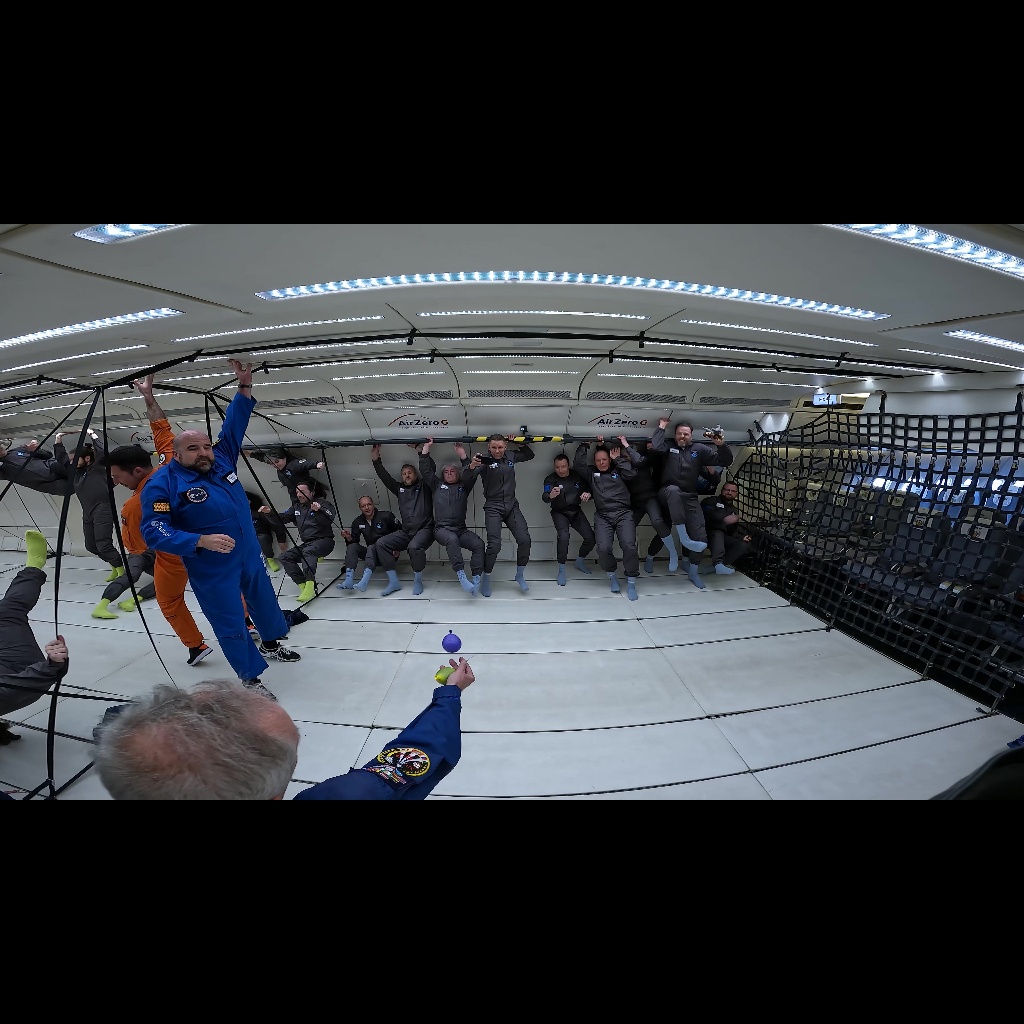
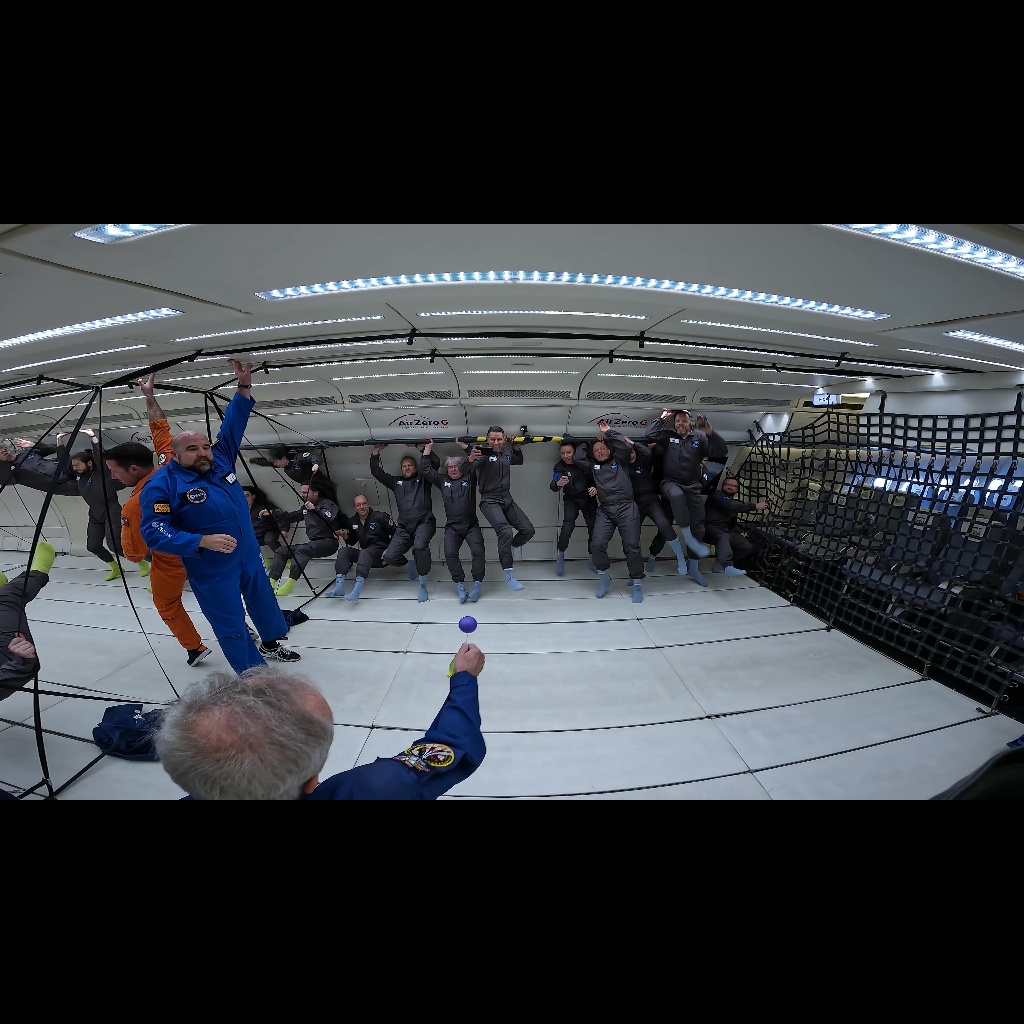
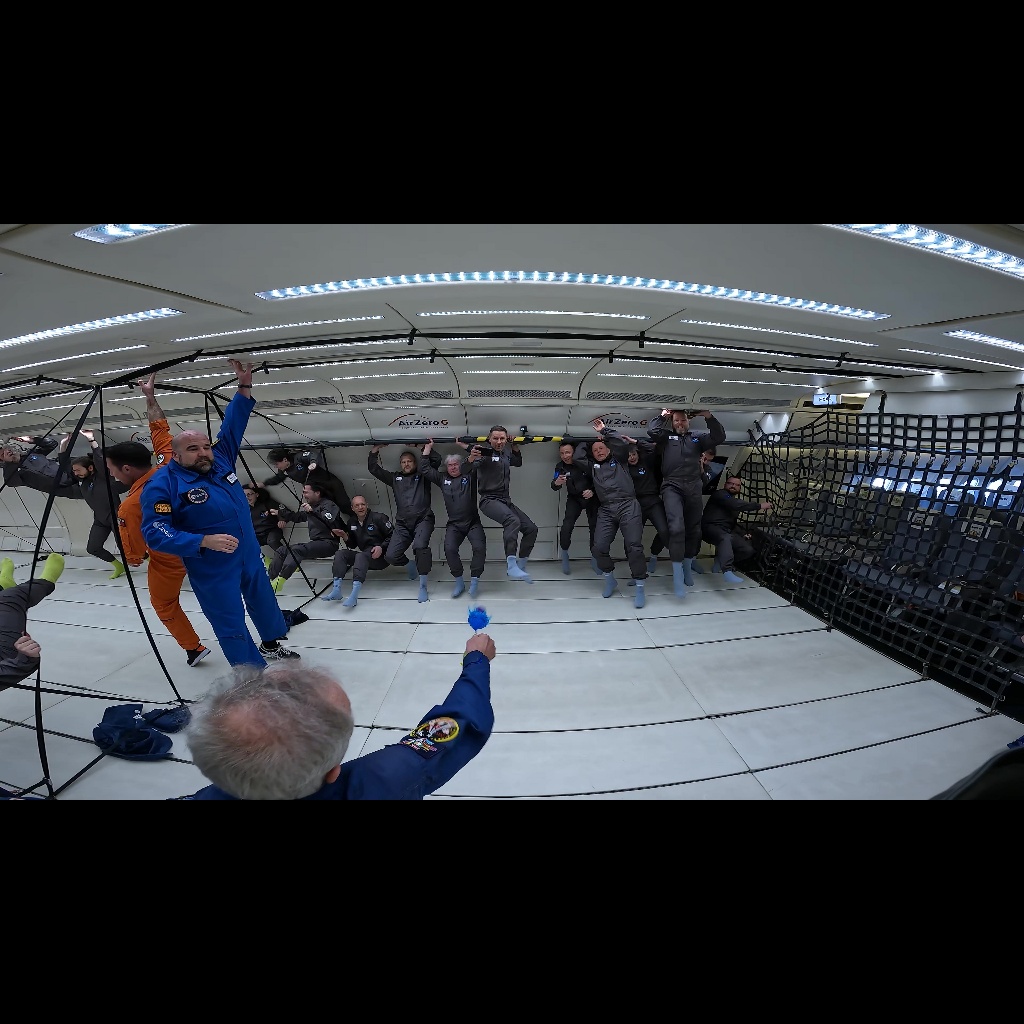
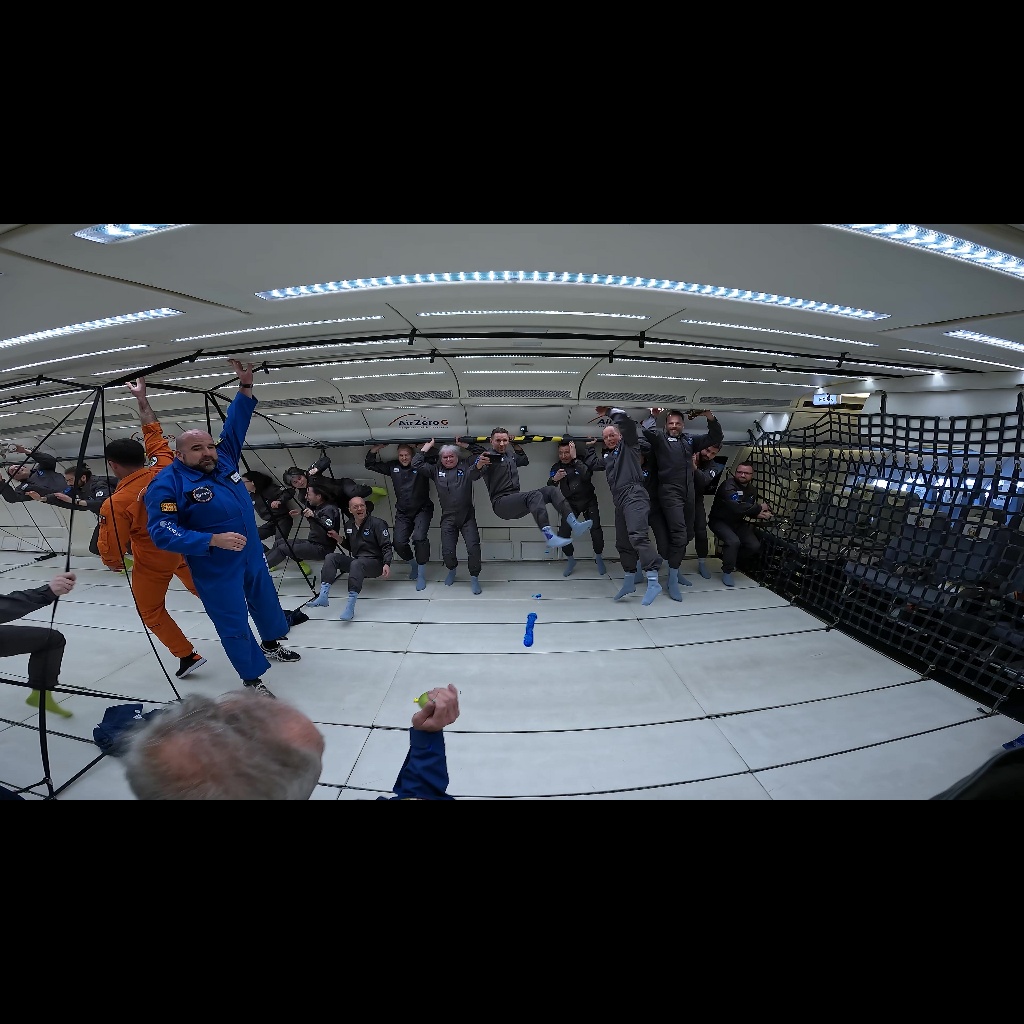
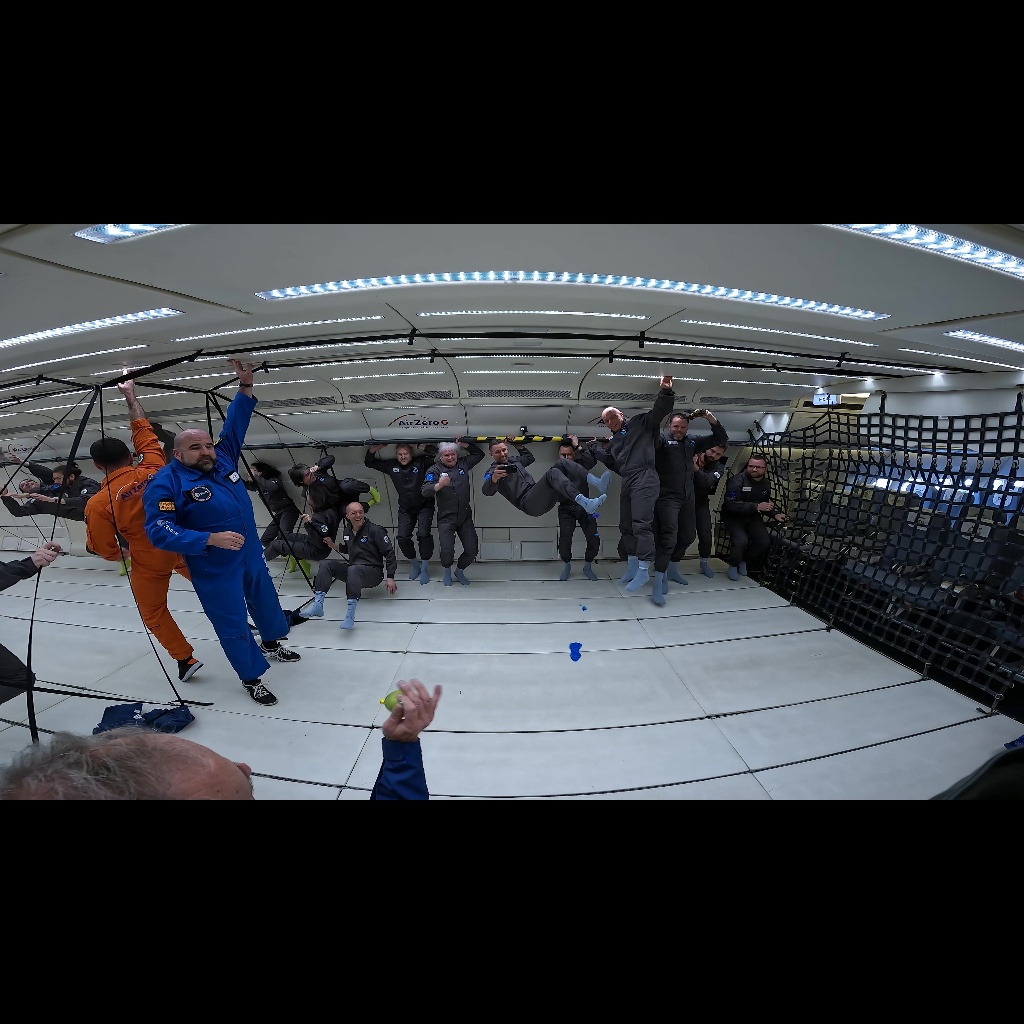
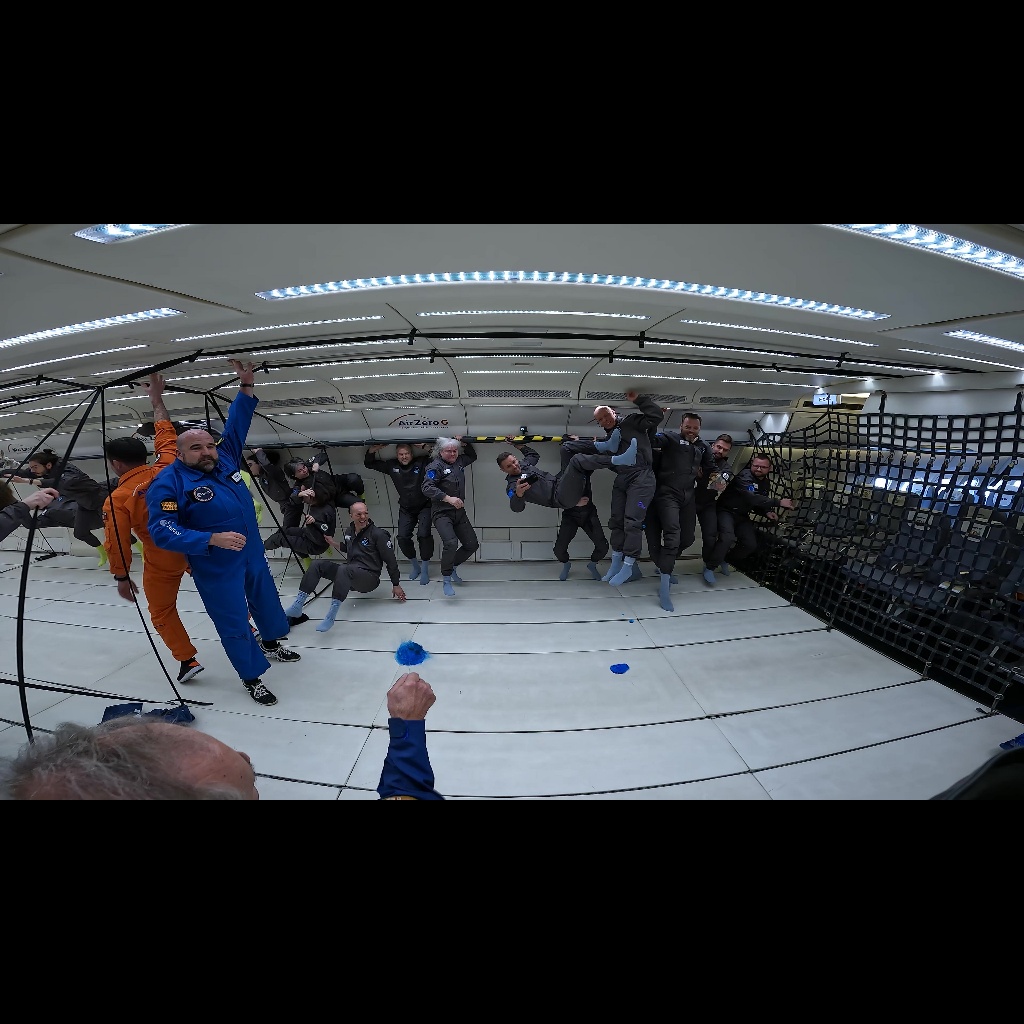
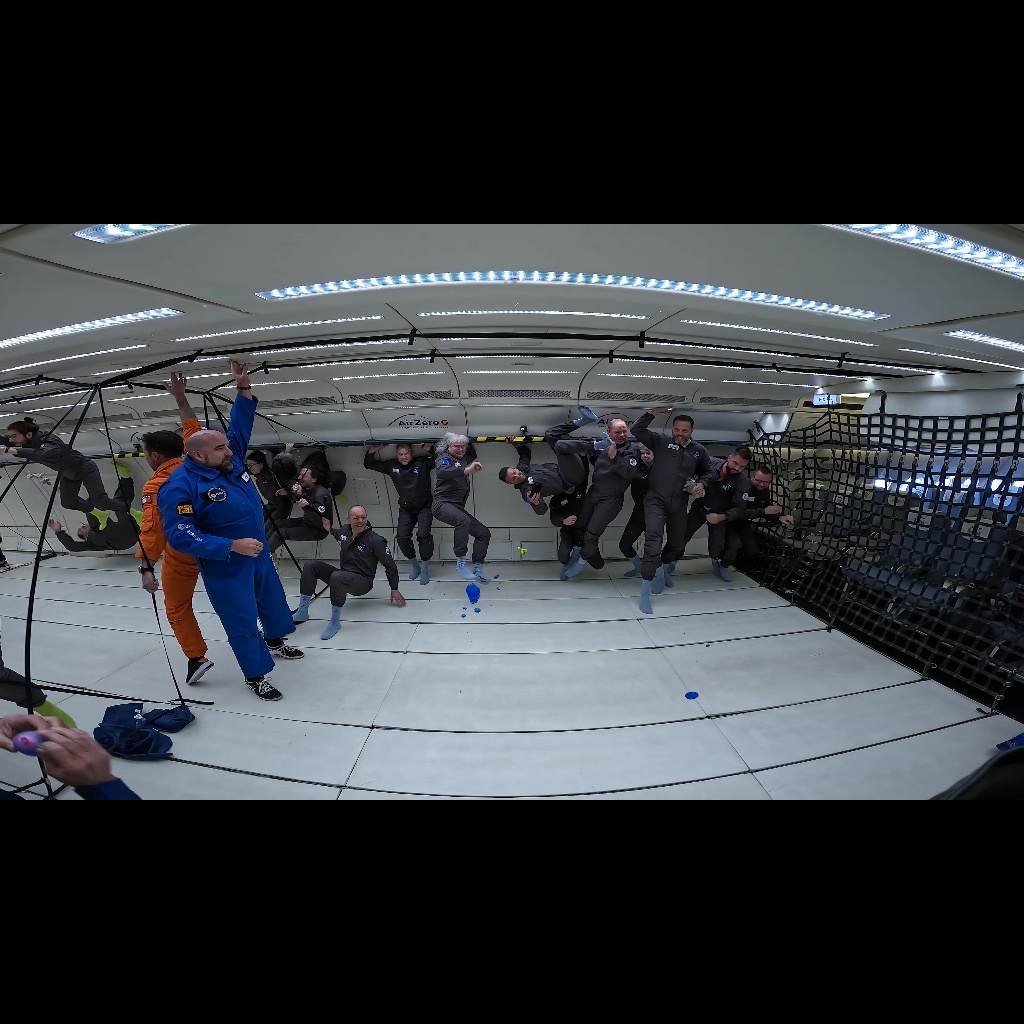
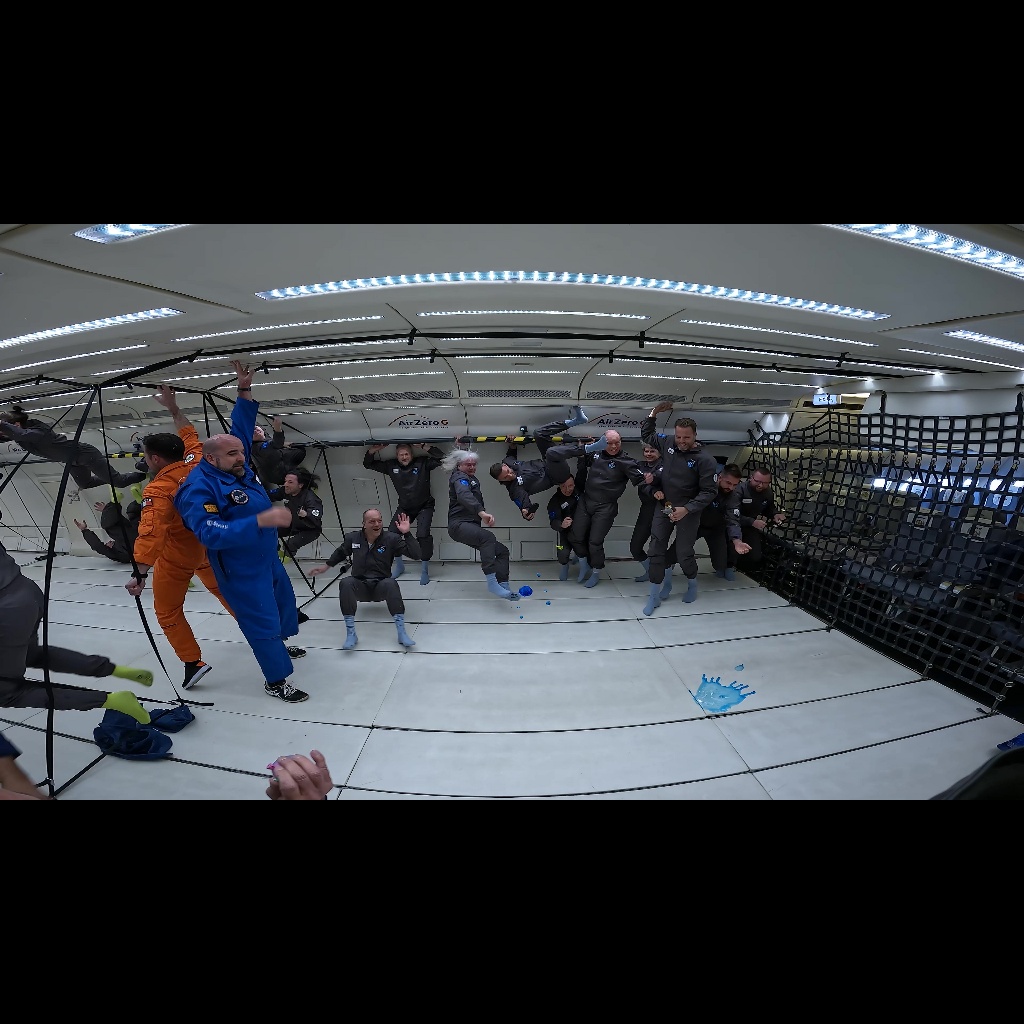
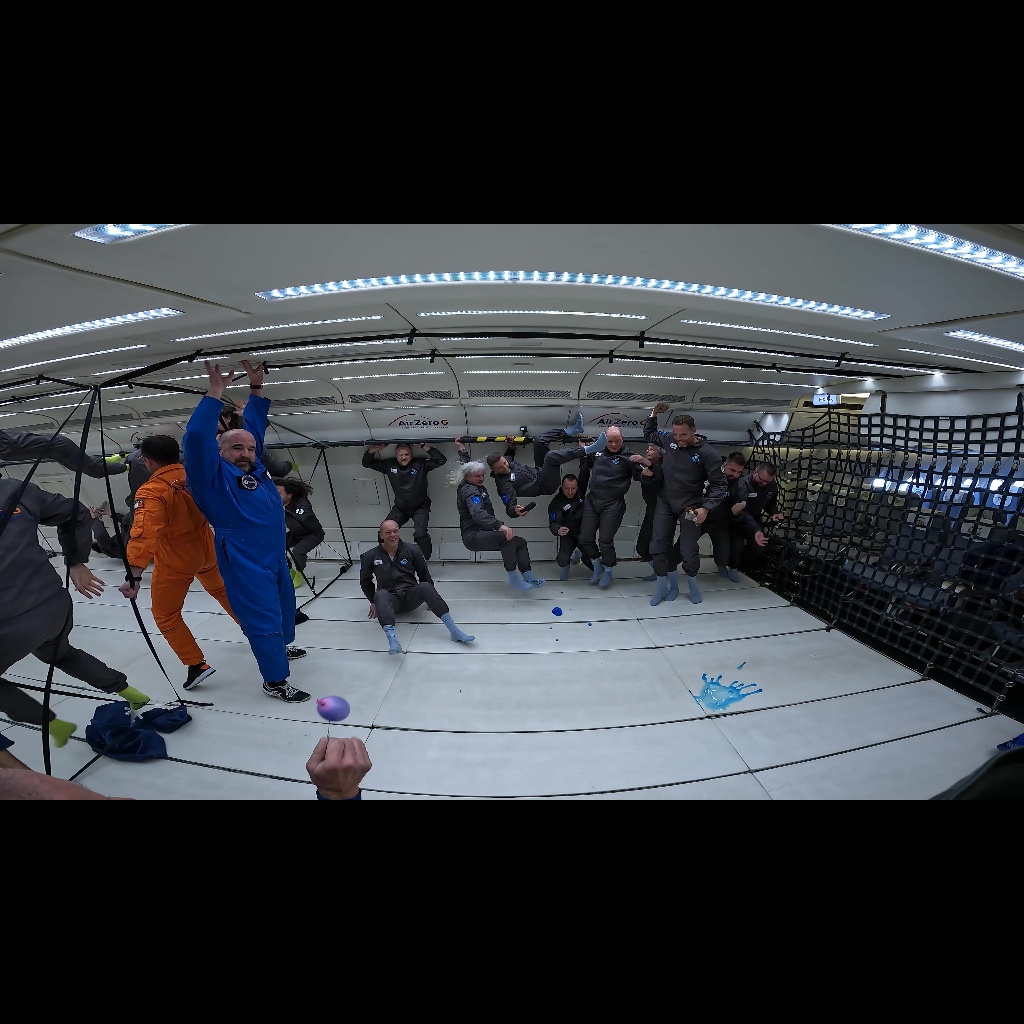
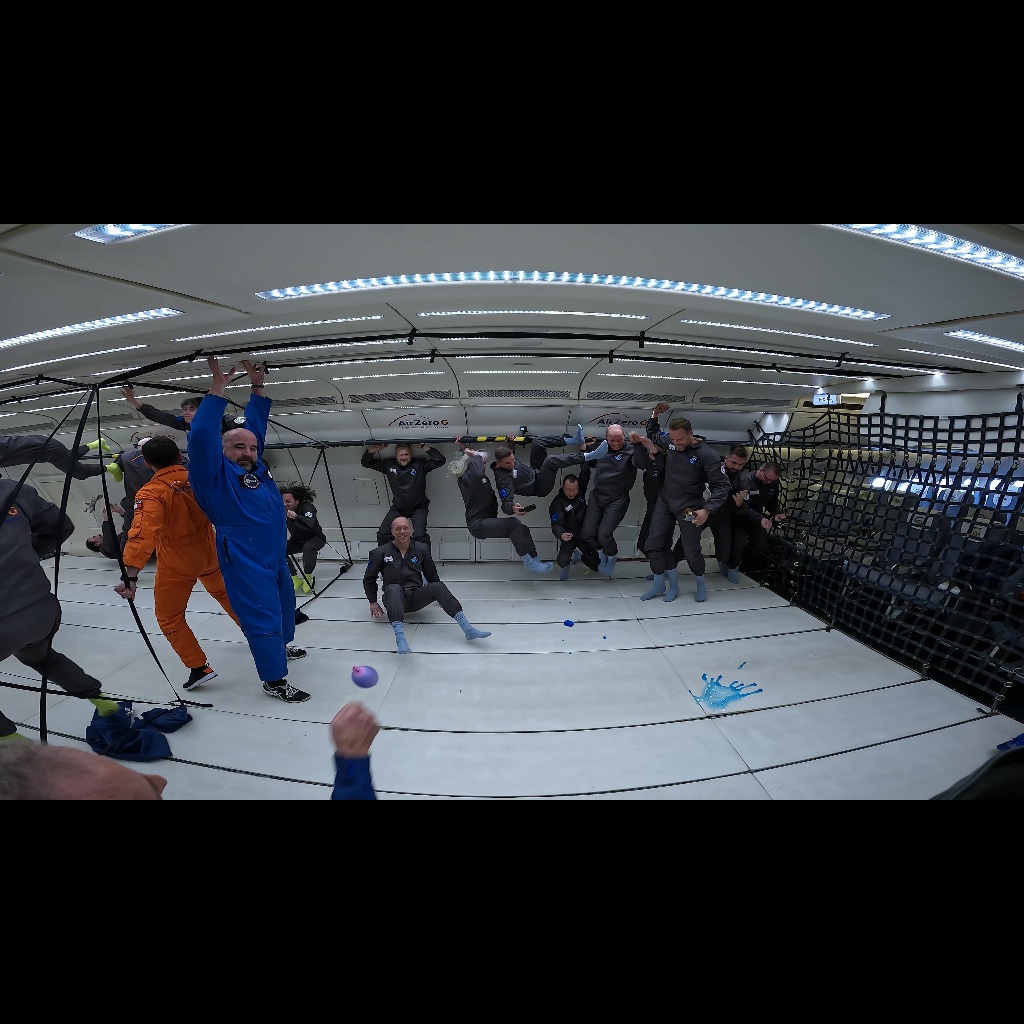
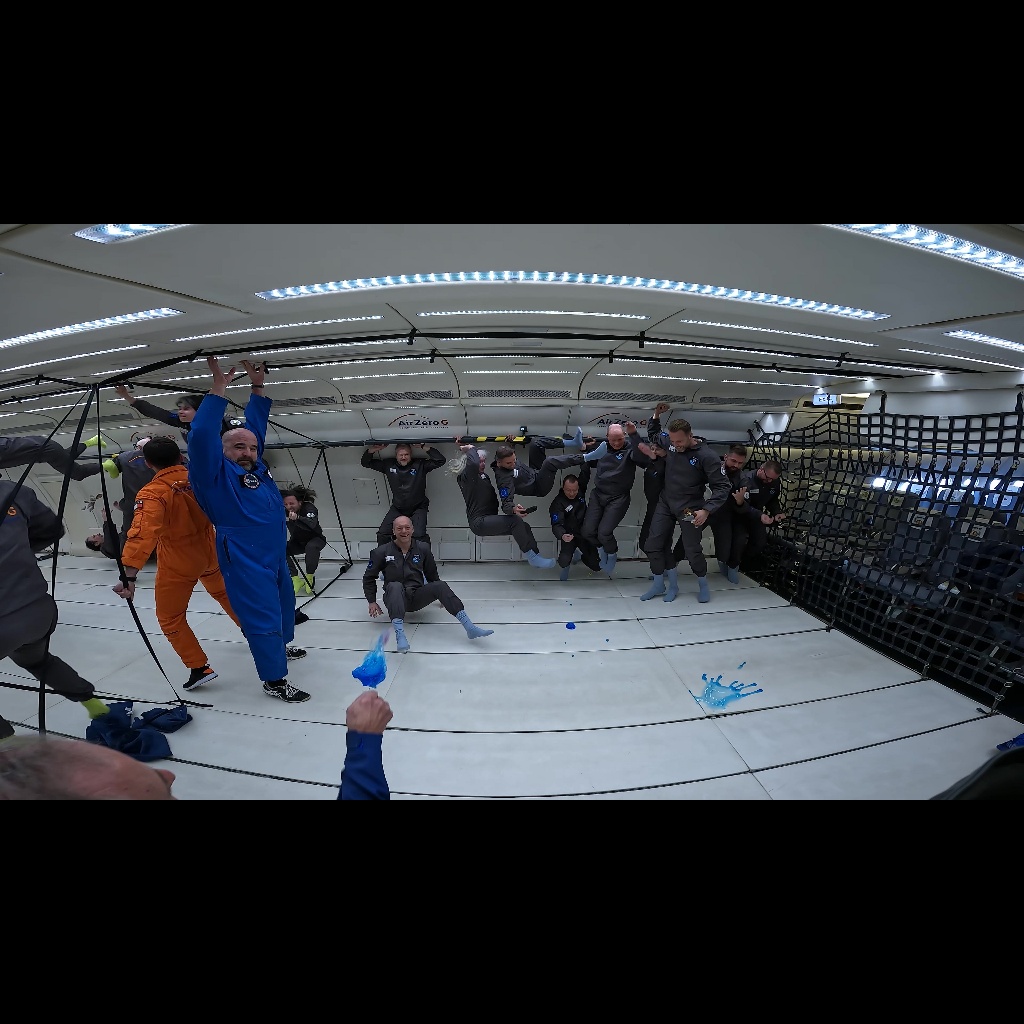
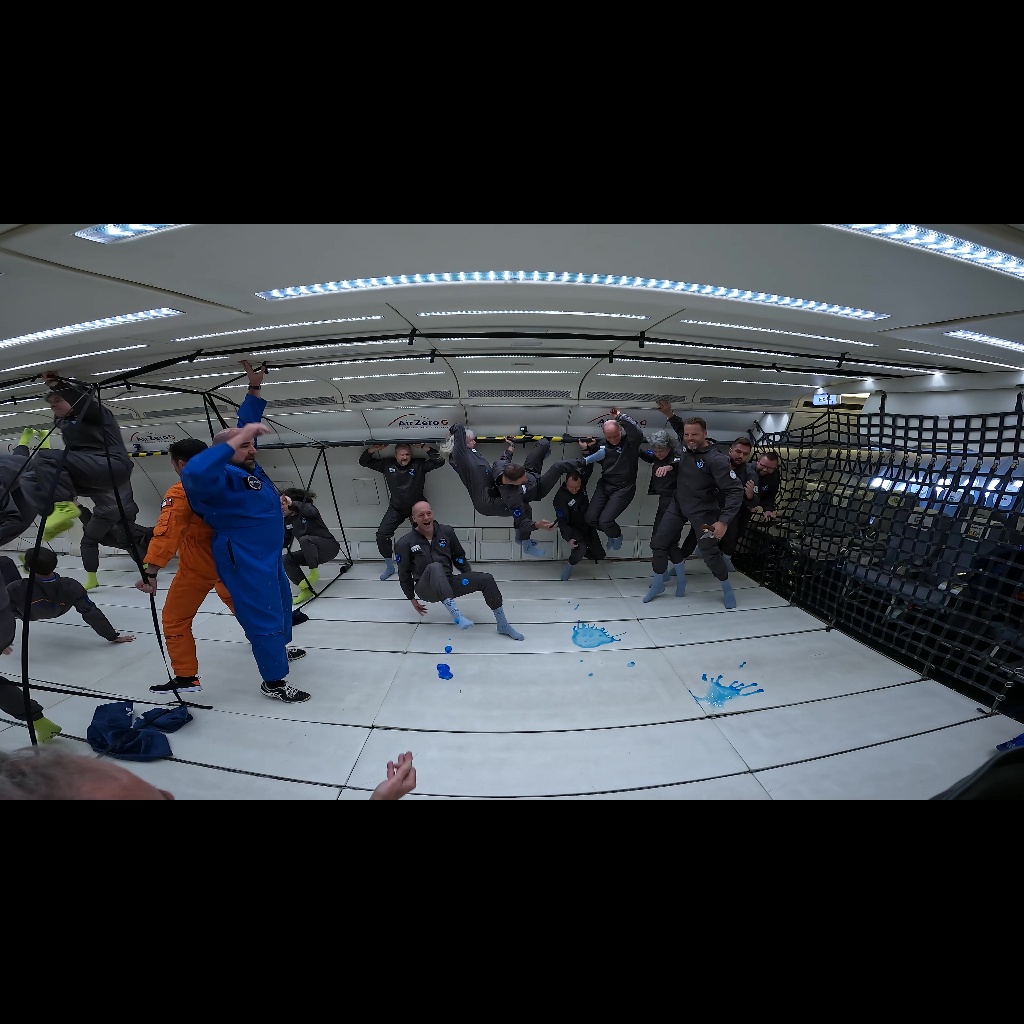
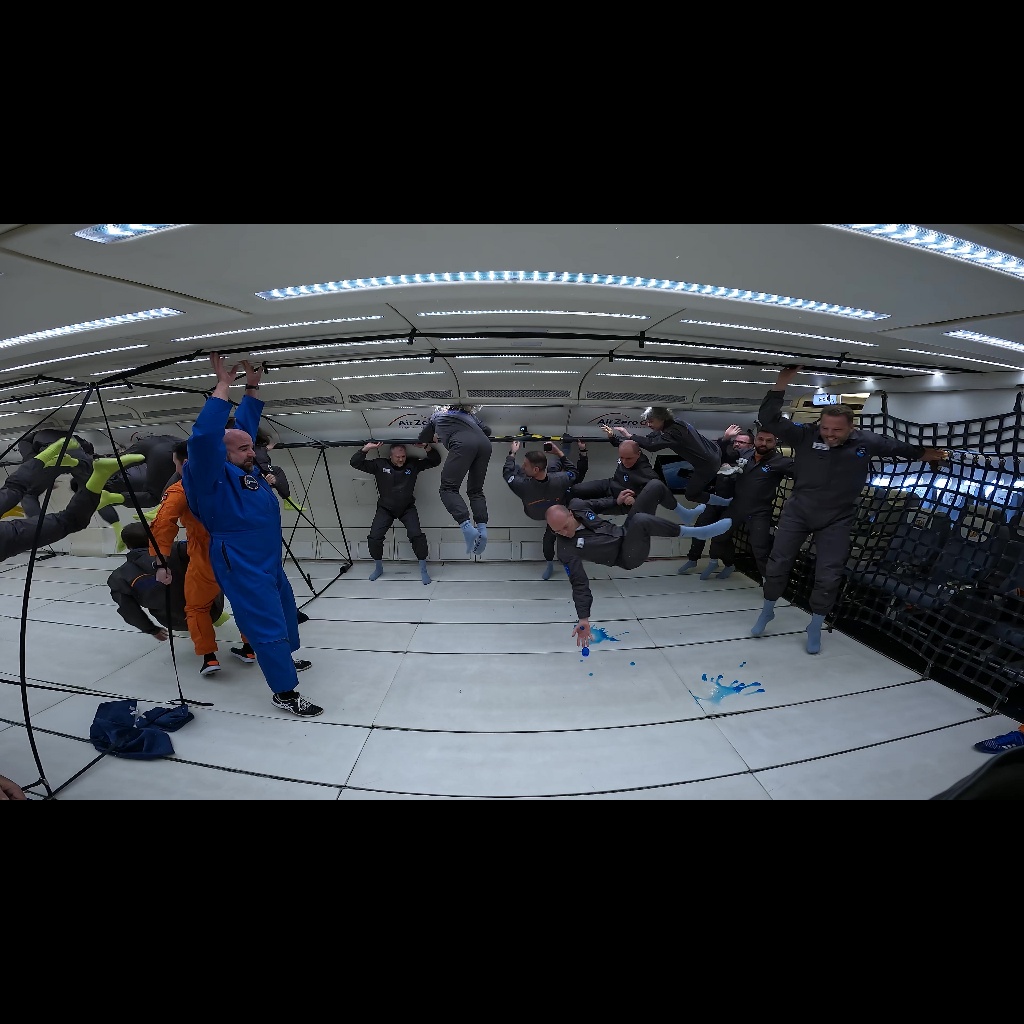
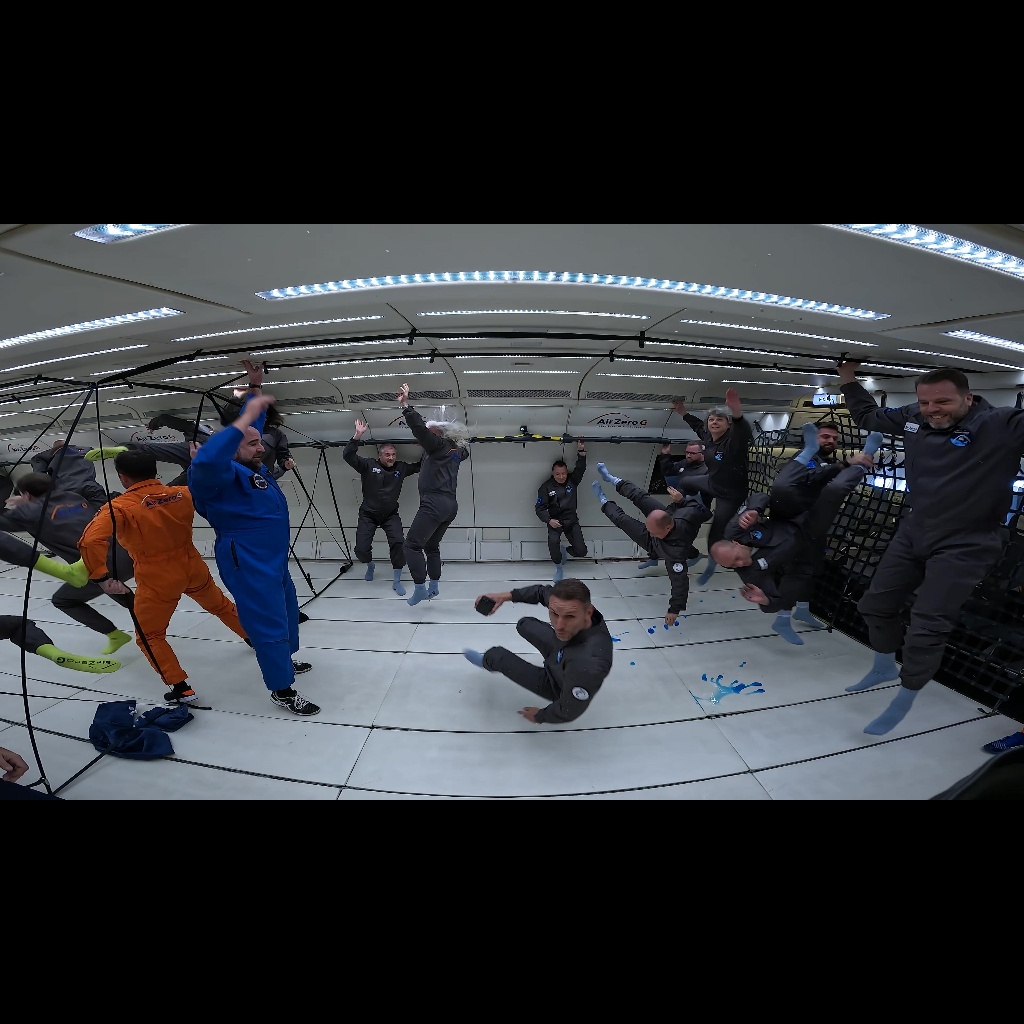
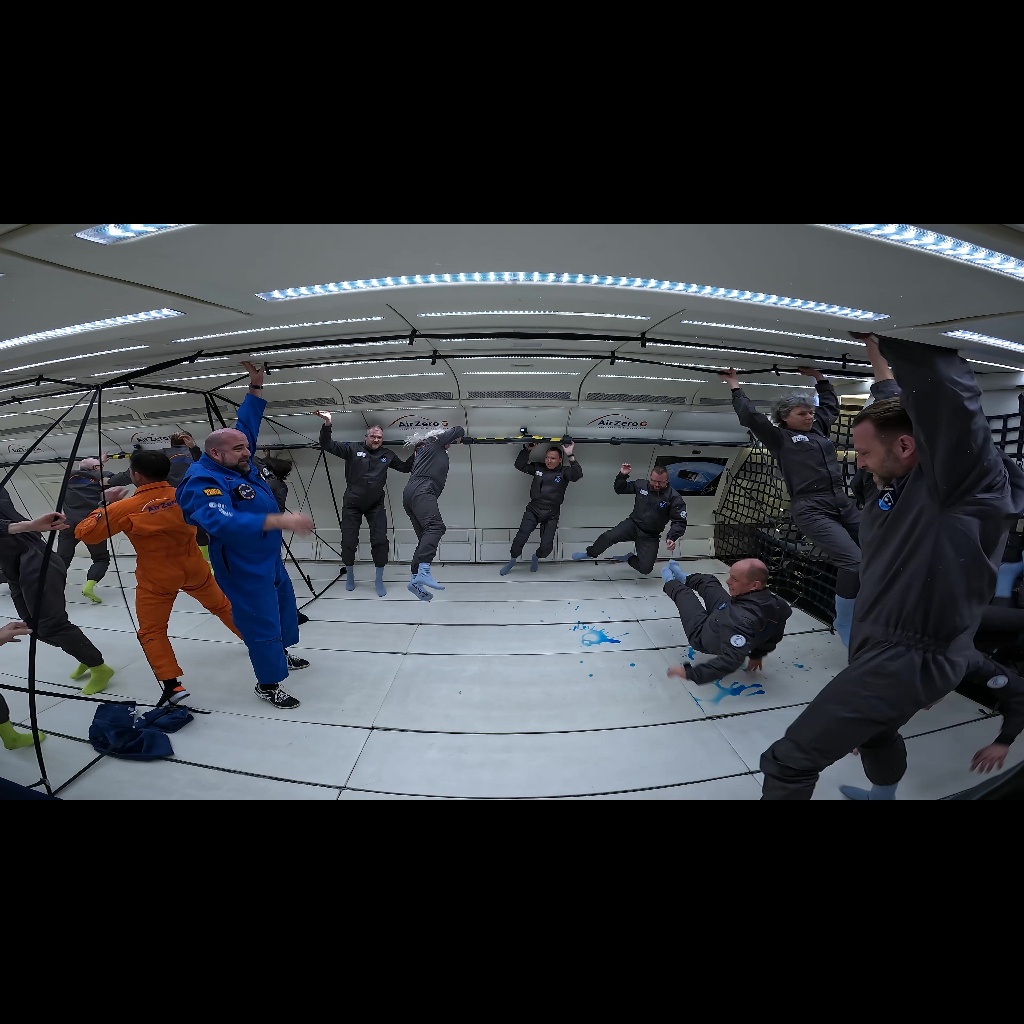
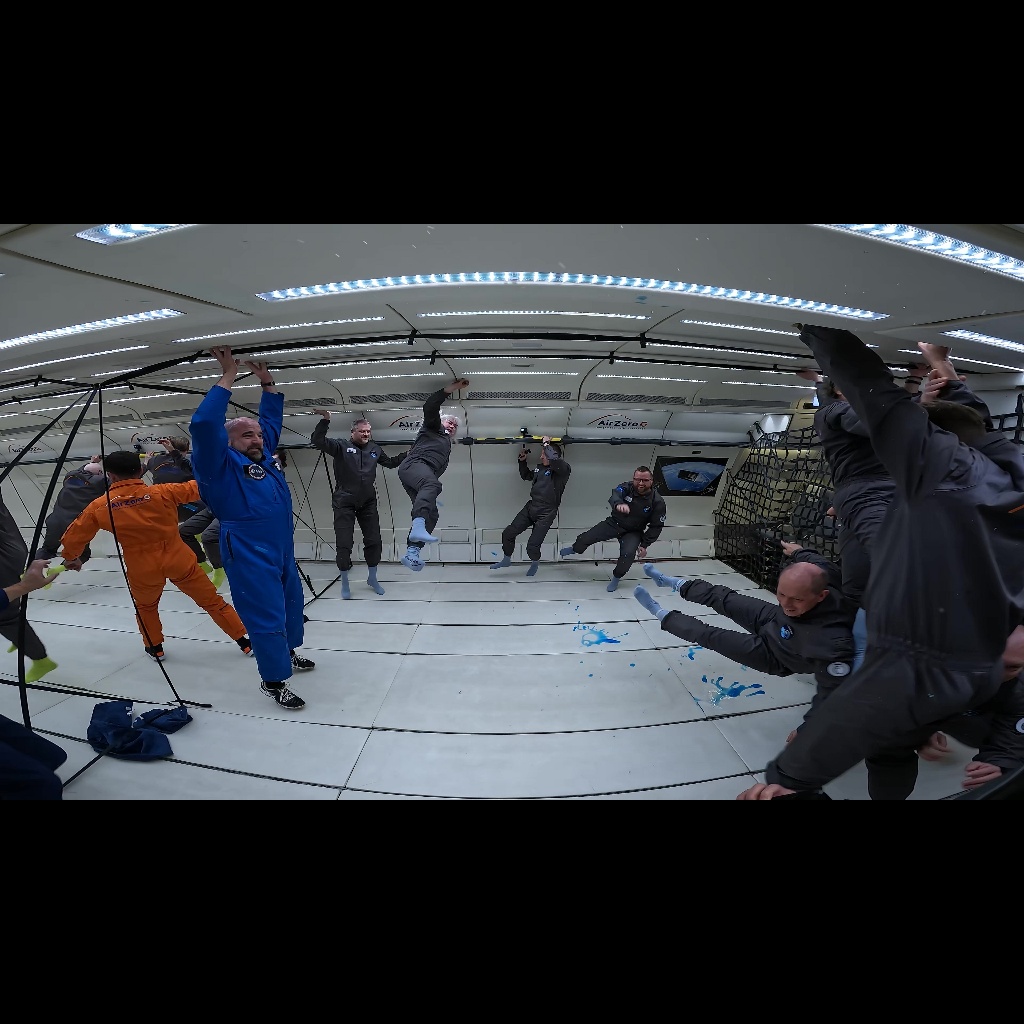
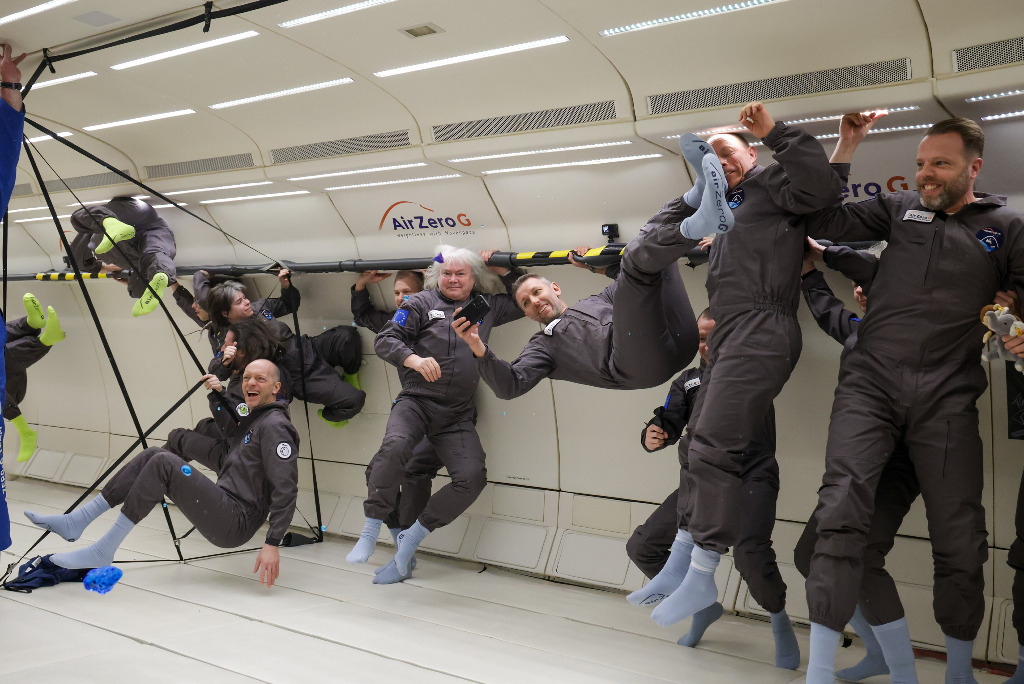
Mostly the resulting "water spheres" weren't that spherical, as the popping of the balloon caused ripples in the water. And the remaining few seconds weren't enough time for these to damp down before hypergravity set in and everything splashed down.
The wobbling, floating water blobs were fun to watch anyhow.
I tried to "catch" one bubble in my mouth. But I didn't get close enough before gravity got both of us down.
Though one of us got a bit overenthusiastic and pushed off too hard when chasing for a water bubble, banging into the ceiling and visibly deforming it. So Neil and a "bouncer" had to act fast to get him down to the ground safely and in time.
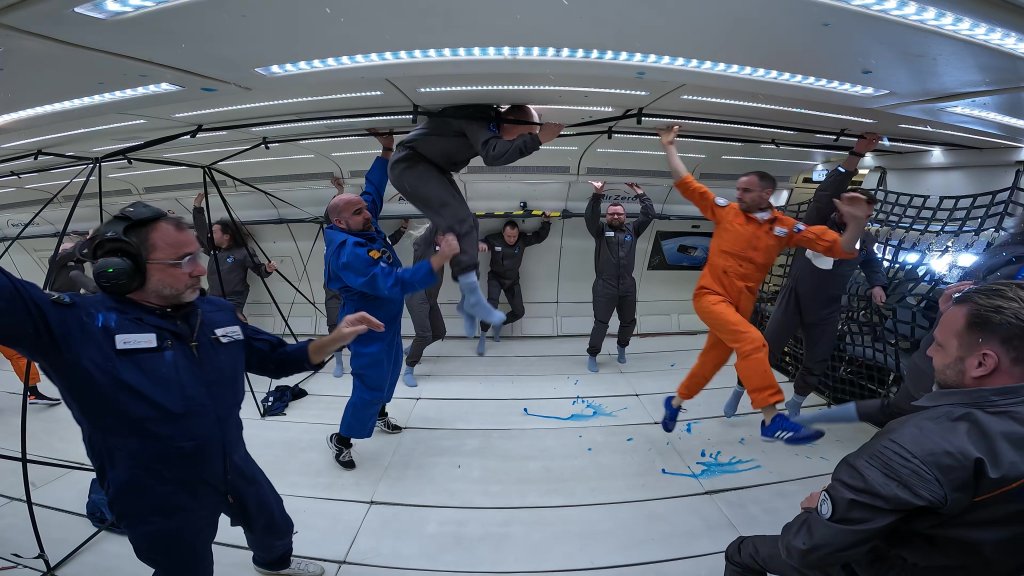
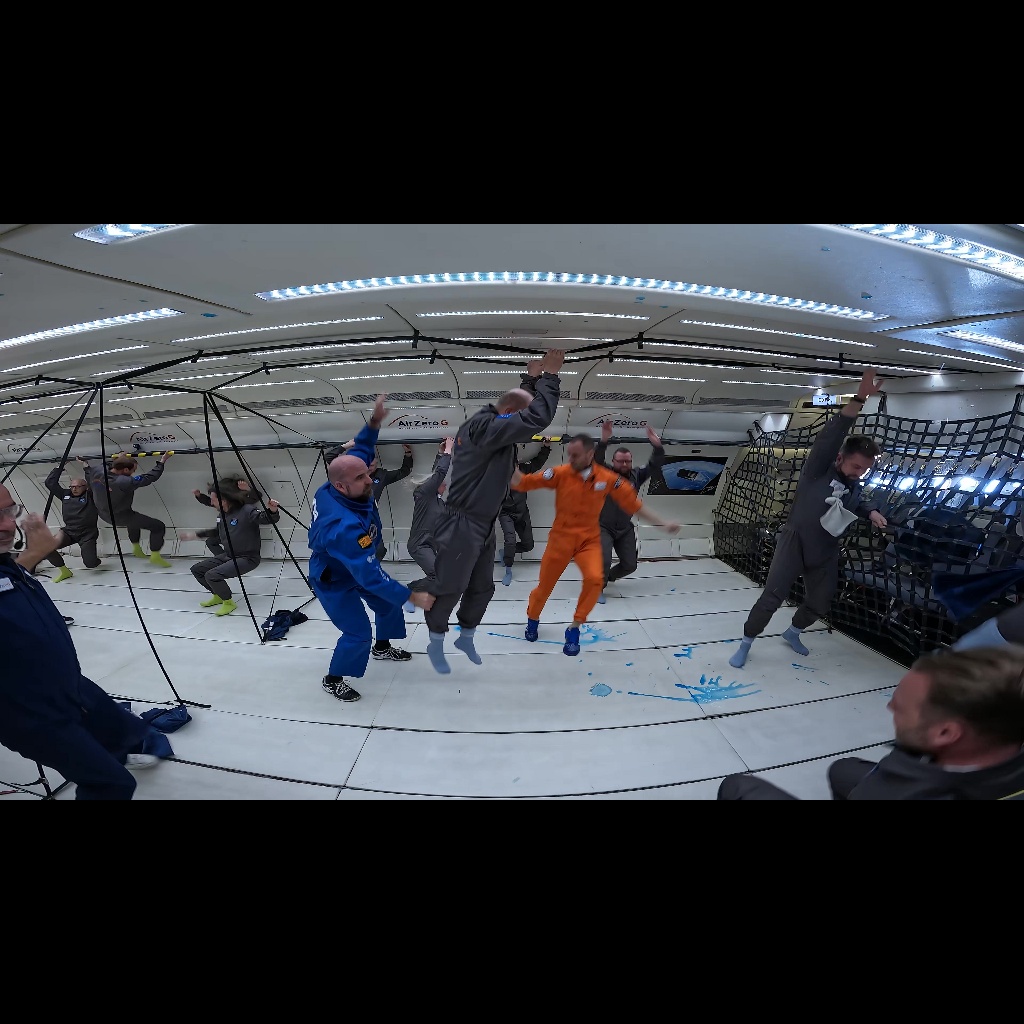
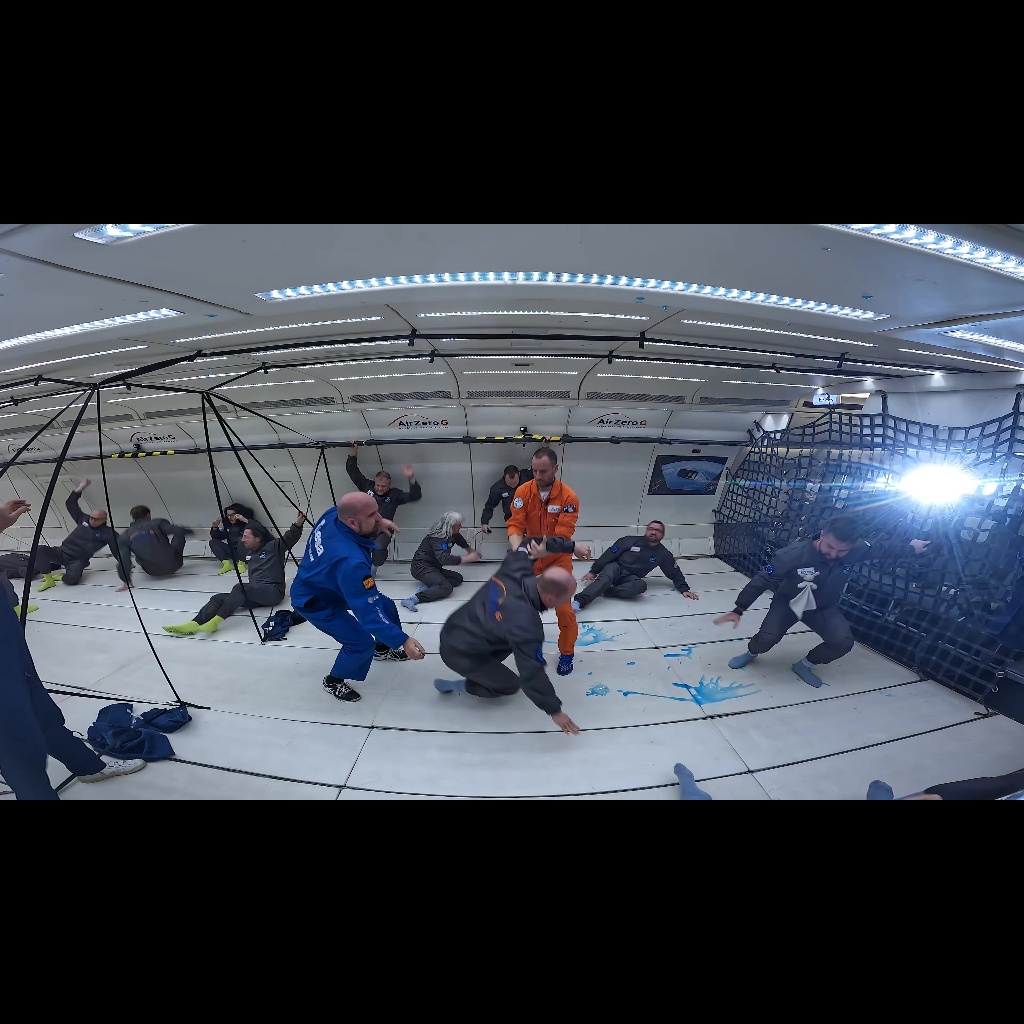
This was followed by a short phase of cleaning the floor at hypergravity. Kind of interesting trying to clean up a spill without moving your head... (Though, while I was still fairly careful, I started not to worry too much about hypergravity and getting sick.)
Another parabola in which we were free to do what we wanted followed, before the "superhero" parabola, where we all started out side by side, trying to strike a Superman pose. Fun to do, but it looked silly, as (parallel dimension stories notwithstanding) a bunch of supermen is a ridiculous idea.
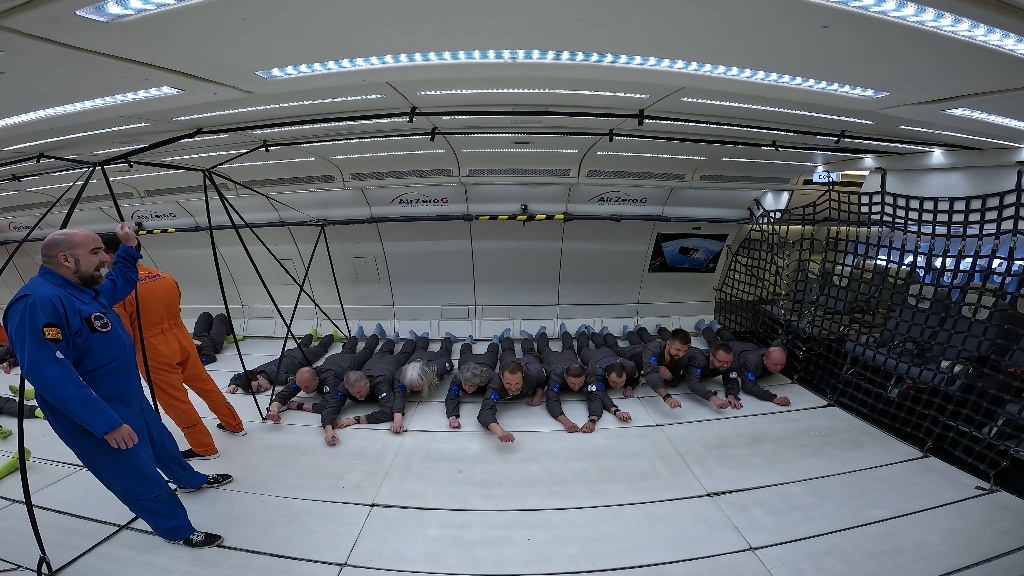
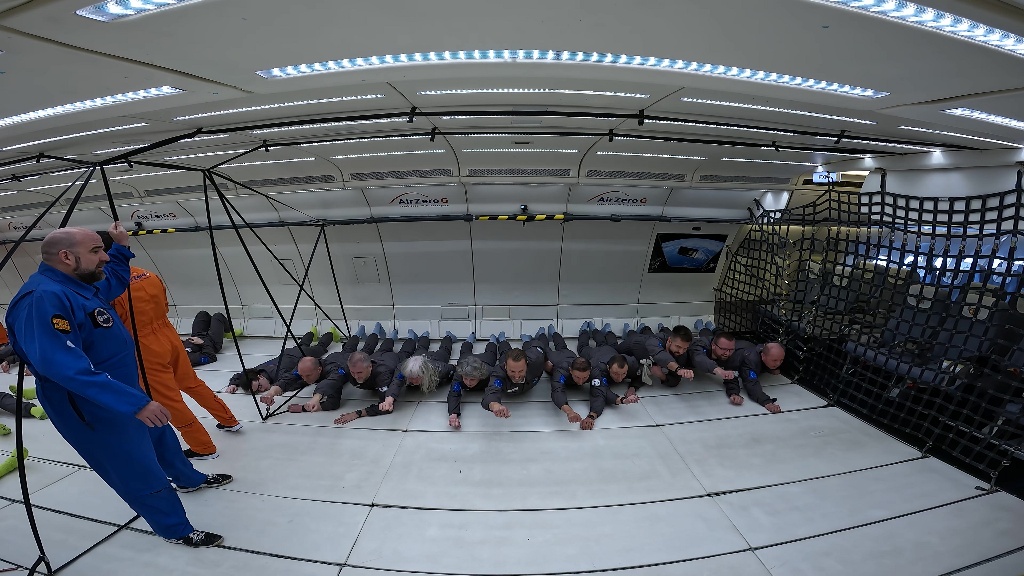
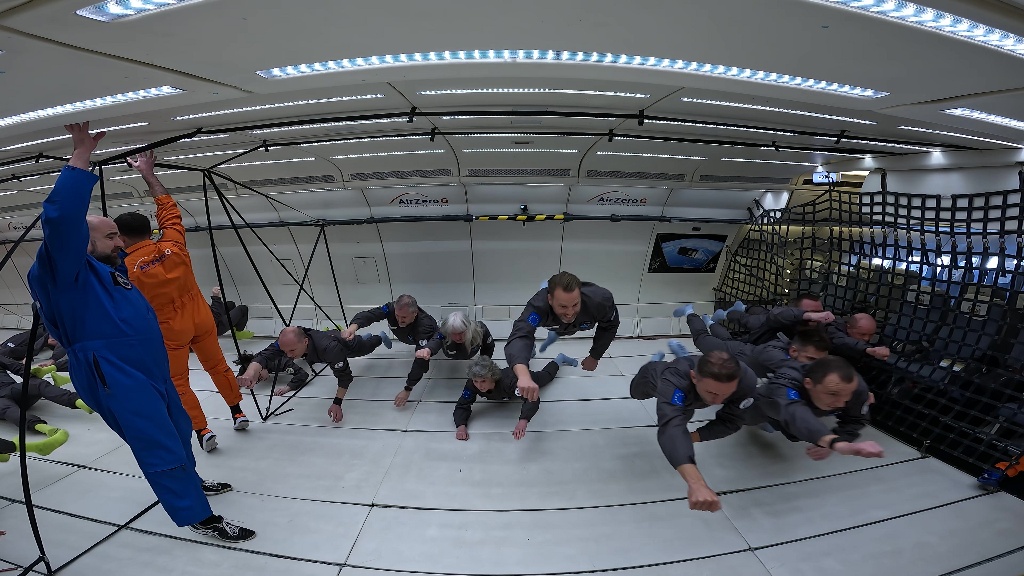
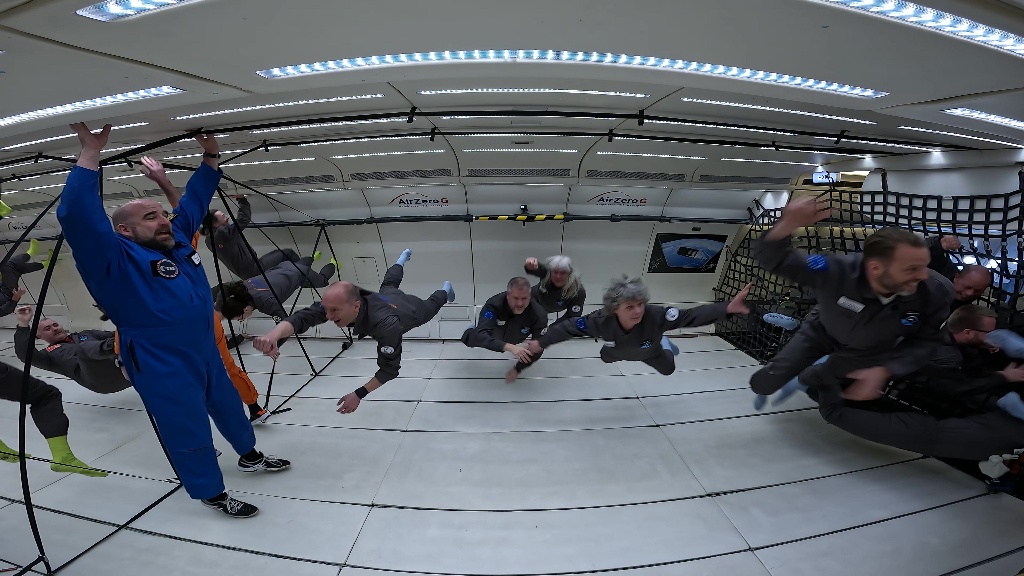
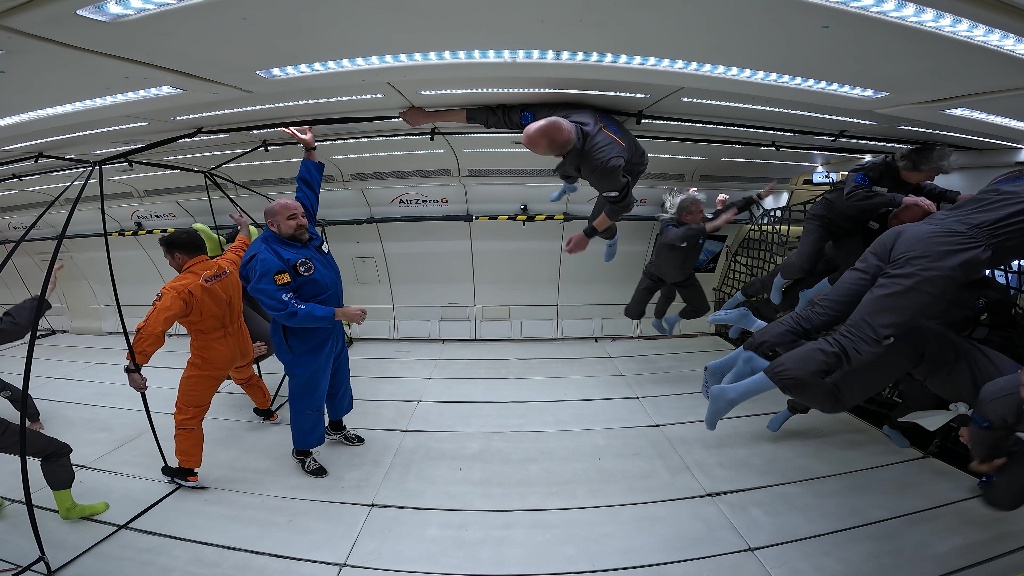
As earlier on, with the zen parabola, we had a bit of drift again, so in the end a fair number of superheroes ended up in the cargo net. Presumably the final score was in favour of Lex Luthor.
Time for the plane to turn around and already head for the last stretch of parabolas.
By now I had gotten a bit more confident and tried sitting during hypergravity.
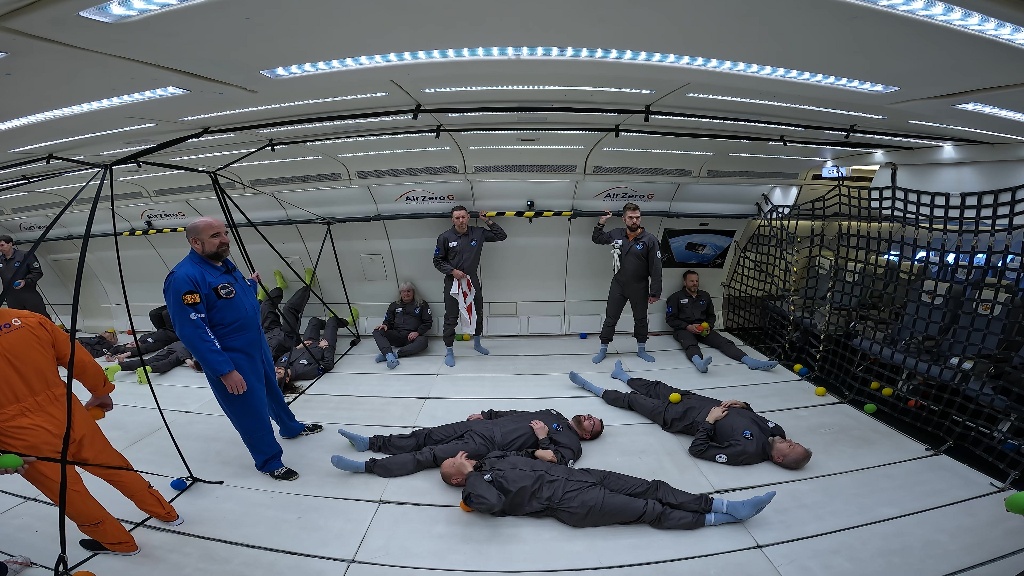
Which was fine and got me more "fun time" during the next zero gravity part, as it is faster to get up from a sitting position than from a lying one. Saving valuable seconds that could be used for floating around.
For three parabolas I was even standing during 1.8 G.
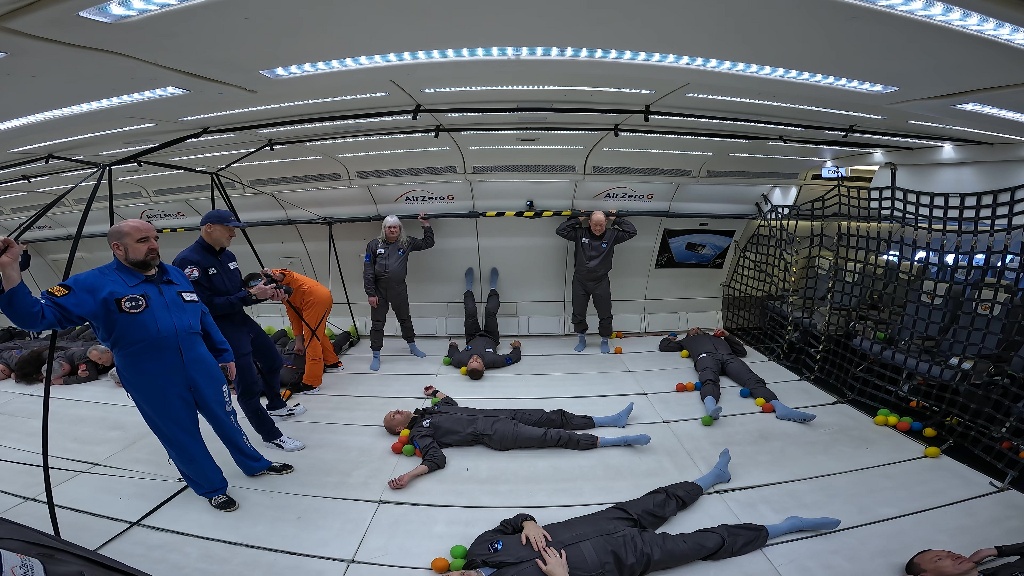
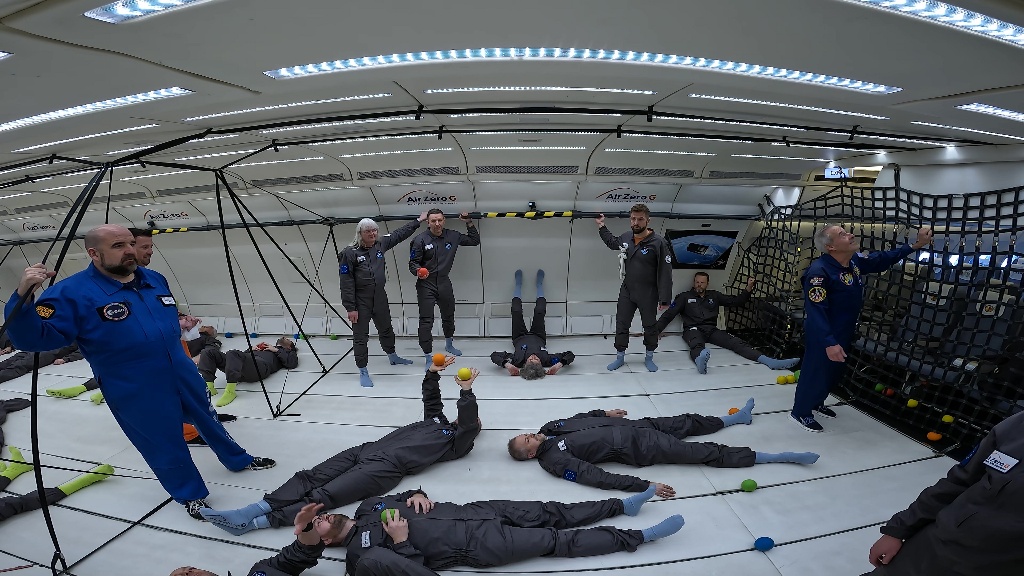
I am not sure why that was so easy.
I wouldn't want to stand for 20 seconds with myself sitting on my back.
My assumption was that I would get weak in the knees and bend over, be out of breath and would need a moment to recover after the weight is taken off me.
But standing there in 1.8 G felt normal.
I didn't get out of breath or dizzy in any way. No issues with pumping blood (weighing 1.8x the normal weight) in my head or my knees hurting.
Waving my arms felt odd (and I didn't try to walk, jump or move my head). But standing there felt no different than usual. It felt less strange than lying on my back, with my cheeks creeping down at the sides.
Besides having a better plan what to do during the "free" parabolas, this is the main thing I would handle differently if I could do it again.
Stand in hypergravity.
It also makes it much easier to spring into action and do whatever you have planned to do than lying on the floor.
At that point they had introduced another element to the flight - foam balls.
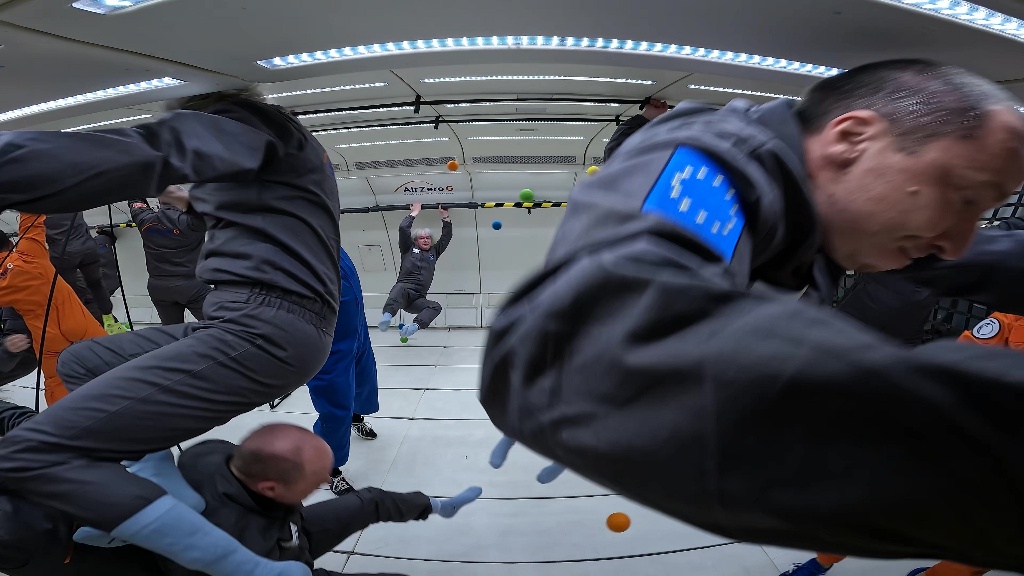
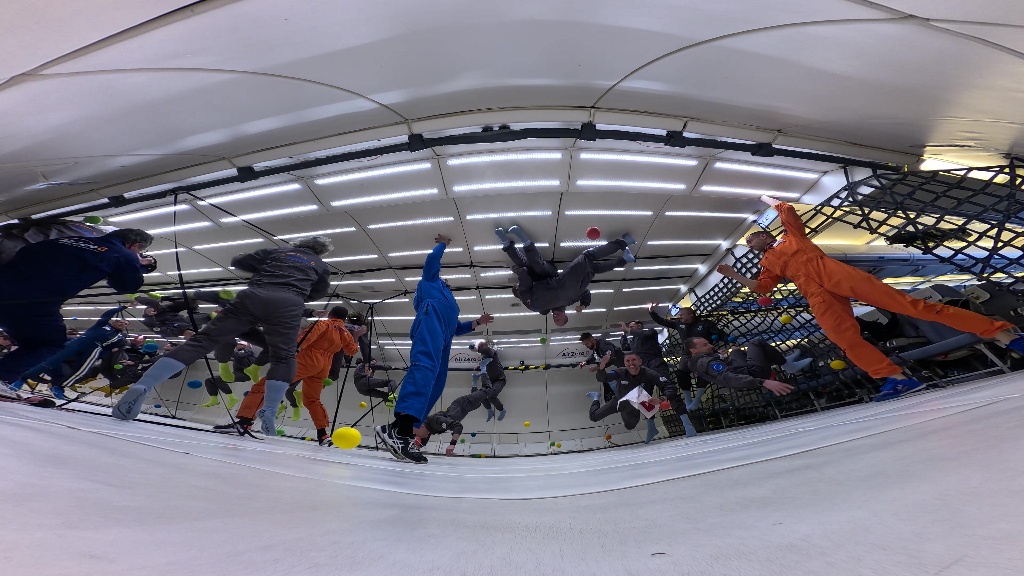
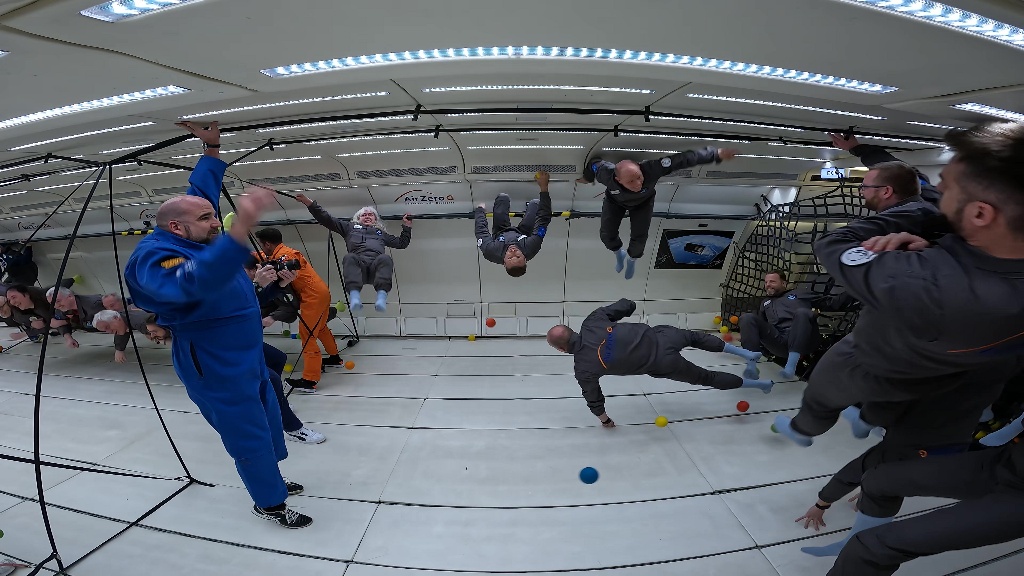
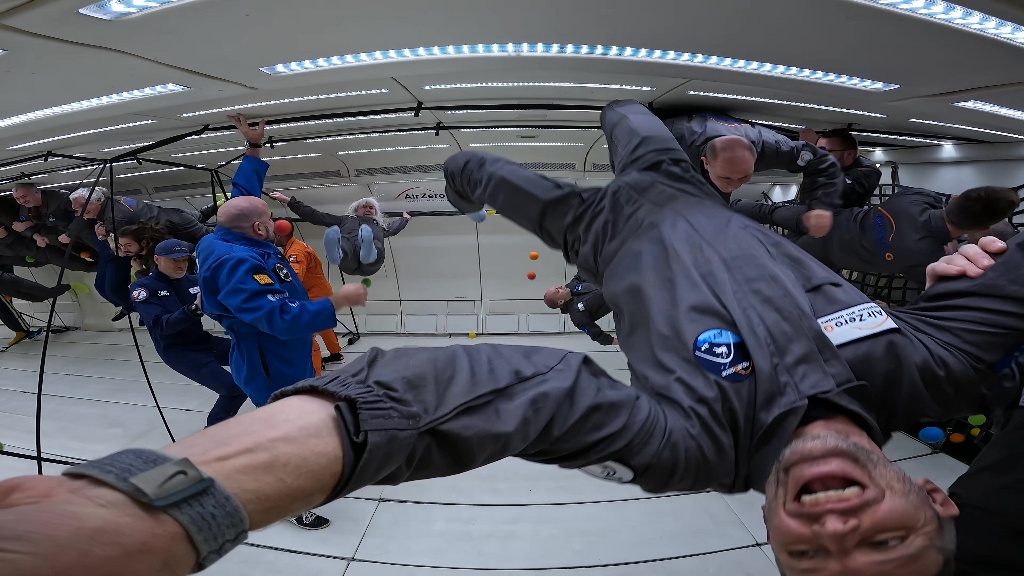
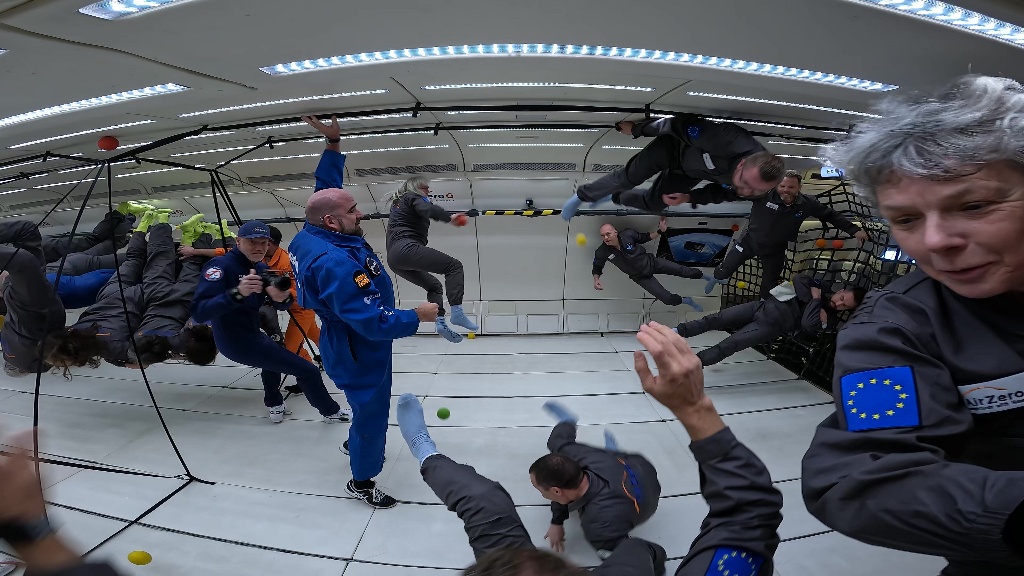
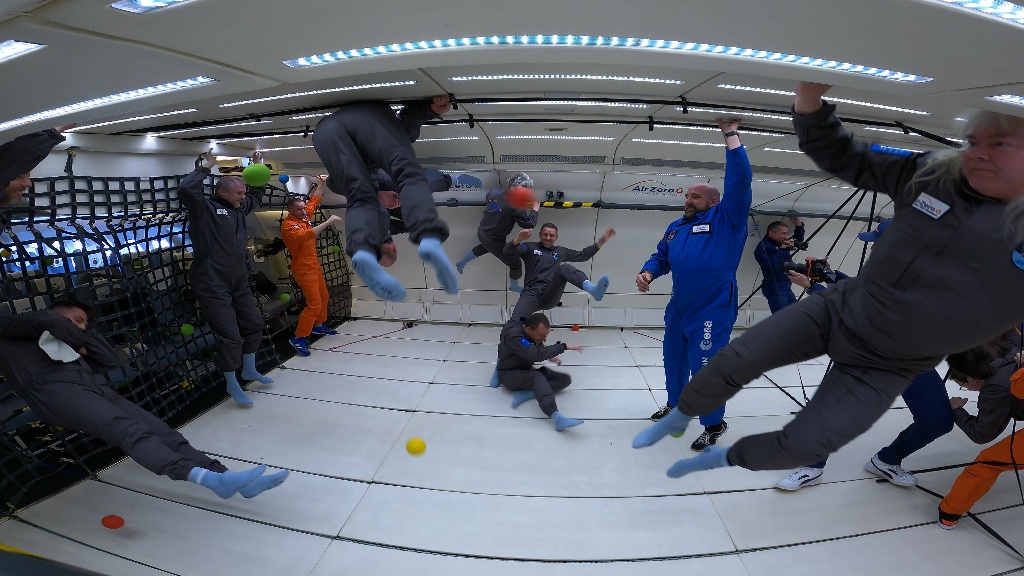
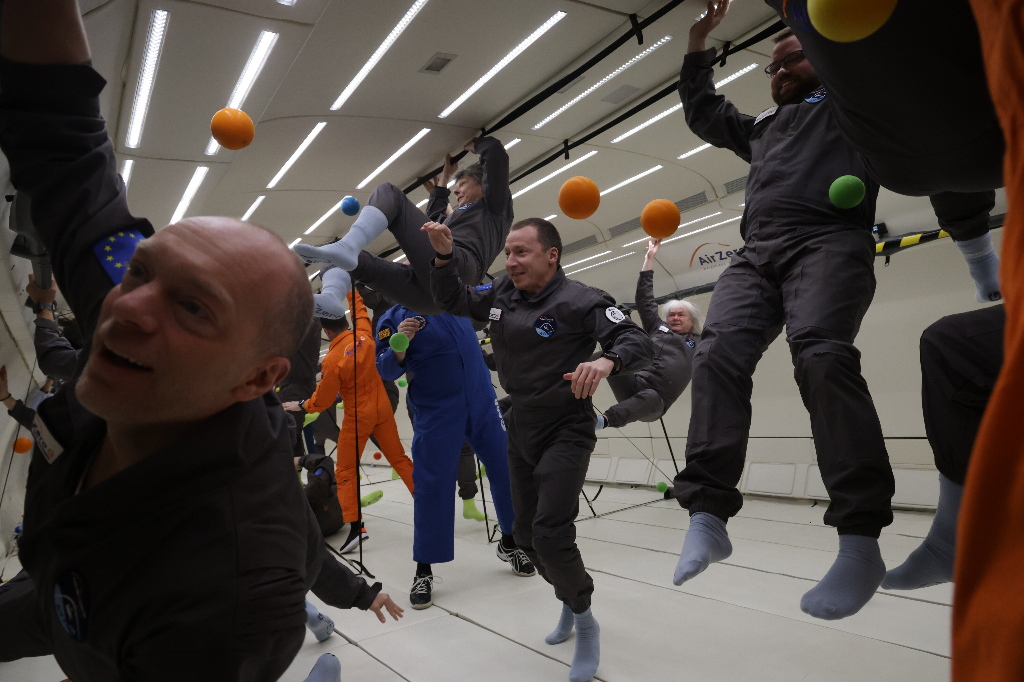
We started to try to catch balls in flight (much easier than catching water blobs with your mouth) and throw balls at each other (which took a few attempts as you tend to aim too high, automatically assuming that the balls would curve down).
It was also interesting to throw the balls during the 1.8 G phase, where they flew more like tennis balls would, due to being heavier then.
Our (supposedly) final parabola was the "human wing" (officially named "group flight").
We would start out lying side by side, with Jean-François in the middle, linking arms and legs with the person(s) next to us.
Neil on one side and the "bouncer" on the other would lift the persons on both ends up and down, trying to either create some "wave" going from one side to the other or some "wing" formation with the ends going in sync and the middle part lagging behind.
I don't know what they had been aiming for, as the linking of the legs didn't work that well and one of our group got unstuck and drifted at an odd angle, distorting whatever effect was planned.
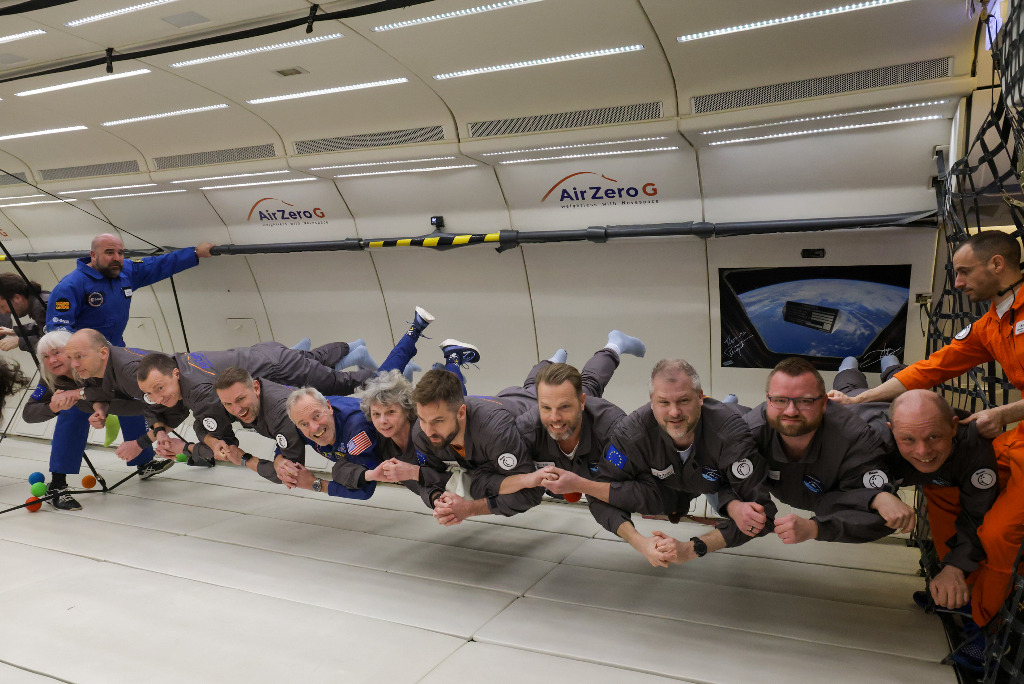
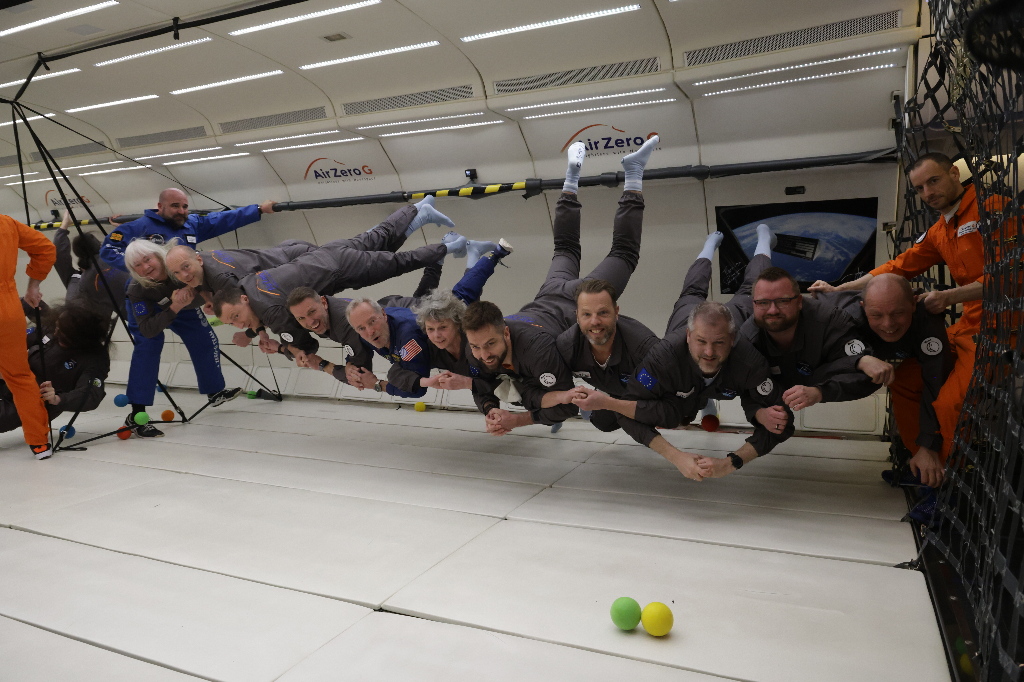
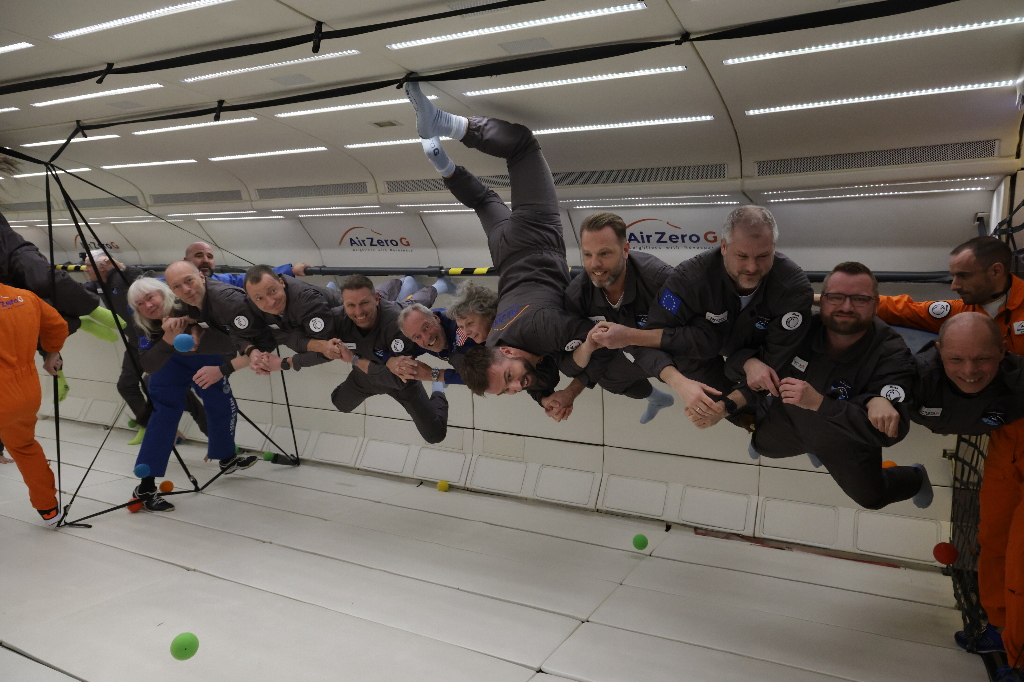
Seeing the images from the other sections of the plane, at least one group managed to achieve a decent sine wave formation...
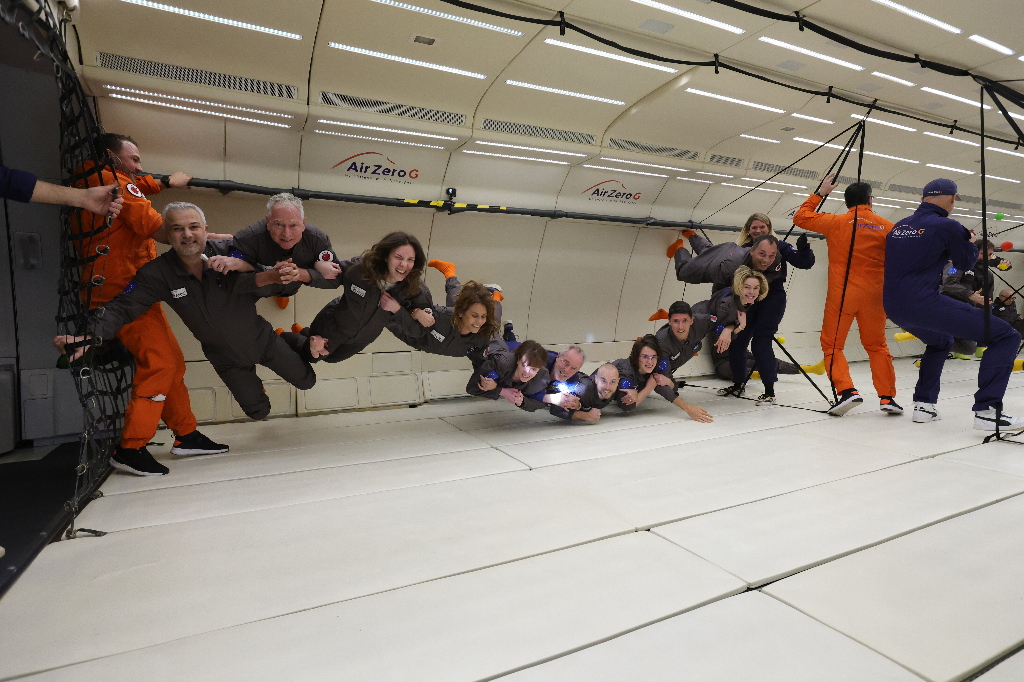
And that was (almost) the end of it.
It was announced as the last parabola.
But after that, there was the question from the cockpit: "Do you want another one?"
And there was one more zero gravity phase coming up.
It's a bit of a spoiler, but they always do it.
Everyone on board has been excited about the flight for months. And then, with the final parabola, it's all over. You could almost feel the mood drop all over the plane.
And it's not nice to end the experience on a low note.
So, they add the extra parabola (the "encore"), so instead of being sad, everyone is happy due to the unexpected bonus. It's cheap and manipulative psychology, but I admit it works well. And everyone ended up feeling happy.
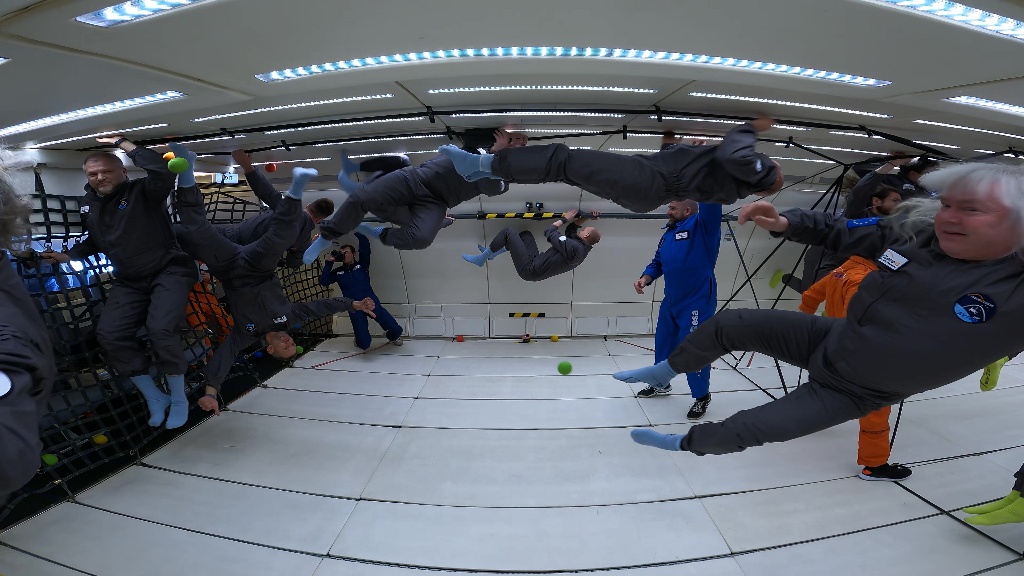
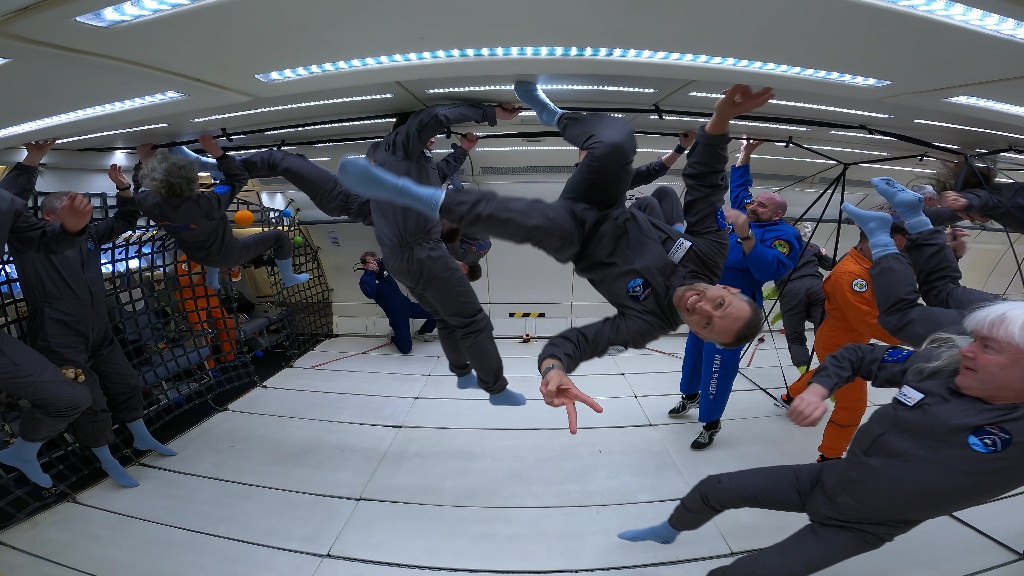
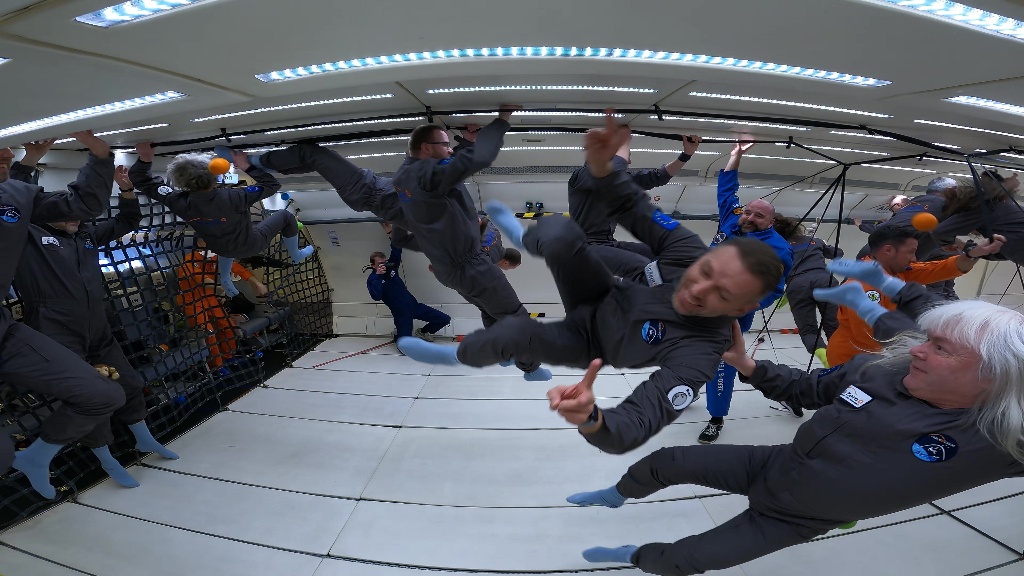
The last thing we did in the "play area" of the plane was one full group picture of all participants (whether "Moon", "Mars", "Jupiter" or "Saturn") and Jean-François Clervoy. To get a more lively look (and because it was more fun) we all got to throw foam balls at the cameramen.
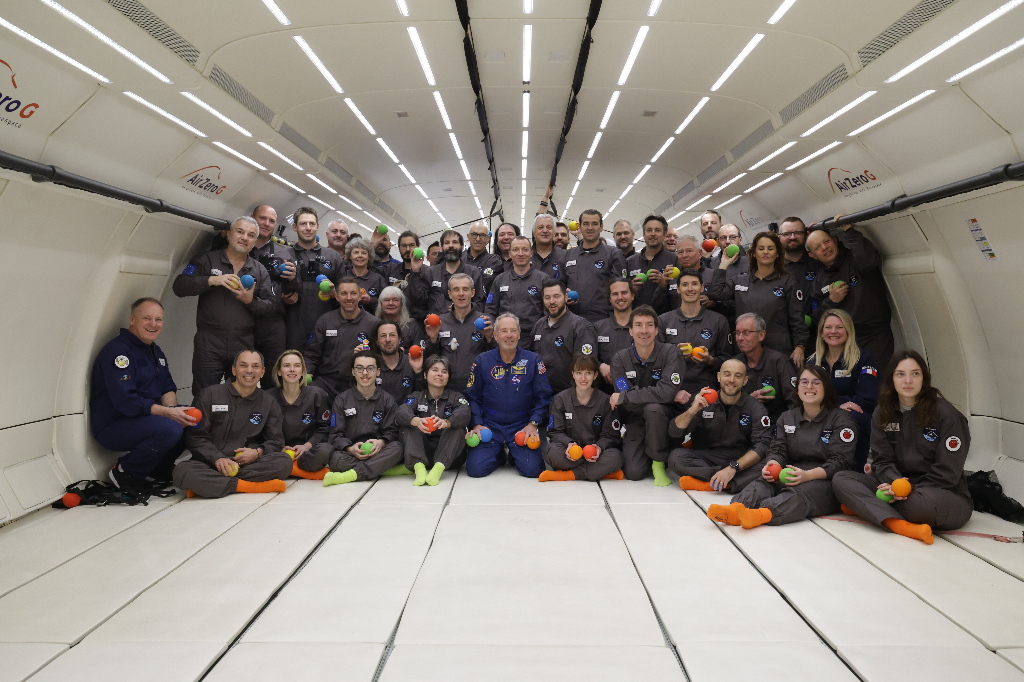
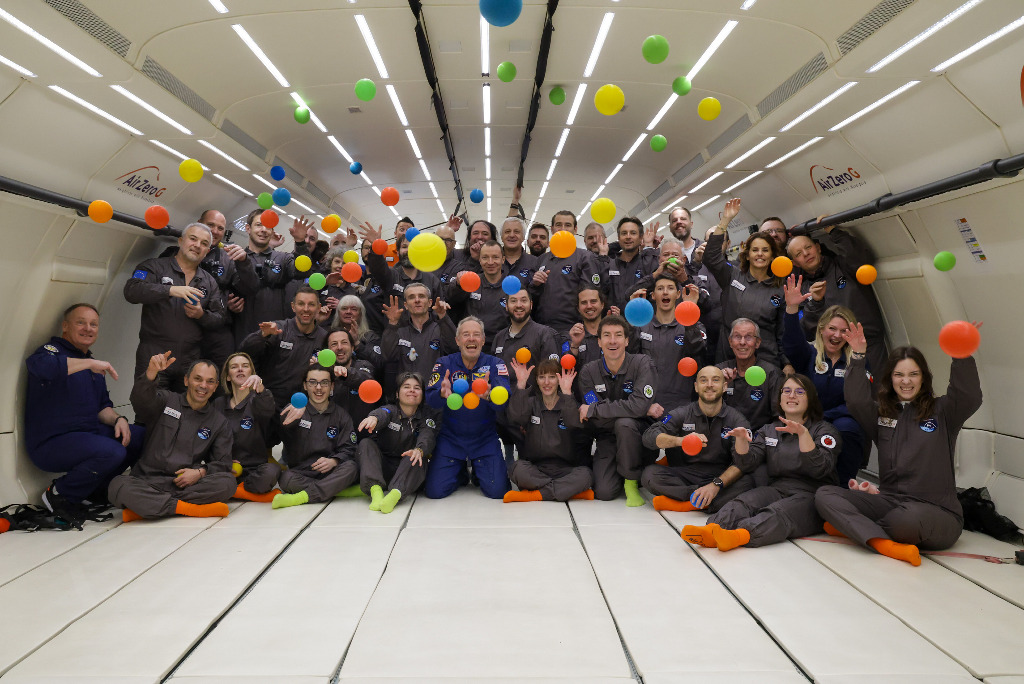
Although it (intentionally) looks like the balls are floating in zero gravity, the plane was flying normally at that point.
Then it was time to head back to our seats. We got our shoes back and a few minutes later we were back on the ground.
One more picture of the plane that we flew with (and the Beluga Airbus, which has been grounded at Bordeaux airport for the last five years and is unlikely to fly again) and it was off to the champagne celebration.
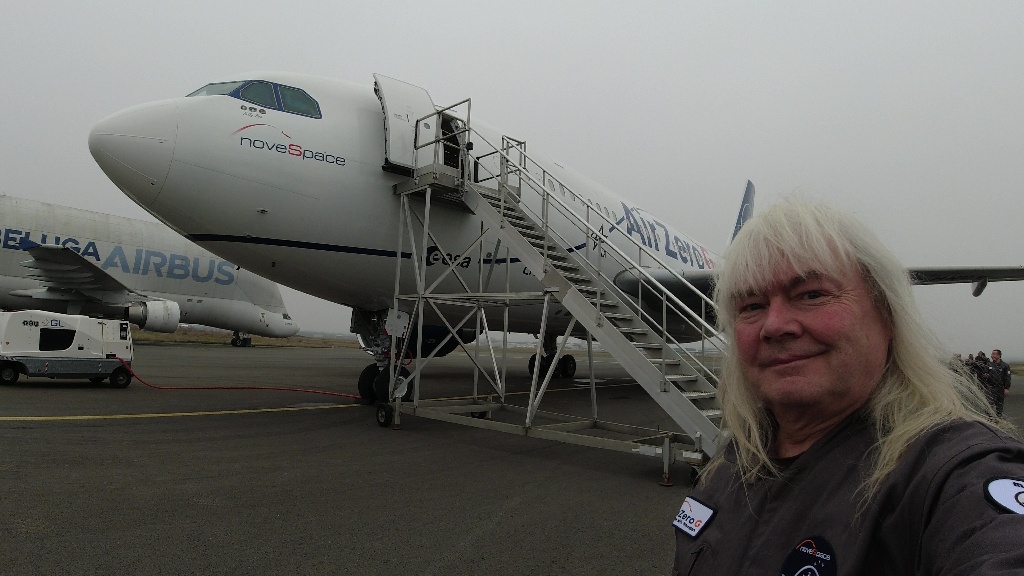
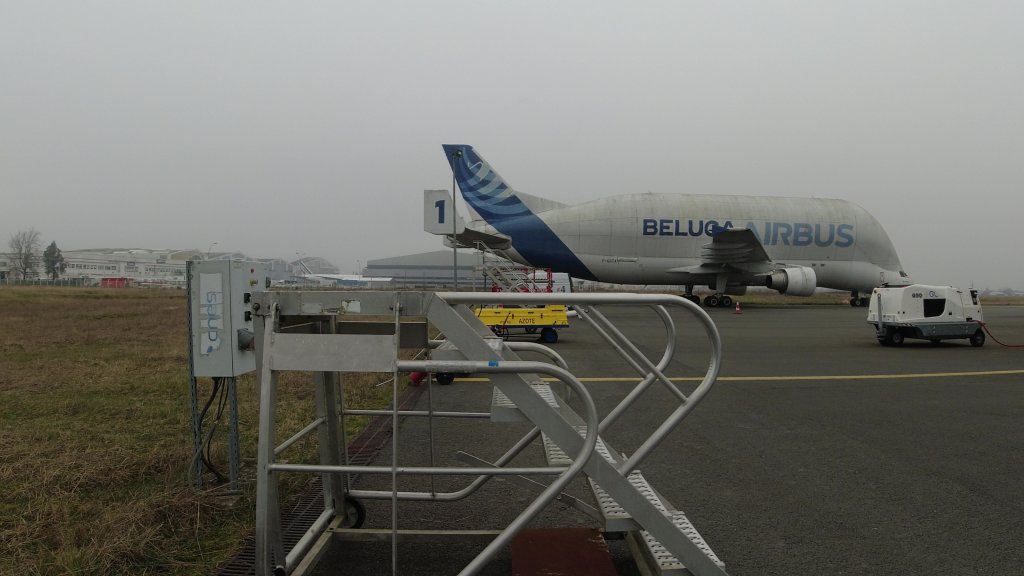
Followed by a lunch buffet.
Including cheese sticks stacked like a log cabin.
I had never seen cheese presented like this before.
Not sure whether this is something new and trendy (like stacking fries in a similar way), whether that is done all the time, but I never went to the right buffets. Or whether it's something so old fashioned (like these cheese and pineapple hedgehogs, which were fashionable at parties in the 70s) that everyone got embarrassed about it for a few decades and now makes a comeback as an "ironic" reference.
It was unusual enough for me to notice, though.
Everyone seemed to be hungry after the flight.
Probably because it was exciting and active (which always brings up an appetite), but possibly also because people might have been careful about not eating much (or anything) for breakfast. And now catching up on that.
Some food and a few glasses later (after all, there was something to celebrate, we were in France, the champagne was good and we would have a bus back to the hotel), there was a presentation by Jean-François Clervoy about space flights, science in space and related topics.
And also a big round of applause to all the people involved in the flight, including the pilots and all the other helpers.
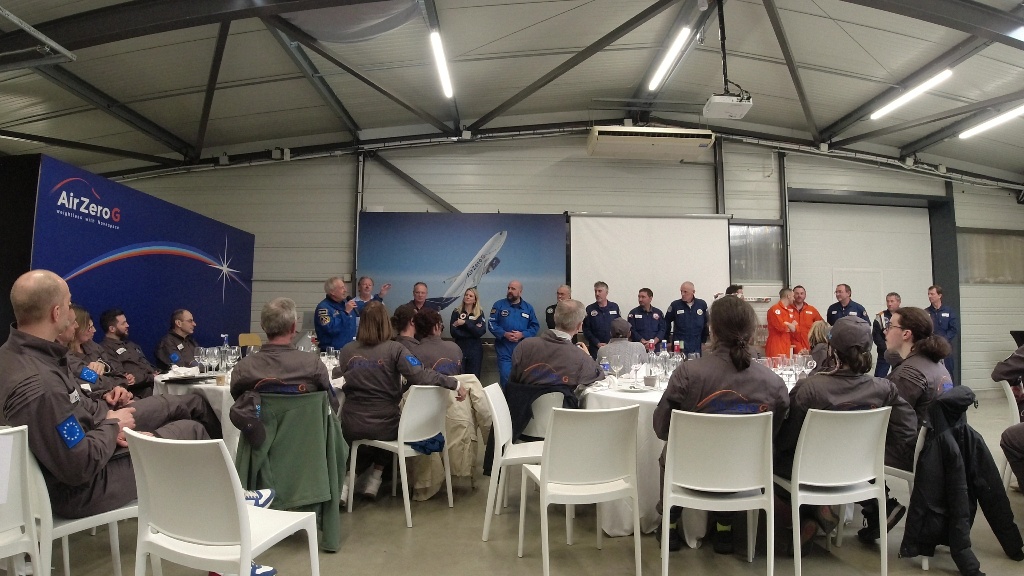
It should be noted that the image in the background, with the Airbus going up at a steep angle, is an actual photo (taken from an Alpha Jet) and not a simple illustration. When going into the parabola, the plane really flies like that. No wonder that the on-board flight computer complains.
During the presentation, Jean-François had an interesting slide about the health effects of staying in zero gravity for longer periods, like weeks or months.
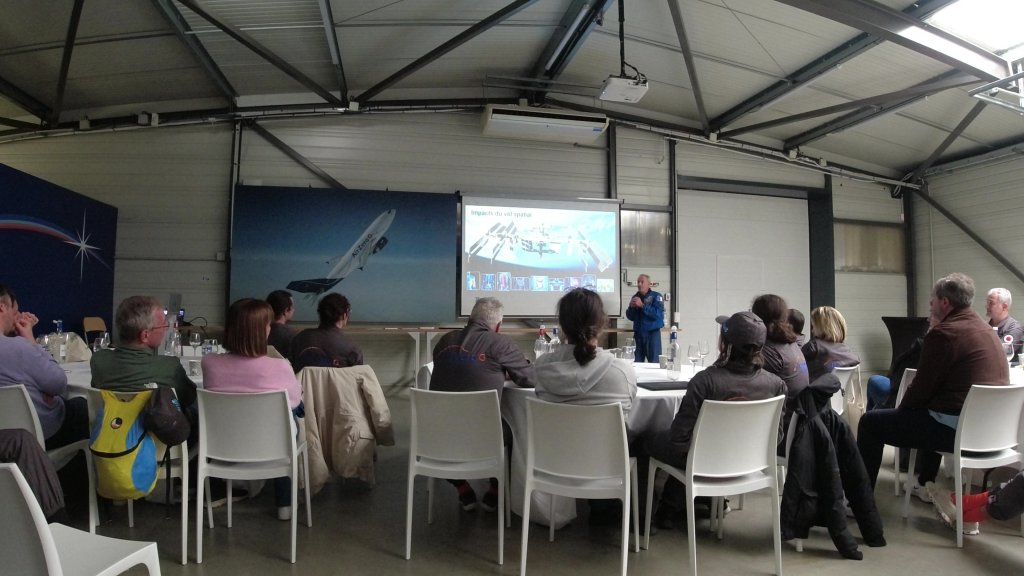
Unfortunately, I don't recall all the details. But he had a long list of issues that would be diagnosed if you went to doctor shortly after a space flight and didn't tell the doctor that you've been exposed to zero gravity for a while.
In short, you would probably be told to make your last will, since almost every function of your body (I remember blood circulation, bone stability, muscular atrophy, compromised immune system, brain swelling and impaired lung function, but that's not the complete list) will have been affected.
To a certain extent, the doctor would be right. If you had acquired all the symptoms you have under regular gravity, something would be seriously wrong with you. But as these are nothing more than adaptations to a zero gravity environment, the body will re-adjust to Earth gravity soon.
Nothing we would have to worry about, though. With less than 300 seconds of zero gravity in total, there was no time for the body to change in any way. (Except for the obvious increased level of excitement and happiness...)
It's kind of surprising though that bodies work in zero gravity at all.
There's no real reason why they should. No real reason why breathing doesn't rely on gravity, for example. Conceptually, lungs could have some heavy muscle mass at the bottom, relying on its weight to elongate the lung and actively contracting to "squeeze" the lung and expel the air. That would make breathing in zero gravity difficult. Maybe a lung could separate carbon dioxide from oxygen by weight and expel that somehow from the bottom of the lung. (Although that kind of lung would work badly even when lying down to sleep, so it makes sense that it doesn't work that way.) Or the salvia in your mouth could form a ball of fluid and choke you. Or something else could go wrong.
Given the things that need to be paid attention to with technology, such as heat sinks not working on CPUs or a candle extinguishing itself in zero gravity, it is a lucky coincidence that none of the function of the human body is really dependent on Earth gravity. (Yes, there are all the effects mentioned above, but most of them are adjustments to the environment.)
In any case, in addition to being glad that the human body as such can deal well with zero gravity, I was also happy that my body managed to like zero gravity as well.
After all the talk of the "vomit comet" and nausea, as well as all the worries about spending a lot of money for having a miserable day and feeling sick, I didn't have any issues at all with that.
Of course, I am not sure whether that is because of the anti-nausea pill, or whether that's because I was careful not to move my head in hypergravity. Or maybe it was because I don't get seasick and don't get motion sickness from playing VR video games anyway.
I assume it was a combination of all of these.
After the flight, I talked to other passengers and at least two of them said that they did not feel sick, but after the last parabola, they thought it was a good time to stop, because they were starting to feel a bit unwell and they got the impression that they might have gotten sick if there had been another series of parabolas. I don't know whether and how much they moved their heads in the hypergravity sections. But it's an indicator that the medication alone didn't account for all of it.
At the end of the flight, I didn't feel unwell at all and had the impression that I could have easily done another fifteen parabolas and enjoyed them. (But then, it might have turned out that it would have only needed another parabola to be in the same situation as the people I talked to. But, luckily, it all worked out fine for me.)
Winding down, at the end of the presentation that Jean-François gave, there was one final picture of the "Moon" group.
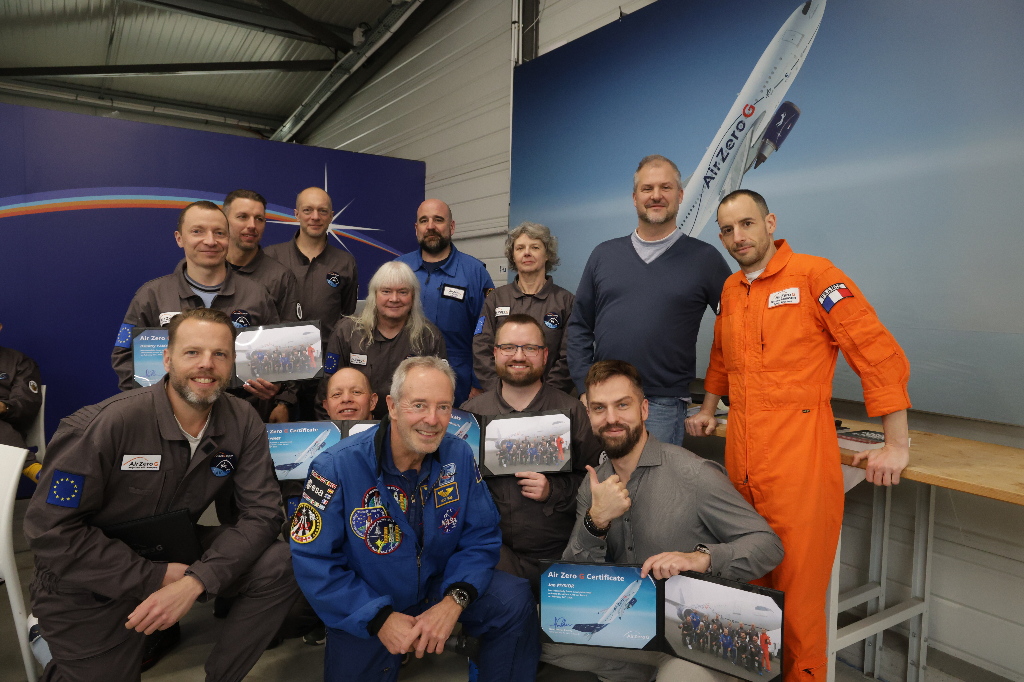
Then it was time to go.
Also, time to wrap up this description. It seems it has gotten longer, much longer than expected. (I've just pasted the text, without any pictures, into Word and it's about 35 pages already.)
All that remained was to go to the bus, take one last picture of the plane standing on the airfield (with cloudy skies, but no longer in the fog), board the bus and get back to the hotel.
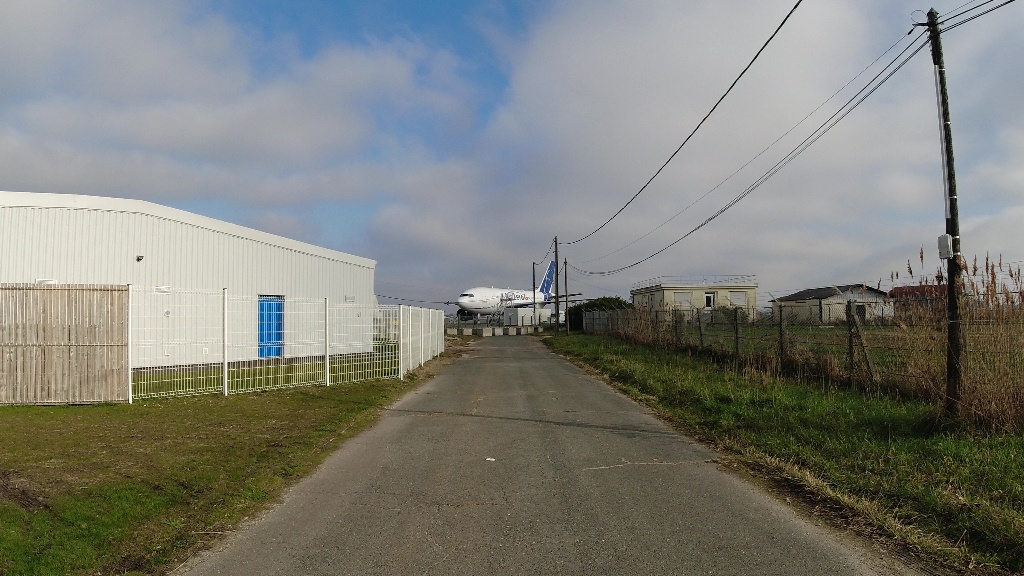
And fly home, in a much less exciting manner, on the next day.
Finally, some statistics for the flight.
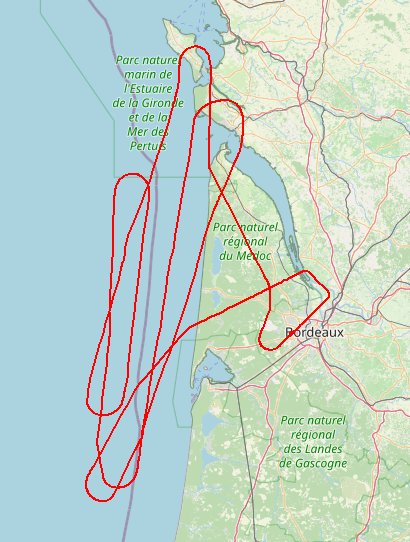
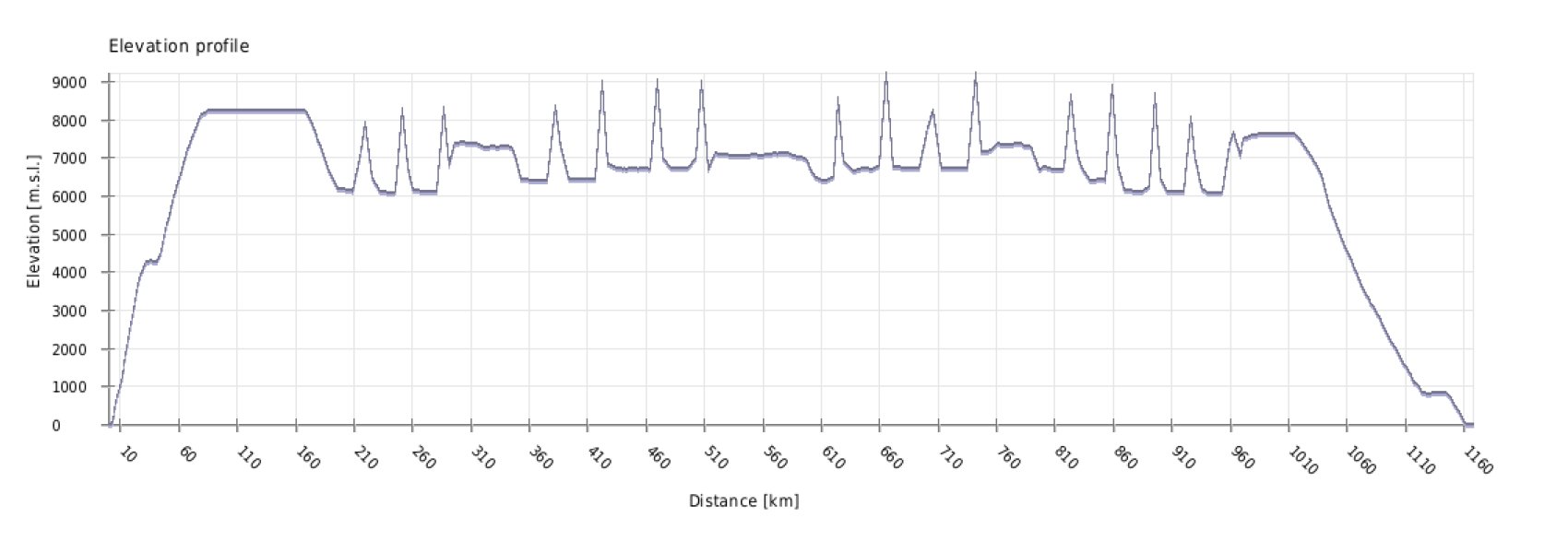
The flight profile makes the whole thing look more dramatic than it was. The altitude is emphasized by a factor of about 42 in respect to the distance data. (That it's "42" is just a coincidence due to the tool used - it has nothing to do with the "Don't Panic" badge.) The parabolas look much steeper than they really were. Also, as there aren't that many data points to the graph, they look more spiky than they were.
The whole flight took 91 minutes, covering a distance of 1145 km. It took 15 minutes until the plane flew the first parabola and it was 18 minutes after the last one until we were back on the ground again.